
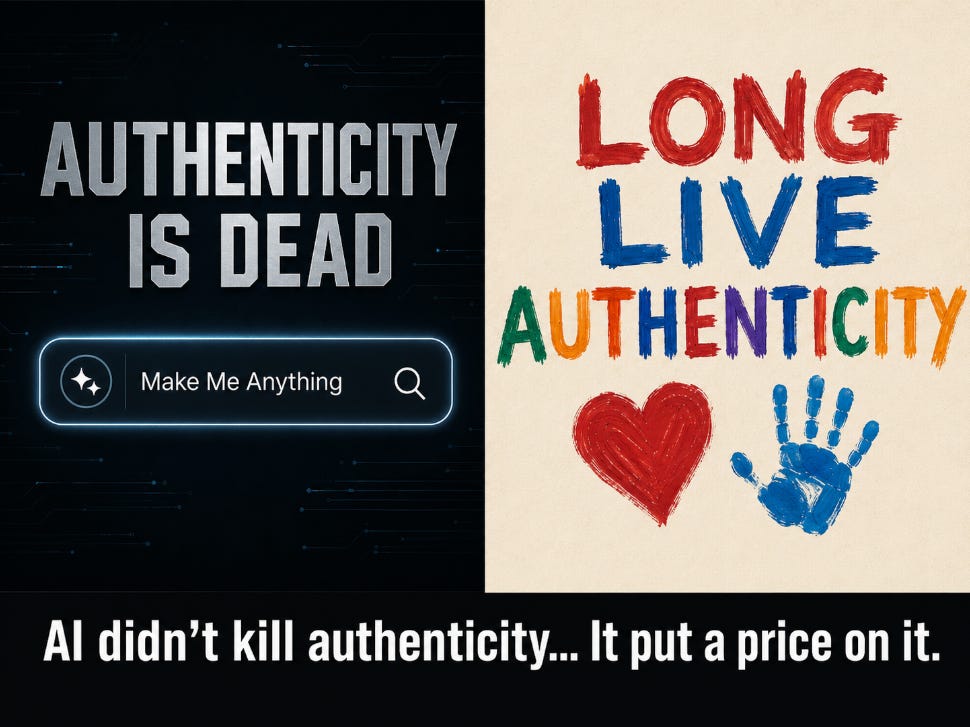
Is authenticity dead in the age of AI?
At first glance, it feels that way. Synthetic influencers, cloned voices, AI-generated reviews, and endless machine-made content now flood every platform. The result is content that is abundant, polished, searchable — and often emotionally weightless. Very little of it feels earned.
And that is the point.
AI didn’t kill authenticity. It changed the economics of authenticity. When anything can be generated instantly, the scarce resource is no longer production. It is belief. The value of what is genuinely real, provable, and humanly accountable starts to rise.
That is why I am not ready to declare authenticity dead. We are heading toward a major authenticity resurgence — and brands that do not prepare for it will be caught flat-footed.
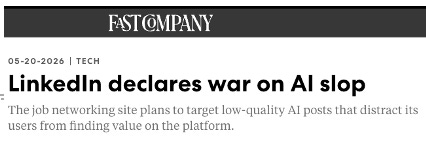
Every cultural movement produces a countermovement. Fast food sparked farm-to-table. Filtered perfection fueled raw, behind-the-scenes creator culture. In recent weeks, students booed commencement speakers for celebrating AI. Last week LinkedIn announced it will demote AI-generated content.
The generation entering the workforce grew up with synthetic media. They are the most sophisticated detectors of it — and the least forgiving. I feel this tension with one of my daughters, who can spot AI-generated content faster than most brand managers can produce it. The countermovement is not coming. It is here.
Brands will not just compete on creativity or content volume. They will compete on provability. Was this made by a human? Can I trust the claim, the source, the review?
In the old internet, content volume created visibility. In the AI-mediated internet, proof will create preference.
This is not just cultural intuition. Trust is in structural decline. When everything is generatable, the credibility discount becomes the default — and trust now carries a higher burden of proof.
I call this the Authenticity Premium: the advantage earned by brands that can prove what others merely claim.
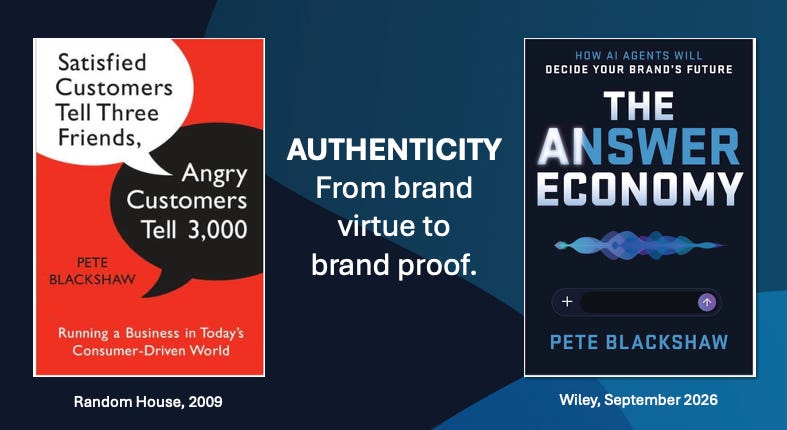
This instinct is not new. Nearly two decades ago, in Satisfied Customers Tell Three Friends, Angry Customers Tell 3,000, I argued authenticity was a core building block of brand credibility — enforced then through reviews, complaints, and word of mouth. In the forthcoming The Answer Economy: How AI Agents Will Decide Your Brand’s Future, I argue those same credibility drivers haven’t disappeared. They’ve become algorithmic.
The driver has not changed. The detection system has. What AI really disrupts is the economics of signals — when content, reviews, expertise, and presence can all be generated at near-zero cost, verification becomes exponentially more valuable.
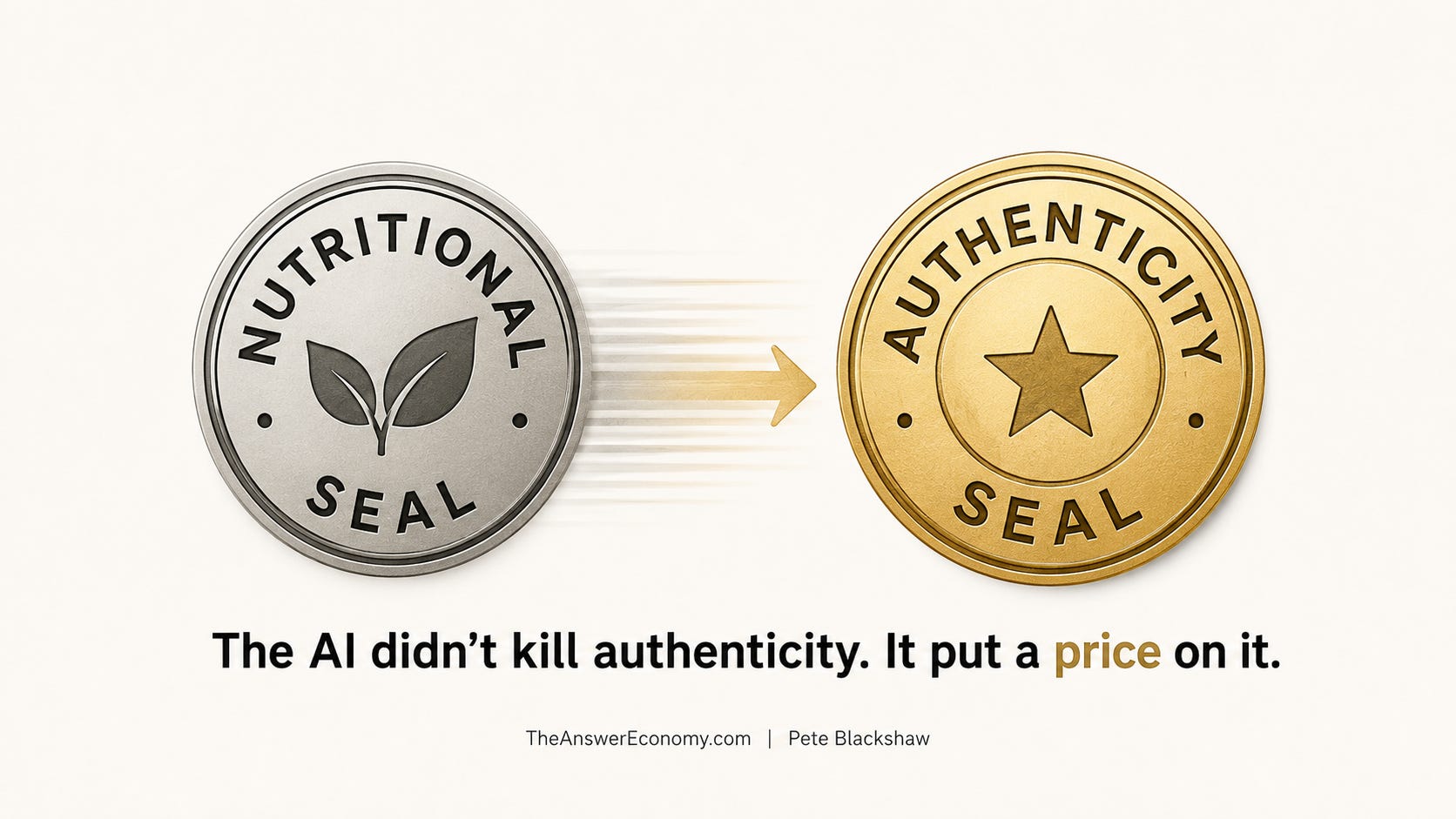
Think of proof assets as nutrition labels for content — signals that indicate whether something was human-created, expert-reviewed, or synthetically generated. The differentiator will not be whether AI was used — it will be how accountably.
This is where brands need discipline.
The opposite of authentic is not AI-generated. The opposite of authentic is unaccountable, unverifiable, and manipulative. Authenticity is not a binary. It is a spectrum.
The better question is not “Was AI used?” It is:
Would it matter to the customer if a human made this?
For some content, the answer is no. For other content, absolutely yes. A product safety apology should not feel machine-generated. A CEO response to a crisis should not be synthetic. A customer testimonial should not be fabricated.
The brands that win will not be the purists or the reckless automators. They will be the ones with the judgment to know where AI adds efficiency and where humanity adds meaning.
Search is already moving in this direction. Google’s new AI Search guidance, unveiled this week, makes the point explicit: useful, reliable, original, people-first content can succeed regardless of production method. Scaled AI content with little originality, expertise, or added value is increasingly vulnerable.
That distinction matters — and it extends well beyond search.
As AI answer engines become the primary interface for discovery, brands will be judged by a broader reputation graph — reviews, expert commentary, third-party validation, and the consistency of what the web says about them. Brands with genuine relationships and earned signals will surface. Brands built on synthetic credibility will be discounted or ignored.
AI is not killing authenticity. It is stress-testing it at scale.
The next phase of authenticity will be more operational than emotional. Sounding authentic won’t be enough. Brands will need systems that make authenticity visible, repeatable, and defensible.
That means new questions for marketing, communications, legal, and leadership teams: Which brand moments should remain deliberately human? Which claims require substantiation? Which customer stories need permission and proof? Which AI uses should be disclosed?
This is not just a communications issue. It is a governance issue. Greenwashing lawsuits, FTC disclosure actions, and synthetic review scandals are already landing on board agendas. Authenticity failures are becoming enterprise risk events — not just brand ones.
A smart starting point is consumer services — the gateway where automation and human touch most visibly diverge. Nearly every brand has room to improve here. At Nestlé, I studied Chinese call centers that blended live response for a concerned mom with AI-powered targeting for everyone else. That balance is the model.

Brands also need to master what I call the Ask-Through — the essential follow-up question that signals empathy and listening. Most brands fail here: consumers get hit with promotional offers before their first question is even answered.
The companies that take authenticity seriously will build systems that make it provable — proof libraries, verified claims, escalation paths for high-trust moments. They will treat authenticity not as a vibe, but as infrastructure.
The brands that prove the most truth will own the next era of trust.
Authenticity is not dead. It is becoming measurable, rankable, and economically valuable.
Which means it is also becoming a discipline.
No posts
Comments
Nothing yet. Say the first thing.
Sign in to join the conversation.