
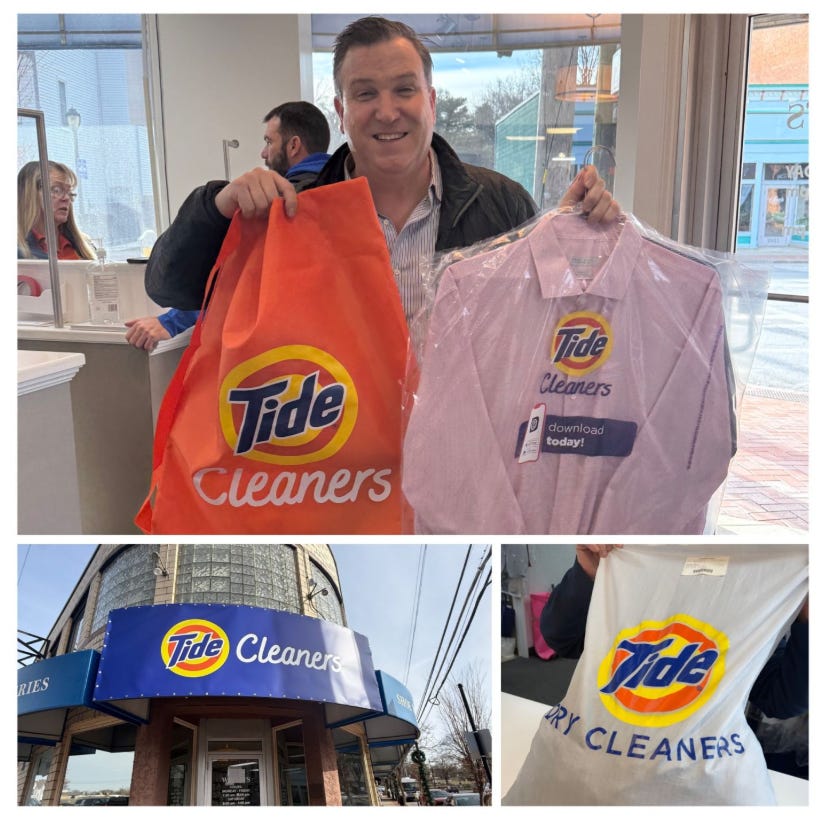
Two days ago I posted a spur-of-the-moment note on LinkedIn about something I noticed at my local dry cleaner: it had been rebranded “Tide Cleaners.” The post took off — likes, shares, comments — and it’s still climbing. I took that as a signal: there’s something here worth unpacking beyond dry cleaning.
Because what stopped me wasn’t just a logo change. It was what the logo represented.
I’ve been a customer of the Widmer’s for over 25 years.
Now it’s Tide Cleaners.
And walking out with perfectly pressed shirts in a Tide-branded bag — plus a handful of free Tide Pods — I had a simple reaction:
This wasn’t advertising.
It was service wearing a brand.
Ever since I took Service Management at Harvard Business School, I’ve been a little obsessed with the idea that brands can extend themselves through service, not just marketing. The age of AI puts a giant exclamation point on that belief — because the unit of competition is shifting from what brands claim to how brands help.
We tend to talk about the Answer Economy like it lives inside screens: search bars, chatbots, AI summaries, shopping agents.
But the deeper shift is simpler:
Brands no longer compete primarily on claims.
They compete on help.
On whether they show up — online, offline, or through an AI agent — at the exact moment someone asks:
“What should I do?”
That question might be typed into a chatbot…
or asked across a service counter…
or triggered inside an app…
or implied by behavior (“I’m stuck. I’m confused. I need confidence.”)
In the Answer Economy, those are all the same moment.
That Tide Cleaners moment took me back.
An early digital experiences I worked on at Procter & Gamble was the Tide Stain Detective, launched in the late 1990s — when “interactive” still meant dial-up connections and early web design.
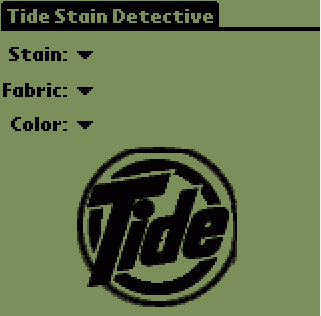
By today’s standards it was simple. By the standards of its time, it was radical.
Consumers could:
identify the type of stain (grass, grease, wine, blood)
specify fabric and color
get step-by-step guidance on how to treat it
No slogans.
No comparative claims.
Just help.
Tide wasn’t just selling detergent.
It was trying to own the stain moment of truth.
Tide Cleaners feels like that idea, fully grown — translated from digital advice into physical service.
A few years later, when I launched PlanetFeedback (one of the web’s early online feedback + measurement platforms), I signed up Tide as an early customer, and we helped the brand answer consumer questions, collect feedback (positive or negative), and develop a more concierge like interface to the consumer. I’ve had a soft spot for the brand ever since — and maybe a bit of a fixation on how it’s evolved over the years.
New Expectations in the Answer Economy
But here’s the challenge for Tide — and for any brand that’s built muscle in online marketing (P&G and beyond): Answer Engines have dramatically raised expectations for brands to behave like a concierge.
What counted as “service” yesterday — a microsite, a FAQ, a loyalty email, a chatbot, even a well-designed brand page — can suddenly feel like noise or clutter when it sits next to the elegant, friction-free, always-on help desk of ChatGPT, Claude, or Google Gemini.
That contrast is now a defining tension point for brands, compounded by “performance marketing” expectations of ecommerce team which often default to interruption vs. help.
I call it The Answer Divide: the growing gap between how brands think they’re helping and how modern answer engines actually set the bar for help — instant, contextual, personalized, and relentlessly simple.
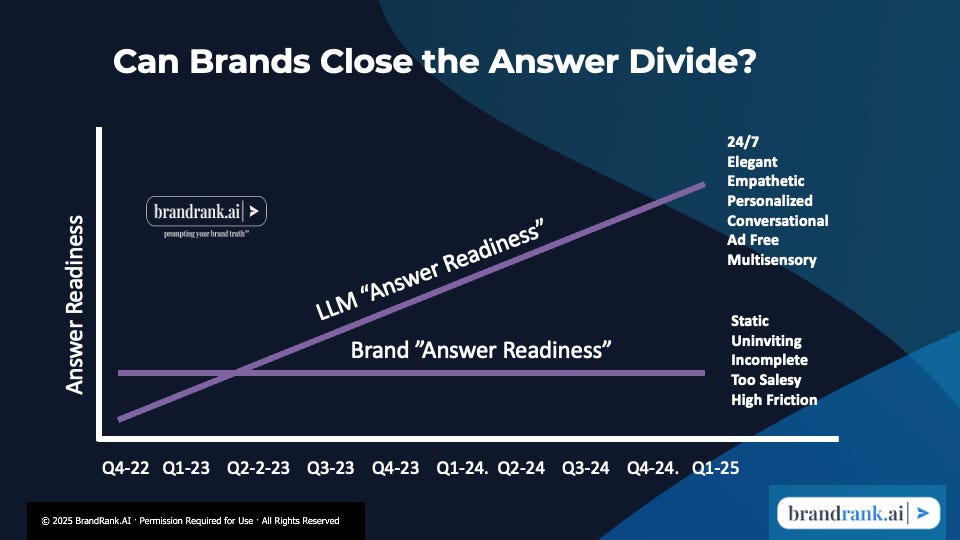
And that divide isn’t theoretical anymore. It’s quickly becoming a real source of advantage (or vulnerability) for most brands.
Nowhere is this more obvious than Amazon’s Rufus — which is effectively a friendly, always-on concierge sitting inside the world’s biggest store.
What struck me about Rufus is that it feels as warm and inviting as the Tide Cleaners staff — constantly encouraging questions about everything from how to use a product to which options are most sustainable, best rated, or right for your specific need.
It’s the “help desk” expectation, embedded at the point of purchase.
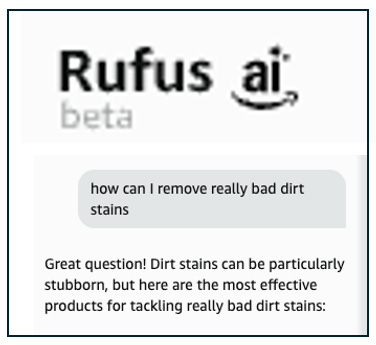
According to Amazon’s CEO, 60% of consumers who ask a question via Rufus buy more online, and he claims the “service” has already generated $10 billion in incremental revenue in a relative short launch window.
Once customers get used to that kind of friction-free guidance, it raises the bar for every brand everywhere: your packaging, your site, your support, and your in-store experience all have to keep up — or risk feeling like yesterday’s version of “service.”
Here’s what AI changes: it collapses touchpoints into a single synthesized judgment.
A brand can’t be “helpful” in one place and “marketing-y” in another.
It can’t be precise online but vague in-store.
It can’t promise premium outcomes in messaging and deliver mediocre reality in service.
When your website says one thing, packaging suggests another, customer support says a third, and the in-person experience delivers a fourth — that fragmentation doesn’t just confuse customers. It erodes trust. And it gives answer engines a reason to hedge, deflect, or recommend someone else.
In the Answer Economy, contradictions aren’t just confusing. They’re disqualifying.
This is where some “old school” service thinking starts to look like a blueprint for the AI era.
What the best service companies understood — long before AI — is that service isn’t about warmth or scripts. It’s about decision architecture.
Service is a series of consequential questions:
What should we do in this situation?
What matters most to this person right now?
What outcome preserves trust?
The best brands design systems — and empower people — to answer those questions well, consistently, and fast.
That logic maps directly to the Answer Economy: when “answers” become the interface, operating behavior becomes the brand.
Tide Cleaners isn’t alone. We’ve watched other brands turn “help” into durable advantage:
Apple built the Genius Bar so the brand shows up when things break
King Arthur opened baking schools to teach mastery, not just sell flour
Nike built Nike Training Club to coach, not just motivate
The Home Depot added project services when DIY gets overwhelming
Sephora created beauty studios to transfer skill, not hype
Different categories. Same playbook:
The brand stops talking.
The brand starts helping.
The service becomes the proof.
As AI becomes the first place people turn for guidance — and increasingly for post-purchase “what do I do now?” instruction — the real test becomes brutally simple:
Could an AI confidently recommend your brand — and explain why?
Not because you ran a campaign.
Because your brand behaves like a trusted help desk — across every touchpoint — and the proof shows up in the world.
If you lead a brand, here are the questions I’d put on the wall:
Where do customers go for help — and are we truly present there?
Do our answers stay consistent across store, site, support, packaging, and agents?
What are the “moments of uncertainty” in our category — and do we own them?
Because the future isn’t more content.
It’s more credible answers — delivered through real service — across every surface where trust is formed.
In a world of infinite content, answers — delivered through service — become the brand.
No posts
Comments
Nothing yet. Say the first thing.
Sign in to join the conversation.