
Back when I was a young cinephile, there was nothing like a Hong Kong action movie. The industry has had its fair share of struggles, change in tastes, and distribution realities, with Americans becoming very aggressive in Southeast markets that it usually dominates and perhaps even more importantly, getting slowly absorbed by the increasingly larger Chinese industry. Around 2000, there was a certain optimism that the handover happening around the time China got serious about the economic potential of their film market would be a great thing, with the Hong Kong industry having an advantage in know how that the communists could use. The realities have been far more complicated than that, but most of the main talent has migrated there, making use of the resources while operating in terms closer to the mainland preference. At times what we call a Hong Kong movie is just that; see Tsui Hark’s epic Legend of Condor Heroes: Gallants (2025), a Chinese superproduction that sounds on paper like a movie Tsui might’ve done in 1993, only with few of its pleasures. There are some very good movies made this way, but they are often a muddled mess. While this goes on, it sometimes feels like Louis Koo stars in half a dozen movies every year to make sure city film crews remain employed.
Old habits die hard, and so I remain committed to follow close the movies that at least can vaguely be associated with the idea of “Hong Kong action film”. I saw two this week that exist in multiple polar opposites. Yuen Woo-ping’s comeback picture, Blades of the Guardians (2026), a huge Chinese film with one of the biggest stars of the local industry (Wu Jing) that has become the most successful swordplay film ever in the Chinese box office. On the other end, The Furious, an actual local production that feels like a prepackaged special from the Eastern Asian action market, includes a Japanese filmmaker (Kenji Tanagaki) and stunt coordinator (Kensuke Sonomura) and some of the Indonesian stars from the very popular The Raid (Joe Taslim, Yayan Ruhian), and it is a big midnight screening sensation in the West. The Raid and Timo Tjahjanto’s work (The Night Comes for Us) seem like a much bigger landmark for it than Chang Cheh or Lau Kar Leung; indeed, most of it feels almost antithetical towards that kind of tradition, outside of a desire to up the violence present in heroic bloodshed movies. For its part, Blades of the Guardians is proudly old fashioned, a traditional wuxia about heroism dressed in modern digital postproduction. The images are very tinkered with, but its 80 year old filmmaker seems to be having a blast with everything he can accomplish. The movie scale is staggering, and he looks at technology as a way to achieve things he couldn’t before.
I know many friends who loved The Furious. It is a movie with many awe-inspiring moments, and Tanagaki, Sonomura, and their performers do some incredible things in it. If you find every way bodies can get beaten up exciting, the movie does deliver, and its better moments are great. The Furious did feel to me as something of a chore to get through. It’s relentless and committed to its principles, but those are also so mean-spirited. Some friends who don’t care to the movie pointed out towards the main plot involving child-trafficking which indeed is too heavy to hang a martial arts movie on, but after some early rough parts I was willing to look past it in Life After Fighting after the fighting starts as I mentioned before. Human traffickers have been a recurring villain in contemporary movies at least since Taken (2008) because they are very easy boogeymen; everyone agrees they are evil, there are few complications involved, but they do add a heaviness to movies. The main issue with The Furious is that Tanagaki doubles down on that; he loves to close in on the violence, and he gets too much out of sadistically displaying how evil his bad guys are. Blade of the Guardians and The Furious are both predicated on threatening the life of a child the main character is in charge of, but only The Furious seems to get pleasure out of it. The faux edginess is what is so bothersome about it, the way it mistakes that for some form of moral seriousness.
I don’t want to get too long on The Furious, a movie that mostly annoys me because it is so close to movies I like, and getting too moralistic about action movies is a limited critical activity anyway. The Raid and the John Wick movies are arguably the most influential action movies of the past 15 years. The empowerment of former stuntmen behind the camera they’ve allowed has often been a good development, but their taste of leads who turned out to be skilled killing machines can grow old fast (see this year’s Hellfire, from the usually talented Isaac Florentine). The Wicks have a playfulness to them (the second one even starts with a Buster Keaton homage) that their better offspring is smart to follow, but The Raid, a good movie I should add, is proudly dour, and too many movies follow its path to punishing exhaustion. The Furious, which could be called Son of The Raid, takes that farther than most. The hero rescues his daughter with half an hour to go, so we suddenly figure out there is one final big action scene, and it comes and it is as skilled as everything else, but by that point very little matters. Everyone involved seems fascinated by what human bodies can endure, but there is no joy in the filmmaking. Without whatever momentum the previous hour had, it becomes pure punishment, and the strings start to show, and no amount of craft can cover them. There is still its share of “holy shit” moments, and it is easy to admire, but there is no weight to any of it.
By contrast, if there is one thing going for Blades of the Guardians, it is how imaginative it remains. It is old school wuxia with no intention of reinventing the wheel, but Yuen has fun with finding small winks in every familiar note. There are two main plots with Wu Jing having to protect a child in his charge and getting tasked with becoming the bodyguard to a wanted political revolutionary, so he has two feuds with mercenaries after both. It is all very complicated with a large cast with multiple agendas while remaining a straightforward chase movie. Blades is based on a manhua, Chinese comics that are close to manga, and as is common in the genre, it understands that every scenario will eventually be exhausted and need a new direction, and the movie is very good at doing this as cinema. Yuen and his collaborators (there are four credited writers: Larry Yang, Su Chaobin, Yu Baimei, and Chan Tai-Lee) do a great job at allowing the film to shift gears while remaining coherent; the whole film seems to naturally come from the same place even if it never stays too long on any scenario.
Yuen Woo-ping is, along with Lau Kar-leung and Sammo Hung, the three greatest masters of Chinese martial arts choreography. He has done great as a director in either a more comic or exuberant vein, and from the late 90s onwards, during the transitional days of the Hong Kong industry, he lent his choreographer talent to plenty of international movies (The Matrix, Crouching Tiger Hidden Dragon, Kill Bill). Yuen is now 80, and the 21st century has been very rough on him. I remember writing that his previous film, Master Z (2018), a spin-off of Donnie Yen’s popular Ip Man series, was “his best movie in twenty years,” never a good sign for a veteran artist. I would say this new one is easily his best since Wing Chun, a Michelle Yeoh-Donnie Yen vehicle he did all the way back in 1994. I was surprised that Master Z was very likable with a good cast and plenty of Yuen choreography, but that was still a minor entry in a filmography that was winding down. There isn’t much to recommend to True Legend (2010) or his Crouching Tiger Netflix sequel, Sword of Destiny (2016), and The Thousand Faces of Dunjia, a Tsui Hark production from 2017, is an ugly CGI fantasy that is barely watchable. Yuen has made many movies I love, the original Drunken Master (1978), Dreadnaught (1981), The Miracle Fighters (1982), Tiger Cage (1988), In The Line of Duty 4 (1989), Iron Monkey (1993), but I didn’t exactly have the highest hopes for a movie he directed in 2026. Since Master Z, the only thing he had done was a pretty good episode for Septet (2020), a Tsui Hark produced omnibus that felt designed as a last hurrah from their generation of Hong Kong filmmakers.
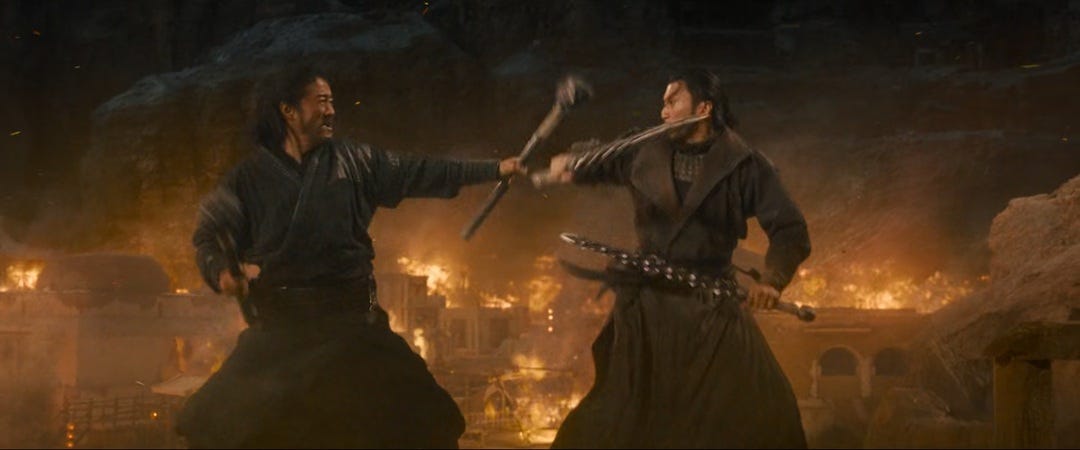
Some of what distinguishes Blades is probably due to Wu Jing. He is a very good action star who, after years as a hard-working figure (Yuen directed him for Hong Kong TV some 25 years ago), did break big with his self-directed Wolf Warrior 2 (2017) and has been one of China’s top stars in the past decade. I assume he was very willing to give Yuen plenty of leeway to let the veteran filmmaker do his thing, and the master makes the most of the opportunity. The movie does have the best of what Chinese money can buy, and it feels big and very assured. The scale of the crossing is part of what is so engaging about it. Yuen treats everything as the chance to do things he couldn’t back in the 80s and 90s. There are, for instance, lots of large-scale scenes involving horses that he can get away with now that CGI can replace real animals. I prefer the less digitally dominated work of Yuen’s past as it allows more space for his stuntmen, but he treats it as another tool he can play with (The Furious has also its far share of post production assist despite its bigger commitment to surface realism). The movie’s greatest set piece, a big attack during a desert storm, is probably this year’s best piece of CGI spectacle and it keeps find ways to expand in the initial action. I’ve seen people compare it to Mad Max: Fury Road due to the large action in a desert setting, but it is less kinetic but better in the small details. Yuen’s imagination seems very engaged throughout, and every action comes with its own staging ideas. The movie peaks in the maximalist desert scene, but unlike The Furious, it finds a new gear as it reorients itself. The final sword duel between Wu Jing and Nicolas Tse is one of its better scenes.
As a drama it is fairly simple and recognizable: a roguish individualist learns to serve the general good while still remaining true to himself the way previous wuxias, westerns, or samurai films, period action subgenres with some national formation backgrounds, have done. The devotion to community fits current Chinese blockbusters, but it doesn’t feel very worried with any of that. The crossing of the desert is a matter of finding new adventures in the possibilities of the fable. Yuen makes the best of his big cast; Tony Leung Ka-fai is put to great use in a small but pivotal role, and Tse, as the former friend pursuing Wu, gives it plenty of weight. His anger and sense of betrayal feels real, so their two major scenes play like actual history is involved and Wu Jing doesn’t need to be just the best swordfighter, but earn his choices. The movie does end promising a sequel, and I hope Yuen gets to make it even if I’d be cautious about him and Wu managing something as good. I’ve complained this year plenty about current populist filmmaking. As a critic who has an investment in it, I will keep watching movies from all over, but things have generally been dire on that front (despite some efforts from India and Japan, especially), so I always welcome good ones, and it is rare to see something on this scale executed with as much skill and imagination as Blade of the Guardians.
No posts
Comments
Nothing yet. Say the first thing.
Sign in to join the conversation.