
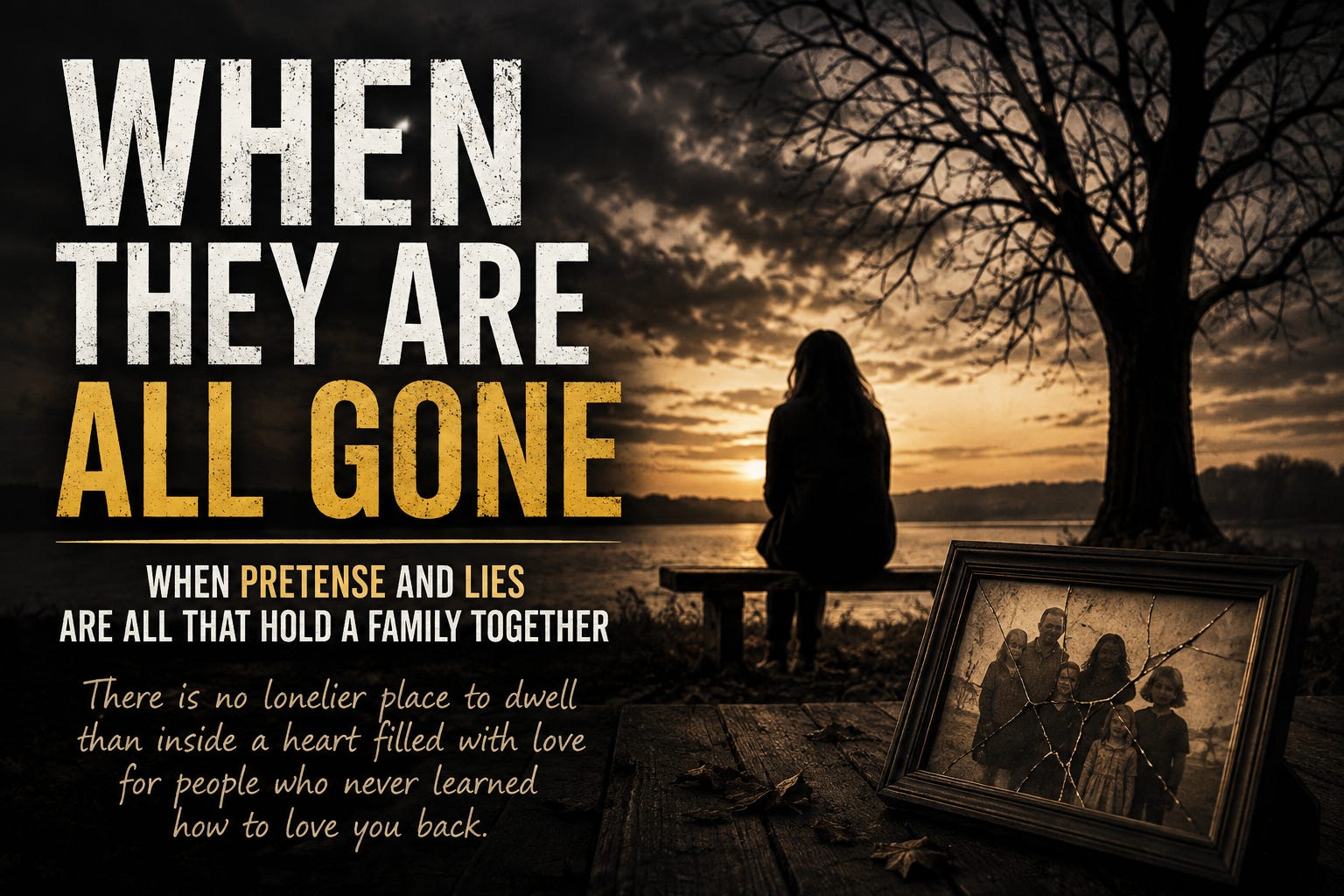
There is a particular kind of loneliness that comes from being surrounded by family and still knowing you are standing on the outside. You share the same blood, recognize the same faces in old photographs, and remember the same kitchens, holidays, funerals, arguments, laughter, and people who are no longer here. Yet somewhere along the way, belonging became conditional. Sometimes the only things holding a family together are pretense and lies.
Everyone keeps showing up. They gather around the same tables, exchange birthday wishes, smile for photographs, hug at funerals, and say, “We need to get together more often.” But beneath it all are conversations nobody wants to have. Old wounds are covered instead of healed. Lies are repeated because admitting the truth would require accountability. One person’s version of events becomes family history simply because it has been repeated longer and louder than anyone else’s.
Eventually, someone becomes the outsider. Sometimes it is the person who refuses to pretend, the person who remembers what happened, asks the uncomfortable question, or finally says, “That isn’t true.” Families do not always reject the person who caused the damage. Sometimes they reject the person who exposes it because truth threatens the fragile peace everyone else has built around pretending.
There is no lonelier place to dwell than inside a heart filled with love for people who never learned how to love you back. You can spend years loving people beyond their willingness to understand you. You forgive what they would never forgive in you. You answer calls they would ignore, show up when they are hurting, defend them when they are absent, and carry burdens they may never know you carried. You keep giving pieces of yourself because somewhere inside you lives the belief that one day they will recognize your heart. Sometimes they never do.
Then there is broken trust. Few wounds reach deeper than betrayal by someone you believed would never betray you. A brother. A sister. Even your own child. These are not strangers who happened to disappoint you. These are people you allowed into places within yourself that the rest of the world was never permitted to enter. They knew your history, weaknesses, fears, and the things that could hurt you most. You trusted them because they were family.
Then something happens that changes the relationship. A confidence is betrayed. A lie is told. Something private becomes public. Your words are twisted. Your loyalty is questioned. Someone you defended speaks against you when you are not in the room. Or perhaps the betrayal is simply discovering that the person you would have protected without hesitation would never have done the same for you.
That kind of betrayal changes something inside the heart. Not necessarily the love, but the trust. Those are two very different things. You can still love someone you no longer trust. You can miss someone you cannot safely allow close to you. You can remember everything beautiful about a relationship while acknowledging that something precious within it has been broken.
When trust is broken by family, you do not only mourn what happened. You mourn what existed before it happened. You remember when you could speak without wondering where your words would travel, when a telephone call felt safe, when you believed a secret would remain a secret, and when you never questioned whether the person sitting beside you would become someone entirely different when you left the room.
Forgiveness may happen. Love may remain. But trust does not return simply because someone says, “We’re family.” Trust is not inherited through blood. It is earned through behavior, and once broken, it must be rebuilt the same way: slowly, honestly, and consistently. There is nothing cruel about saying, “I love you, but I don’t trust you anymore.” Sometimes that is simply the truth.
When the person who breaks that trust is your own child, the pain can reach even deeper. A parent remembers the little hand wrapped around a finger, the scraped knees, birthdays, Christmas mornings, school pictures, sleepless nights, sacrifices, and countless times their child’s needs came before their own. Then one day that parent must reconcile those memories with an adult capable of making choices that wound them deeply.
Yet the love remains. Perhaps that is what hurts most. You discover that love and trust can become separated. You can love someone completely while recognizing that giving them unrestricted access to your heart may only provide another opportunity to break it. You learn the painful difference between loving someone and being loved by them in the same measure.
That imbalance becomes its own kind of grief. You grieve people who are still alive. You grieve relationships that technically still exist. You grieve conversations you wish you could have, phone calls that never come, invitations that never arrive, misunderstandings nobody cares enough to correct, and affection continually poured into places that return almost nothing.
Eventually the outsider learns that blood can establish a relationship, but it cannot manufacture loyalty. A last name cannot create honesty. Childhood memories cannot guarantee respect. Being related to someone does not automatically mean they truly know you. There comes a point when you stop fighting for a seat at a table where your character is discussed differently whenever you leave the room. Not because you stopped loving them, but because you finally understood that constantly defending yourself is not the same thing as having a family.
Then the years begin doing what years always do. Grandparents disappear. Parents leave us. Brothers and sisters grow older. Aunts and uncles become photographs. Voices that once filled Thanksgiving kitchens become memories. The family tree that once seemed enormous begins losing branches. Eventually there comes a day when they are all gone.
That is when the pretense becomes meaningless. The arguments that seemed so important have no audience anymore. The grudges have nowhere to go. The person everyone was trying to impress is buried. The relative whose approval everyone fought for is only a name engraved in stone. Then come the questions that should have been asked years earlier. Why did we waste so much time? Why didn’t we simply tell the truth? Why did pride matter more than reconciliation? Why didn’t we apologize when there was still time? Why didn’t we rebuild the trust we destroyed? Why did we wait until the funeral to say beautiful things about people we barely spoke to while they were alive?
There is something brutally final about standing beside a grave. You cannot apologize to a headstone and expect an answer. You cannot explain yourself to an empty chair. You cannot recover Christmases intentionally spent apart. You cannot rebuild trust with someone who is no longer here. You cannot call someone who is gone and finally say, “I understand now.” Death has an unforgiving way of revealing how temporary our stubbornness should have been.
Perhaps the saddest realization belongs to those who finally understand that the person they kept outside the circle never stopped loving them. They simply grew tired of bleeding to prove it.
One day the family house will belong to somebody else. The furniture will be sold. Photographs will be divided among children and grandchildren who may not even recognize everyone standing in them. Stories will fade. All those things people refused to forgive may eventually disappear with the people who carried them.
So if you are the one standing outside the family circle, you do not have to participate in a lie simply to belong. You do not have to surrender your dignity to maintain appearances. You do not have to accept mistreatment simply because the person delivering it shares your blood. Forgiveness does not require pretending trust was never broken. You can forgive and still remember. You can love and still establish boundaries. You can hope for reconciliation without sacrificing yourself to achieve it.
Sometimes all you can do is tell the truth, extend your hand once more, and let everyone decide what they are going to do with it. Because someday the phone really will stop ringing. The chair really will be empty. The house really will be quiet. The people whose presence once seemed guaranteed will become stories beginning with the words, “Do you remember when…”
I don’t want the funeral to be the first place where everyone suddenly remembers how much they loved one another. I don’t want flowers saying what our mouths were too proud to say. I don’t want us to discover that we spent our limited years protecting lies that should have died long before the people did.
Because eventually, whether we are ready or not, they will all be gone. And one day, so will we.
When that happens, the lies will not matter. The grudges will not matter. Who won the argument will not matter. What will matter is whether we chose truth without cruelty, forgiveness without surrendering ourselves, and love without pretending. It will matter whether we protected the trust someone placed in us, whether we apologized when we broke it, and whether we valued the people who loved us before we were standing beside their graves wishing we had.
Family should be more than people performing for one another. It should be more than blood and appearances. Pretense eventually falls away. Lies eventually collapse. Broken trust leaves scars. Time eventually runs out.
And when they are all gone, the only thing left will be the truth of how we treated one another while we still had time.
Comments
Nothing yet. Say the first thing.
Sign in to join the conversation.