
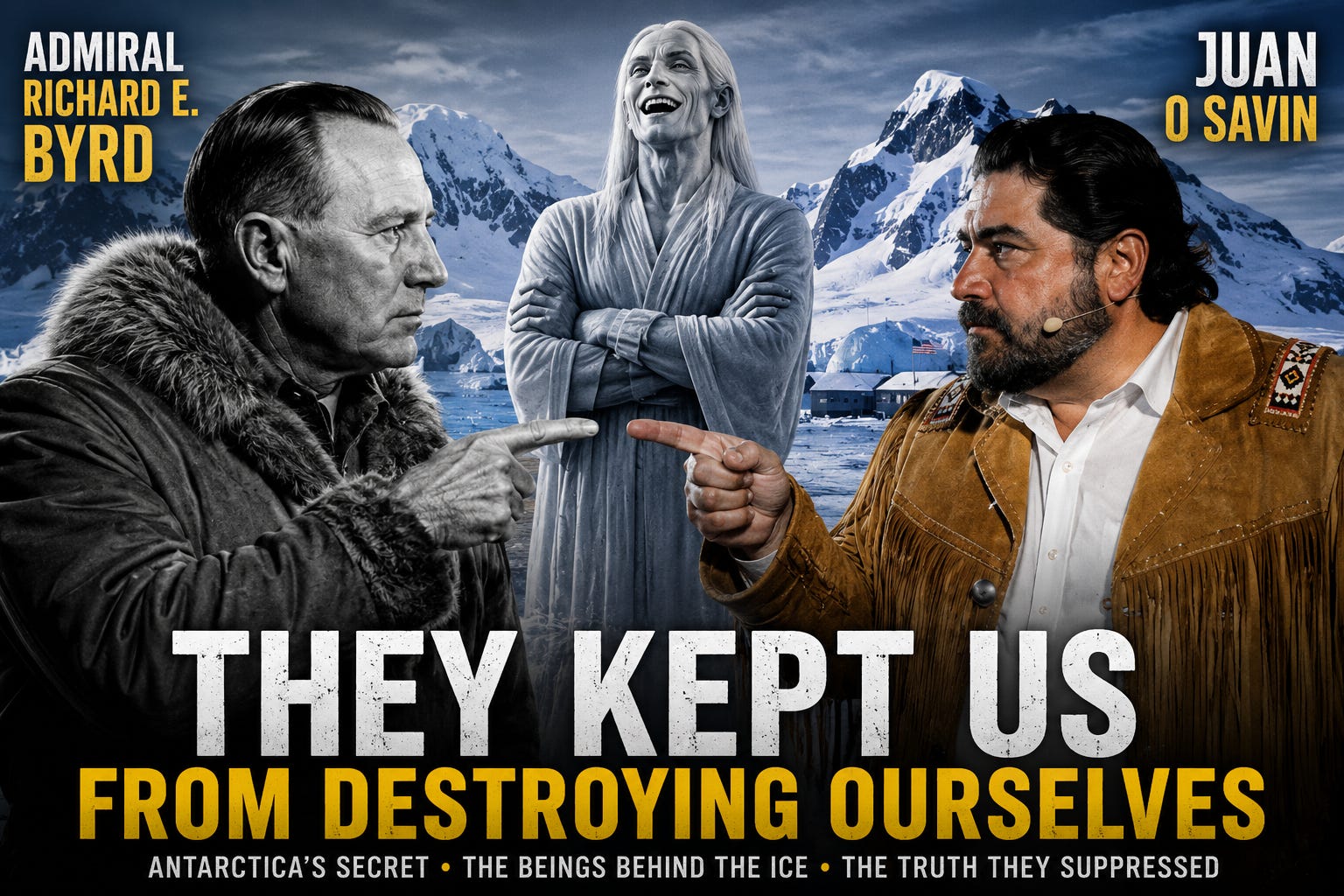
For generations, Americans were conditioned to laugh at UFOs. Witnesses were dismissed, pilots risked ridicule for reporting unexplained encounters, and stories involving strange craft around military installations were pushed to the fringes.
Then something changed.
UFO became UAP. Military videos were acknowledged. Pilots testified. Congress held hearings. Government offices were established to investigate anomalous phenomena.
None of this proves extraterrestrials are visiting Earth. It does, however, establish something important: the subject was taken far more seriously behind government doors than much of the public was led to believe.
That history forces us to reconsider an extraordinary question.
If information concerning UFOs and UAPs could remain classified, compartmentalized or dismissed for decades, what else might have been kept from us?
More specifically, what if Rear Admiral Richard E. Byrd knew something he was forbidden to tell humanity?
Recent statements by Juan O Savin during an interview with John Michael Chambers of JMC Broadcasting bring that old mystery back into focus. Savin spoke of beings associated with Antarctica and claimed humanity has been protected from destruction multiple times.
His statement remains an extraordinary, independently unverified claim. But place it beside the controversial document commonly called Admiral Byrd’s Secret Diary, and the similarities deserve examination.
Perhaps Byrd’s diary didn’t somehow escape censorship.
Perhaps the diary existed because Byrd anticipated censorship.
The Admiral and the Ice
Richard Evelyn Byrd wasn’t an anonymous UFO witness. He was a decorated U.S. naval officer, aviator and one of America’s most celebrated polar explorers.
Operation Highjump is documented history. The enormous 1946–47 U.S. Antarctic expedition involved approximately 4,700 personnel, 13 ships and 33 aircraft. Its stated objectives included polar training, equipment testing, aerial photography and mapping.
Extensive records concerning Byrd and Operation Highjump survive.
Then there is another record.
A controversial document has circulated for decades under names including The Inner Earth: My Secret Diary of Admiral Richard B. Byrd. Its authenticity has never been satisfactorily established.
That qualification matters.
But so does what the document claims.
The diary describes an extraordinary February 19, 1947 flight. One frequently overlooked complication is that the circulating account describes an Arctic or North Polar flight, despite Byrd’s famous association with Antarctica. Over the decades, Byrd’s Arctic adventures, Antarctic expeditions, Operation Highjump and later Hollow Earth stories have frequently become intertwined.
According to the disputed account, Byrd encounters an extraordinary environment and ultimately an advanced civilization.
Their greatest concern isn’t territorial conquest.
It’s humanity’s atomic weapons.
The beings allegedly tell Byrd that humanity’s development and use of nuclear weapons caused them to increase their attention toward surface civilization. Hiroshima and Nagasaki are specifically central to the narrative.
Think about the distinction.
They supposedly weren’t concerned because humanity had developed weapons capable of destroying them.
They were concerned because humanity had developed weapons capable of destroying itself.
Two Records of the Same Man
Imagine Byrd actually encountered something his government considered among the most sensitive discoveries in human history.
There could effectively have been two records.
One belonged to Rear Admiral Richard E. Byrd of the United States Navy. It contained what he was authorized to report.
The other belonged to Richard Byrd, the man. It contained what he believed he had actually witnessed.
The official record could be classified, compartmentalized or sanitized. A private diary could remain hidden.
That doesn’t establish that it happened. But from the standpoint of military secrecy, the concept isn’t unreasonable.
If Byrd believed something enormously important to humanity was being withheld, a private diary could have provided a compromise between military duty and personal conscience.
Obey the order while alive. Preserve the truth for those who come afterward.
“I Must Obey Orders”
Perhaps the most fascinating part of the disputed diary isn’t the strange environment, advanced technology or alleged civilization.
It’s what supposedly happened afterward.
According to the document, Byrd returned, was questioned by authorities and was ordered to remain silent.
The diary’s concluding material portrays a man struggling with that secrecy and believing the truth would eventually emerge.
If the document is fictional, this could simply be effective storytelling.
But suppose it isn’t.
Byrd was a career military officer. Duty mattered. Orders mattered. Honor mattered.
What happens when an honorable officer believes something he discovered belongs not merely to his government but to humanity?
Does he violate his orders and destroy his career? Does he publicly reveal classified information without being permitted to produce the evidence supporting him?
Or does he remain silent publicly and write privately?
Perhaps the diary, if genuine, wasn’t an act of rebellion.
Perhaps it was Byrd’s insurance policy against history.
Then Juan O Savin Says Something Extraordinary
Nearly eight decades later, Juan O Savin sits down with John Michael Chambers of JMC Broadcasting, and Antarctica enters the conversation again.
Savin describes beings associated with Antarctica and says humanity has been saved from destruction multiple times.
That is Savin’s statement, not an independently established fact.
But compare the underlying themes.
An advanced civilization associated with Earth’s polar regions. Knowledge unavailable to ordinary humanity. Human beings developing technology capable of destroying civilization. Another intelligence observing us. And, ultimately, intervention.
Are Savin and the disputed Byrd diary describing the same beings?
We don’t know.
But the similarity produces a legitimate question: are we looking at two independent stories, an old story influencing a modern one, or fragments of information that have circulated through certain circles for generations?
The Nuclear Connection
The question becomes even more intriguing when placed beside decades of reports involving unidentified objects and nuclear facilities.
Former military personnel have described unexplained objects around nuclear installations. Some witnesses have alleged missile systems temporarily malfunctioned during unusual aerial events. These accounts remain debated and do not establish extraterrestrial intervention.
But consider the hypothesis.
If another civilization were monitoring humanity, where would it concentrate its attention?
Our cities?
Our television stations?
Or the weapons capable of ending civilization?
We split the atom before learning how to live peacefully with one another.
Perhaps an older civilization would immediately understand the danger.
Technology without wisdom eventually becomes suicide.
When the Witness Becomes the Target
There is another question surrounding the Byrd mystery: what happens when an extraordinary claim comes from someone society already considers credible?
An anonymous witness can be ignored.
A decorated admiral, astronaut, military pilot or intelligence officer presents a different problem. These are people governments themselves previously asked society to trust.
If their testimony becomes inconvenient, the discussion can quickly shift away from what they said.
Was he confused? Was he unstable? Was he getting old? Was his memory failing? Was he seeking attention?
Suddenly we’re no longer examining the information.
We’re examining the person delivering it.
History demonstrates that reputation can become a battlefield.
Buzz Aldrin and the Importance of Context
Buzz Aldrin provides an important cautionary example.
During a 2015 conversation, a young girl asked Aldrin why humans hadn’t returned to the Moon “in such a long time.” During his answer, Aldrin uttered the words, “because we didn’t go there.”
Isolated from their context, those words sound extraordinary.
The fuller conversation, however, shows Aldrin discussing why America stopped sending astronauts to the Moon and what happened after Apollo. The statement does not establish that Aldrin admitted Apollo 11 was fabricated.
That distinction matters.
If we’re investigating suppression, we cannot create evidence of suppression ourselves.
But the Aldrin controversy demonstrates something valuable.
Original recordings matter. Complete interviews matter. Context matters.
Calling someone confused or crazy isn’t an investigation. Neither is extracting a sentence from its surrounding conversation and making it say something it didn’t.
The same standard should apply to Byrd.
Governments Have Targeted Messengers Before
History gives us documented examples of authorities attempting to undermine people they considered threatening.
The FBI’s campaign against Martin Luther King Jr. extended far beyond legitimate investigation and included efforts designed to damage his reputation and influence.
Pentagon Papers whistleblower Daniel Ellsberg faced something equally revealing. Members of the Nixon administration’s “Plumbers” broke into the office of Ellsberg’s psychiatrist searching for material that might be useful against him.
Those cases don’t mean every whistleblower is truthful or every extraordinary allegation is real.
They establish something narrower and extremely important.
Powerful institutions have, at times, attempted to destroy the credibility of people carrying information they considered dangerous.
Therefore, ridicule cannot itself be treated as evidence that a witness was wrong.
What If Byrd Understood the Game?
Now return to Byrd.
Suppose he really encountered something extraordinary.
He understood military hierarchy, orders, classification and national security. He also understood reputation.
Imagine Byrd publicly announcing that he had encountered an advanced nonhuman civilization while every photograph, instrument reading, report and piece of physical evidence remained classified.
What could he show the public?
Possibly nothing.
Then Byrd himself would become the evidence.
Discredit the man and you discredit the story.
An intelligent career officer might have understood that immediately.
Perhaps that is why, under this hypothesis, he didn’t hold a press conference.
He wrote.
Privately.
Quietly.
Not because he lacked courage, but because he understood what would happen if he spoke without evidence he was authorized to reveal.
Was Byrd’s Official Record Sanitized?
Could information concerning an extraordinary encounter have been removed from Byrd’s official public record?
Certainly it could have been classified.
Whether that actually happened is another question entirely.
Imagine the national security implications if Byrd encountered technology dramatically superior to anything possessed by the United States.
Who built it? Where did it originate? Could it penetrate American airspace? Could it disable nuclear weapons? Could its propulsion system be duplicated? Did another nation know about it? Could communication be established?
Virtually every question would have immediate military implications.
It is difficult to imagine information of that magnitude being freely released to the public in 1947.
That doesn’t prove an encounter happened.
It explains why, if one did happen, secrecy would hardly be surprising.
Suppression Doesn’t Require Burning the Evidence
Perhaps effective suppression doesn’t require destroying documents.
Classify the official information.
Compartmentalize witnesses.
Allow contradictory stories to circulate.
Mix legitimate questions with ridiculous claims.
Let misinformation attach itself to genuine mysteries.
Eventually nobody knows what to believe.
Look at what happened to the Byrd narrative.
North Pole becomes South Pole. Arctic becomes Antarctic. Operation Highjump becomes mixed with Hollow Earth. Extraterrestrials become underground civilizations. Military exploration becomes a supposed secret war.
Facts and mythology eventually become almost impossible for the average person to separate.
Then merely mentioning Admiral Byrd and nonhuman intelligence causes many people to stop listening.
If someone wanted an extraordinary story neutralized, would they really need to erase it?
Or would contaminating it be more effective?
Investigate the Diary
The mistake may be treating Byrd’s diary as something that must either be believed completely or rejected completely.
There are better questions.
Where did the earliest known copy originate? Was there an original handwritten manuscript? Who physically examined it? Were photographs taken? Can the handwriting be compared with authenticated Byrd material? Can the paper and ink be dated? Did Byrd’s children or other relatives ever examine the alleged original? Do military records contain unexplained gaps corresponding with events described in the account?
Those are questions capable of investigation.
And if an original handwritten document exists somewhere today, modern forensic analysis could potentially resolve much of the argument surrounding its authorship.
Authenticating Byrd’s handwriting still wouldn’t prove everything described in the diary happened.
But it would transform the historical question considerably.
Perhaps Juan O Savin Is Pointing Backward
There are two fundamentally different explanations for the similarity between Savin’s statement and the Byrd narrative.
The conventional explanation is straightforward. Byrd mythology has circulated through military, intelligence and UFO communities for decades. Savin’s information could ultimately descend from those stories.
That possibility must remain on the table.
But consider another possibility.
What if both accounts descend from information that existed independently behind classified walls?
Byrd allegedly encountered something during an era when such a revelation would have been almost impossible to disclose publicly.
Savin speaks during an era when UAPs are discussed openly before Congress.
One man supposedly wrote privately.
Another speaks publicly.
Perhaps the phenomenon hasn’t changed. Perhaps what we’re permitted to discuss has.
What If Disclosure Was Never Supposed to Happen Overnight?
Maybe disclosure was never going to involve a president walking to a podium and announcing that humanity isn’t alone.
Perhaps it happens gradually.
Witnesses are ridiculed.
Government investigations become known.
Military footage becomes public.
Pilots testify.
Congress begins asking questions.
Terminology changes.
Previously forbidden conversations become legitimate.
Eventually society realizes that something dismissed for generations has entered mainstream discussion without the world ending.
Perhaps disclosure isn’t revelation.
Perhaps disclosure is acclimation.
They Kept Us From Destroying Ourselves
Now we arrive at the possibility connecting everything.
Perhaps humanity survived the nuclear age because human beings repeatedly chose restraint.
That alone would be remarkable.
But the disputed Byrd diary and Juan O Savin’s recent statement suggest something considerably more extraordinary.
What if human judgment wasn’t always enough?
What if something else intervened?
What if an intelligence far older than ours watched humanity discover atomic power and recognized something we hadn’t yet understood?
We had become technologically sophisticated enough to destroy civilization before becoming morally mature enough not to.
Perhaps they didn’t come to conquer us.
Perhaps they didn’t come to govern us.
Perhaps they weren’t interested in our politics, currencies or borders.
Perhaps they were protecting humanity from the only enemy capable of eliminating humanity entirely.
Ourselves.
We cannot presently prove Admiral Byrd wrote the secret diary. We cannot independently verify Juan O Savin’s claims concerning beings associated with Antarctica. We cannot prove the government removed an extraordinary encounter from Byrd’s official record.
Those remain unanswered questions.
But history has established that governments keep secrets, military information is classified, intelligence can remain compartmentalized, institutions have sometimes targeted troublesome messengers, and subjects once ridiculed can eventually become subjects of congressional hearings.
So perhaps Byrd’s diary deserves neither blind belief nor automatic ridicule.
It deserves serious investigation.
Because if Byrd really faced an impossible choice between his orders and his conscience, perhaps the most important record he created wasn’t the report he was authorized to file.
Perhaps it was the one he quietly left behind.
And if Savin’s extraordinary statement is ever substantiated, humanity may discover that the greatest secret wasn’t simply that we were never alone.
Perhaps someone else was watching during our darkest moments.
Perhaps someone understood what we were capable of doing to ourselves.
And perhaps, more than once, they kept us from destroying ourselves.
What are your thoughts? Drop them in the comments.
Comments
Nothing yet. Say the first thing.
Sign in to join the conversation.