
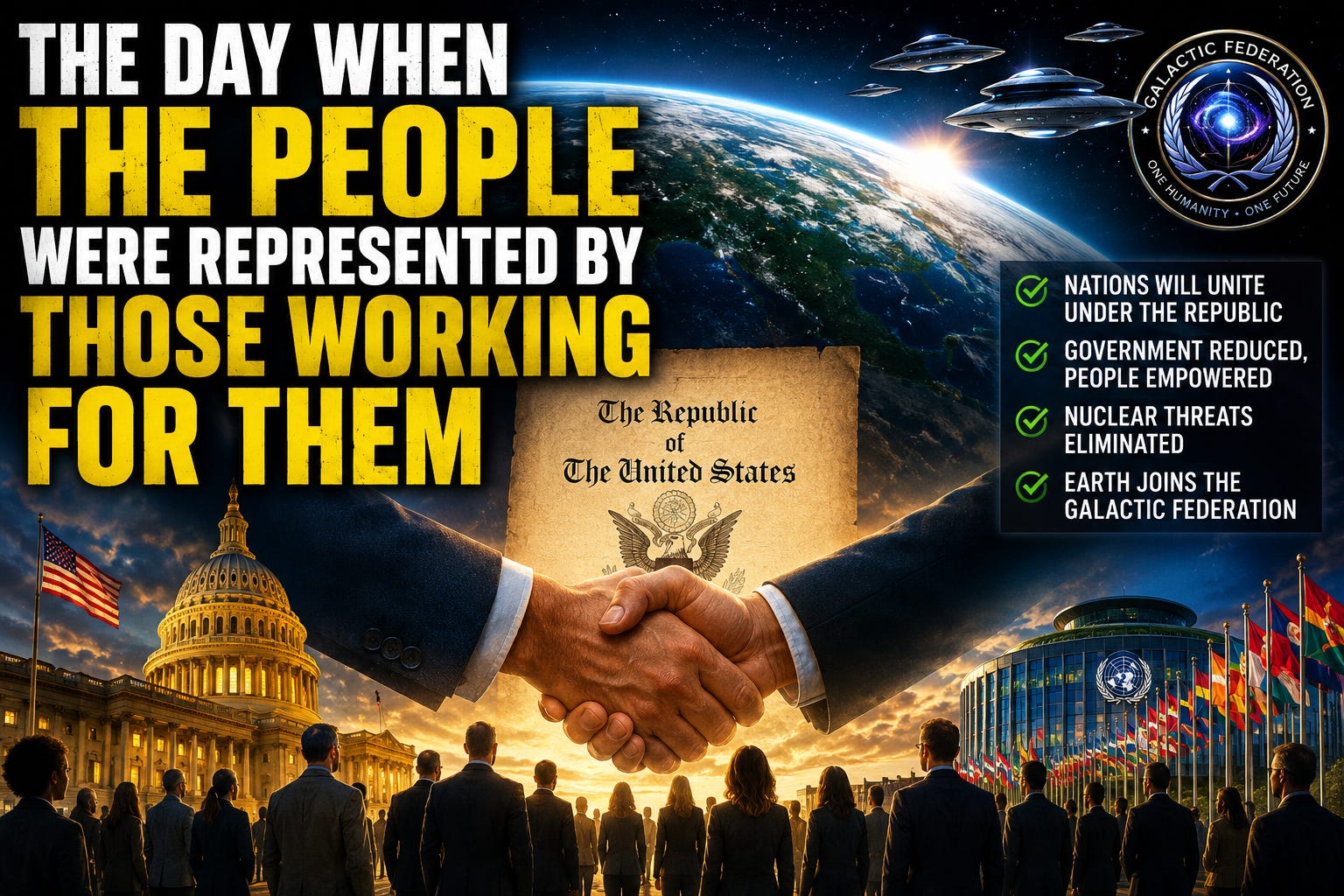
There may come a day when the political map of Earth no longer resembles the map we know today.
For centuries, humanity has organized itself into nations, governments, borders, armies, treaties, and institutions that were created for an earlier age. But what happens when humanity reaches a point where those structures no longer serve the people who created them?
Perhaps the next great transformation will not be the creation of another empire, but the gradual disappearance of the divisions that have kept humanity separated.
Imagine a United States that is no longer defined simply by fifty states, but by a broader union of peoples and territories that once considered themselves separate nations. Imagine governments becoming smaller, more accountable, and less powerful while representatives become more directly responsible to the people who elected them.
That would not necessarily mean the destruction of local identity. It could mean the opposite.
States, territories, communities, and cultures could retain their identities while becoming part of a larger constitutional framework built around one fundamental principle: government exists to serve the people, not rule them.
There are legal and historical arguments that can be made about the corporate nature of governments, the status of nations, treaties, territorial relationships, and the historical transactions through which governments acquired territory and authority. Some interpretations go much further, arguing that the United States, as a constitutional republic, possesses mechanisms that could ultimately allow other political entities to enter a greater union.
Those interpretations remain controversial and are not established as settled constitutional law. But the larger question deserves consideration.
What if the future of humanity is not more separation, but integration?
The world has already demonstrated the danger of allowing small numbers of people to control weapons capable of destroying civilization. Nuclear weapons made that danger unmistakable. A relatively small state can possess enough destructive power to threaten millions, perhaps billions, of human beings.
That is an unacceptable vulnerability for a civilization attempting to survive for thousands of years.
A future political order could therefore make the old concept of competing nuclear powers obsolete. Instead of nations maintaining arsenals against one another, humanity could eventually move toward a unified planetary security structure in which weapons capable of destroying civilization are placed beyond the control of individual governments, factions, corporations, or military organizations.
The objective would not be world domination.
It would be world survival.
And perhaps that is where the idea of a Galactic Federation enters the conversation.
If intelligent life exists beyond Earth, humanity’s greatest challenge may eventually become learning how to join a civilization larger than itself. The nations of Earth could become members of a broader federation in which Earth’s internal borders become increasingly irrelevant.
But there is an enormous condition.
Humanity would have to prove that it can be trusted.
Any civilization possessing advanced technology would have reason to fear giving dangerous capabilities to governments, secret organizations, extremist movements, or individuals whose ambitions exceed their concern for human life. The possibility of advanced extraterrestrial or reverse-engineered technology therefore raises a profound hypothetical question: What would happen if humanity obtained technology it was morally incapable of controlling?
The answer cannot be another arms race.
It must be responsibility.
There are also extraordinary stories and claims concerning hidden civilizations beneath Antarctica, ancient beings, advanced technology, and unknown forces that have supposedly intervened to preserve humanity. These accounts remain unverified, but they persist because they speak to something larger than politics: the possibility that humanity’s history is not as complete as we have been taught.
If such a civilization existed, and if it had quietly prevented humanity from destroying itself, the implications would be staggering.
It could mean that the greatest story of our time is not the conflict between nations.
It is the struggle to make humanity worthy of joining something greater.
Perhaps the old world is approaching its final chapter.
Not because humanity will be destroyed, but because the system that produced endless division, war, corruption, and fear may eventually become incapable of surviving its own contradictions.
The nations we know today could change.
Borders could change.
Governments could shrink.
Representatives could once again become servants of the people rather than permanent political classes.
And humanity could eventually discover that sovereignty does not have to mean isolation.
It can mean responsibility.
The ultimate vision would not be a world where everyone is forced to become the same. It would be a world where different peoples voluntarily participate in a structure designed to prevent any one government, military, corporation, or faction from possessing the power to extinguish civilization.
Perhaps that is what the next great American experiment could become.
Not the expansion of one nation over another, but the expansion of the definition of “we.”
One people.
Many communities.
One planet.
And, if humanity eventually proves that it can live peacefully enough to enter the wider cosmic community, perhaps one day, one civilization among many.
The day when the people are represented by those actually working for them may therefore be more than a political reform.
It may be the beginning of the end of the old world.
And the beginning of something far larger.
Get ready for a new day.
Get ready for humanity’s Golden Age.
Get ready for a new world.
It’s coming and it doesn’t matter if you approve or not.
Comments
Nothing yet. Say the first thing.
Sign in to join the conversation.