
For years, Americans have been told that the fight against climate change requires sacrifice. Drive less. Buy an electric vehicle. Reduce your energy consumption. Use less plastic. Lower your carbon footprint. But what happens when the people advocating for aggressive climate policies live lifestyles that produce enormous carbon footprints of their own?
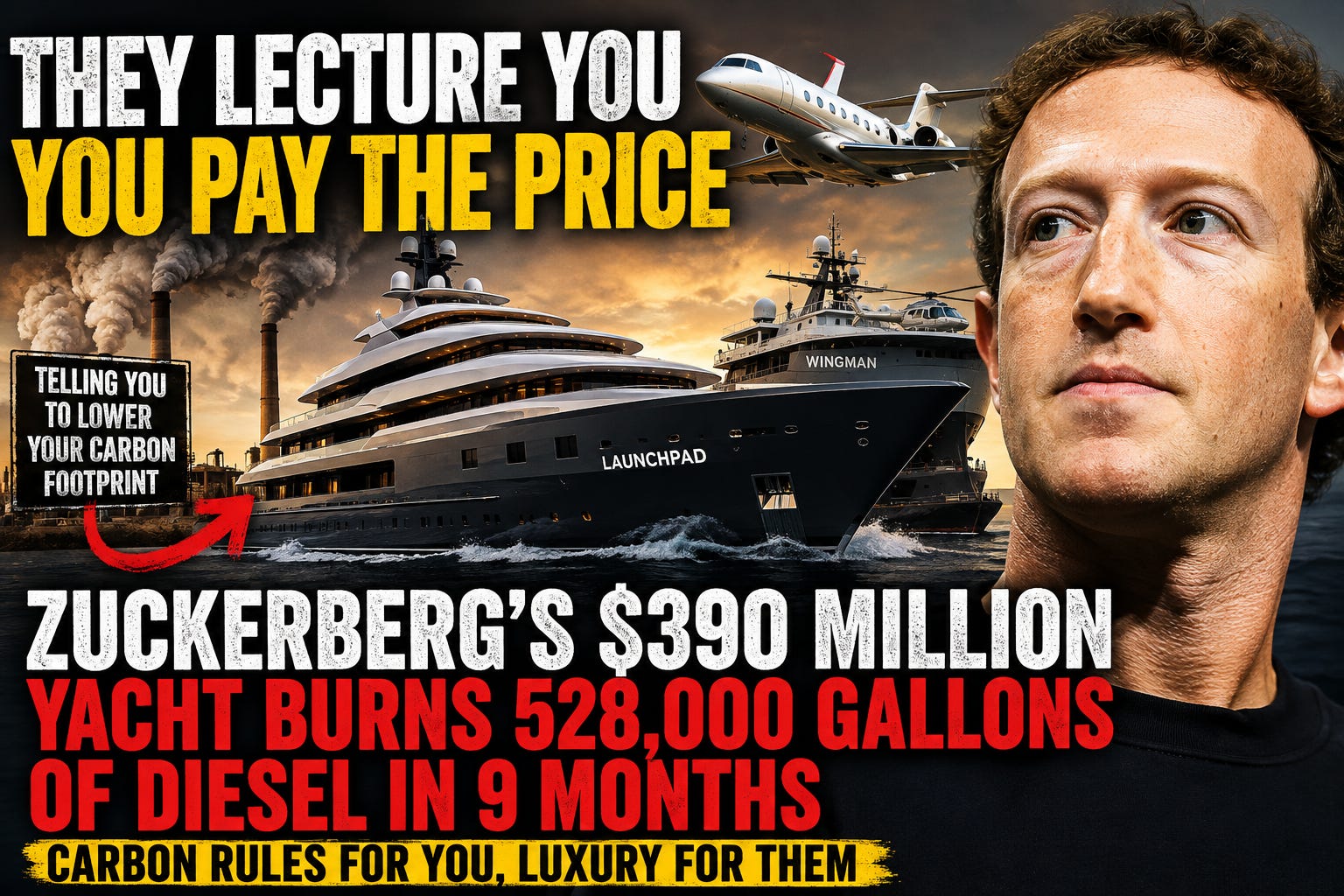
That question is back in the spotlight following renewed attention surrounding Meta founder Mark Zuckerberg and his 387 foot superyacht, Launchpad. The yacht, delivered to Zuckerberg in 2024, has been valued in reports at roughly $300 million to as much as $390 million. It is not simply a luxury boat. It is essentially a floating private resort, measuring nearly 400 feet and capable of carrying dozens of guests with a crew of roughly 50 people.
And Launchpad does not travel alone. Zuckerberg’s fleet also includes Wingman, a 220 foot support vessel reportedly worth around $30 million. Wingman can carry additional boats, watercraft, a helicopter and a personal submersible, turning the billionaire’s recreational operation into something resembling a private maritime expedition fleet.
Then there is the fuel.
Reports based on vessel tracking and fuel use estimates have claimed that Launchpad burned more than 528,000 gallons of diesel in approximately nine months, producing more than 5,300 tons of carbon emissions during that period. One comparison cited by multiple reports estimated that amount of emissions to be roughly equivalent to the annual emissions of nearly 400 U.S. households.
Those numbers deserve scrutiny and context because estimates based on ship tracking are not the same thing as an independently audited emissions report. But even the broader figures being reported paint a remarkable picture.
More recent tracking estimates are even larger, with one July 2026 report estimating that Launchpad had traveled nearly 100,000 kilometers since its delivery, consuming approximately 1.4 million gallons of diesel and generating an estimated 14,300 metric tons of CO₂ over roughly two years.
And that brings us to the real issue.
This isn’t about whether Mark Zuckerberg is legally entitled to own a yacht. Of course he is. He earned an extraordinary fortune and, like other billionaires, can spend that fortune however he chooses.
The question is about consistency.
When ordinary Americans are repeatedly told that their personal choices are contributing to a planetary crisis, it is reasonable to ask whether the same standards apply to the wealthiest people on Earth.
If driving an older gasoline vehicle is supposedly a threat to the planet, what standard should apply to a nearly 400 foot diesel powered yacht?
If families are told to reduce their household energy consumption, how should they view a lifestyle involving private aircraft, enormous residences and ocean going vessels that consume extraordinary amounts of fuel?
And if carbon emissions are truly an existential emergency, should wealth provide an exemption from the sacrifices being demanded of everyone else?
These questions aren’t an attack on environmental conservation. Quite the opposite. If reducing emissions is important, then the principle should apply consistently.
The public shouldn’t be told that climate responsibility means ordinary people must continually give something up while the ultra wealthy continue consuming on a scale that most Americans cannot even comprehend.
That is where the conversation about Zuckerberg’s yacht becomes bigger than Zuckerberg. It becomes a question about the credibility of the people promoting these policies.
There is nothing inherently wrong with wanting cleaner air, cleaner water, more efficient technology or responsible stewardship of the environment. But people are naturally going to become skeptical when they see one set of rules being promoted for the public and an entirely different lifestyle being enjoyed by those at the top.
The contradiction becomes even more striking when the billionaire in question has publicly supported action on climate change.
That creates an unavoidable question:
If the climate emergency is serious enough to require sacrifice from ordinary Americans, why isn’t personal consumption at the highest levels subjected to the same scrutiny?
The answer cannot simply be that billionaires represent such a tiny percentage of the population that their individual emissions do not matter. If that is the argument, then the public deserves to hear it honestly.
If personal emissions don’t matter when someone is wealthy enough, say so. If the rules are supposed to apply to everyone, then apply them consistently.
Because people notice the contradiction.
They see the private jets. They see the megayachts. They see the enormous homes. They see the luxury lifestyles. And then they hear that they need to drive less, consume less and sacrifice more.
That doesn’t inspire confidence. It inspires resentment.
The debate over climate policy should not be about forcing everyone into poverty while billionaires are forbidden from enjoying their wealth. Nor should it be about pretending that environmental concerns don’t exist.
It should be about honesty, consistency and accountability.
If carbon emissions are the threat we are repeatedly told they are, then the conversation cannot stop at the driveway of the middle class. It has to reach the marina of the billionaire.
Because environmental responsibility should not be a rule that applies only to the people who cannot afford to ignore it.
The public isn’t necessarily demanding that billionaires live like everyone else. They are simply asking why the people lecturing everyone else about sacrifice seem to have an entirely different definition of sacrifice for themselves.
Comments
Nothing yet. Say the first thing.
Sign in to join the conversation.