
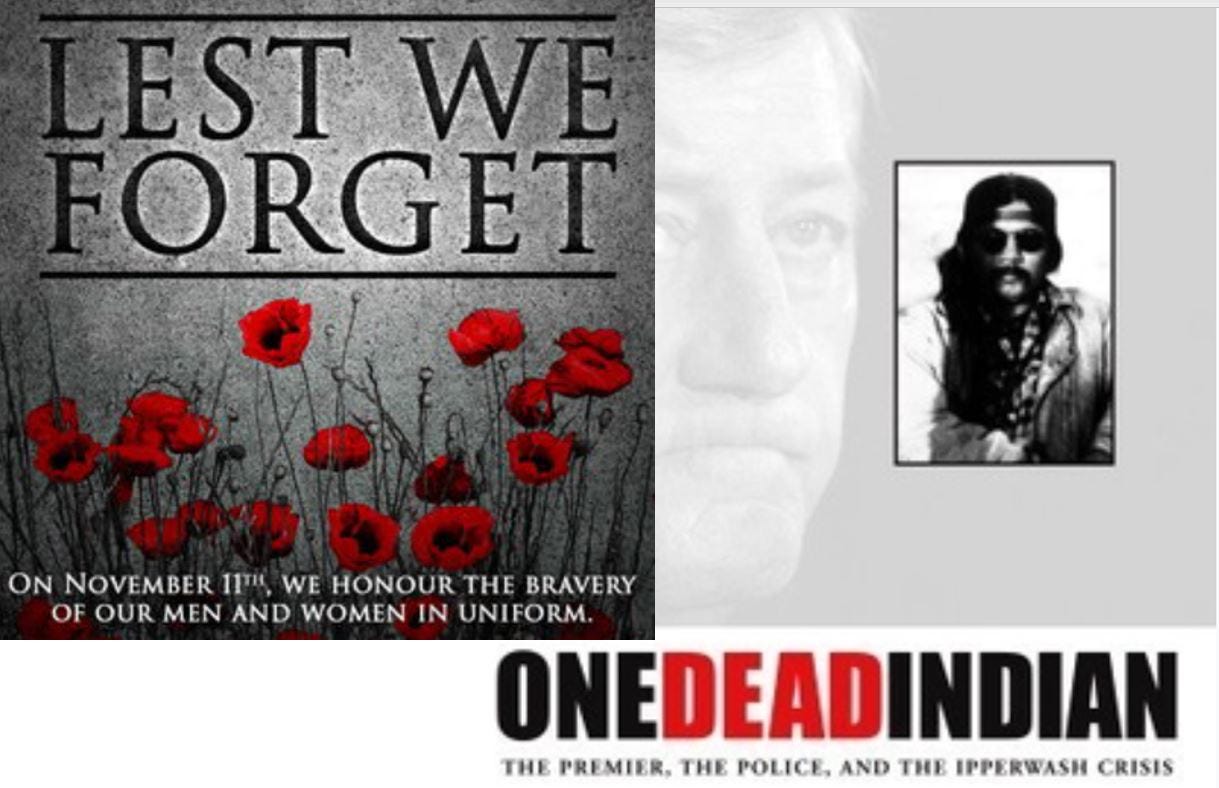
Source: Anokiigamig created image.
This image is a combination of the Canadian Remembrance Day image and statement Lest We Forget1 and the One Dead Indian2 book cover.
One of the myths often quoted to minimize the plight of Indigenous people in Canada is that theirs are ancient grievances that belong to a different age and no longer have relevance. Relative to the 12,000 years Indigenous people have occupied parts of Turtle Island the 500 or so years since settlers from Europe first arrived is very short. However, more to the point government actions to deny Indigenous people their rights and to confiscate their land continued right up into the late twentieth century and reparations have been very slow to reverse the course and to begin the process of legal restitution and healing the relationship.
In 1942 during the early part of the Second World War, the federal government under the authority of the War Measures Act, expropriated the lands from the Stoney Point Reserve in Ontario and established Camp Ipperwash as an infantry training facility. The Stoney Point First Nation resisted the expropriation claiming that the grounds contained an ancestral burial site, a fact proven true in 2010 through archaeological surveys.
The government later offered to buy the land from the Stoney Point First Nation but that offer was turned down (given the significance of the land). Then the government promised to return the land to the First Nation after the war ended, a promise they later reneged on. After decades of having their legitimate claims ignored by the government the people began to take action. In 1993, while Camp Ipperwash was still being used as a summer training centre for the Royal Canadian Army Cadets, band members occupied portions of the camp and the adjacent piece of land. After the summer of 1993, the government moved the cadet camp to CFB Borden but there remained trouble at Camp Ipperwash.
On Labour Day Monday, September 4, 1995, a group of approximately 35 people started a protest in Ipperwash Provincial Park to draw attention to the decades-old land claims. It is important to note that the occupation began after the park had closed for the season. The protestors had been threatening occupation since the spring but decided to start the occupation after the camping season to minimize the impact on the Park and campers.
The original police strategy was to co-occupy the park peacefully with the Indigenous people. In anticipation of the move on the park by more protesters, the OPP had prepared a contingency plan named Project Maple. The plan stressed “a peaceful resolution” and called for a team of two negotiators to be on call around the clock. Nevertheless, several factors came together to turn the event into a crisis and into tragedy.
There is no doubt retrospectively that the then Premier of the province, Mike Harris, had a hand in escalating the protest into a violent confrontation between Indigenous protestors and the OPP. He is quoted as saying, in fact shouting, “I want the fucking Indians out of the park.” There is tape recorded evidence that the Premier’s views reflected on actions subsequently taken by the police that escalated into violence in the park. In conversation between OPP Inspector Ron Fox and Inspector John Carson, the OPP commander overseeing the standoff at Ipperwash, Premier Harris’s views that the government has “tried to pacify and pander to these people far too long” and to use “swift affirmative action” to remove them from the park were discussed.
In addition, as confidential government files now reveal3[1] the Canadian Security Intelligence Service (CSIS) used covert infiltrators in many instances to gather evidence of “Native extremists embracing the Mohawk Warrior Society’s model of armed standoff as a tactic to accomplish their political goals.” These Canadian Spy Service spies however assumed they were dealing with “extremists” and fabricated reports to confirm their suspicions and to win favour with their handlers. One spy in particular reported that the Protestors were armed with guns and other weapons and intended to use violence.
It is likely that this misinformation led the OPP to believe they needed to be hyper-vigilant. On September 6, 1995 the situation did turn chaotic and, in the turmoil, an unarmed protestor named Dudley George was shot and killed by an OPP officer. The officer claimed he had heard gun shots coming from the school bus Dudley George was driving and that he saw a gun in George’s hands. In the subsequent inquiry both these claims were proven to be patently false and the officer was found guilty of criminal negligence causing death and was dismissed from the police force.
The killing of Dudley George was tragic and laid bare the underlying racism that hid beneath the surface amongst many people in government roles including the police and the Ontario Premier. It was a watershed moment in Canadian history and needs to be remembered by all. It is not an event that happened in ancient times but a modern-day occurrence. Moreover, despite the tragedy the underlying land claim continued to linger for years and has only partially been resolved as of today in 2025 more than thirty years later.
The Canadian government and the Kettle and Stoney Point First Nation reached a land claim settlement in 2016 that included $95 million and safe return of land, but that must be cleaned up first. It’s use as a military training facility has left unexploded ammunition hidden throughout the property. This must be cleared for the land to be habitable, a process that reportedly will take another twenty-five to thirty years to complete!
In addition, housing conditions, including access to potable water and the availability of safe heating remain a problem for the band members who do live there. Unfortunately, while the killing of Dudley George was national news and woke many Canadians up to the problems faced by Indigenous people, it is also long forgotten. The recent revelations of the role played by CSIS, while reported by the news media at the time, ought to have stirred outrage amongst al Canadians. The use of spies who we now know carried the inherent and racist bias to assume that Indigenous people fighting for their rights to the land of their ancestors were “Native Extremists” should alarm all Canadians. Thankfully CSIS has changed its posture in this respect and no longer refers to Indigenous protestors as “extremists”.
Let’s all remember Dudley George who made the ultimate sacrifice. Let’s also remember that the healing process is a long process and is not a historic relic but is in fact part of our modern- day reality.
Indigenous people served in the Canadian Armed Forces and are often forgotten. They served in uniform for Canada, gave their lives and lent their land in service to War time efforts. This coming Remembrance Day let’s remember the contribution made to the war effort by the Indigenous People of Turtle Island.
For the full Dudley George story read the book One Dead Indian, The Premier, the Police, and the Ipperwash Crisis (2001) by investigative journalist Peter Edwards ISBN: 9780771030475
Comments
Nothing yet. Say the first thing.
Sign in to join the conversation.