
In May of 2026 the people of Harbour Grace Newfoundland will recognize the 94th anniversary of Amelia Earhart’s historic solo transatlantic flight1[1]. There is a statue of Earhart in the town in recognition of Harbour Grace being the point where she set off on her flight. There is no doubt that Amelia Earhart was an aviation pioneer and, as a woman, her accomplishments contributed to the future advances of women’s rights. There is also no doubt that the mysteries around her later disappearance while attempting to circle the globe in her plane added to her legacy and has helped maintain her fame.
In Canada we have at times not done a good job in remembering the women who helped shape our country and our culture. Two women of Historic Significance who have also had statues raised in their honour in Newfoundland are Demasduit and her niece Shawnadithit. These two women were members of the Beothuk people who lived in Newfoundland from long before the time when European settlers began to arrive in the 17th century, and until the last of the Beothuk people passed away in 1829.
Demasduit (also known by the name Mary March which was given to her by her capturers indicating the month she was taken) was born in 1796 and was captured by English fishermen in 1819. She was sent to an Anglican missionary priest where she created a list of Beothuk vocabulary (approximately 180 words). Shortly after what proved to be a brief stay with Rev John Leigh she was sent to St. John’s NL but was unable to locate any family members. After a failed attempt to return her to her people, she died of tuberculosis at Ship Cove (now Botwood) aboard Captain Buchan’s vessel Grasshopper, on 8 January 1820. After her death, Demasduit’s body was initially placed, by her Beothuk tribe, in a burial hut beside her husband and child, however her remains and those of her husband were later taken by Scottish explorer and philanthropist William Cormack to Scotland where they were housed at the National Museum of Scotland2[2].
In 2015, Chief Mi’sel Joe of the Miawpukek First Nation at Conne River began a process to repatriate their remains. Joe travelled to Scotland to view the remains and performed a sweetgrass ceremony for the Beothuk people, a spiritual purification ritual meant to wash away negative thoughts and feelings. In February 2016, Newfoundland and Labrador premier Dwight Ball officially wrote National Museums Scotland to ask them to return the Beothuk remains to Canada. This was followed by a similar request in November 2017 from the federal minister of Canadian Heritage, Mélanie Joly. In January 2019, Gordon Rintoul, director of National Museums Scotland, announced that an agreement was reached with Canadian authorities to have the remains returned to Canada. After much lobbying, the remains were returned to Newfoundland in 2020.
The Government of Canada has recognized Demasduit as a Person of National Historic Significance. Two statues depicting Demasduit, her husband Nonosabasut and their infant child can be found in the town of Botwood, Newfoundland at one of the highest points in the Exploits Valley region overlooking the local harbour. This is where Demasduit was believed to have died. It is considered to be “a traditional home” for Beothuk.
Incidentally, Nonosabasut was killed by the same settlers who had captured Demasduit when he attempted to rescue her from the Europeans. It was believed the capture of Demasduit and murder of Nonosabasut was in retaliation for an alleged theft by the Beothuk people. At that time,, the perpetrators were acquitted by the courtsIt is part of the sad legacy of the Beothuk who were subsequently rendered extinct by the newcomers.
In 1828, after Demasduit’s death her niece Shanawdithit, was brought to Scottish naturalist and merchant William Cormack, who also recorded a Beothuk word list. Additionally, Shanawdithit drew maps of Beothuk territory and sketches of Beothuk material culture.
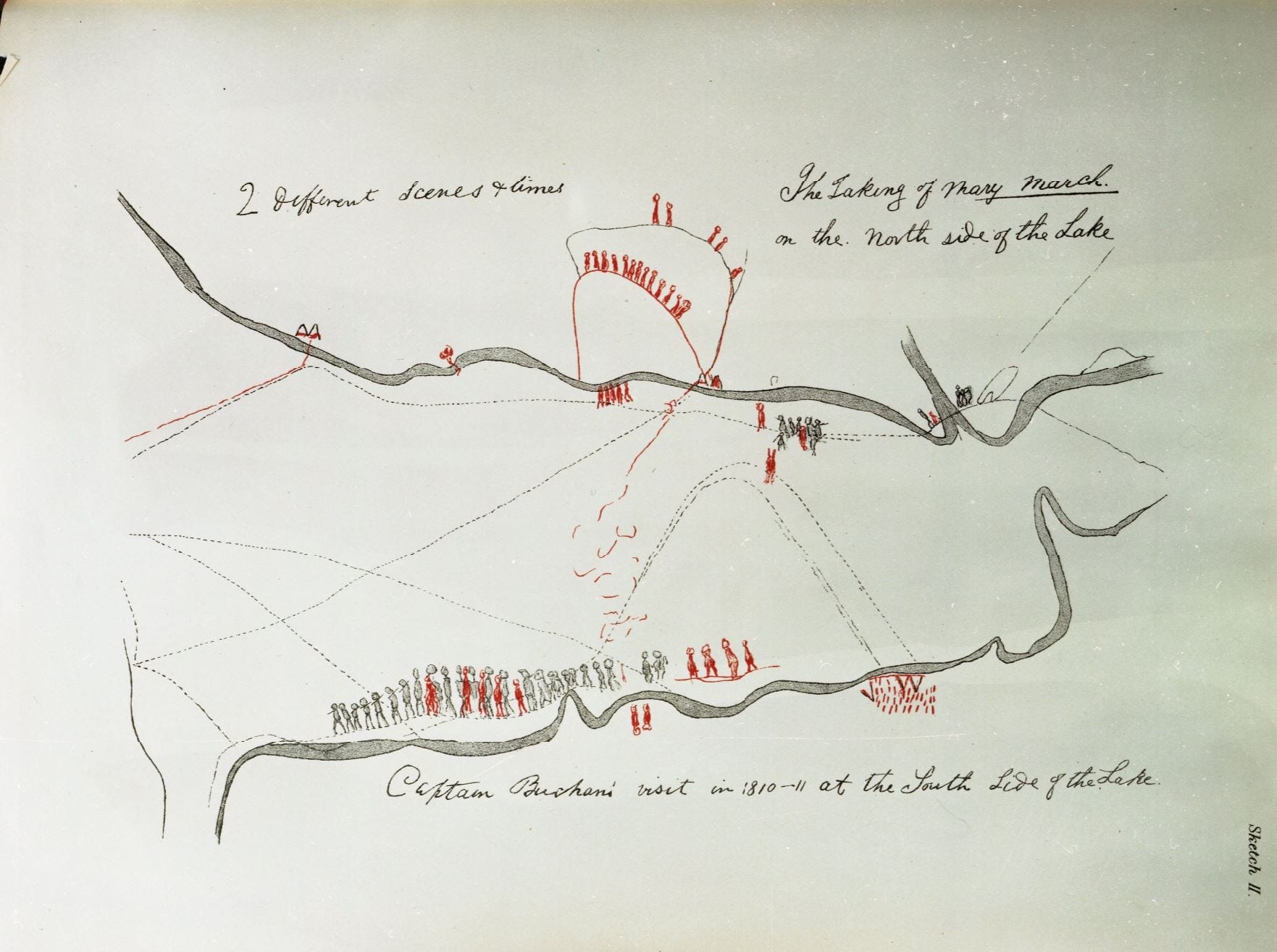
One of Shanawdithit’s eleven (11) drawings.
Find all 11 of Shanawdithit’s Drawings at: https://collections.mun.ca/digital/collection/cns_images/id/64
At the time the Beothuk population was dwindling, their traditional way of life becoming increasingly unsustainable in the face of encroachment from both European colonial settlements and other Indigenous peoples. The Beothuks were slowly cut off from the sea one of their food sources. As well they were exposed to infectious diseases like smallpox for which they had no immunity.
Unlike other indigenous peoples the Beothuk resisted interactions with settlers. This unfortunately created greater animosity against them and they were often hunted and killed as the Europenas regarded them as thieves who represented a threat to the colonists. As a child, Shanawdithit was shot by a white trapper while washing venison in a river. She suffered from the injury for some time, but later recovered.
Shanawdithit played a vital role in documenting what little is known about the Beothuk people. Researcher Ingeborg Marshall has argued that a valid understanding of Beothuk history and culture is affected directly by how historical records were created and who created them, pointing to the ethnocentric nature of European accounts which positioned native populations as inherently inferior. She notes that without Shanawdithit’s accounts of her nation’s later life, the Beothuk voice would be absent from historical accounts.
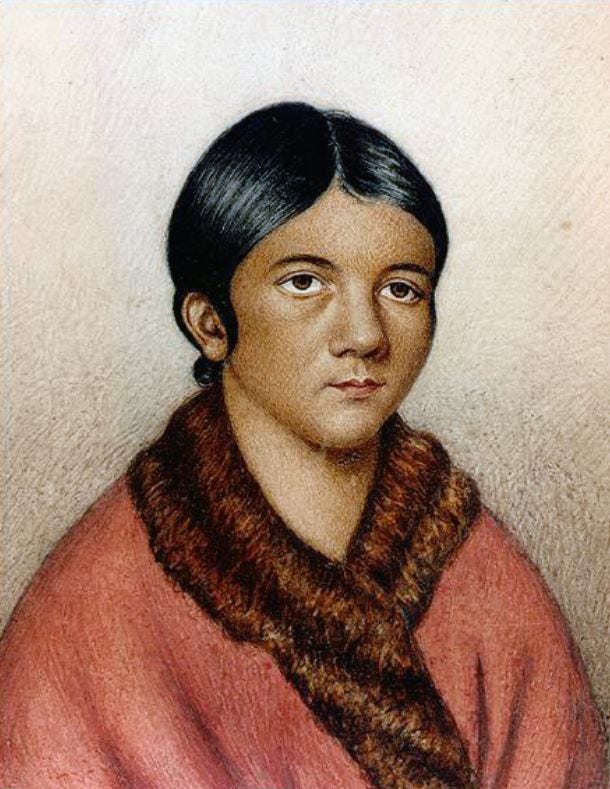
A beothuk woman (ca. 1841) believed to be Shanawdithit, though possibly a reproduction of a portrait of Demasduit (her Aunt).
Source: https://en.wikipedia.org/wiki/Shanawdithit
After having been in frail health for a number of years Shanawdithit spent the last nine months of her short life under the care of the attorney general, James Simms.,. In 1829, at the age of 28, Shanawdithit died in a St. John’s hospital after a long fight with tuberculosis. In reports of her death of it was noted that Shanawdithit “exhibited extraordinary strong natural talents” and he identified the Beothuk as “an anomaly in the history of man” for not establishing or maintaining relationships with European settlers or other Indigenous peoples.
Like her aunt Demasduit, Shanawdithit’s life is remembered by a statue raised in her honour near the Beothuk Interpretation Centre in Boyd’s Cove. It was unveiled in the year 2000. For many Newfoundlanders it is not enough and there has been some calls for a second statue to be raised in St. John’s. Shanawdithit is believed to have been the last surviving Beothuk person.
Remembering these women whose brief lives had so much meaning is an important part of our history and Canadian heritage.
Comments
Nothing yet. Say the first thing.
Sign in to join the conversation.