
Welcome to another installment of my Book Reflection series — a space where I sit down and reflect on my recent reads. In this series I answer the same questions to offload my thoughts on the book.
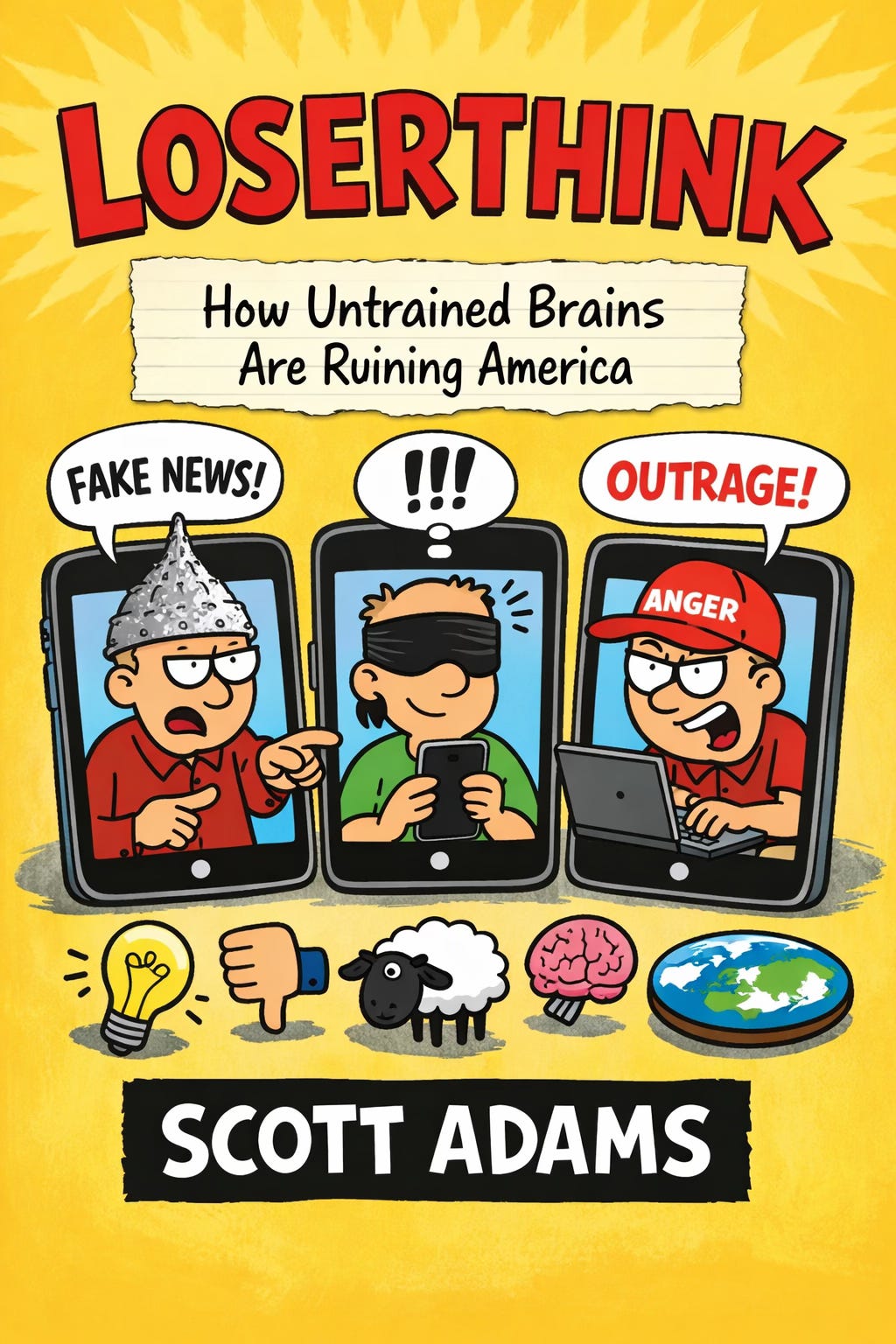
Today’s book is Loserthink: How Untrained Brains are Ruining America by Scott Adams. I borrowed the audiobook from my local county library.
Scott Adams, the creator of Dilbert, recently passed away. After his death, I realized he had written far more than just comics and had evolved intellectually well beyond the world of office satire. I asked ChatGPT for a summary of his career because I kept seeing technology influencers reflect on what his loss meant to them. That made me curious.
Reading about his trajectory — especially the range of books he’d written — caught my attention. Loserthink stood out in particular. ChatGPT described it as a critique of poor thinking habits, especially the kind that show up on social media. It also mentioned that it was one of his newer books and, notably, one of his least commercially successful.
That combination intrigued me: social media thinking patterns, a later-career intellectual evolution, and a book that didn’t necessarily resonate with a broad audience. I was especially drawn to the idea of examining the flawed reasoning habits that seem amplified online.
I didn’t go into this with some big intellectual objective. I mostly just wanted to see how Scott Adams writes. Because he created Dilbert, I assumed it wouldn’t be overly academic or self-serious. And like I said before, I was genuinely curious about the idea of breaking down bad thinking habits — especially the kind that show up on social media.
I have my own online presence, and it lives in a very niche world: Tableau, analytics, and how data should actually function inside businesses. Even in that small corner of the internet, I’ve noticed patterns. The loudest voices tend to repeat very reductive takes (“pie charts are bad”), stick to the same angle for years (“survey data is my jam”), or — especially right now — position themselves as anti-AI. I am not anti-AI. I’m very much pro-AI. But for whatever reason, that stance doesn’t seem to move cleanly through the algorithm. What I end up seeing over and over are the people who post constantly, often from what feels like fear or incomplete understanding.
So I was curious what Scott would say about all of that. He’s not embedded in my tiny analytics bubble, which felt important. He isn’t shaped by the same micro-community dynamics. And I figured if anyone could clearly diagnose flawed thinking, it might be the guy who built a career distilling corporate absurdity into a comic strip.
So what did I want out of it? Mostly his perspective. His take. His diagnosis. What does he think is actually going wrong in how people reason? And what does he mean when he says “untrained brains are ruining America”?
What stood out to me most was honestly how basic and straightforward the book was. I listened to the audiobook, and Scott narrates it himself. His tone is very easy and conversational. He comes across as skeptical, but not negative. Toward the end, he mentions that he trained himself to be more optimistic — to pair a negative observation with something positive — and once he said that, it kind of clicked. You can feel that balance in how he speaks.
The book didn’t feel tightly anchored to any one industry or ideology, which I deeply respect. The “loserthink” patterns he describes pull from all over the place — psychology, persuasion, business, history, economics, even hypnotism (which he openly admits to studying). He doesn’t lean on academic jargon or citations to make his point. There’s no “a Harvard study proves…” energy. He just says what he’s observed, explains why he thinks it’s flawed, and suggests a different way to approach it. Plain English. Very direct. No shoulders of giants.
One moment that really stuck with me — maybe the most sticky or bold line — was when he said that “stay in your own lane” is the worst advice you can give someone. He argues the better advice is to “widen your lane.” Of course I agree with that (hello, confirmation bias), but I agree with it deeply.
I’ve benefited enormously from learning a lot about a lot of things and integrating them into how I see the world. But that approach is often treated as suspect — like you’re not serious enough, not specialized enough, not “the right kind” of expert. I’ve felt that tension in my own career, especially trying to stay neatly boxed into a single domain.
To me, data is knowledge. Knowledge is power. And data visualization is one of the best tools we have to conceptualize, understand, and improve from that knowledge. That doesn’t fit cleanly into “Tableau vs. Power BI” debates. It doesn’t sit neatly inside “how to tell great stories with data.” It’s broader than that. And his argument about widening your lane felt like validation that there is space for that type of thinking (even if uncommon).
For some reason, this book really made me think about how many of my favorite non-fiction audiobooks were narrated by the author. It’s not true 100% of the time, but often enough that it makes a difference. In this case, it felt necessary. I genuinely don’t think I would have understood Scott’s intent the same way if someone else had read it. I can’t imagine it being delivered by a smooth British male voice or a polished female narrator. It just wouldn’t have landed the same.
Hearing him read his own words — with his pacing, his tone, his slight skepticism — gave context that might have been lost otherwise.
One of the best anecdotes he shared was about how literally he interprets public signs and instructions. It was such a small thing, but hearing someone who’s had real commercial success, someone who has distilled corporate dysfunction into two-panel comics and has influenced powerful people — struggle with something like that (and his aversion to car washes) was oddly grounding.
It humanized him.
It’s one of those reminders you can never hear enough: people are just people. The loudest voices, the famous or semi-famous ones, the ones with billionaire readers — they aren’t superheroes. More often, they’re just deeply obsessed with or fascinated by something. They stick with it. They commit. They refine and in Scott’s case, they expand.
Of course, that’s not true for every commercially successful person. But for many, it probably is.
As an anecdote: I’m currently watching the Winter Olympics, and as much as I enjoy curling, I cannot imagine committing my entire life to that game. And yet someone does. That’s the difference. Obsession, fascination, devotion to something most of us would never choose. And I respect them for it. Truly.
This book is definitely a product of its time. It was written pre-COVID, back when X was still called Twitter, during Trump 1.0, pre-woke, pre-post-woke, and before generative AI exploded into mainstream use. The world it was reacting to feels almost simpler compared to now.
From that distance, two things stand out.
First, Scott was slightly ahead of his time on a few fronts — especially around how mainstream media handles political discourse, how algorithms create entirely separate realities for different groups of people, and how little most internet participants understand about human cognition and persuasion. Reading it now, those observations feel less controversial and more… obvious.
I actually laughed at one point when he said something along the lines of humans being excellent at post-event rationalization. It reminded me almost word-for-word of something Claude once told me when it was in one of its more unfiltered moods: “Humans are primarily rationalizers, not reasoners. Most beliefs are formed through social conformity, emotional resonance, and tribal identity — then justified afterward.”
Different delivery. Same underlying point. And something I also believe.
That said, some of the optimism in the book didn’t quite materialize the way he may have expected. A few timelines and implied trajectories feel dated now. The landscape shifted dramatically after COVID and the generative AI wave. It is almost like the optimism he spoke from is now more tangled up than clear. Most of it is happening, but there’s almost an adversarial nature to all types of progress at this moment. Maybe it is better labeled as skepticism.
But to his credit, one of the strongest sections, in my opinion, was how he framed opposing political positions on healthcare, immigration, and climate change. He described both sides in a way that was blunt but not hysterical. No dramatic moralizing. Just clear framing.
Also worth mentioning: I do still find myself skeptical of any defense he has of Trump. I have updated my own stance on Trump 2.0, but I still experience a lot of distaste when someone tries to smooth out Trump’s behavior. (This is because to me, Trump is publicly extreme as a tactic and pretending otherwise isn’t necessary, it is better to just call it what it is).
Yes — this book connected pretty directly to my own general perspective on social media. Scott approaches it with more structure and rigor, but a lot of the mental models he recommends are things I’ve already spent time learning on my own. In that sense, whatever Scott was reading and whatever I’ve been reading seem to overlap. That’s always calming. It makes me feel less like I’m out on some strange limb by myself.
There’s also a newer realization I’ve been having — and this book reinforced it — which is that there may not be as many truly unique voices generating original thought as I once assumed.
Since I’ve been reading more books intentionally, I’ve noticed the same names, frameworks, and “definitive experts” recycling across domains. It’s not necessarily harmful, but it is a little disappointing. It reinforces this broader cultural feeling I’ve been sensing — that much of what we consume is second- or third-generation knowledge. (As an aside, I feel that usually you lose the rigor and purity of intention through this process.)
It reminds me of the Six Sigma concept of “The 5 Whys.” The classic example is the turkey with its legs cut off before cooking. A child asks why, and the answer is “because that’s how grandma did it.” Eventually, tracing it back, you discover the original reason was simply that the turkey didn’t fit in the oven. The behavior persisted long after the constraint disappeared.
I think I’m starting to wonder how much of modern thought works that way. How much of what we repeat is inherited, reframed, and repackaged rather than truly generated?
The moment this clicked in the book was when Scott recommended Robert Cialdini’s work on persuasion. I kind of smiled to myself (actually I gloated to my husband). I not only know who Cialdini is — I’ve referenced his persuasion principles in my own arguments. And where did I learn about him? From an advertising agency CEO that was a client when I was building Tableau dashboards for them.
It’s all connected. The same intellectual roots feeding multiple branches.
And while maybe that’s not entirely bad. It does make me reconsider how much “original thinking” is actually happening — versus how much is recombination. And in particular, right now, how much it makes sense for us to rely on outdated models, assumptions, or constraints that are no longer necessary to cling to within our today.
Said simply: we have better ovens now.
Yes, I would recommend it.
It’s an easy read — or listen — mostly because of the tone and pacing. It feels conversational the whole way through. You’re not fighting dense prose or academic language. And because Scott narrates it himself, it feels even more personal.
I actually think the book would translate really well into some kind of distilled comic or infographic — something that lays out the different forms of “loserthink” he identifies in a more visual way. The ideas themselves are fairly straightforward; it’s the framing and examples that make them stick.
Beyond the content, though, I appreciated getting insight into someone I previously only associated with a comic strip. It gave me a clearer mental picture of the person behind Dilbert — his thinking, his history, his intellectual evolution. I like understanding the journey behind the output.
One of the things that stood out most was his explanation of how he’s continuously expanded and adjusted his thinking over time. That felt like a real story. Not reinvention for attention. Not arrogance. Just steady movement in the direction of his interests, refining as he goes.
And as a bonus, you’ll learn the scientific term for being pee-shy.
This book made me want to read more of his work. In particular, How to Fail at Almost Everything and Still Win Bigcaught my attention, especially the way he described his intentions behind writing it. There was a kind of fondness there. Based on that alone, it’s going on my list.
I also find myself curious about Scott beyond the book — especially his on-camera presence. I’m almost completely ignorant of that side of him. And if I’m being honest, there’s a small part of me that hopes looking more closely won’t disrupt the impression I currently have.
There’s something fragile about forming a mental model of someone through their writing alone. The voice in the audiobook felt measured, skeptical, thoughtful, even a little self-aware. I’d like to believe that extends outward. But I also know public personas can complicate things.
Maybe that’s part of the broader lesson here. People are layered. We rarely get the full picture from one medium. And maybe the discomfort of potentially updating our view of someone is just part of staying intellectually honest.
Either way, I’m glad I read it.
No posts
Comments
Nothing yet. Say the first thing.
Sign in to join the conversation.