
In March of 2025, my husband told me that his company was beginning an RTO mandate. I didn’t even know what the acronym stood for. Turns out it was for return to office.
He was two months into his job and a remote worker. Mandated to return to the office he had never stepped foot into.
As their “plan” rolled out over a 6-month-turned-12-month period, we watched the paranoia rise and the productivity fall. The culmination of the plan resulted in disgruntled employees who were forced to go to the office without space for working or parking, but with free celebratory breakfast in the lobby.
A plan that also left remaining remote workers, deemed exceptional and granted an exception to the mandate, unable to change roles or be promoted without foregoing their remote status.
If you’re more of a numbers person, the mandate produced an employee Net Promoter Score (NPS) of -10. That is, more employees were likely to tell their friends and families not to work there than recommend it.
Needless to say, my exceptional husband doesn’t work there anymore, his colleagues don’t recommend it and neither does he.
Fast forward to now, and it’s easy to understand why I wanted to read Adam Grant’s guest essay in the New York Times titled “The Secret Reason Bosses Want Everyone Back in the Office, Every Day of the Week.” (gift link) In the article, Grant outlines pretty clearly what his team’s research suggests: the objection to any remote work is more likely to be about ego than collaboration, creativity, or culture (not productivity, since that has already been debunked).
I would have settled for blaming it on commercial real estate investments, but narcissism works for me too.
Through Grant’s descriptions, we’re left with a vision of a boss demanding to be “worshiped at the office altar.” A place for “slamming doors” and “staring people down with direct eye contact.” Between the worshiping and the stare-downs, I can’t tell exactly where we are, at a church or in the arena. (Perhaps just an episode of The Apprentice.)
Irrespective of the venue, the research is also clear. RTO mandates fail to increase financial returns, motivate star employees to quit, reduce satisfaction of those who stay, and discourage new talent from joining. That is, a -10 employee NPS.
What they do offer, according to Grant, is a place for “sycophantic reassurances” delivered in person instead of via Slack. Just what the drug-like narcissism craves, a “regular supply of attention and validation.”
What then is the answer? The useful takeaway from Grant, treat in-office time like a coordination problem. One planned and designed around the actual work of the team, not the boss’s ego. A plan considerate of the type of work being done by the team and the way the team itself works, as Grant analogizes, “You need to gather together more if your staff operates like a basketball team passing the ball back and forth, rather than a gymnastics team whose members do their own individual events.”
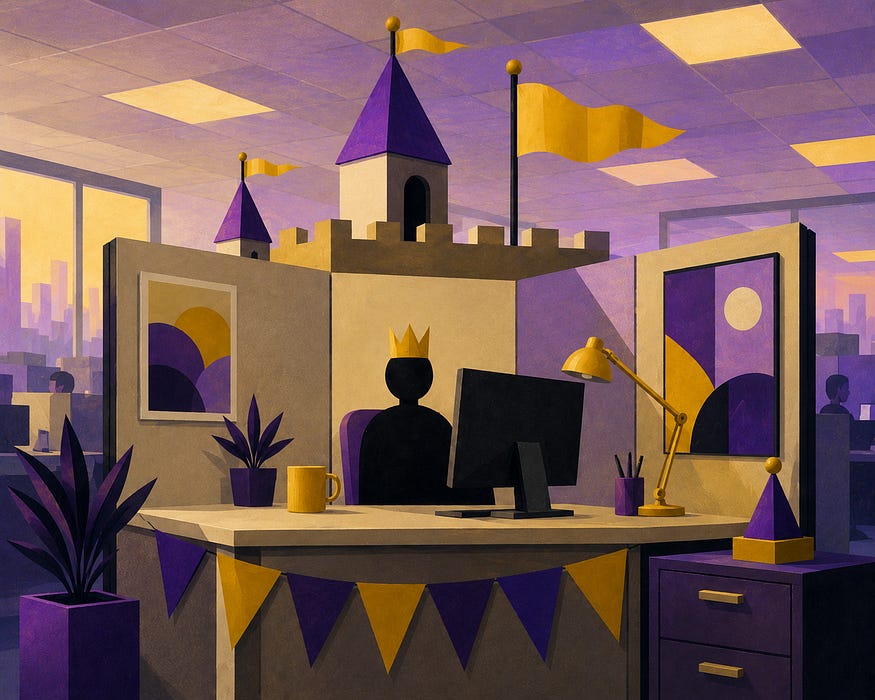
As we continue to see the workplace evolve, AI included, I’m left with an odd extrapolation — not a prophecy. Will the observed rise in narcissism, marked by the prize of a corner office and glaring-rights, become more ubiquitous through the next office mandate: AI? AI is already known to be sycophantic, so does it reason that when the boss’s subordinates are encouraged to use AI agents, they’ll adopt their own Napoleonic complex — decorating their cubicles with ornate turrets and closed tickets as big-game heads?
Will we all be playing Command & Conquer from 9 to 5?
No posts
Comments
Nothing yet. Say the first thing.
Sign in to join the conversation.