
As a result of an illegal war waged by old white men, and the retaliation of a politically repressive state fighting for survival, you read it everywhere. That the ‘choking’ of oil, gas and fertiliser flows at the Strait of Hormuz has caused shipping companies such as Maersk to suspend crucial services, while Bahrain’s oil refinery and a Singaporean chemical company were forced to declare force majeure. These constraints on supplies will lead, thanks to demand for these assets, to price rises in energy and food, once again triggering worldwide inflation.
To deal with this threat traders and ‘markets’ are betting/speculating that central bank interest rates will, and must inevitably rise. As Frances Coppola notes in her post on “the irrelevance of central banks”…
Inflation expectations promptly soared (after the invasion), and markets that had confidently priced in further cuts to interest rates did a screeching handbrake turn, pricing in at least one interest rate rise before the end of the year. Stock prices fell, and yields on government bonds rose.
To prove her point, the FT’s Robert Armstrong followed up with:
Pre-war, rates traders had clearly been betting on a decline in short-term (central bank) rates globally. The possibility of oil-driven inflation blew them out of those trades, especially in Europe, leading to a big jump in two-year (bond) yields. What happens to short rates in the next few days will be fun to watch:
Every mention of ‘Inflation’ is twinned with another threat to the livelihoods of the world’s working people and to the survival of heavily indebted companies: higher interest rates. This week both the Bank of England and the Federal Reserve are holding Monetary Policy committee meetings, and both are expected to either raise rates, or keep them at the present relatively high rate.
In the case of the Bank of England, the governor would back such a move even though he has publicly admitted that the Bank can do little to damp inflation. As the Progressive Economics Working Group has shown in its report Rewiring for Success, in 2022, the Governor told MPs
It’s a very, very difficult place to be. To forecast 10 per cent inflation and to say there isn’t a lot we can do about it is an extremely difficult place to be.
Despite this admission of impotence in the face of inflation, he nevertheless felt obliged to raise rates. Had the Bank’s Monetary Policy Committee not done so the British economy might today be a lot stronger today.
Raising rates at this stage of the Israel-led US war on Iran, would be equivalent to a 2000-pound penetrator bomb dropped on to the complex and tightly coupled but also heavily indebted, weakened and unbalanced global financial system. The main victims would be low income, indebted countries and their people; but also indebted firms, households and individuals in so-called ‘advanced’ economies.
Central bankers act politically
In The Global Casino I devote a chapter to the role speculators have played in fixing prices and triggering global inflation by betting on, or bidding up, future rises in oil, gas and food prices. As if to confirm the point, the Financial Times in a piece titled Inside one of the wildest days the oil market has ever seen - shares the insights of one exhausted trader who began trading on Sunday 8th March and discovered that
“financial speculators play a far larger role in oil trading than they once did.”
The trader was one Manny Newman, 32, who worked for 23 hours through
one of the most volatile trading sessions the oil market has ever seen. Over the next 23 hours, the benchmark Brent crude price surged to as high as $119 a barrel before plunging to $84, the biggest intraday swing in dollar terms on record.
I’ve been through a lot of crises, including Covid, Russia and the Saudi oil attacks in 2019,” she said. “They were nothing like yesterday.” The pace of trading, she added, felt like playing a video game “for 24 hours straight”.
“Today, we do not know who is behind some of the financial trades and what information they have. They might come in very aggressively, and you ask, ‘Do they know something you don’t?’”
Given that prices for commodities driving up inflation - like oil, gas and fertilizer - are a) all settled in global markets, and b) these markets deliberately operate well beyond the reach of British, European or US central bankers and regulators, how will higher central bank rates bring down global prices?
As I wrote back in 2023, inflation is damaging, especially for those on fixed incomes, and must be tackled. Rather than using the blunt weapon of higher rates to depress the economy as a whole, I (and many others) want to see inflation tackled by regulating highly speculative, global markets in key commodities like energy and grain. And like Isabella M Weber and Evan Wasner, we believe that today’s ‘greedflation’ is
a sellers’ inflation that derives from microeconomic origins, namely the ability of firms with market power to hike prices…
…that hurt the poor struggling to pay for energy and food, while at the same time inflating corporate profits and remuneration, and protecting shareholder dividends.
Tackling inflation with rate hikes while refusing to take regulatory action to deal with spiralling food prices, rocketing profits and falling real wages - means central bankers are acting politically.
Is Private Credit today’s version of Sub-Prime mortgages?
The instability of the system is already apparent. Private credit markets (non-bank lenders), a relatively niche sector of the global financial system, are showing signs of buckling under the strain of unregulated, highly leveraged debt owed by dodgy companies. Funds in this corner of The Global Casino increased their assets under management (AUM) from about $0.2 billion in the early 2000s to over $2,500 billion today. And while a $2 trillion sector might seem small beer relative to the vast global system, we must recall that failures in one part of that system can rock the whole, system.
Do we all remember the obscure sector of the pre-2007 financial system dubbed ‘sub-prime lending’?
Today’s private money markets have provided finance to private equity firms to invest in smaller, highly indebted firms that traditional, regulated banks decline to lend to. They raise finance from investors for this purpose. While Main Street banks avoid certain kinds of lending, they are nevertheless indirectly exposed to this market because they too have made loans to private credit firms or Business Development Companies (BDCs), as the BIS explained in 2025.
The other point about private credit is that its erm… private. There is little public accountability of what finance has been raised, what has been borrowed and what has been lent.
Back in October, 2025 Andrew Bailey governor of the Bank of England warned of:
… “alarm bells” ringing over risky lending in the private credit markets following the collapse of First Brands and Tricolor, as he drew a parallel with practices before the 2008 financial crisis.
He raised alarm bells, but took no action.
Another global debt crisis?
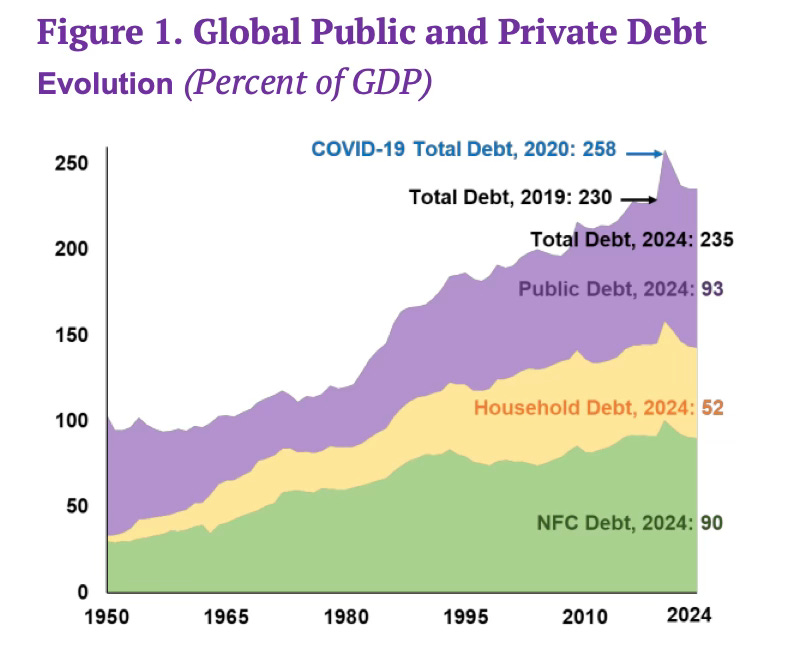
Just as in 2007-9 there is a bigger debt story too. Global levels of private and public debt far exceed that of private credit companies - and continue to exceed global income (GDP). That matters because debts are repaid out of income, and if the ratio of debt to income keeps rising, defaults, bankruptcies and crises are inevitable.
In September 2006 I published a book that warned of ‘The Coming First World Debt Crisis’. Then the ratio of global public and private debt was about 200% of global income.
In 2020 at the time of the COVID19 pandemic it peaked at 258% of global income.
Today it is at 235% of global income as the IMF reports:
To be clear, both public and private debt have risen significantly as shares of global GDP over the past five decades. Private debt grew from 80 to 143 percent of GDP, while public debt surged from 28 to 93 percent of GDP.
And then only last week, Torsten Slok of Apollo shared this chart of margin debt - the stock market borrowing that triggered the 1929 Stock Market Crash.
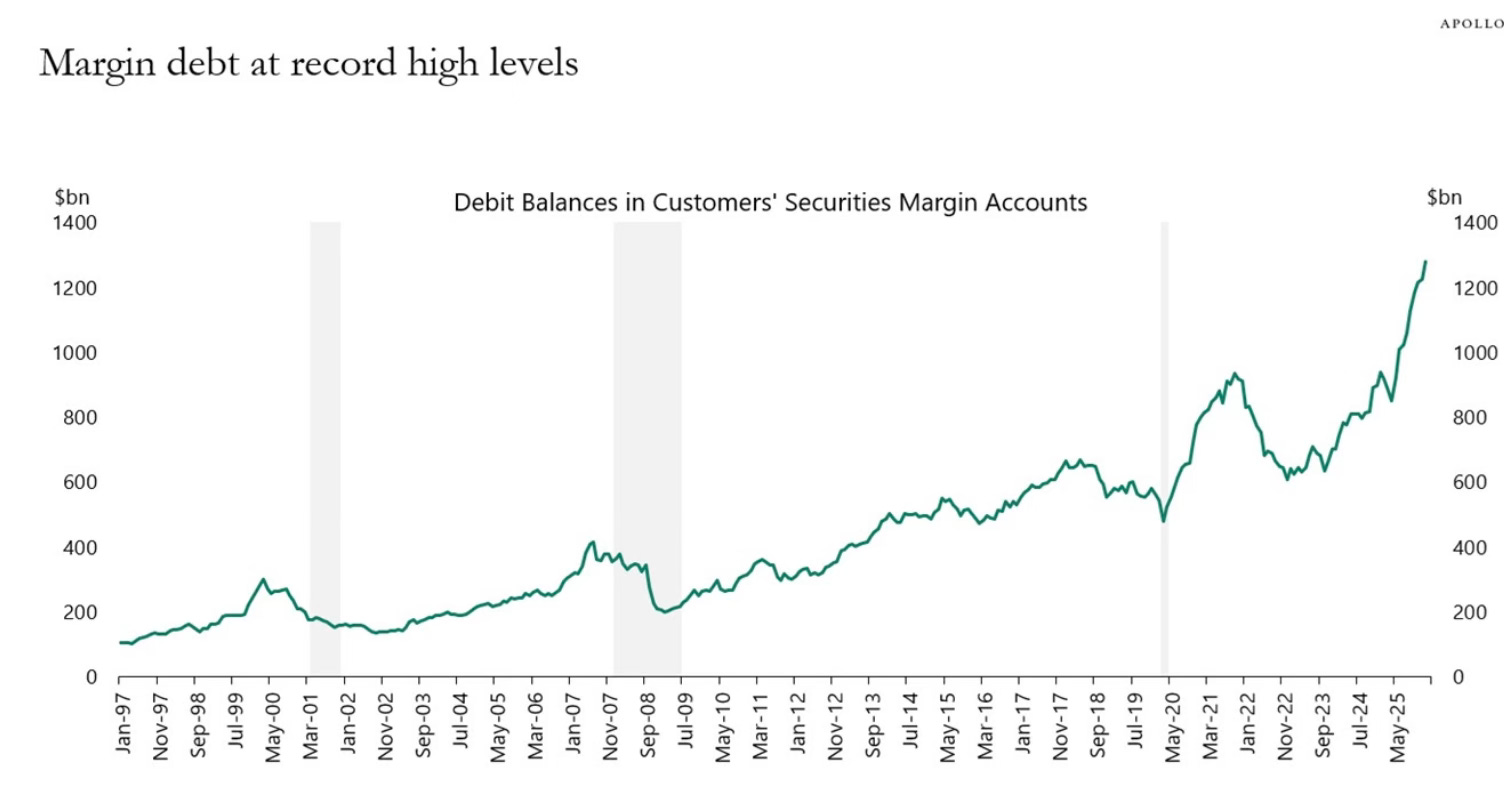
[Investopedia explainer: Margin debt refers to the money that an investor borrows. Using margin debt as a form of leverage can magnify gains but also exacerbate losses.]
Lowering rates is the right strategy
Higher rates increase the cost of public and private borrowing. In a global, complex and tightly connected financial system where stress can quickly spread across globally integrated markets, higher rates can trigger and amplify a crisis. That is why we must call a halt to this knee jerk reaction - and call for central bank monetary policy to be implemented as if democracy, international economic justice, and working people - matter.
(For more on why raising rates is the knee-jerk reaction of central bankers to any sign of rising wages or prices see my post Paul Volcker didn’t Save the Economy: He trashed it.)
Central banks should be supporting investors and consumers by keeping interest rates low as governments, entrepreneurs and consumers grapple with the consequences of Trump’s ‘war of choice’. Low rates could help boost confidence that things will get better. Second, with low rates governments could use fiscal policy to invest and spend and thereby increase the disposable incomes and profits of those suffering from the long-running ‘affordability crisis’.
It’s common sense. And yet not only do we have to endure Trump’s “Operation of Epic Fury’, a ‘war of choice’ - we are also expected to endure the ideological dogma that central banks are ‘independent’ and therefore cannot use low rates and macroeconomic policy to support democratically-mandated government investment and stimulus at this time of a catastrophic Middle East war, and global private sector weakness.
As I argued in my last post, this war will be transformative. And the global economy is ripe for transformation.
No posts
Comments
Nothing yet. Say the first thing.
Sign in to join the conversation.