

There’s a fake video circulating in which Trump supposedly asserts that, if the Epstein files are revealed and he “goes down”, he would take us all with him.
The story might be fake, but it does not end there. After catastrophic and humiliating military losses in the war on Iran, Trump is threatening not just to take Iran down, but to “blow up the global financial system” - as his Treasury Secretary Scott Bessent revealed in a Freudian slip last week.
Operation Economic Outcast, Bessent declared, is designed to ‘asphyxiate’ the Iranian economy and to hurt every country trading with Iran, including China.
This is dangerous talk at a time of grave instability in the globalised creditor-dominated financial system.
And the use of the term ‘asphyxiate’ when the world is experiencing wildfires on a horrific scale - signifies irresponsible, deluded ignorance and contempt for society’s life support system - the biosphere.
The Coming Global Crisis
I (and very many others) fully expect the global financial system to implode, soon and once again - given historically unprecedented levels of debt - on a devastating scale. If the increasingly indebted AI sector’s IPOs are
ill received, this could end violently (although after the rubbish that was SpaceX - the bar may be low). With maybe 100s of billions in financing to become worthless in short-order.
as Æðelwułf remarked on BlueSky.
The reason for the inevitable crash will lie, as it has done periodically since the first global financial crisis in 1873 - in ‘free markets’ in money that have avoided or ignored governmental intervention and regulation - and have created vertiginous volumes of unpayable debt - at high, real rates of interest.
Debts become unpayable when real (relative to inflation) interest rates are high, and income insufficient to repay at those high rates. In other words, rising rates of interest act like daggers aimed at today’s vast debt bubble.
Back in 2006 and 2007 it was the US Federal Reserve’s Alan Greenspan’s insistence on raising interest rates to dampen the subprime mortgage market bubble - that in the end burst that bubble. See the the systematic sharpening of the red line ‘dagger’ below.
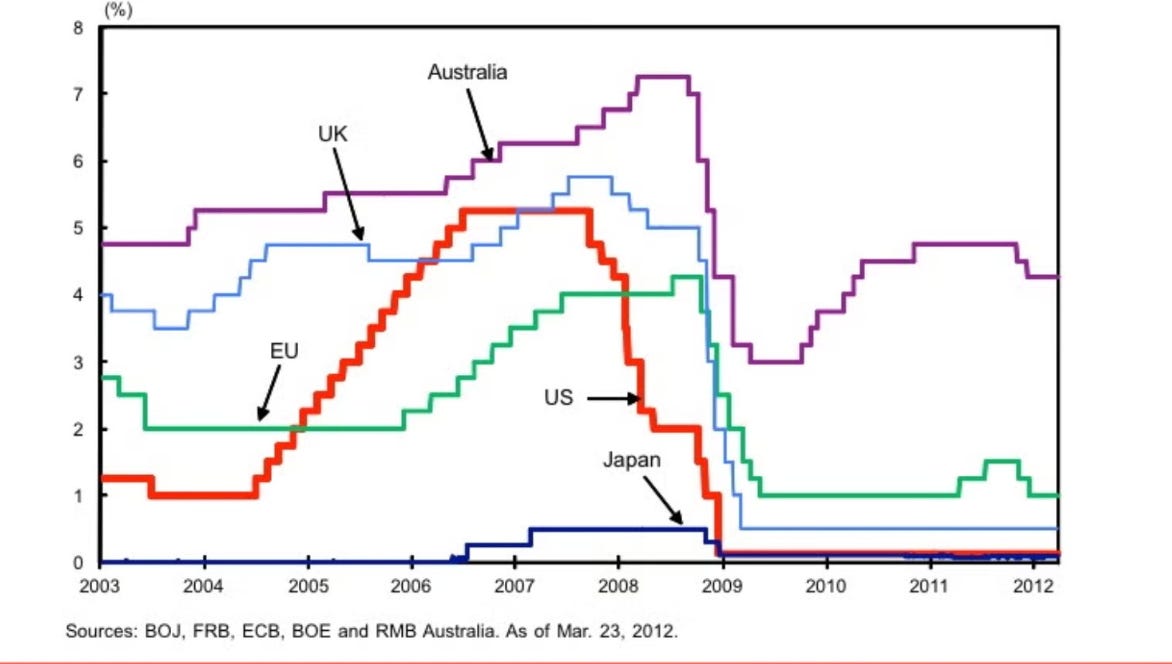
‘Easy money’ lent at high, real rates of interest have frequently, and predictably, led to major financial crises.
Donald Trump and the Fed’s interest rate
Donald Trump wants the Fed to lower the ‘bank rate’ (the Federal Funds Rate) - the rate to which all other lending rates are linked. Trump wants lower rates for good reason: he has always got rich on other peoples’ money and needs low rates to limit his debt liabilities. He is not alone. There are millions - perhaps tens of millions - of Americans living on credit card and mortgage debt. (US credit card debt hit a record high in the fourth quarter of 2025 at $1.277tn - a 63% increase since the first quarter of 2021.)
Plus, thanks to Trump’s tax cuts and other reckless policies, the US government’s debt has also risen. (Like the economist Dean Baker I do not think US public debt a major problem - a subject for another day.)
A far lower number of Americans are creditors. They include the rich, banks, private equity firms and other lenders. Creditors have the power to use loans to extract wealth from those without wealth. And that power is amplified as rates rise arithmetically, compounding the extraction of wealth by creditors from debtors.
Trump understands that, and in his clumsy and corrupt way, has set about trying to lower rates by hiring and firing members of the Fed board.
His is a hopeless cause. Not just because he’s doing it all wrong. But for this reason: thanks to the economic ideology that he shares with most mainstream economists and central bankers, the global economy has since the 1960s, been largely governed in the interests of creditors.
To uphold my case, consider this: all central banks claim low inflation as their primary mandate. Why? The partial truth is that inflation hurts consumers and people on fixed incomes.
But the real truth is that those hurt most by inflation are creditors.
Central bank anti-inflation mandates take priority over all other mandates - e.g. full employment and financial stability - and are in place because inflation erodes the value of debt owed to the world’s creditors - the 1%.
The majority- the 99% - are debtors and are of lesser concern to central bankers.
How inflation erodes the wealth of creditors
A loan of a £10,000 can fall, in real terms to £8,000 if inflation (prices and incomes and the value of money) rise relative to the loan.
Because the value of the outstanding loan stays the same, while prices, wages, and property values rise, inflation reduces the value of the loan, in real terms. So the value (cost) of mortgage loans taken out during the era of 1970s inflation (as I can testify from personal experience) was gradually eroded as incomes rose (thanks to strong trades unionism) and the price of properties rose, over the term period of the loan.
That inflation benefited debtors like myself, but hurt creditors.
Deflation (i.e. falling prices of goods, assets and incomes) can achieve the reverse result by increasing the value of that £10,000 loan to £12,000.
That is why creditors prefer deflationary (austerity) economic policies that lower incomes as well as prices and the value of money, and by those means increase the real value of their outstanding assets - loans (debt).
Central bankers, economists and creditors reacted strongly to the 1970s inflation and actively set out to change central bank mandates and implement higher rates of interest on loans - as a way of slashing inflation - and restoring wealth to creditors.
Since then deflationary policies for cutting spending and increasing interest rates have dominated economic policy discussions. These policies have been coupled with policies to make bank lending easier - by reducing regulation of such lending. Today powerful banking-style institutions lend unregulated money in the ‘shadow banking’ system - away from the oversight of regulators and decision-makers.
Despite regular, and utterly predictable crises of debt defaults brought on by ‘easy’ (deregulated) lending at high rates of interest, both central bankers and the economics profession remain loyal to the interests of creditors. They have, since the 1960s advocated austerity policies that lower prices and incomes, while protecting the value of debt and the wealth of creditors. For consumers deflationary policies may lead to lower prices in the shops and falling house prices - but they hurt the interests of both private and public debtors - and most consumers are also debtors.
Invariably these policies led to the kind of explosive borrowing of the current era, - borrowing that has inflated the value of assets like property - a form of inflation to which central bankers for long turned a blind eye. They have instead paid more attention to consumer price inflation (CPI) and used higher rates to dampen that inflation.
High levels of debt and rates of interest, have had a depressed impact on the economy. They reduce investment, productivity, employment and innovation. That economic weakness has in turn led to societal and political unrest, and ultimately to the rise of authoritarianism.
What has this got to do with Scott Bessent’s recent blundering in the bond markets?
I have to come clean and admit that because of my position on high rates, I last week posted an encouraging comment on BlueSky about Scott Bessent’s interventionist bond-buying debacle. I called on the UK Chancellor to note his intervention, and effectively endorsed the right of a Treasury Secretary to intervene in the US bond market to lower yields or interest rates. In other words, his right to undertake what are routine, regular actions to manage liquidity and cash - and bond yields. [His actions were not new. As Treasury Secretary, Janet Yellen, his predecessor, used these repurchases of older, less-liquid long-term bonds alongside short-term bill issuance to manage liquidity and federal debt maturity. Under Yellen,
Buybacks amounted to $32 billion in 2024 — a year in which the program was only live for seven months, according to figures from Guy LeBas, chief fixed-income strategist at Janney. That increased to about $78 billion in 2025.
So far in 2026, the Treasury has bought back about $50 billion…]
Bessent’s intervention turned out to be a case of embarassingly deliberate self-harm. Embarassing for me too. The consequence of his timid intervention was to undermine confidence in his ability to manage the nation’s finances, and to induce panic in a stock market that has for some time ignored economic reality while investors binged on AI stocks.
Worse, Bessent’s bond buy-back led to the reverse of his intention. US government bond yields (the interest, or return on a bond) rose instead of falling as he had apparently hoped.
‘Bossing’ the markets
Katie Martin, the FT’s bond market expert and all-round exemplary human, wrote a piece highlighting the Treasury Secretary’s incompetence and explaining why the intervention had not worked. She concluded thus:
The effort under way today to boss markets around and tell them they are wrong is not having the desired effect. Honestly, it never does. A course correction to shore up confidence is desperately needed.
Katie Martin was not alone. Paul Krugman piled in with: Scott Bessent fails to Gaslight the Market. The New Yorker bemoaned The Humbling of Scott Bessent’. The Wall St Journal scoffed at The Wild Week When Scott Bessent Was Schooled by the Bond Market.
Martin and others are right about the urgent need to restore confidence in a government ruled by a dodgy, at times deranged, mafioso-style president who spends other peoples’ money lavishly, and a Treasury Secretary operating well beyond his pay-grade. That much is given.
But I had questions.
Why are ‘markets’ empowered to do the reverse: boss governments around?
More precisely when did human civilisation reverse course and transfer power over society to remote, unaccountable and invisible money markets dominated by creditors? (Michael Hudson is the expert on that subject. Read this: on The Arc of Time: Pro-creditor history. )
The foundations of today’s system were laid by Adam Smith and David Hume in the late eighteenth century. They used the liberal idea imported from Spain and France to describe their favoured pre-political free market system. As Alexander Zeven has documented in his study of The Economist magazine, it was not until the 1850s “that ‘Liberal’ superseded ‘Radical’ as a political calling card in Britain.” And in contrast to European ideas of liberalism, the British version - ‘Pax Britannica’ - fused the political ideas of rule of law and civil liberties with the economic maxims of free trade and free markets. That is what made it so powerful in expanding British imperialism.
And it is ‘free’ trade and ‘free’ umanaged and unregulated markets in money that remain at the heart of periodic economic failures.
Not just economic failure, but also the failure to regulate and govern AI. As Geoff Mulgan explains in his post, there are parallels with the way in which many tech players maintain at all costs
the asymmetry between strong, wealthy, highly organised corporate power and weak and poorly organised public power.
The technique is now to present anyone arguing differently as a lover of bureaucracy, as anachronistic and ignorant about technology. They argue for self-regulation, as Hassabis recently did, though there are no examples where self-regulation has proven adequate for powerful technologies…
I am not an anachronistic lover of bureaucracy, but I do believe that an elected, democratic government has the right to intervene in private markets whose interests directly counter the interests of society as a whole, but also social and political stability.
History’s monsters and public power
No matter how evil and incompetent the monsters that have at times governed society, there is one thing they had in common with the good guys. They existed within frameworks of kinship, neighbourhood and creed, and within agreed social structures and standards. They were tangible, visible human beings - whose actions, abuses and failures could be resisted, witnessed and recorded.
Today, elected representatives are expected to submit to invisible, unaccountable financial markets (like the private credit market - a multi-trillion-dollar market of non-bank lending that has grown rapidly to an estimated $1.5 trillion to $3 trillion according to the Economist) .
Markets whose actions - or so it appears - cannot be resisted without incurring self-harm.
I write ‘appears’ - because of course markets can be resisted, moulded and subordinated to the interests of democratic governments. Throughout history markets have been subordinated to the interests of the communities and societies in which they operated. If Scott Bessent is in a spot of trouble, it is because, defying all our history, economists of the dogma to which he adheres have persuaded finance ministers that government must stand aloof and allow the ‘free market’ in money creation (credit), interest rates, goods and services to predominate and govern society and the economy.
It is precisely that approach that has caused his administration so much trouble, and that has so enraged the public - i.e. society.
It is that approach that is fuelling authoritarianism and the demand for a ‘strong man’ - or woman - to wrench the reins of power away from invisible, unaccountable markets - and restore these to - you guessed it - President Trump, President Putin, PM Modi, PM Meloni and - potentially - President Le Pen.
Only a cause external to them all could have led to the worldwide rise of authoritarianism.
The external cause of this era’s rise in authoritarianism is the insecurity generated by the globalised and self-regulating financial system and the US Dollar Standard – an economic system that mirrors the deflationary Gold Standard of the 1930s. A system well explained by Polanyi - that the ‘fount and matrix’ of the global system in the 1920s and 30s was and is today, the self-regulating market and markets in fictitious commodities: Labour, Land and Money.
I cannot write this too often: money, including the government’s money, is not a commodity. Money is a promise to pay. A social construct. Promises that have to be upheld by regulation and the law.
Money cannot be traded as a commodity in a de-regulated global market for commodities without causing instability, corruption and periodic catastrophic crises.
Government intervention in, and regulation of the market for money - in the interests of debtors - is therefore essential if society is to avoid periodic, and predicable crises.
Intervention that is not as delayed, piecemeal, incompetent and inept as Scott Bessent’s recent panicky buy-back.
Interventions that require the public authorities to once again “boss” markets.
No posts
Comments
Nothing yet. Say the first thing.
Sign in to join the conversation.