
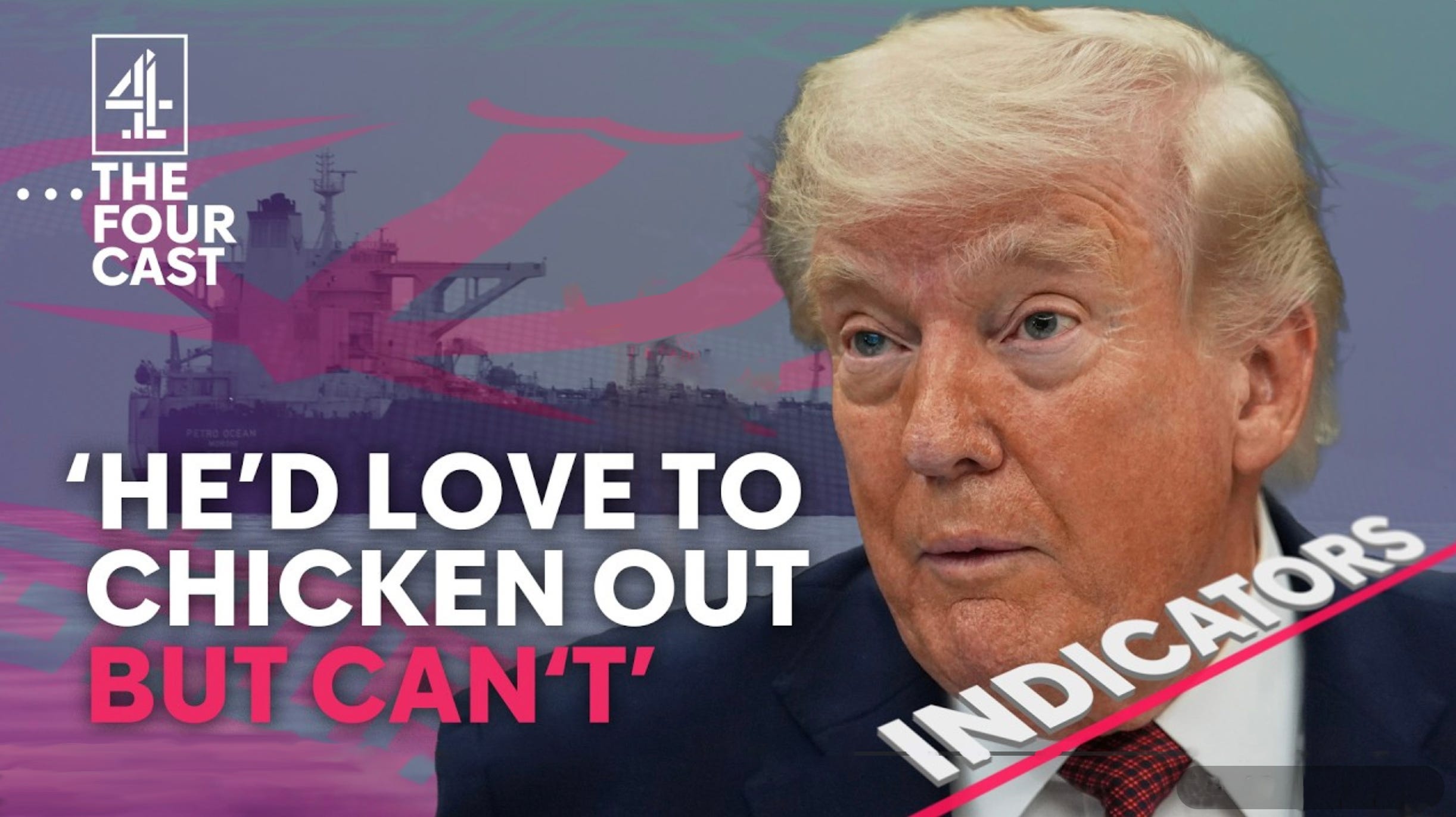
TACO - Trump Always Chickens Out - has worked for a while. But it cannot work in this illegal war on Iran without the president of the United States admitting defeat. And so he is not (at the time of writing) chickening out.
I talked about this on Channel Four’s FOURCAST with the broadcaster Krishnan Guru-Murthy and Mark Urban, British journalist and historian. To listen to our discussion here’s the link.
Prepare for a Slump
Readers have asked what I meant by the headline phrase in the last post: ‘Prepare for a Slump’. In this post I try to explain.
The world’s key commodity supply lines for vital manufacturing sites in Asia, and for agricultural markets across the world, have been held up in the Gulf for eight long weeks - since the start of the US’s and Israel’s illegal war on Iran.
While those commodities, essential to the global economy, have been stuck in the Gulf, they have registered as a profound, if invisible economic shock after just six weeks. That is the time tankers should have taken to arrive at their destinations to be docked and their cargo delivered. Only then could inventories hauled across the oceans by the vessel be drawn down by importers, and the containers’ commodities/ inputs used to drive economic activity - production and outputs.
Not only have those deliveries and that production not occurred, but cargo stored on docksides to be uploaded on to the vessels for their return journeys - remain stranded in docks across Asia. Backlogs build up as stock arrives at ports from across the region expecting to be uploaded on to returning vessels and delivered across the world, but is instead stalled.
Those are the silent and invisible shocks cascading through global markets. As Alan Day notes, the visible shock is happening at sea. The more damaging shock, but less visible is moving through the globalised economic system, and clogging up economic activity thousands of miles away from the Strait of Hormuz. That shock is already triggering shortages and with it inflation, but also lost production. Lost production leads to losses, including job losses and bankruptcies. Inflation crushes demand for goods and services, accelerating the rise in losses. If inflation is compounded by the hawkish monetary policies of central bankers (higher rates of interest and more quantitative tightening) then a global slump is an inevitable consequence.
Compared with normal levels, 90% of tankers carrying some of the most important of the world’s inputs into the economy have failed to transit since the start of the war on 28 February, 2026. These tankers are carrying key commodities including: energy (as a result of the war around 13 million barrels per day of oil production and 2.7 million barrels per day of refining capacity - mainly aimed at Asian markets) remain offline. Cumulative supply losses have already exceeded 550 million barrels).
More than one-quarter of global seaborne oil trade moved through the Strait of Hormuz. Around one-fifth of global oil and petroleum product consumption depended on it. And 84% of the crude and condensate moving through the strait went to Asian markets, with China, India, Japan and South Korea the most exposed.
Diesel fuel underpins trucks, locomotives, agricultural equipment, industrial machinery, heating and generators in many parts of Africa and Asia. In the West Jet fuel matters just as much. Aviation fuel is one of the largest airline operating costs and reliable supplies are essential.
But oil and gas are not the only commodities vital to the global economy currently stalled in the Gulf. Others include: fertilizers (urea and ammonia) vital to modern agriculture; sulfur (the feedstock for sulfuric acid, a chemical required in battery chemistry and used in phosphate fertilizers, vital for soil fertility); methanol vital for resins, coatings and plastics; graphite feedstocks used in electric vehicle (EV) battery anodes; aluminium used in construction, transport and renewable energy; and helium that plays a critical role in semiconductor manufacturing.
The world’s agricultural sectors are tightly integrated with the fossil fuel sector as my friend Vandana Shiva has long argued, including in her book The Violence of the Green Revolution - and has inflicted enormous ecological and social costs on agricultural sectors in India and Africa. One of its less discussed consequences is the link it established between food production and the fossil fuel industry across every stage of farming.
As a consequence the illegal war on Iran has meant that the shock of shortages of the commodities outlined above have already cascaded through supply chains that carry food from the world’s farmers to supermarket shelves. As prices of these commodities surge, disruption threatens both sustainable transport and large-scale commercial farming. And those in turn threaten hunger and famine. As Adam Hanieh wrote in the FT, after only seven weeks, food shortages and even famine are now looking more likely for millions of people across vulnerable countries in Africa and Asia.
The World Food Programme has estimated that an additional 45million individuals will be pushed into acute hunger as a result of the war, with about two-thirds of these people located in Africa.
Bear in mind too, that to compound that threat, African countries are facing yet another sovereign debt crisis, with little hope of the crisis being resolved as the stronger dollar increases the cost of debt servicing.
The price of globalisation
Thanks to the ideology of ‘globalisation’ many western economies have outsourced the bulk of manufacturing (and the consequent greenhouse gases) to markets in Asia - notably China, Vietnam and Korea. Bear in mind also, that neoliberal economists have over decades assured decision-makers that buffer stocks of key commodities were unnecessary. That the world could function well on the basis of ‘just-in-time’ manufacturing and transportation.
To restore stability, the war has to end, immediately. Only then can shipping networks be rebalanced as vessels are repositioned and restored to their rightful place in the order of things. Insurance has to be repriced. Ports have to sort out the congestion built up for the duration of the war. Recovery will be slow.
If the war drags on the global economic slump will deepen.
On the 16th March, weeks after the war had started, a reporter asked Trump if Iran was obliterated as he said it was, and whether the war would be wrapped up in a week? Trump responded “Yeah. sure. We could.”
“Will we?” the reporter asked.
Trump replied: “I don’t think so, but it’ll be soon, won’t be long. And we’re going to have a much safer world when it’s wrapped up, it’ll be wrapped up soon.”
No posts
Comments
Nothing yet. Say the first thing.
Sign in to join the conversation.