

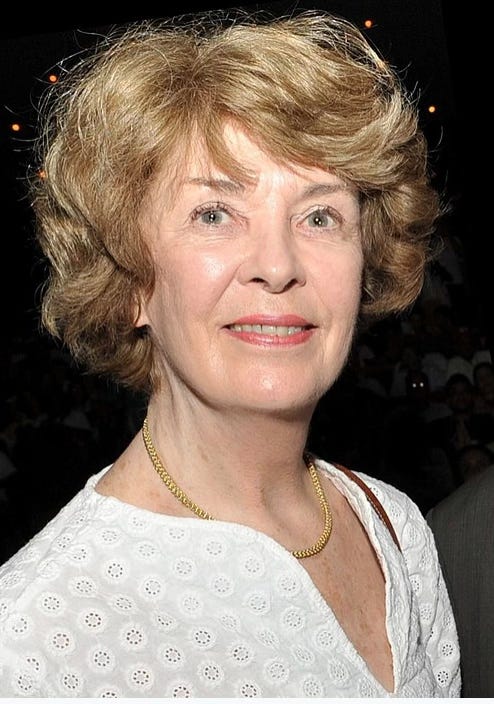
First, I want to dedicate this post to a beloved mentor and beautiful friend, Susan George, who has died at the age of 91. She was the author of two books, A Fate Worse than Debt (1988) and The Debt Boomerang, (1992) which had a profound influence on my career, and on my intellectual journey through the world of globalised finance: in particular the unjust world of sovereign debt. She was also a major force behind the launch of a global campaign, Jubilee 2000, to cancel the debts of the poorest countries. Susan was American-born, but lived most of her life in France, where she wrote extensively about social justice, under-development and debt. She was a vivacious woman, with a ferociously sharp mind and a deep appreciation of the rich cultural life of her adopted home. I owe her, and her work, a great deal and am immensely saddened at her passing.
The tragi-comic tale of a billionaire gambler in The Global Casino
There is an instructive story in the Financial Times today that I want to share with you. It so clearly illustrates the degree of speculation, gambling, fraud and corruption at the heart of The Global Casino - and the urgent need for re-regulation of the system to begin to rebuild trust and with it the proper functioning of the international financial system.
It’s the story of Ricardo Salinas Pliego, a potential Mexican presidential candidate, and the billionaire owner of the conglomerate Grupo Elektra. He has been in business for 45 years and has 200,000 employees. According to the FT he is
One of Mexico’s wealthiest and most combative tycoons, (and) is known in the country as “Tio Richi”, or “Uncle Richi”.
Those who have read my new book will know that there are several pages in Chapter Three devoted to the important role that assets, and importantly, the sound valuation of assets play in the elaborate process of borrowing, leveraging, gaming and betting. Games central to the roulette tables of the International Financial and Monetary system (IFMS). In that chapter I explain something well understood, namely that
Assets are valuable as collateral for leveraging additional finance. Creditors will only lend if they can take possession of a borrower’s asset or collateral in order to receive full or even partial payment in case of the borrower’s default.
Ricardo Salinas Pliego was in possession of an immensely valuable asset: the Mexican banking-to-retailing conglomerate Grupo Elektra - founded by his father.
Back in 2021 Pliego wanted to bet $400 million on Crypto, but did not have sufficient cash in hand to do so. He proposed to use his ownership of shares in the asset that is Grupo Elektra as collateral against the borrowing of $400 million for the gamble. That practice is not unusual. According to the FT’s Paul Caruana Galizia :
The outstanding stock of so-called Lombard lending, which allows individuals to leverage their assets for loans, stands at an estimated $4.3tn according to Deloitte, and has recently grown faster than the broader credit market thanks to rising stock values.
What followed is what Galizia calls
a case study of what can go wrong in a booming yet lightly policed corner of finance.
Pliego’s advisers steered him towards a lender - Astor Asset Management 3, a Canadian-registered special-purpose lending vehicle. Astor Asset Management was owned by one Thomas Astor-Mellon - both names associated with wealth. Astor, Salinas was told, was a name associated with the family that owned the famed Astoria hotels, in fact owned by New York-listed Hilton. And Andrew Mellon was the rich and powerful banker-owner of a vast business empire, who served as US Treasury Secretary under President Hoover, and presided over the 1929 Wall Street crash.
Both names were fakes. Pliego’s team later found that “Thomas Astor-Mellon” was
Alexei Skachkov, a man of Russian origin who lived in Atlanta, Georgia, and had convictions for forging prescriptions and stealing jewellery.
The unregistered and unregulated lenders behind Asset Management were big time crooks. They accepted Pliego’s shares as collateral, and promised to hold that collateral in a safe, protected place. The collateral (i.e. the shares) was worth four times the value of the loan - and the corrupt lenders were given ‘power of attorney’ over the collateral.
Then came the bung. The lenders began illegally selling the collateral. They raised about $420mn from their sales of Pliego’s precious Elektra shares. They then withdrew $104 million of that bonanza and forwarded it as a loan - to the billionaire Pliego.
“It was the perfect fraud,” Pliego says. “The guy took my stock, sold it, and gave me the money as a loan — Jesus, that’s as bad as it gets.”
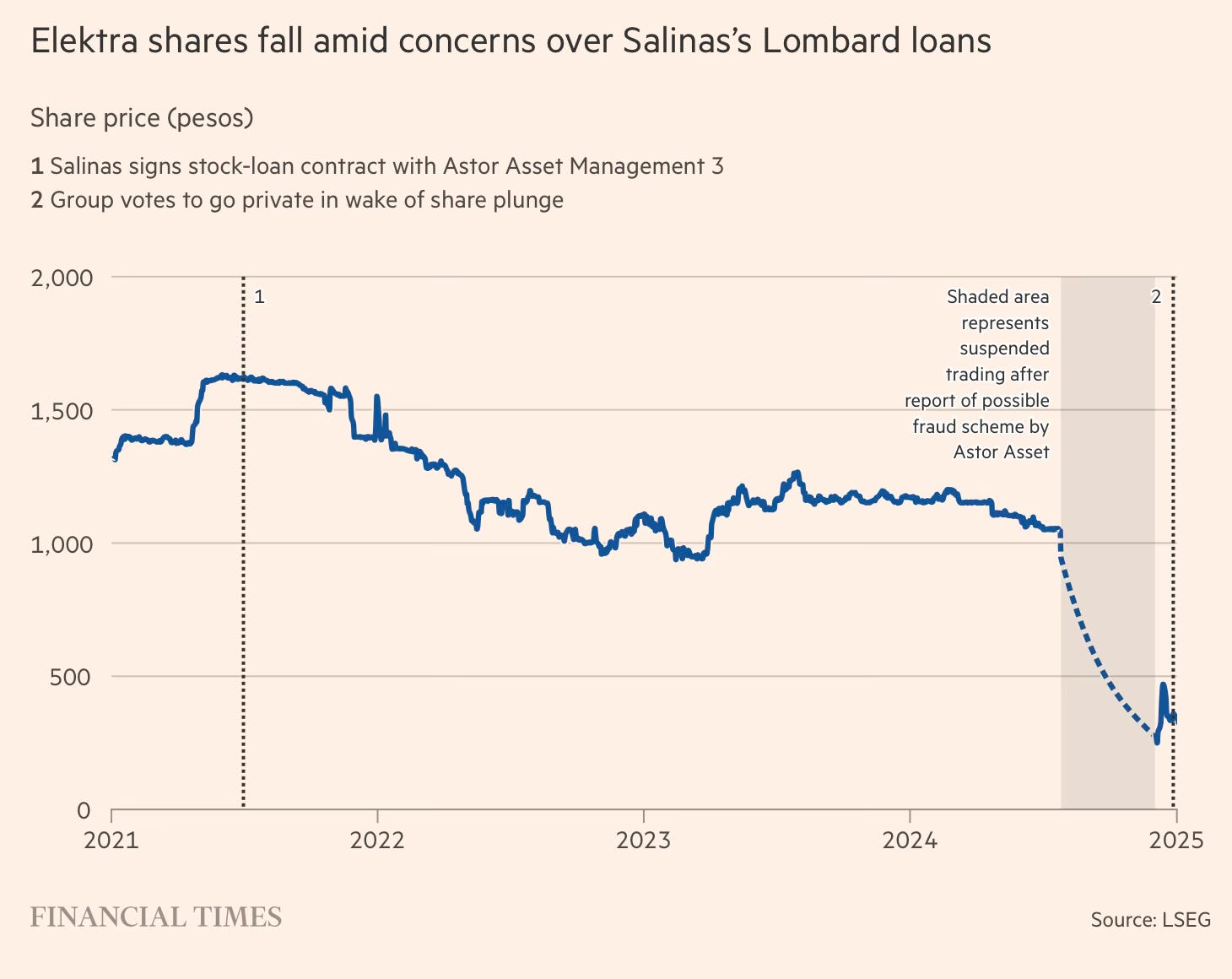
The tragedy of the story is this: Pliego was not the only victim. Distant ‘others’ - small time shareholders in his powerful company lost too, as is shown by the collapse of share prices in this chart: section 1 shows the value of the shares at the start of the stock-loan contract - and their decline as shares are dumped on the market by the crooked lenders.
There is another lesson from this tragi-comedic farce: namely the power of lenders to “rehypothecate” pledged collateral - standard practice even in the regulated banking system, as the FT explains - and one of the causes of the 2007-9 Great Financial Crisis.
Re-hypothecation is the right of lenders to use a borrower’s pledged collateral as one’s own asset - and to use that asset to leverage additional finance.
In other words, one asset is used to leverage additional borrowing twice over; first by the borrower, and second by the lender holding the asset as collateral. That is like pledging your property/home as collateral against a new mortgage or loan from the bank…and the bank then using your property (collateral) to line their own pockets by borrowing more for their own use.
The practice, prevalent before the 2008 financial crisis, is still in use in the U.S., where broker-dealers can only rehypothecate up to 140% of a client’s loan, the FT explains.
Conclusion
We could shrug our shoulders at this story and repeat as I often do: ‘its a bad old world’. After all, the loser of this story was primarily a billionaire Mexican wheeler dealer.
Who cares?
We should care because Salinas Pliego’s supporters want him to stand for president in 2030, the Financial Times tells us.
The government of President Claudia Sheinbaum portrays him as a right-wing agitator and has pursued his family conglomerate Grupo Salinas for underpaying tax, (reaching a settlement earlier this month).
Sklarov (the crooked lender) says that Salinas’s dispute with the government demonstrates his refusal to play by the rules and his capacity for deception.
“God help Mexico if he gets elected,” he adds.
We should believe that man. After all it takes one to know one.
Thanks to my readers I am not on any organisation’s payroll. This gives me the power of independent thought. Please consider the modest and voluntary subscription fee.
Comments
Nothing yet. Say the first thing.
Sign in to join the conversation.