
Hi friends. Guess what? I was on a podcast! It’s on video too. Please forgive all the “ums” and “likes.” I am not a professional speaker, and every time I said “That’s a great question…" it was translation for “Holy #@%! I did not prepare for that question, so give me ten seconds to manufacture a coherent answer.”
Writing is definitely my prefered medium!
In this podcast, I talked about my research article "Observed versus predicted vaginal birth after cesarean for patients of a community health center.” If you don’t have 31 minutes and 40 seconds to devote to this topic, here’s the TL;DListen version of this conversation.
When I first started as a midwife, I noticed that many of the doctors I worked with relied on a VBAC probability calculator to estimate a mom’s chances of having a vaginal birth after a previous cesarean. If a mom was Black or Latina, the calculator automatically predicted a lower chance of VBAC than it would for an otherwise identical White patient—with the same age, weight, and obstetric history.
It wasn’t exactly based on bad math. It looked out the outcomes of 7,660 people who attempted a trial of labor after cesarean (TOLAC) between 1999 and 2002. But it only looked at patient characteristics. It didn't account for factors like the C-section rate of the hospital, or whether someone gave birth with a doctor or midwife, or RACISM—things that can ALSO have an impact on whether a VBAC actually happens.
It looked like this:
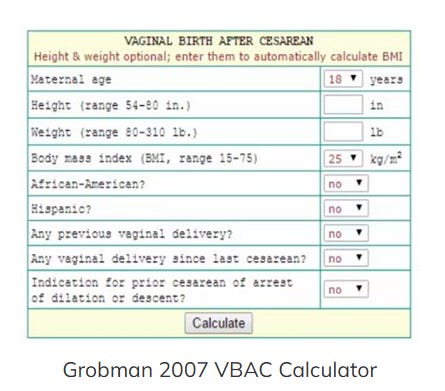
I never liked the calculator because I watched it systematically dock my Latina patients before they'd even gone into labor. More than once, I found myself advocating for someone who wanted a VBAC while an obstetrician colleague pointed to the calculator as evidence that she wasn't a good candidate to even try.
Then, in 2020, I got one of the most satisfying forms of validation a clinician can experience: an article (Hidden in Plain Sight—Reconsidering the Use of Race Correction in Clinical Algorithms) came out in the New England Journal of Medicine challenging race-based medicine, and the VBAC probability calculator was on the list of concerning algorithms that might contribute to racial discrimination. I felt vindicated!
The developers responded by acknowledging the potentially problematic nature of such an algorithm, and redid the calculator by removing the race variable and adding a “history of chronic hypertension” variable instead. Today, that’s the version you’ll find online, and based on my experience, it is widely used and rarely questioned. I understand the appeal. People love the idea that you can just plug some numbers into an algorithm and get a good sense of the likely outcome. Heck, I wish it were possible too! I could save my pregnant patients a lot of trouble if I just knew which ones were gonna end up with a C-section anyway.
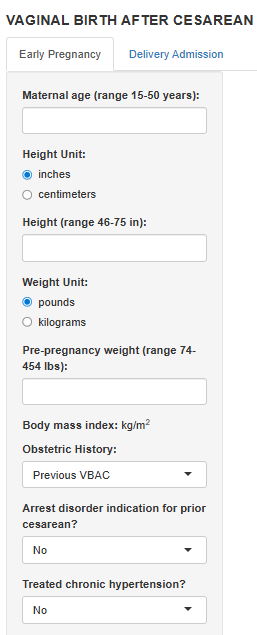
And...racism solved, right?
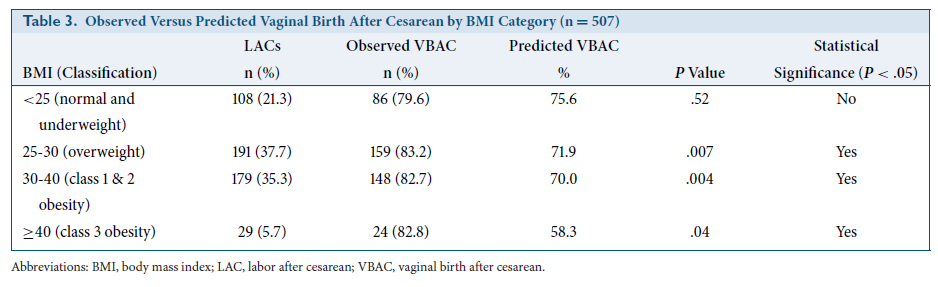
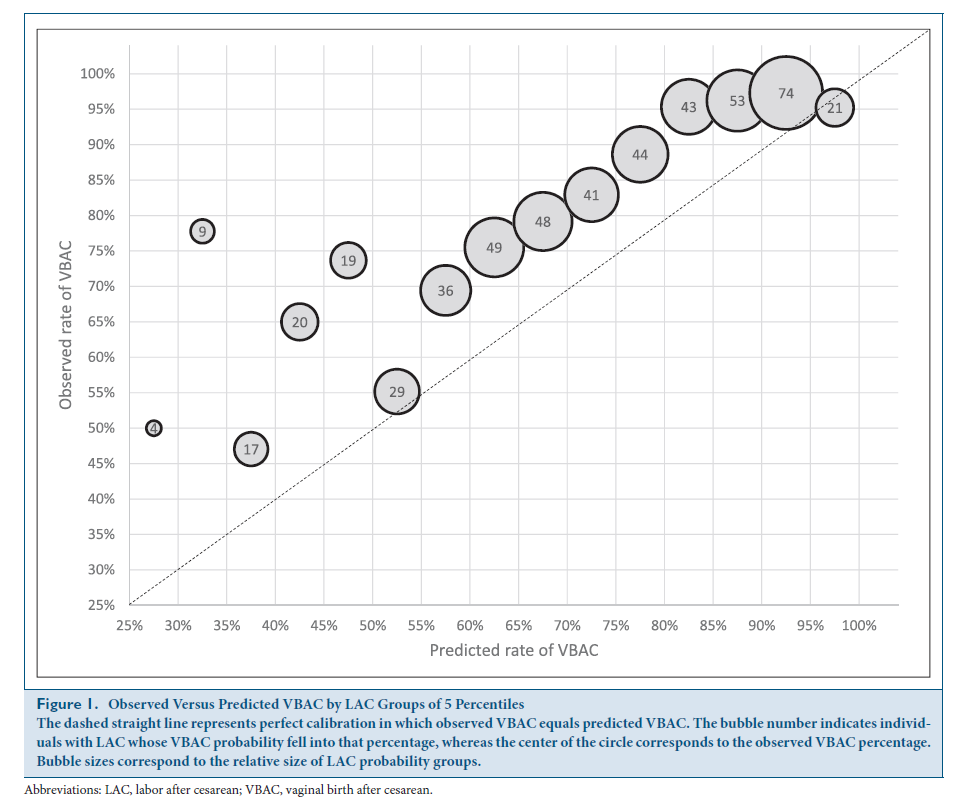
Personally, I wasn’t so sure. And by that point, I realized I had access to exactly the kind of patient population that could put the revised calculator to the test. If you want all the details, you’ll have to read the paper. But here’s the gist of it: in a community health center where nearly 90% of patients attempting a trial of labor after cesarean were Hispanic, the updated calculator underestimated VBAC success for two groups in particular—people with no prior vaginal birth and people with an “overweight” or “obese” BMI.
In fact, the only BMI category where our patients didn’t outperform the calculator’s predictions was the “normal weight” category.
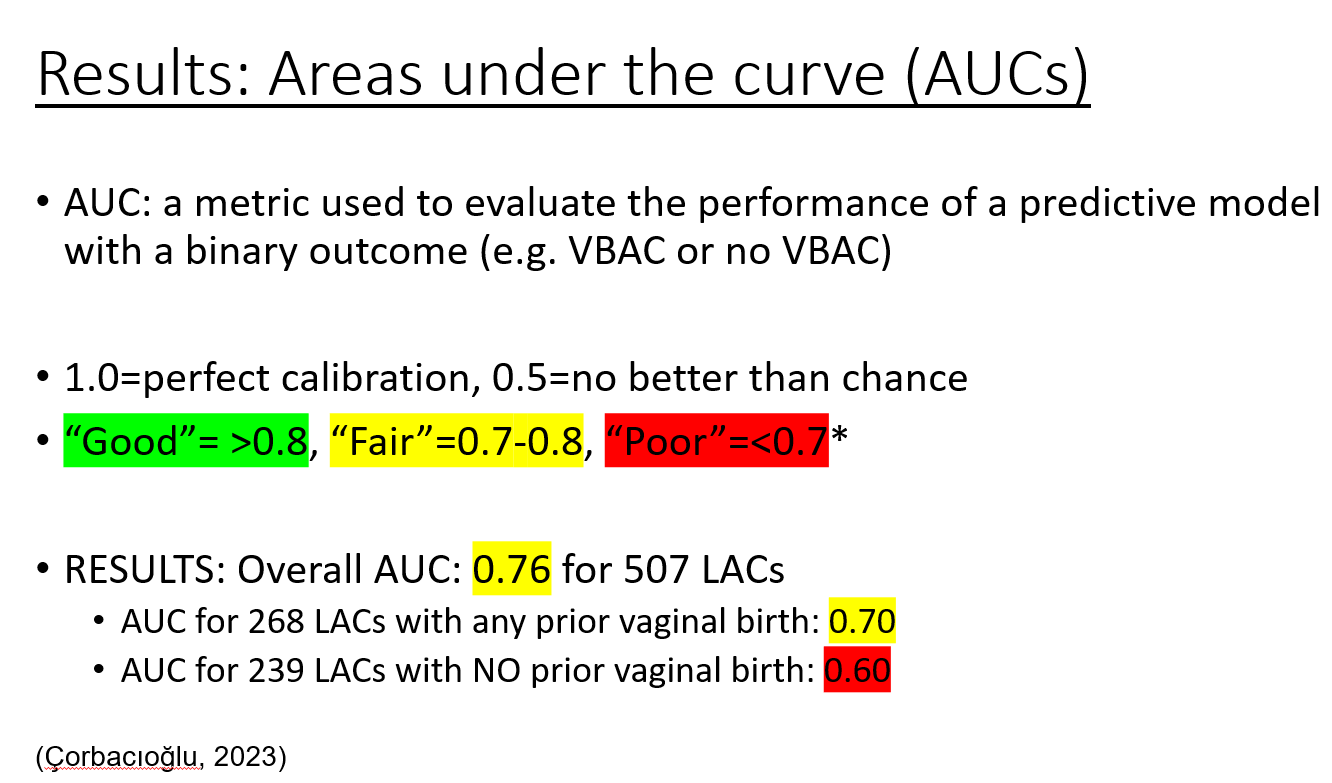
When it came to prior C-section moms with no history of a prior vaginal birth, our AUC was 0.6, meaning that the algorithm performed only slightly better than a coin flip at predicting VBAC for these moms.1
That raises an uncomfortable question: if removing race didn’t fix the problem, what was the calculator still failing to capture in our population? Glad you asked. We talked about this a little in the interview. My suspicion is that one of the biggest missing pieces is the role of hospitals and providers themselves. Firstly, these moms overwhelmingly had midwifery care. Second, they were giving birth in a hospital with a pretty low C-section rate overall.
The calculator focuses almost entirely on patient characteristics—age, BMI, prior birth history, and other clinical factors. But a VBAC doesn’t happen in a vacuum. It happens in a place with a specific culture, specific resources, specific staffing patterns, and specific people present, all of whom have their own approaches to risk.
I’m incredibly grateful that our clinic and hospital were able to offer VBAC to our patients. As I’ve mentioned before, this is far from guaranteed. Many hospitals in the U.S. do not offer VBAC at all, as I complained about in the note below.2
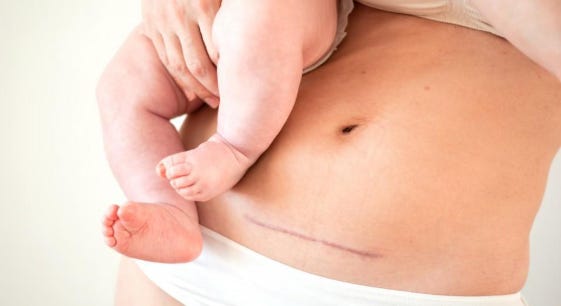
This has serious consequences for moms, particularly those who want larger families. Because our study period spanned eleven years, some patients in our sample had multiple trials of labor after cesarean. In those cases, supporting VBAC didn’t just mean avoiding one cesarean—it potentially meant avoiding several.
If we had discouraged patients with lower predicted VBAC probabilities (<70%) from attempting labor, our overall VBAC rate would have dropped from 82.2% to 39.4%. Several patients would likely have gone on to have multiple cesareans instead of multiple VBACs—a very high risk scenario—or potentially just wouldn’t have chosen to have those babies. I don’t want to beat a dead horse, but C-section overuse is suppressing the birth rate, and access to VBAC affects family size! If you want people to be able to have the number of kids they want, you should care about this issue.
I would love to see us move beyond the idea that cesarean rates are primarily a reflection of patient risk. At this point, the variation in cesarean rates across American hospitals cannot be explained by differences in the patients walking through the doors. What we are seeing is the effect of different medical cultures: each hospital developing its own norms around intervention, risk tolerance, and what constitutes a “safe” birth—and women being forced to deal with the consequences of those hospital policies.
So anyway, that’s my research in a nutshell. If you’re interested in this topic, I hope you take a listen to the podcast. And for the nerds among us, below is my favorite graph from the manuscript!
Questions, comments, experiences with VBAC? ✌️A.L. And as always…
If you’re like me and don’t really speak stats, this explanation from a powerpoint presentation I did on my research may be helpful:
No posts
Comments
Nothing yet. Say the first thing.
Sign in to join the conversation.