
The other day during a clinic visit, I told a woman that I noticed she was overdue for her pap smear, and asked if she might like me to do it.
She sighed and said, “Well, I guess I have no choice.”
I shook my head and responded emphatically, “You absolutely have a choice!”
She looked surprised, so I went on.
“Well, if you’re not ready today, we can schedule you to come back another day. And obviously, I’m not going to do a pelvic exam without your consent. So if the idea of getting a pap smear frightens you, you can choose to never do it.”1
She stared at me with a confused, blank expression, as if to say “What’s the catch?”
“I wouldn’t recommend that,” I continued, “Because pap smears are a pretty simple, preventative thing you can do to avoid cervical cancer, which used to kill a lot of women. Most likely, the result will be normal, and then you don’t have to worry about it for 5 years, when the next pap would be recommended. And if the result is abnormal, well, that will be annoying, but follow up and treatment can basically reduce your chance of dying of cervical cancer to zero.”
She nodded, admitting that sounded like a pretty good deal. She consented to the pap smear, but before she hopped up on the exam table, she laughed nervously and said something that I’ve grown accustomed to hearing over my 20 year career in women’s health:
“It’s so hard to be a woman, isn’t it? Men are so lucky! They don’t have to deal with any of this stuff.”
An Argument Against Biological Self-Pity
This essay is a response to that statement—and to a lifetime of feeling expected to laugh along with a joke I don’t find funny (or true).
As observed by the woman in my opening story, female biology is indeed more involved than male biology, and it makes demands of us. I don’t want women to feel guilty for acknowledging this. But there is a difference between acknowledging a burden and building an identity around it, and in my opinion, our cultural interpretation of female biology as inherently disadvantageous has overplayed its hand. And this has consequences.
As a midwife, I hear talk of women’s biological disadvantage shared often while attending births. A sympathetic father will remark “Gosh, it’s so hard what women go through,” or a mother-in-law will joke, “If men had to give birth, there would be no children!” And they’re not wrong about one thing: childbirth is an incredibly exhausting, painful (though this can be mitigated)2, carnal experience. So, if we’re comparing reproductive effort—yes, men’s role is undeniably easier, as illustrated by comedian Jim Gaffigan in the clip below:
As someone who has spent years caring for women throughout the life cycle, I’ve come to believe that the stories we tell about our bodies matter a lot. If women are constantly told that their bodies are weaker, more troublesome, more vulnerable, and biologically disadvantaged, they start to inhabit that story. Women stop asking what their bodies are capable of and start assuming they need to be rescued from themselves, which can lead to worse physical and psychological health.
And when we repeatedly describe female biology as a collection of inconveniences and liabilities, we shouldn’t be surprised when women come to see their own bodies as obstacles rather than assets.
This is a perspective I expressed in a recent Substack notes exchange with Lane Scott. I reached out to her before resharing this note, because while I can tell we have pretty different world views, I respect her writing and didn’t want it to be seen as some kind of personal take down. Her response was to say that she welcomes disagreement, and that arguing the other side of this issue could be very fruitful. So here goes!
How Disadvantageous Is It To Be Female?
My argument is simply that culture has a habit of viewing female biology almost exclusively through the lens of its costs, while rarely noticing its benefits. Many people interpret male biology as the default model of perfection and strength. We notice that men are generally taller, stronger, and faster, but spend much less time considering the advantages that come with female biology: greater flexibility3, greater precision in fine motor tasks, and a smaller physical frame that can be an advantage as often as it is a limitation, as any six-foot-tall man folded into an airplane seat in the back of the plane can attest.
Pregnancy, birth and breastfeeding are huge biological investments—yes. But they are paired with corresponding forms of influence, certainty, and control over the end reproductive outcome that men just don’t have.4 Yet we are primed to pay attention to the visible burdens of female biology while ignoring the evolutionary strengths that make it a very successful survival strategy, such as lower caloric needs, and better ability to survive disease or famine.
We also tend to focus on these “burdens” of female biology without considering the larger systems they belong to. Menstruation is often discussed in isolation, only as an inconvenience, rather than as part of a cycle that is not universally negative. Many women notice a very pleasant increase in energy, mood, confidence, and libido particularly around ovulation5 but this is barely talked about in comparison to the focus on the discomforts of menstruation. Also, because it has become so culturally normal to suppress cycling with hormonal contraception, many women don’t regularly experience these benefits. I discussed this rarely considered downside to birth control in a recent post:
What I Think About Birth Control
·
Mar 12

The topic of birth control inspires a lot of strong opinions. Today I’m going to surprise no one by taking a moderate stance: I will argue that birth control is neither the holy grail of women’s rights and freedom, nor the frivolous, selfish choice of sexually licentious women trying to cut themselves off from their embodied, natural fertility.
While scientists continue to debate exactly why menstruation evolved, it is increasingly understood as part of a complex reproductive strategy rather than a biological flaw.6 One leading idea is that cycling allows women to invest heavily in pregnancies that are likely to succeed rather than carrying every conception forward indiscriminately, allowing for healthier offspring.
Similarly, menopause, which gives older women a reprieve from reproduction that most other mammals don’t experience, may allow them to increase their impact through investments in existing children, grandchildren, and broader social networks rather than additional pregnancies—a perspective that contrasts sharply with the common depiction of menopause as little more than a period of decline, with menopausal women melting into obscurity and uselessness once their reproductive potential has ended.
Moving Away From A Biological “Battle Of The Sexes”
Male biology is remarkable in its own right, so I am in no way arguing that men’s bodies are worse. Nor do I want to make a “girl power” argument that ignores the way women’s biological experiences can be difficult. But I’m skeptical when people imply that biology empowered men while shortchanging women. Men and women are not rival species competing for evolutionary advantage; we are one species, and our success has always depended on one another.
Every woman carries half of her father’s genes, and every man carries half of his mother’s. The genes that influence a woman’s breast size or ability to lactate are inherited from her father as well as her mother. Likewise, many of the genes that contribute to a man’s strength and athletic ability came from his mother. So while evolution certainly produces areas of conflict between male and female interests, it would be surprising if it consistently favored traits that optimized one sex while systematically undermining the long-term reproductive success of the other.
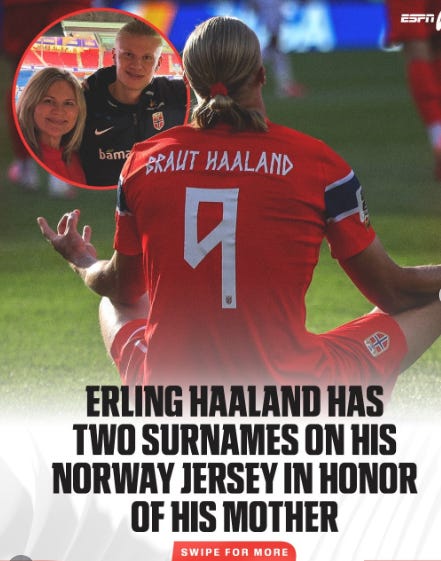
I am not going to argue that the costs of female biology are imaginary, or that biology has always served women equally well in every cultural context. As I discussed in the essay below about the difficulty of childbirth for some humans, a trait can be evolutionarily successful and still come with real physical and social burdens, and serious risks.
I would also point out that we tend to emphasize the benefits of male biology while paying much less attention to the costs. Men die younger, suffer more injuries, have higher rates of infant mortality, require more calories to maintain their larger bodies and greater muscle mass, and high testosterone levels come with immunological as well as behavioral trade-offs.
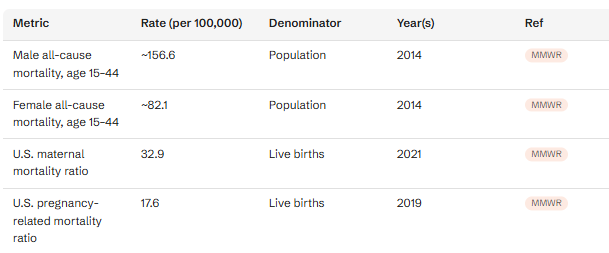
For example, men were more likely to die of Covid and are more likely than women to be murdered or commit suicide. In fact, despite the justified attention paid to high maternal mortality in the U.S., men aged 15-44 (the range that is often used for childbearing women) actually die at higher rates than same-age women do, even when pregnancy and the postpartum period are included in the comparison.7 If female biology were truly the evolutionary short straw, that would be a surprising outcome.
This does not take away the truth that, in many ways, our culture has been designed in a way that disadvantages women’s bodies and considers their reproductive systems a liability. I have been reading Leah Libresco Sargeant’s book The Dignity of Dependence and in the early chapters she lists a litany of ways in which the female body is poorly fitted for a material culture designed around men’s bodies. She offers several compelling examples, including pharmaceuticals that have been developed and tested predominantly on men, and crash test dummies modeled on male physiques, resulting in cars that make women 17% more likely to die and 73% more likely to be injured in a crash. Even kitchen countertops, which are presumably used more by women than men, are optimized for the height of a typical man.
But many of the disadvantages women face are not consequences of female biology itself, but of living in a material world built around male bodies as the default. And yet, even within that world, women consistently exhibit remarkable biological resilience. For example, even though a woman is more likely than a man to die in the same car crash, mile for mile, men are 63% more likely to die in this way than women, probably due to differences in substance-use and risk-taking behavior.
Across history, across cultures, and at nearly every stage of life, women have higher survival odds than men. So if we judge biology by one of evolution’s most fundamental metrics—the ability to survive long enough to reproduce and help the next generation survive—it becomes difficult to maintain the assumption that female biology is inferior.
Women—The Consummate Survivors of History
If you look at a list of the richest people on the planet, they are nearly all men. If you look at a list of the 50 oldest people on the planet, they are nearly all women. So if female biology is fundamentally disadvantageous, it’s striking that women are so much more likely than men to reach exceptionally old age.
It is also hard not to notice the irony that some of the richest men in the world have become obsessed with longevity, spending extraordinary sums in pursuit of a few extra years of life, while countless women continue to have a biological advantage while just living ordinary lives.
Personally, I think living five years longer on average8 is a pretty nice perk of being female. But beyond making reasonable lifestyle choices, how long any of us lives is not really under our control, so it's not something I spend much time dwelling on. And I certainly don't mean to dismiss longevity research. If science can reduce age-related disease or extend healthy life, that's good news for everyone.
In fact, one reason scientists are increasingly studying why women outlive men is because they hope those biological insights can help improve healthy aging for both sexes. Researchers are investigating women's generally stronger immune responses, the protective effects of estrogen on the cardiovascular system and brain, and the ways that having two X chromosomes may provide greater genetic resilience.9
The main point I want to make here is that our culture is fascinated by male displays of power—wealth, strength, speed, dominance. History documents them well. But survival itself is arguably one of the greatest biological achievements, and women of all ages, through all stages of life, are really good at it—nearly always better than men.
I often find myself thinking about things written by Alice Evans of The Great Gender Divergence because I appreciate her fresh, honest takes on gender throughout history and in the current day. In particular, she is willing to raise difficult truths that conflict with my feminist sensibilities. In a recent note, she said the following:
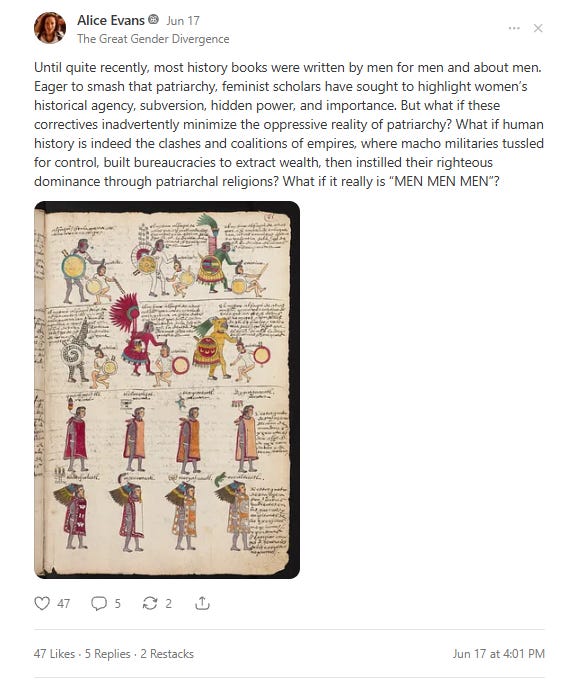
And in another recent post, In Confining Insiders, Raping Outsiders, she said the following:
Julius Caesar famously encapsulated imperialism as veni, vidi, vici, but that is perhaps too benign. Veni, rapui, genui may be more accurate: I came, I seized, I begot. Throughout the historical record, militarised male coalitions have seized territories, slaughtered rivals, captured women and achieved disproportionate reproductive success.
She goes on to give several examples of this throughout history, but the one of most interest to me came from Latin America:
In the 16th century, when Iberian men colonized the Caribbean, Central and South America, they not only seized land, minerals, and labour, but also gained an extraordinary reproductive advantage. Today’s Latin American populations exhibit sharply sex-biased ancestry: paternal lineages are disproportionately European, while maternal lineages are primarily Indigenous. In countries with long histories of African slavery, the maternal line is often substantially African.
While it was hard to read this essay, filled with examples of violent, oppressive, and cruel men, it also struck me that there are two ways to interpret this history. Historians naturally emphasize the first: powerful rulers and militarized male coalitions shaped the course of civilizations. But for me, the phrase, "maternal lineages are primarily Indigenous," really sticks out. If we unpack what those words mean, we see that countless Indigenous women survived conditions of extraordinary adversity: conquest, rape, slavery, racism, displacement, starvation and physical abuse. And not only did they survive—they managed to raise children who themselves survived long enough to leave descendants.
One could argue that these women and their children survived only because conquering men “let them.” But modern evidence consistently shows that abuse, coercion, chronic stress, malnutrition, and violence undermine women's health and reproductive success rather than enhance it.10 Violence is not an adaptive gift bestowed upon women. Rather, female biology—and female resilience more broadly—repeatedly proves capable of enduring extraordinary hardship despite harsh conditions. Throughout human history, the female body and psyche, so often dismissed as fragile or defective, turn out to be pretty resilient.
When I read historical sources like those presented by Evans, I can’t help but think of my own sons. We tend to romanticize history by identifying with its winners—the conquerors, the emperors, the dominant figures who are almost always men. But the fact is, these empires were often built on the idea of male expendability. Most men were not doing the conquering. They were peasants, laborers, or soldiers whose lives were cut short by conflicts they did not choose, serving at the whim of a small number of corrupt, powerful men. What we call "reproductive success" in certain epochs of history was built on the murder and disenfranchisement of less powerful men.
So when I consider my maternal investment in my sons—the time and energy I poured into raising them—I can’t imagine how awful it would be to parent in an age where they were viewed as expendable. Even the idea of them signing up for the draft when they turn 18, making them vulnerable to the whims of whatever potential war-mongering president we may have in the future, makes me feel kind of ill.
We should be honest about historical events in the past, yes. But I think we can also acknowledge that, for the vast majority of people throughout history, it was not conquest that carried human lineages and achievements forward. It was peace, cooperation, and caregiving—during which women did a lot of the heavy lifting. And our female biology probably helped. Being more prosocial and having less intimidating (and potentially more attractive) physical features probably helped.
As stated by one of my favorite anthro profs from college, Dr. Agustin Fuentes in the excellent TED talk below:
We have this notion that might makes right, survival of the fittest, meanest, baddest. Is that true? Are humans naturally aggressive at our core? Are humans really aggressive, violent and selfish? Actually, no. I’m going to show you today that it’s not all about sex and violence. Rather, the key to human evolutionary success is all about cooperation and getting along.
A Better Story About Women’s Bodies
Do you remember my opening story about the woman who implied that it’s so unlucky to be a woman? I hope I have convinced you that it’s not really worse-just different, in both some good and bad ways. But I understand why my patient said what she did. Female biology asks a great deal of us: menstruation, pregnancy, childbirth, lactation, menopause and even uncomfortable pap smears! But it also gifts us with other wonderful things: flexibility, resilience, longevity, babies, breastmilk!
Personally, I would argue that the female body is not an evolutionary mistake, nor is it a defective version of the male body. It is one of evolution's great success stories: it is astonishingly good at keeping both itself and the next generation alive. What more could we ask for?
Please comment below, especially if you answered “no” or “maybe” to the above poll question. And please subscribe!
Consent is extremely important, and a lot of pelvic exams are done without it, or with implied consent IMO. Fun fact: the first thing I ever published was this journal article in 2018, Has The Time Come To Discontinue Routine Pelvic Exam?, wherein I argued that routine pelvic exam on asymptomatic women is not evidence-based, has no benefits but does have risks (women find the experience violating, embarrassing and anxiety-inducing), so it should be discontinued.
If you want kids but are afraid of childbirth, just get an epidural! In this post I discuss all the pros and cons:
You May Want To Give Birth Without An Epidural
·
November 12, 2025

I’m always hesitant to wade into the waters of the “natural childbirth,” debate, at least when it comes to the over-simplified version of it contained in the so-called “Mommy Wars.” A recent example is this Babylon Bee article.
I attend a yoga class semi-regularly where about 3-5 of 20 participants are men any given day. And TBH they are way worse at yoga. Flexibility has benefits like: reduced risk of muscle strains and joint injuries, improved posture through corrected muscle imbalances, and relief from chronic pain and tension.
I have been in a few birth rooms where the partner reeked of marijuana, cigarette smoke, or even alcohol and thought to myself “I’m glad it is her who is pregnant and not him!”
The evolution of menstruation: A new model for genetic assimilation. This article attempts to answer the question of why humans menstruate while most other mammals do not, and suggests that the endometrial lining is essentially a complicated “biosensor” which develops independent of the fetus. Because it is prebuilt, it can test the quality and genetic viability of the embryo once implanted. If the embryo is abnormal, the mother’s uterine cells can halt its development and discard it (aka miscarriage) rather than investing time and energy into a nonviable pregnancy.
This chart shows male vs female mortality for the same age range, plus the same rates for maternal mortality and pregnancy related mortality specifically:
Women’s longevity advantage is remarkably consistent over different cultures and countries. This is kind of remarkable when you consider the serious disadvantages women in certain countries face. Even in Afghanistan, women live 3 years longer than men. In countries like Russia, the gap is 10 full years!
No posts
Comments
Nothing yet. Say the first thing.
Sign in to join the conversation.