
The answer is…25-31. Thanks for reading! Have a nice day!
Just kidding. Mostly.
If you’re short on time, the TL;DR really is: whenever you want, whenever you can—but ideally somewhere around 25-31. But since you took the time to click, I’m going to reward you with a brilliant, comprehensive post to explain why I think this window makes the most sense. It will involve some data, and also my own meandering experience as a midwife and parent.
This conversation isn’t just for women. While much of what follows—particularly the discussion of biological constraints around fertility—applies more directly to women, many of the broader lifetime tradeoffs apply to men as well, maybe even more so. On average, men live about 5.3 years less than women, which means there is even less time to spend with your children and get to know your grandchildren if you choose to procreate later in life. That being said, guys can probably add a year or five to the range, but if they want to be fathers in their lifetimes, they too should put some serious thought into the following question:
At what age will I reach the intersection of being young and healthy enough to be an energetic parent to young children (and undergo a pregnancy if female), and also be secure enough in my relationships and financial situation to provide for a family?
A Moderate Midwife is not just for women! I do snarky parenting takes as well. Consider subscribing even if you are a dude.
First, I want to acknowledge that “At what age should you have your first kid?” is an oversimplified question built on a false premise: that we have full control over our reproductive lives, and that the answer is the same for everyone. We don’t, and it isn’t.
Even floating the idea of this post drew comments that made it clear it would strike a nerve. Many of us don’t get to have children when—or with whom—we hoped to, and suggesting that that this reflects some kind of misjudgment or personal failure on an individual’s part understandably lands badly. While infertility varies by age and other factors, about 1 in 6 people worldwide will experience it at some point in their lives—that’s roughly 17.5% of adults.
And lately, I’ve started to worry that many in Gen Z may be taking their fertility for granted. As a certified nurse-midwife (CNM), my work extends well beyond attending births; I also provide general women’s healthcare like contraception, preconception and fertility counseling. In that role, I’ve had some concerning conversations that suggest many young women don’t have a realistic understanding of their fertility.
I don’t normally like to agree with , nor do I love the term “pronatalist,” but I couldn’t help hitting the “heart” button when I saw this:

It’s not that we all have to identify as “pronatalists” but if you are pro-“I would like to have kids in my lifetime” then it is worth pondering the question of when to start your family.
A few weeks ago, shared this fascinating graph from the British Fertility Society which, for me, doubled down on the idea that young adults need to start asking themselves some questions like...is having kids really important to me? If I make it to the end of my life and haven’t had them, or don’t have as many as I want, how sad will that make me? In comparison to other goals I have for my life, where does this one sit?
If the answer is a resounding “Having kids is really important to me!” then it’s worth taking a closer look at this graph:
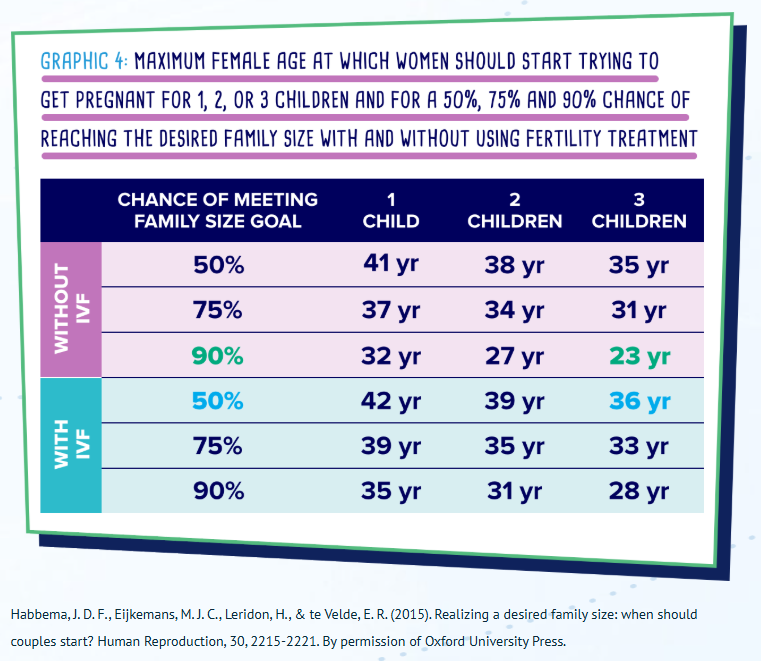
Suppose you really, really want at least two kids—so much so that it would be deeply upsetting not to have them. In that case, it makes sense to shape your life choices around having, say, a 90% chance of that outcome. As this graph shows, even with access to IVF, achieving a very high probability of having the family you want typically means starting to try around age 31.
From that perspective, delaying serious relationships until your 30s and childbearing until your 40s—because you’re writing a novel, pursuing a PhD and a tenure-track position, or hiking Mount Everest—represents a clear prioritization of one goal over another. And that can be completely reasonable. I’m not judging people who pursue ambitions beyond childbearing. But we should be honest that devoting substantial time and energy to one goal often means accepting increased risk or reduced odds for another.
My point here is that when it comes to having children, those of us who truly want them shouldn’t leave it up to chance. If building a family is a lifelong dream, it’s reasonable to make choices that maximize the likelihood of that dream becoming reality. The same way you wouldn’t wait until your 50s if your goal were to compete in the Olympics, you probably shouldn’t wait until your 40s (IVF or no IVF) to try to have a baby.
All of that said, it’s just as important to acknowledge the other side of the timing equation: many people delay childbearing for very good reasons, and one of them is that young parenting is not a walk in the park. So, let’s talk more about childbearing at the early ages.
The Pros And Cons of Having Kids Young
As a midwife working at a community health center that serves people with significant socioeconomic disadvantages, I take care of a lot of moms with unplanned pregnancies.. While rates of unintended pregnancy have been declining, they still account for 41.6% of pregnancies in the U.S. These moms tend to be poorer and younger.
I recently became what you might call a “grandma midwife.” I cared for a 17-year-old patient whose mother recognized me and said, “I think you delivered her.” Dang—nothing makes you feel old like realizing you’re caring for babies whose births you attended who are now pregnant themselves!
There is a lot of judgment of young mothers. But accepting a pregnancy that comes at an inconvenient or imperfect moment often makes sense when you zoom out far enough. I have a friend and former student who became pregnant in high school (oops). She later told me that the kindness she received during pregnancy and childbirth—especially from midwives—was what motivated her to finish high school, go to college, and eventually become a midwife herself. Many of us can relate to the idea that unexpected, sometimes even tragic events shaped our lives in ways that ultimately made them more meaningful.
When it comes to giving birth, young moms are among my favorite patients to care for because they’re so good at it! In my experience, they come at it with a “can do” attitude and seem to have shorter, less complicated labors with shorter pushing phases. I just checked in with Open Evidence AI to see if my anecdotal impression was correct, and it was! (nulliparous=never given birth before)
Labor progresses more quickly in younger women. Nulliparous adolescents had significantly shorter first and second stages of labor compared to women aged 25-30 years (384 vs 524 minutes for first stage, 47 vs 63 minutes for second stage). Analysis from the Consortium on Safe Labor showed that for nulliparous women, time to progress from 4-10 cm decreased from 8.5 hours in those <20 years to 7.4 hours in those 30-39 years. The second stage was up to 97 minutes shorter in younger nulliparous women (<20 years) compared to older women (>39 years).
In a U.S. study of over 43,000 nulliparous women, younger adolescents (≤15.9 years) had half the cesarean delivery rate compared to young adults aged 20-24.9 years (aOR 0.49; 95% CI 0.42-0.59), and older adolescents (16-19.9 years) also showed reduced rates (aOR 0.75; 95% CI 0.71-0.79). A Swedish national study found teenagers were more likely to deliver vaginally (aOR 1.70; 95% CI 1.64-1.75) and less likely to have cesarean sections (aOR 0.61; 95% CI 0.58-0.64).
So great, birth is easier if you’re young! But none of this is meant to sugarcoat reality. Teen and very young mothers also face higher risks of preterm birth, anemia, preeclampsia—largely driven by socioeconomic factors in my opinion.
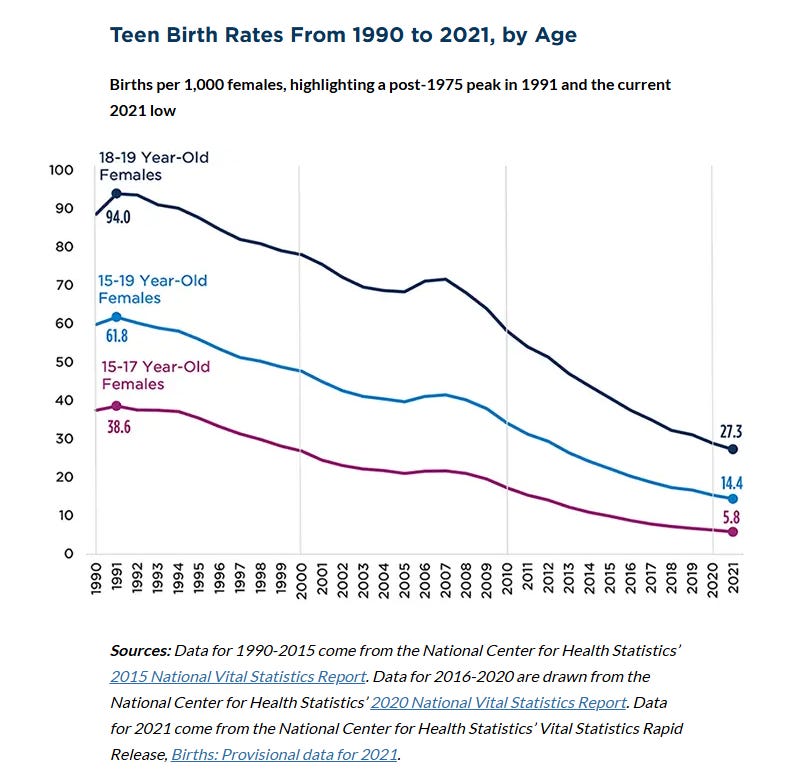
And the costs of early parenthood are rarely about the pregnancy or birth itself. They’re about everything that comes after: economic instability, reduced ability to remain in school or the workforce, and relationship strain. This (and increased access to more reliable birth control) is probably why births to teenage moms are at an all time low (source).
If there were a way to separate out the socioeconomic factors that make young pregnancy and parenting difficult—poverty, lower levels of education, and higher rates of abuse in relationships—the children of young mothers might do just as well, or even better, than those of older parents. But the fact is, the children of younger mothers (defined as <25 yo) experience more adverse childhood events (ACEs), which can impact them for a lifetime. They are more likely to have:
experienced economic hardship (food or housing insecurity)
experienced parent or guardian divorce or separation
experienced the death of a parent or guardian
had a parent or guardian who served time in jail
witnessed domestic violence
witnessed violence in their neighborhood
lived with someone who was mentally ill, suicidal, or severely depressed
experienced discrimination (based on race, disability, sexual orientation, etc.)
Having children at a very young age doesn’t have to be a disaster—I’ve seen many young parents do a wonderful job—but it’s also understandable why most people aren’t eager to have kids before 25. Very few of us in our late teens or early twenties have the stable relationships, financial stability and emotional maturity that would help make a child’s life safe and nurturing.
From an evolutionary perspective, human biology evolved in contexts where people often started families earlier—but they did so within close-knit groups, surrounded by extended family members who shared the work of raising children. Among my younger patients, I sometimes see relatives step up in exactly this way, particularly in Black and Latino communities. But I’ve also seen situations where that support wasn’t available, much to the detriment of both the parent and the child.
Taken together, this suggests not that young parenthood is doomed to fail, but that starting too early often comes with real structural challenges that can make life harder for parents and increase the risks children face.
Now let’s talk about the other side of things…
The Upsides—And Risks—of Waiting to Have Kids
The average age at first birth has risen steadily for decades, and beginning motherhood in your 30s is now common—especially among highly educated women. This delay often reflects real advantages: people who start families later tend to have had more time to complete education and establish careers, which can make them more financially secure and better able to afford stable housing, health insurance, and other resources that support child-rearing. In addition, recent data show that first-time mothers with a bachelor’s degree are much more likely to be married or living with a partner at the time of their first birth compared with previous generations, suggesting increased relationship stability among older parents.
So it’s understandable why many people postpone childbearing. But I also think we need to be honest that waiting has disadvantages. Biology is not offended by our ambition to do other things; it just doesn’t care about them. When I see for older first-time moms as patients, I don’t judge them at all. I am genuinely happy for them, as these are usually very wanted pregnancies! Whether the guys they dated in their 20s were losers or they were considering life in the covent, it’s really none of my business what took them so long to have a baby. Far be it from me to judge anyone’s childbearing choices.
But I do usually end up working harder and worrying more.
I don’t want to beat a dead horse, because everyone already knows this, and in my experience women are really sick of the threats and fear-mongering. But there is solid evidence that childbearing at older ages comes with additional risks. None of this is to say women shouldn’t pursue motherhood in their late 30s and early 40s if it’s what they really want. But here is a brief summary of the risks associated with “advanced maternal age” (AMA)—also historically called “elderly multigravida”—everyone’s least favorite medical term (feel free to skip this section if you’re sick of hearing about it!):
Advanced maternal age (≥35 years) is associated with significantly increased risks for both maternal and fetal complications compared to younger women. According to the American College of Obstetricians and Gynecologists, women aged 35 years and older face higher risks of gestational diabetes, preeclampsia, labor dystocia, and cesarean delivery. These risks increase progressively with advancing age, particularly beyond 40 years.ACOG
Maternal morbidity and mortality risks escalate substantially with age. A large U.S. cohort analysis found that compared to women aged 25-29 years, those aged 35-39 years had a 1.36-fold increased risk of pregnancy-related morbidity, those aged 40-44 years had a 1.83-fold increase, and those aged 45-54 years had a 3.33-fold increase. Maternal mortality risk ratios are particularly striking: 3.18 for women over 40, 11.60 for those over 45, and 42.76 for women over 50 years.
Fetal and neonatal risks are also elevated. Women of advanced maternal age face increased risks of chromosomal abnormalities (particularly trisomies), miscarriage, stillbirth, preterm birth before 34 weeks, fetal growth restriction, and neonatal intensive care unit admission. The stillbirth risk is approximately 1.75 times higher in women ≥35 years compared to younger women, with a population attributable risk of 4.7%. For women aged 40 and older, stillbirth risk increases to 2.16-fold, and chromosomal abnormality risk increases 7.44-fold compared to women aged 20-34 years.
Chronic medical conditions are more prevalent in pregnant women of advanced maternal age, including obesity, chronic hypertension, and type 2 diabetes, which further compound pregnancy risks. Even after controlling for these baseline conditions, older women remain at significant risk for developing preeclampsia and gestational diabetes.
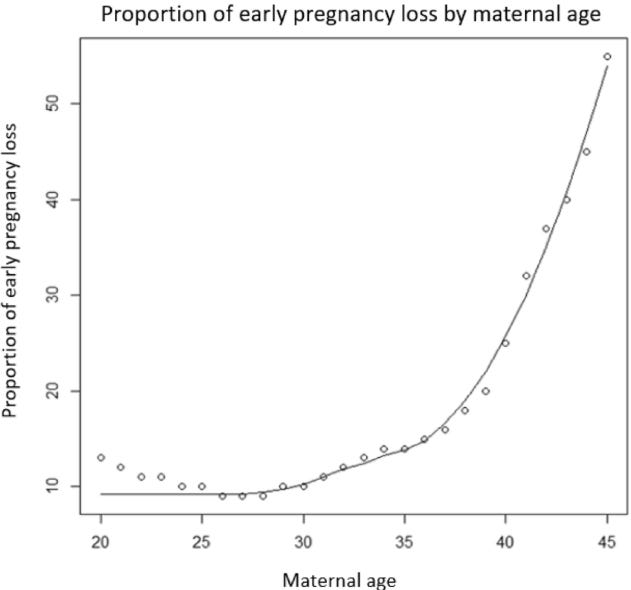
Also, there’s this sad reality: miscarriage is a lot more common at an older age:
This doesn’t even consider older age during parenting, which is its own marathon. More on that later!
Will Technology Save Us From Biology?
Egg freezing and assisted reproductive technologies (like IVF) are often presented as ways to pause or bypass the biological clock. But I’m skeptical that they can truly substitute for the higher fertility, lower complication rates, and healthier pregnancies (and therefore—healthier babies) that most women experience in their 20s and early 30s. Most of my concerns about IVF come from the standpoint of someone who has seen how much higher-risk these pregnancies are. For that reason, I’m biased toward the idea that a more reliable path is working with our biology—that is, attempting to find a partner and start a family in the roughly 25–31 year-old window, when fertility is still relatively high and risks are lower.
I made this argument in “Why I Don’t Fear An IVF Takeover” and similar thoughts were shared recently by who went through IVF and basically confirmed that it sucks. Or in her words:
Having done IVF a few times—three retrievals and three transfers, to be specific, culminating in two live births—I find it very hard to believe that a sizable amount of people would voluntarily choose this hard road for a spurious promise of a 130 IQ baby when they could simply take some backshots for three minutes instead and risk the outcome of a midwit baby.
On a lighter note, I am sympathetic to the argument made by in a recent NYTimes article about making IVF more available to women.
Although cultural commentary often suggests otherwise, many Gen Z women, including myself, deeply want children. We’re simply trying to navigate a world where the timelines of our bodies and the timelines of our ambitions rarely align. As a result, childbearing drifts later, and many of us feel a sharp anxiety as each year passes, widening the distance between our hopes and reality. Meanwhile, technologies to preserve and support fertility exist, but they remain prohibitively expensive and inconsistently effective.
But I think that, even when technology is used optimally, it’s a bit of a false promise to depend on IVF to have children in your 40s—or even 50s. Using younger eggs can improve the odds of conception, but pregnancy still occurs in an older body, with all the physical risks that come with age. For these reasons, I don’t see IVF, egg freezing, or genetic screening as a substitute for planning with biological realities in mind.
Is It Really So Bad to be Female? And, A Few Thoughts on Older Fatherhood
One thing I sometimes hear during the fertility conversation is: “Life is so unfair! Men can ruthlessly pursue their careers, put off relationships and childbearing, and still have kids late in life.”
Yeah, they can, but…why would they want to? Men are not immune to the challenges of older parenting: the sleep deprivation, the way your kids want to run around, go on roller coasters, or wrestle you before bedtime (ouch). In some ways, I think women are better off because our biology nudges us to have children earlier, which means we tend to be younger when our kids grow up.
Having a kid at 60 doesn’t sound great if there’s a 50% chance you’re going to die before they graduate high school! I don’t mean to be rude here; it just depends on what your goal is. If your goal is purely to push your DNA into the next generation, sure, having a kid later is fine. If your goal is to actually be in their lives—to have relationships with your children and grandchildren—well, waiting too long can backfire. Even on the DNA front, having children younger means more descendants by the time you die, as was pointed out to me by in back and forth notes where, I stupidly didn’t understand her point and she kindly clarified by saying:
At the population level the demographic effect is very different if everyone has two children starting at 39 or two children starting at 19.
Sticking to this caricatural example, in the first case, at age 40 you have 2 descendants, at 60 still 2, and at 80 you have 6 (when your 2 children had their own 2 children each around age 40). In the second case, at 40 you have 6 descendants (your 20ish year old children had their own 2 children each), at 60 you have 14 (2 children, 4 grandchildren, and 8 great-grandchildren), and at 80 you have 30. That’s a lot more children around, and more population growth, simply by having generations closer together.
Personally, I have never envied men, wished to be one, or felt that male bodies are superior. Yeah, they’re stronger, but women can literally create new life! And we live, on average, five to six years longer. I feel like those extra years more than make up for the fact that we may spend several years in pregnancy and intense parenting. Granted, the total depends on how many kids we have and our parenting choices (breastfeeding, working vs SAH motherhood, homeschooling, etc.). But for the average woman who wants two kids, she might spend about 18 months pregnant and maybe two years breastfeeding, adding up to roughly five years of intense parenting…followed by decades of life to concentrate on other things.
And then there’s the emotional piece: research consistently finds that mothers tend to have closer and more sustained relationships with their children than fathers do. Adults are more likely to report being closer to their mother than their father growing up and children and parents alike report stronger emotional bonds with mothers. Mothers also spend significantly more time on day-to-day childcare and emotional support, which deepens attachment over the long term. (Sadly, this is unlikely to apply to me. My kids all prefer my husband, probably because I spend too much time writing Substack essays.)
Interestingly, evolutionary biology offers a neat explanation for why women’s long-term involvement with their children and grandchildren might matter. The Grandmother Hypothesis suggests that menopause—and the long post-reproductive lifespan that comes with it—may have evolved so that women can invest in their children and grandchildren. By helping the next generation survive and thrive, grandmothers indirectly increase the likelihood that their genes are passed on.
So when it comes to older parenting, men may have more flexibility on paper, but in practice they also face challenges. Shorter life expectancy, less guaranteed emotional closeness, and the physical demands of parenting mean that postponing children has consequences for them too. IMHO…women are the lucky ones: biology and longevity align to give us a better chance at meaningful, long-term relationships with our kids.
My Conclusion: Have Your First Kid Between 25-31 If You Can
I realize that by writing this post, I have probably pissed off people of all ages, family situations, political and religious beliefs. Sorry! Young parents might feel judged, older parents might feel judged, and honestly, some people will just be mad because I suggest there’s a “sweet spot” that I can’t really prove and is just based on my own opinion and experience.
To review, the reason I argue for this age range is that: younger parenting is a lot harder—admittedly, often due to socioeconomic disadvantages rather than biology—and waiting too long risks infertility, increased pregnancy complications, and more challenging parenting realities. But keeping with my moderate branding, I will also admit that I can’t possibly understand your situation enough to give you advice! I just wanted to get the conversation moving. Feel free to comment telling me why I’m stupid and wrong.
And no matter what, I hope you get the number of kids you want, when you want them. ✌️

Comments
Nothing yet. Say the first thing.
Sign in to join the conversation.