
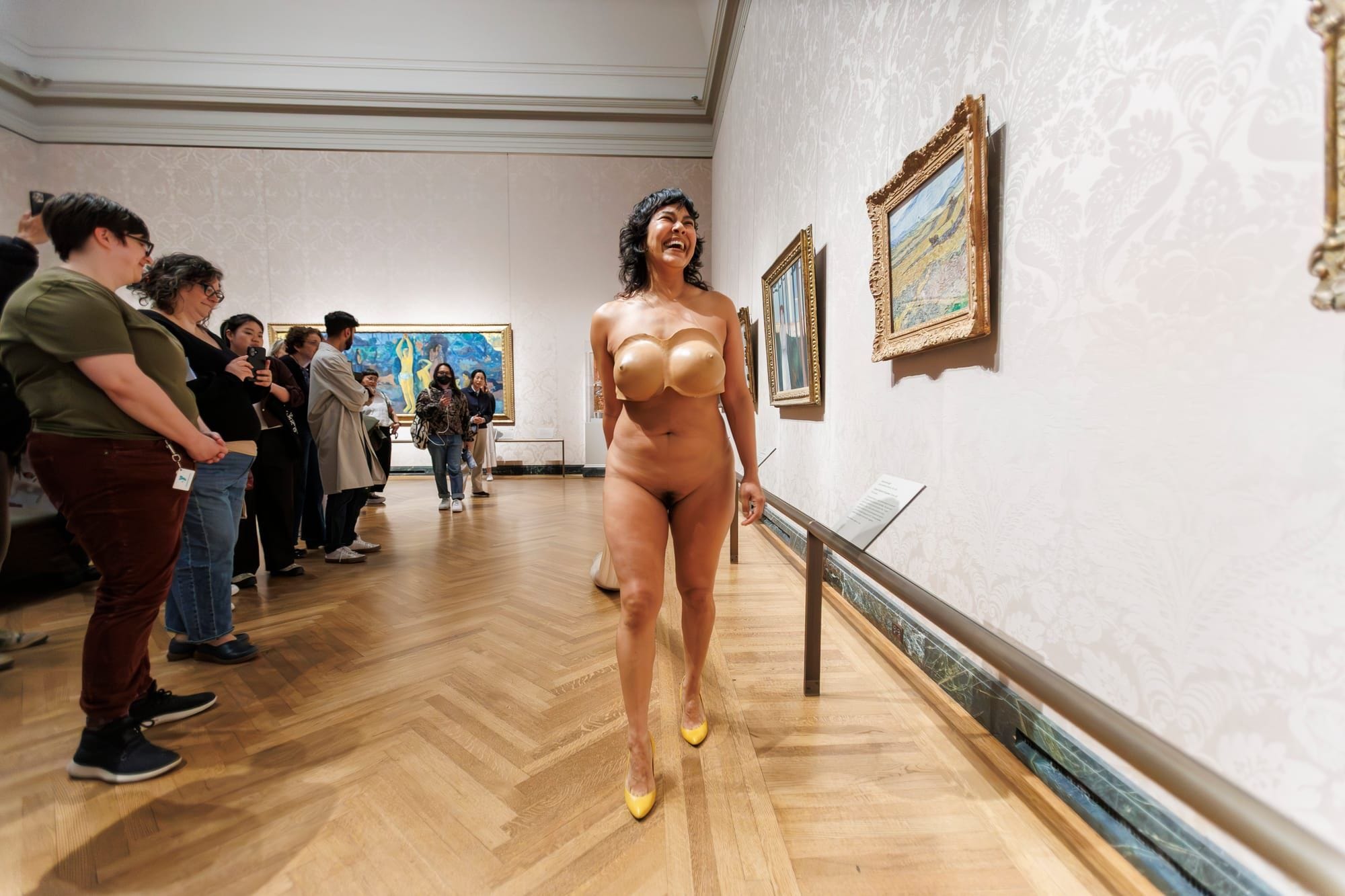
Nearly a month ago, a performance artist named Xandra Ibarra traipsed around Boston’s venerable Museum of Fine Arts, at first wearing yellow stiletto heels and a plastic breastplate with generous flesh-colored boobs, and then gradually stripping down till nothing was left to the imagination. She dragged behind her a stocking filled with “white lady accoutrements” (blonde wigs and “hyperfeminine” accessories, according to Hyperallergic). The performance was called “Nude Laughing,” and I’ll let Hyperallergic describe the particulars: “Starting with a silent stride, Ibarra traversed the gallery and made her way through several others, cutting the quiet with bubbly giggling. While navigating through the Art of Europe section, her laughter crescendoed into hysterics as she responded to the surrounding artworks. Once she reached Paul Gauguin’s Where Do We Come From? What Are We? Where Are We Going (1897–98), she ultimately wrestled herself to the floor and into the nylon sack, still laughing.”
And I thought, Wow, this is like déjà-vu all over again!
Naked women have been causing a stir in the art world at least since Goya unveiled his maja desnuda in 1800. But in this century, nakedness has inspired ever new interpretations, and so I’m reposting here an essay published nine years ago in Vasari21 that still seems very up to the minute.
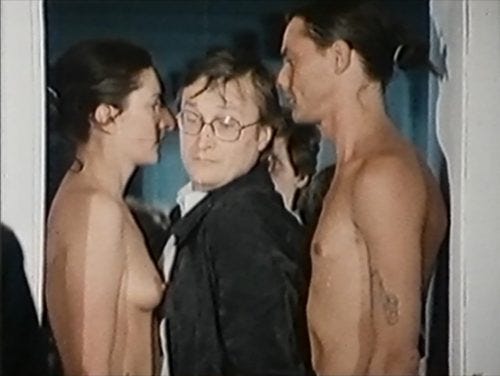
In 2010, at New York’s Museum of Modern Art, a young man and a young woman stood facing each other in a doorway, immobile and wearing nothing. Visitors could choose to squeeze between them or to use another entrance into the exhibition.
The piece, called Imponderabilia, was a re-creation of a 1977 performance work by Marina Abramović (together with her then-partner, Ulay), and it was among the most talked-about aspects of her 40-year retrospective at MoMA. Most reviewers referred to the two people in the doorway as “naked,” but might they not also be thought of as nudes—living embodiments of a long line of sculptures of the human body stretching back to Greek kouroi, especially since the “performers” were trained dancers with well-toned bodies, who stood as stiff as, well, statues?
Naked or nude? Or something else altogether in our postmodern stew of mediums and messages?
More than half a century ago, when Kenneth Clark published The Nude: A Study in Ideal Form, he could make a clear distinction: “To be naked is to be deprived of our clothes, and the word implies some of the embarrassment most of us feel in that condition,” he wrote. “The word ‘nude,’ on the other hand, carried in educated usage, no uncomfortable overtone. The vague image it projects into the mind is not of a huddled, defenseless body, but of a balanced, prosperous, and confident body: the body re-formed.”
The unclothed body is still a subject for artists, but how it is perceived is a more complicated question for us than it was for Clark. The people making academic nudes are probably aware of the distinction, but that is less true of the artists staking out new ground (and the curators and critics who support them).
Take the Abramović show. “Part of the power of her work with the body is that she breaks down the division that Clark makes, which has absolutely held true in art history,” noted Chrissie Iles, the Anne and Joel Ehrenkranz curator at the Whitney Museum of American Art. “When she’s making a work in which she’s naked, she is both naked and nude. Her body is very beautiful; it’s almost classical. At the same time, the context of her work and what she does with her body makes her very vulnerable. And in that sense, the nudity conforms more to Clark’s argument about nakedness.”
To RoseLee Goldberg, though, the terms are meaningless when it comes to performance art of a certain era. “The distinction between naked and nude was completely irrelevant,” says Goldberg, an art historian and the director of Performa. “Imponderabilia was more about sexual politics, pure and simple.” Marina and Ulay, she says, “looked very much alike. They wanted to make it plain that there was this androgyny to the two of them. That’s what gets lost when you reproduce these things.”
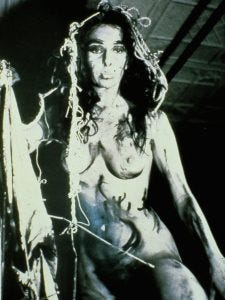
When Minimalism and Conceptualism were dominant, Goldberg points out, “performance art was keeping the body alive.” Carolee Schneemann, Vito Acconci, Joan Jonas, Dennis Oppenheim, Eleanor Antin, Yoko Ono, and others were all making pieces “using the body to articulate political issues, dealing with class as much as relationships between men and women. Everything was showing the body as a vehicle for big storytelling.”
Naked and Nude in Traditional Mediums
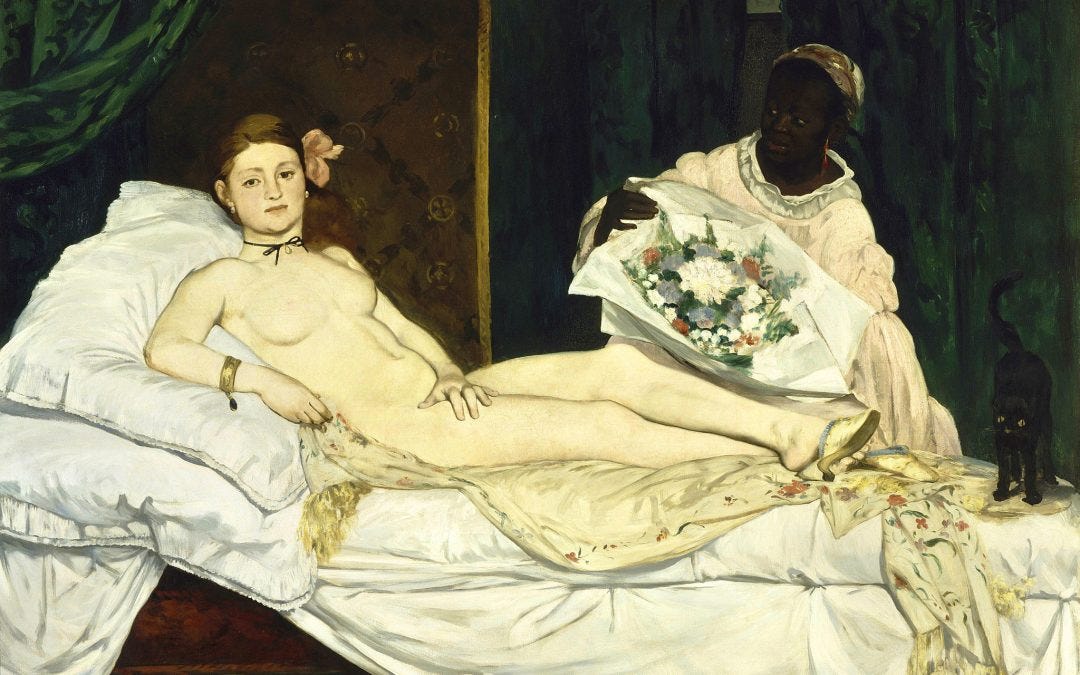
Yet when it comes to other mediums—painting, photography, sculpture—the categories “naked” and “nude” can still seem valid. For Elizabeth Armstrong, the former executive director of the Palm Springs Art Museum, who is now an independent curator, the traditional nude walked out of the picture plane for good with Duchamp’s Nude Descending a Staircase (No. 2), in 1912. “He was one of the artists who was hammering the last nails into the coffin of academic idealism,” a development that started with Edouard Manet’s Olympia. “I think it’s fair to say that one ambition of the nude is that it will seduce you. Nakedness is more raw. The expression ‘the naked truth’ comes to mind, because it captures the vulnerability of nakedness.”
Olympia, that celebrated shocker of the Paris Salon of 1865, kicked off a debate that continues today. “I would say she is naked,” says George Shackelford, senior deputy director of the Kimbell Art Museum in Fort Worth, TX. “But she’s also a nude in the tradition of reclining nudes, and Manet is counting on your recognizing that fact. He’s counting on the above-average visitor understanding that he’s taking a Renaissance Venetian trope and recasting it in Grand Boulevard terms.”
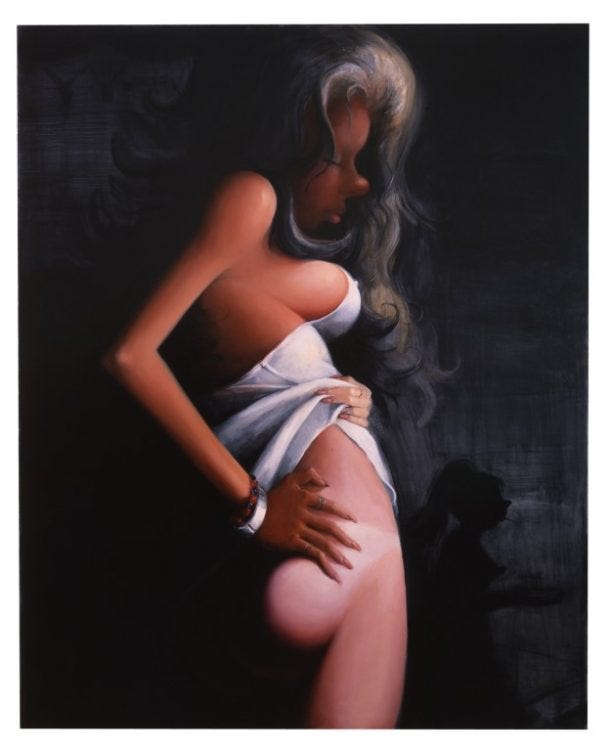
Lisa Yuskavage continues the tradition of painting works about unclothed women that tick people off. Famous for her outlandishly proportioned female subjects, the artist says the issue is not something she thinks about at all. “‘Naked’ and ‘nude’ sounds classist in a way to me,” she says. “Artfulness and high art versus everything else. The question of naked and nude doesn’t engross me because maybe I do both at different times.”
Yuskavage is one of several artists who are known for painting inflated female bodies, often to the point of grotesquerie. Jenny Saville’s nude women are “mountains of flesh” with “neuroses bursting through,” according to London’s Guardian. She has also painted transvestites, using a model with a natural penis and silicone breasts. John Currin has painted near-pornographic images of women in garter belts and panties, but he is also capable of bringing a Boucher-like tenderness to images of his wife.
Minding the Gap
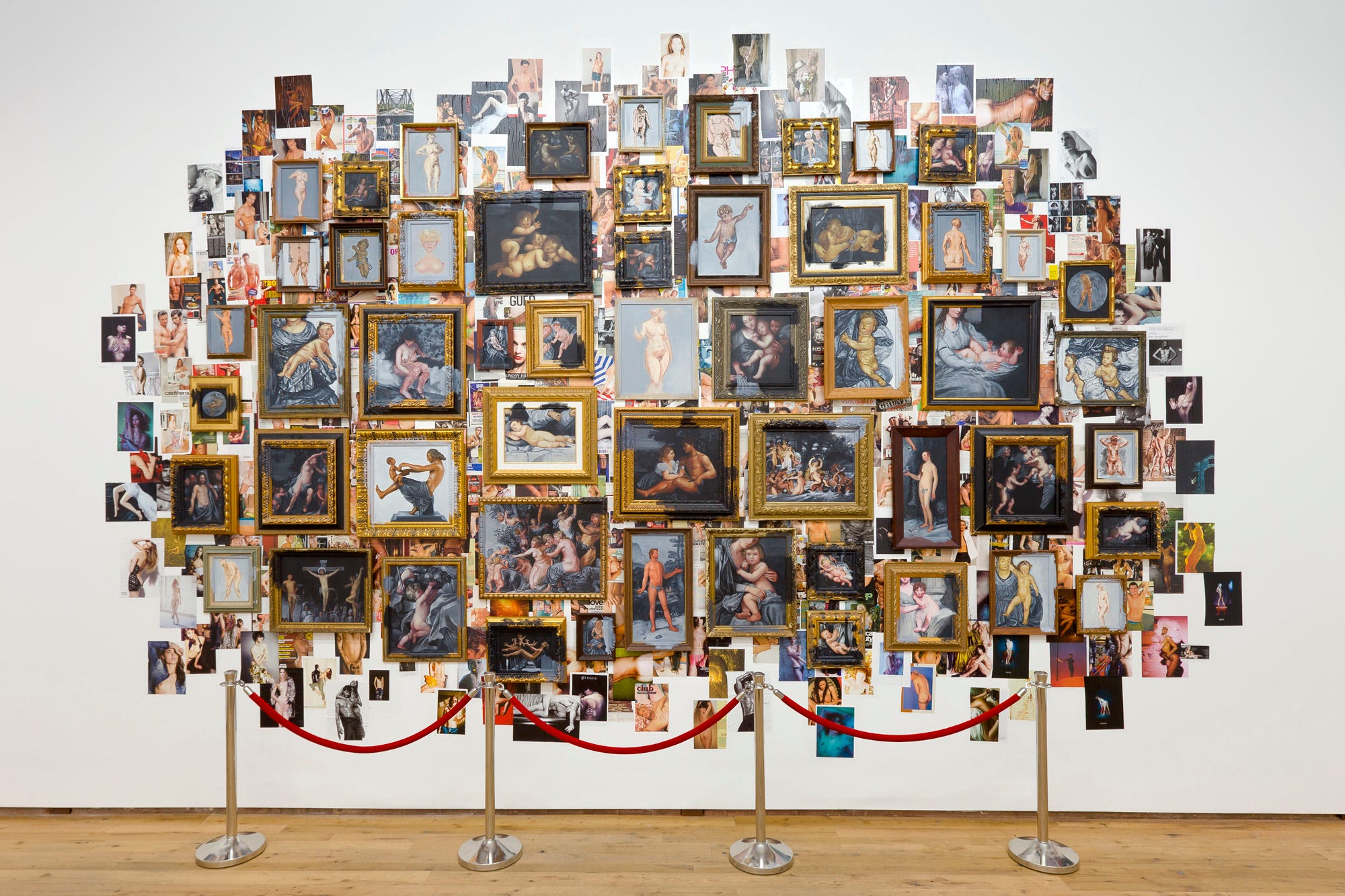
An artist who playfully operates in the breach between naked and nude is Ellen Harvey, in the past 16 years she has completed two projects providing idiosyncratic overviews of nudity in Western art. The Nudist Museum (2010) documents every nude in the Bass Museum of Art in Miami Beach. The more recent Nudist Museum Gift Shop (2012) offers up paintings of design objects featuring nudes, most of them junky tchotchkes like ashtrays and vases.
“The art-historical nude created an aura of idealization that mass media have now perfected and moved to a point where you look at most porn stars and they don’t look naked; they look like they’re wearing a silicone outfit,” Harvey says. “Paradoxically most of these ‘sexy’ mass-media nudes end up seeming pretty unsexy.”
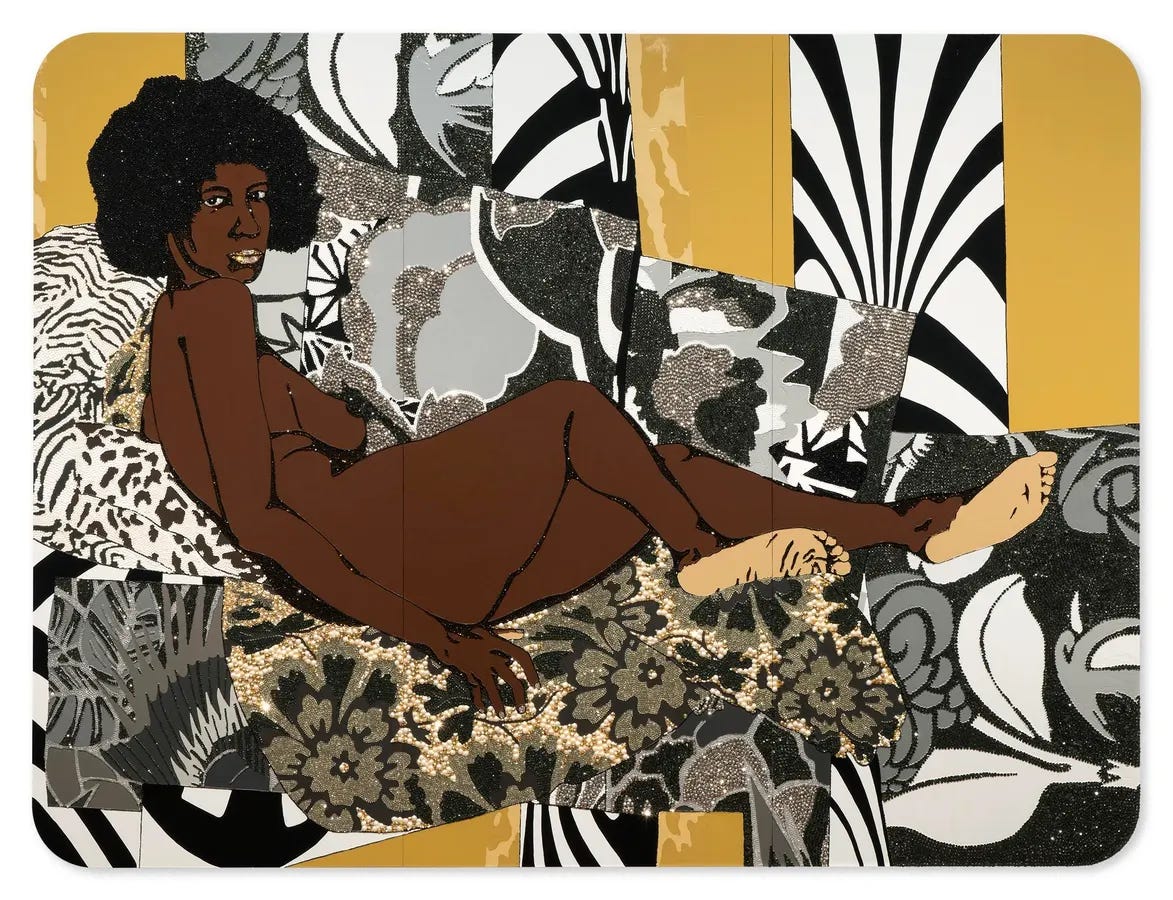
In almost all discussions of the nude, scholarly or otherwise, the subject of the unclothed black body, whether male or female, seldom enters into the conversation. “The black nude is still very tribal,” said Mickalene Thomas, who is examining old taboos in her photography and mixed-media paintings. “There’s still the need to associate the black body with something ethnic.”
Thomas has occasionally riffed on the work of the masters, particularly Courbet’s lush nudes and Manet’s Olympia. “When I use those particular, very iconic compositions, I choose them because I know that they will be shocking.” As for the question of naked versus nude, she says, “I like to say my work oscillates between both worlds. There’s a sensuality in both nakedness and nudity for me, a line of eroticism.”
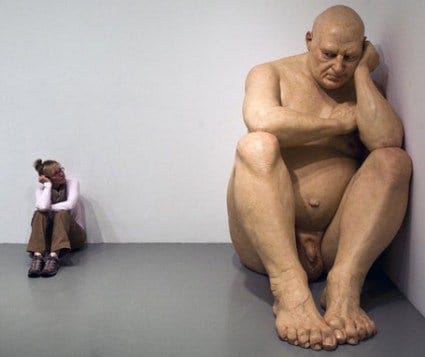
Curiously, few contemporary sculptors outside the academic tradition tackle the nude, male or female, even though the subject has had one of the longest runs in art history, from ancient times to Maillol and Giacometti. Among the sculptors who do consider the nude is Ron Mueck, an Australian, who makes hyperrealist sculptures of subjects that run the gamut from infancy to old age, and whose work is currently the subject of a retrospective at the Museum of Fine Arts in Houston. He plays with unexpected collisions of scale and subject: an infant may be blown up to gargantuan proportions but a spooning young couple or a robust middle-aged woman can be almost doll size.
Mueck’s work recalls Clark’s original evocation of nakedness as a “huddled, defenseless body.” Nothing could be more defenseless than Mueck’s over-life-size, deeply wrinkled, troubled-looking, and totally unclothed man, brooding in the corner of a gallery.
But naked or nude, political or sexual, remote or in-your-face, the body stripped bare will probably always command our attention, in real life and in art.
“The body is so fundamental that it will never disappear,” says Iles. “There’s been no period in art history when it hasn’t been front and center.” Which leaves me wondering what kind of nudes AI will inflict on us. Fasten your seat belts!
No posts
Comments
Nothing yet. Say the first thing.
Sign in to join the conversation.