
Note from the author: From 2007-2012, I blogged regularly (as in two or three times a week) for a blogsite called “Brainstorm,” hosted at The Chronicle Review (now called The Review of The Chronicle of Higher Education. All told, I published somewhere around 800 posts (what I prefer to call “little essays”), about half of them pertaining to art. When Brainstorm ended, I was told the posts would be archived, but I have yet to locate them. Fortunately, natural clerk that I am, I saved them all. A few days ago, I stumbled across a reference to a post from around 2009, and I was struck by how the problem I describe has only been exacerbated with time. Here’s the original post, with a few changes made for clarity.

Given the general eco-consciousness of most contemporary artists, and given the generally lefty, liberal tendencies in the contemporary art world, you’d think that the art world would be Green—or at least trying to get there. Not so.
Take installation art, an ever-hot art form that’s been around since the 1970s. Almost without exception, it’s designed to be ephemeral and site-specific. Most installation art is time-consuming to set up, difficult to move from one place to another, and a one-shot, one-time, one-gallery moment. Only the rare installation piece—like Judy Chicago’s The Dinner Party at the Brooklyn Museum—manages to find a permanent home.
Even if the artist recycles tons (literally) of plastic, cardboard, wood, cement blocks, styrofoam, bubblewrap, string, tape, and paper into his or her art—crud that might otherwise directly hit the landfills—what happens when a particular exhibition ends? It’s hard to believe that the artist methodically stores all 1200 plastic bottles, 62,000 feet of string, and two and a half tons of broken concrete for the next (improbable) iteration of that installation.
As for photography—well, we should all be cringing in fear. Digital photography is indeed slowly and methodically killing chemical photography, but chemical photography is not going gently into that good night. There are still thousands of artists, scattered all over the country, who step into the darkrooms carved out of the basement of their homes, casually dipping their prints in and out of trays of chemicals that then get dumped directly into their town sewers. As for digital photography, there’s plenty of e-waste involved, not to mention the energy consumption.
At first glance, sculptors seem relatively harmless. But unless they’re wood-chippers, the odds are they’re doing something (e.g., grinding some rock-hard substance that results in tiny, harmful particles of that substance being released into the air, or using piles of solvent-soaked rags, or working with this or that plastic that contains endocrine disruptors, or using something else that’s nasty for the planet). Their attitude toward the air around them, and the sink and drain in the corner of their studio, isn’t much different from that of any other artist, which is to never question whether their art-making might be toxic.
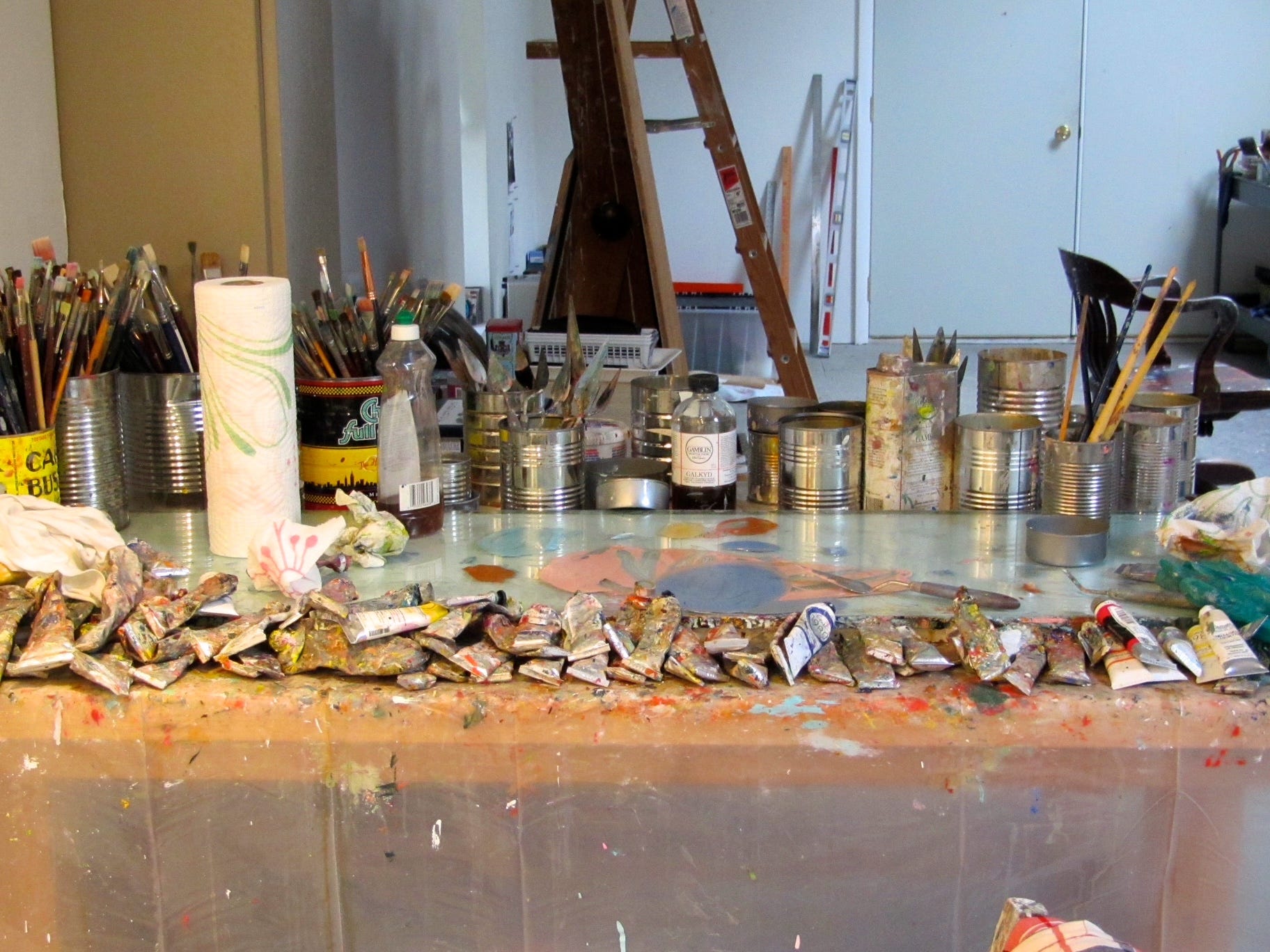
Painters? Don’t get me started. Acrylic painters may think they’re off the hook as polluters (their paint mixes with water, not turpentine), but they conveniently forget that acrylic is a petroleum product. It’s plastic. Meanwhile, oil painters merrily pushing pigments that are “all-natural” are just as bad. Oil paints with heavy metals in them (e.g., cadmium and cobalt) are marked with a tiny “X”—indicating, at the very least, “Don’t eat this” are banned in most classrooms but for sale at most of the major art-supply stores.
As to turpentine, mineral spirits, odorless mineral spirits and varnishes? Those who don’t directly pour what they don’t need down the drain often do what I used to do—leave cans of dirty mineral spirits open to the air until the pigments precipitate out. Even the very act of painting—whether with acrylic or oils—involves releasing volatile organic compounds that can cause headaches or nausea. And what do artists do with their used-up tubes of paint other than toss them into the trash, that intermediate step on their way to the ocean or the landfill?
Just as few meat-eaters have ever been inside a slaughterhouse, and think meat means plastic-wrapped blobs of red stuff, few painters have ever seen the insides of a paint factory. Few know where they’re even located (answer: mostly California, Florida, and Texas). Few painters know much about the history of pigments—or about how they’re ground, or how the degree of grinding affects their appearance once they’re on a canvas, or how the different vehicles in which they’re suspended affect them, or how synthetically made pigments have almost completely pushed to the side pigments derived from natural substances.
In New York alone, where I lived for almost forty years before moving to Lakeville, CT, there are thousands of artists working in individual studios. During my years living and working in Tribeca, I knew at least five working artists on my block, not to mention dozens more working in my neighborhood. Most of them were like me—tossing the waste from our art-making into the trash. When I called the Department of Sanitation to ask about how individuals should recycle substances such as turpentine or used tubes of paint, I was told (very vaguely) that it was the individual’s responsibility to take the substances to specific locations that I could find on the Department of Sanitation website. Needless to say they were all a serious schlep from lower Manhattan, and I’m here to confess I never followed through and did this.
Finally, there’s the hefty carbon footprint of all those artists, dealers and critics who buzz about the world or ship crates of art from one biennial to another. Artists as a group are hardly unique in polluting our exhausted little planet, but we sure are good at ignoring our role in it.

Comments
Nothing yet. Say the first thing.
Sign in to join the conversation.