
Watching Hamnet last week, I said to my husband, “if Jessie Buckley wins the Oscar, it will feel like a win for the tradwives.”
And so it does. Like the tradwives movement, that emblematic decision reveals an overall confusion in feminism in the USA right now: layering surface gestures of female satisfaction over a deeper repression of matriarchal agency and values.
The Academy Awards Ceremony, festive and amusing almost in defiance of the mounting world horrors around it, was framed by two wonderful victories for women: the launch of the first-ever Oscar for the female-dominated job of casting director, and the choice of Autumn Durald Arkapaw, first woman awardee in cinematography, who asked all the women in the room to stand during her thrilling speech. On the flip side, the speeches featured a steady parade of people addressing the mixed-gender audience as “you guys.” The last time I heard that phrase spoken so often from a stage was during a brief browse of the Republican National Convention. On the surface, “you guys” honors women by including them in a male club of full human beings whose gender doesn’t matter; underneath, however, it affirms that full humanity is only attainable through renouncing femaleness.
Similarly, on the surface, awarding the Oscar to a female-directed tale about a previously-ignored woman does, of course, honor women. But wait a moment.
When we first meet Hamnet’s Agnes as a fierce, solitary denizen of the woods, she’s calling a hawk to her wrist and following the arcane herbal knowledge of her witchy foremothers. But no sooner does she get knocked up than she drops all that ecstatic self-sufficiency to become a docile helpmeet and nurse laser-focused on her children and her Great Male Writer husband.
Watching this rare and compelling character cheerfully sacrifice her once-sacred independence on the altar of a man and his son (Buckley’s character Agnes’ two daughters barely say a word), am I the only feminist who wants to cry “auntie!”?. Haven’t we had enough female sacrifice (self-inflicted or otherwise) over the past 5000 years?)
Miserably, for a movie directed by a woman based on a novel by a woman, this film doesn’t even pass the Bechdel test (in which two named women must speak to each other about something other than a man). Rather, it “passes” it in a way even WORSE than failing: the only time two women talk to each other about something other than a man is to declare hatred for each other: “You’re not my mother!” shouts Buckley witheringly). Ouch. Ouch.
After Buckley won the award, my husband, Glen, asked why I didn’t consider Buckley’s Best Acttress Award a win for feminism. Aren’t herbalism and a narrative centered on female expereience helpful aspects of reclaiming matriarchy? Of course they are. I’m totally into honoring and reclaiming earth-centered ways, and I consider pretty much any win for women something to celebrate. I agree 1000% with Buckley when she tells People Magazine, “i know women, and we’re pretty epic . . . we contain multitudes.”
But when Buckley used a well-earned moment of glory to call out to her husband in the audience, “you’re my best friend and I want to have 20,000 more babies with you,” all I could think was that J.D. Vance and the MAGA “pronatalist” movement could not have worded it better.
No matter how nice the husband is, that’s not a feminist family, y’all! I know nothing of Buckley’s real-life support network. But in the context of current patriarchal US culture, this unprecedented (I googled “Oscars best actress winner mentioning desire to have babies in her acceptance speech” just to make sure:) remark perpetuates, like Buckley’s character in the movie who lacks a connection with the women around her, the model of woman as breeder in a nuclear family. If matriarchy means anything, it means fully centering women’s agency and connections with other women—preserving the family as a matrilineal clan, whether consanguinous or chosen.
Buckley’s performance in Hamnet is consistently compelling, the theme of parental bereavement is powerful and beautifully resolved, and the whole ending is uniquely wonderful. Still, like the supposedy complimentary phrase “you guys,” the choice of Buckley for the award reflects a misguided and dangerous confusion of form for stubstance where feminism is concerned. LIke the tradwives movmement, this year’s award may honor female experience on the surface, but it does so within carefully preserved patriarchal structures of power and at the expense of deeper matriarchal values.
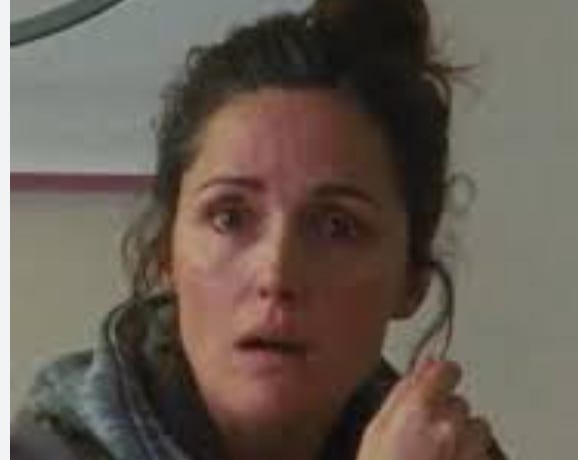
I would have preferred that Oscar to go to Rose Byrne for her truly brilliant performance in one of the most profoundly feminist movies I’ve seen in a long time. Glen and I also watched If I Had Legs I’d Kick You together. While he (along with, I would imagine, many other men ) found the heroine’s trials bewildering and exhausting, I was relaxed and exhilarated to watch a film capture so precisely (and comically! and tragically!) much of my own lifelong experience living as a woman under patriarchy.
The life of the movie’s heroine, Linda, reflects the contemporary reality of all too many women. It is a life in which the “beautiful chaos of a mother’s heart” that Buckley evoked in rosy terms in her acceptance speech has been stripped of most of its ancient power to shape the world by the sterile violence of 5000 years of the patriarchal system. It is a world in which our deepest matriarchal wisdom is constantly both provoked and frustrated, heedlessly overstimulated and cruelly underutlized, by the bureaucracies, aggressions, and exploitations that all genders still suffer under.
Linda’s home is a shell, empty of matrilineal sisterhood and engulfed in floods of grief. Her daughter is trapped in the endless mirages of big medicine. Her young patient is desperate for the love and guidance of elder women. Everyone needs Linda, yet she has nothing to give them. She sold out her power long ago to build a marriage and career within the judgmental isolation of white patriarchal culture; she seems to have no female support network at all; and she is traumatized by an abortion—one with no spiritual context except the shame and guilt offered by patriarchal religion.
Yet through the pileup of fears, failures, and farces that make this movie so cathartic or excruciating, depending on your perspective, Linda manages to claw back shreds of her matriarchal power. She begins to move forward. In Byrne’s phenomenally honest portrayal, she advances gradually and courageously out of the fatal male-centered house of cards, and if it collapses as she goes, still she moves forward by reaching with compassion towards others and herself.
Rose Byrne’s character faces and begins to heal from the trauma of the abortion she suffered in a patriarchal instittuion. She slightly awakens to connection with other wounded women; she slightly befriends a caring man from a saner cultural background; she slightly recognizes the Goddess-power of the nighttime ocean, and bit by bit she recognizes some of the power she does have to help shape a more matrifocal, humane life for her daughter. Amid such a hellish trumult, these are small steps, often slight steps— but they are true steps, in a new direction.
What a wonderful luxury to be able to compare these two women-written and women-directed movies. (I still remember when it seemed the only way a woman could win awards for a Hollywood film was to make it about men in war.)
We are all at different places in our journeys. May all our steps be true.
Comments
Nothing yet. Say the first thing.
Sign in to join the conversation.