
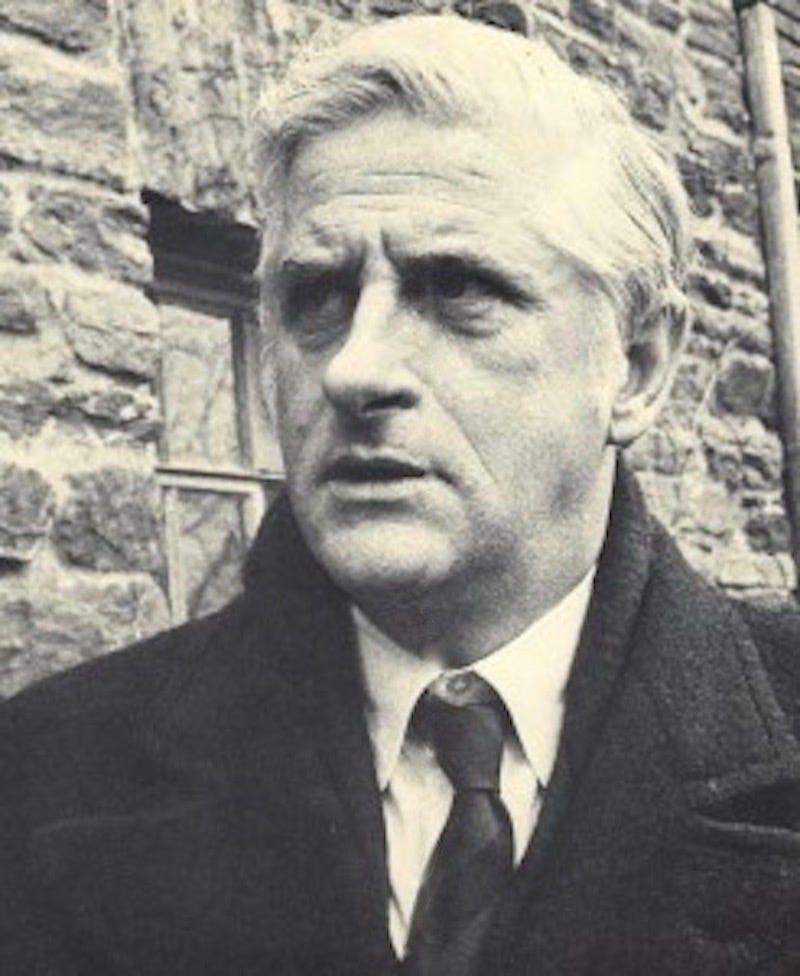
I’ve lately been thinking a lot about my father, Roy Finch (that was his pacifist name; his philosopher name was Henry Leroy Finch Jr.) He was not an easy person to live with; I now believe he had BDP, as I now believe I once did, although mine is a lot better after decades of healing work.
Lately for some reason—maybe because all the healing I’ve done has taken me to a new place of tenderness towards men and how acutely, and often silently, they suffer under patriarchy—I have felt him very much with me. I have felt certain, and poignantly grateful, that he did his best (this is actually my Second Law of Witchcraft: always believe that everyone is doing their best. The fact that it applies to everyone makes it no less profound and moving to be able to apply it to each person we love).
It is certainly true that I would never, never, never have become the poet, nor the witch, that I am without him.
I want to thank my father for a lot of things. For reading “The Night Before Christmas” aloud every year until I got addicted to triple meters. For telling me women couldn’t write epic so obnoxiously that I had to write one. For bombarding me with so many books about Dickinson that I ended up writing an essay called “My Father Dickinson.” For dragging me to Horace Gregory and Marya Zaturenska’s house where I was more-or-less inoculated against poetry gossip and exposed to the first library I ever saw that was entirely poetry. For taking me to Assissi and Lourdes and Delphi and Santa Sophia and Jerusalem. For typing out one of my earlyish poems on his old Royal typewriter that smelled of oil so that he could appreciate it better. For having an old Royal typewriter that smelled of oil, and keeping his thousands of draft manuscript sheets about Wittgenstein in neat stacks, and typing again on their backs. For his desk drawers (but I have written about those elsewhere).
For all the fathers he, in turn, gave me: For showing me D.H. Lawrence’s house and Shakespeare’s birthplace. For talking the merits of Eliot vs. Stevens or Stevens vs. Crane or Crane vs. Yeats over decades worth of cups of coffee. For his library shelves dripping with yards of Blake and Valery and D.H. Lawrence and Dogen. For intoning Hart Crane’s “Voyages: II” in tones I can never forget. For xeroxing an entire out-of-print book of Paul Engle’s poetry, cutting and pasting each page to fit the pages of an artist’s blank book, and mailing it to me just after I moved near Iowa City. For listening to LP records of actors reciting Vaughan and Crashaw and Traherne on the couch with his eyes closed for hours, especially in the months before his death, and for thinking a lot about Milton in the weeks before.
For telling me that e.e. cummings had been a very nice and ordinary seeming gentleman when he drove him home once from some event. For having once sat across from Thomas Mann on a train. For tracking down for me every obscure prosody volume I ever needed, even in the days before the internet. For mentioning “Lydia Sigourney, the Sweet Singer of Hartford” so often that I got curious. For saying John Ashbery should “just spit it out in Daddy’s hand.” For going to the Auden lectures where he met my mother.
For finally publishing his book of poetry, Flying Over Ocean City, just in time to see it on his deathbed. For including in it poems about balloons and philosophers, and one that opened, “Athena’s owls are little and friendly / and wise because they’ve made peace with the night.” For looking at a copy of my first chapbook around the same time, and telling me, “These are real poems, so I know people will look after you. I won’t worry about you. You’ll be allright.”
ELEGY FOR MY FATHER
HLF, August 8, 1918—August 22, 1997
“Bequeath us to no earthly shore until
Is answered in the vortex of our grave
The seal’s wide spindrift gaze towards paradise.”
—Hart Crane, “Voyages”
“If a lion could talk, we couldn’t understand it”
—Ludwig Wittgenstein
Under the ocean that stretches out wordlessly
past the long edge of the last human shore,
there are deep windows the waves haven’t opened,
where night is reflected through decades of glass.
There is the nursery, there is the nanny,
there are my father’s unreachable eyes
turned towards the window. Is the child uneasy?
His is the death that is circling the stars.
In the deep room where candles burn soundlessly
and peace pours at last through the cells of our bodies,
three of us are watching, one of us is staring
with the wide gaze of a wild, wave-fed seal.
Incense and sage speak in smoke loud as waves,
and crickets sing sand towards the edge of the hourglass.
We wait outside time, while night collects courage
around us. The vigil is wordless. And you
watch the longest, move the farthest, besieged by your breath,
pulling into your body. You stare towards your death,
head arched on the pillow, your left fingers curled.
Your mouth sucking gently, unmoved by these hours
and their vigil of salt spray, you show us how far
you are going, and how long the long minutes are,
while spiralling night watches over the room
and takes you, until you watch us in turn.
Lions speak their own language. You are still breathing.
Here is release. Here is your pillow,
cool like a handkerchief pressed in a pocket.
Here is your white tousled long growing hair.
Here is a kiss on your temple to hold you
safe through your solitude’s long steady war;
here, you can go. We will stay with you,
keeping the silence we all came here for.
Night, take his left hand, turning the pages.
Spin with the windows and doors that he mended.
Spin with his answers, patient, impatient.
Spin with his dry independence, his arms
warmed by the needs of his family, his hands
flying under the wide, carved gold ring, and the pages
flying so his thought could fly. His breath slows,
lending its edges out to the night.
Here is his open mouth. Silence is here
like one more new question that he will not answer.
A leaf is his temple. The dark is the prayer.
He has given his body; his hand lies above
the sheets in a symbol of wholeness, a curve
of thumb and forefinger, ringed with wide gold,
and the instant that empties his breath is a flame
faced with a sudden cathedral’s new stone.
Poem by Annie Finch, From Spells: New and Selected Poems (Wesleyan University Press, 2013)
Post adapted from a post for the Harriet blog, Poetry Foundation website, 2009
Comments
Nothing yet. Say the first thing.
Sign in to join the conversation.