
This is too good to miss. As I’ve said before, Marion Cran (now titled ‘Mrs Cran, the author of The Garden of Ignorance’) manages to introduce many discussions which are not strictly garden related. And this particular tale has to be told. Strange, violent, so much of an alien time but relatable and involving both a baby brother and a Penny Farthing bicycle.
“It had been a busy day, for first of all there was a great clatter in the household, because something crumpled appeared on a pillow, which I was told was a new brother….. I protested at being led away.
‘He is noisy and very ugly, ‘ I said. The nurse was horrified. ‘Not nearly as ugly as you are, she answered and for all the shortness of my six years, the idea that I was as ugly as that caused me exceeding discomfort. I went into the nursery, seized a little sister, who was pretty, and cut off her eyelashes, with a view to levelling things up; after a painful interval the mutilated beauty and I were sent to visit grandpa, who lived in the same village in a lovely house near a famous trout stream.“
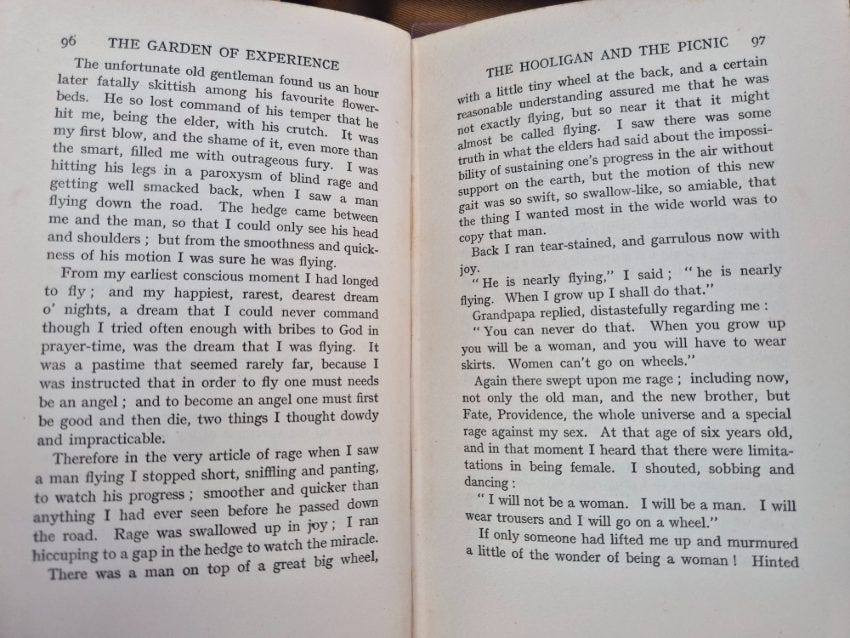
Let’s not pretend she actually wished to change sex in the current sense. Rather: “Ridiculous and pathetic the picture of the girl child nourishing her infantile spite at being crossed; and yet on my pedestal of obstinacy, hatred and revolt, I stood, had I only known it, for all my sex; for the very spirit of my generation; and the bicycle forbidden and beckoning stood for the freedom women were long denied, and had been denied so long - so age-long.
Altogether well said.
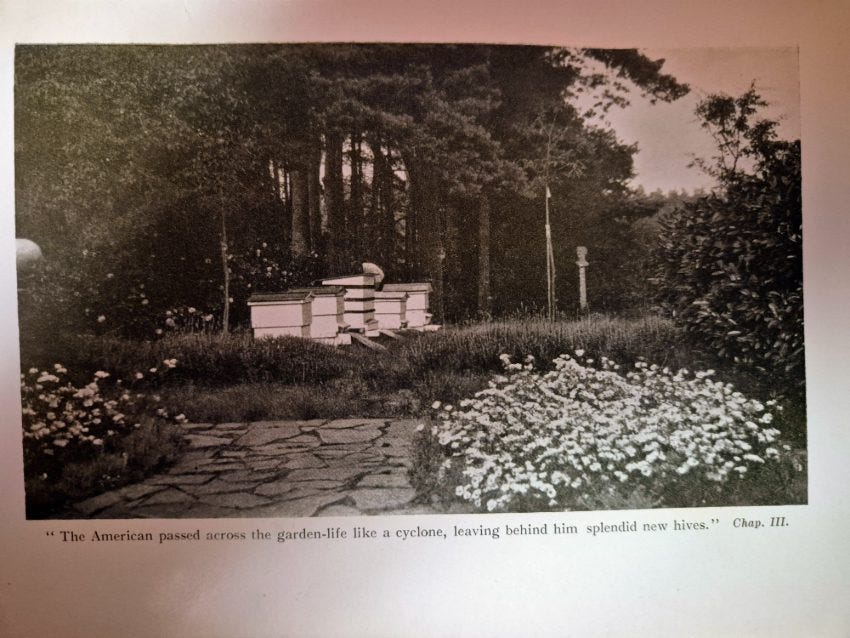
Recently I read someone asking where and why the American love of sweetness began. I haven’t yet found an answer, but it dates back to Marion Cran’s time at least, it seems. In the first World War there an American serviceman was billeted in their household. And at some point some honeycomb ‘’appeared, refreshing as rain in a drought, upon the jamless, sugarless, war-breakfast table, to the extreme delight of the Californian. Like most Americans, refused all alcohol..., preferring his system to manufacture its own by supplying it with large quantities of sugar; and the shortage of ‘candy’ hit hard at his comfort.“
And so there had to be bees and bee hives - “One might as well have tried to cage Niagara in a bucket as stem the torrent of that man’s devastating energy” which, having started on bee hives then turned the man into a carpenter.
But, yes, all right, we must have some gardening. As in a defence of deciduous trees and shrubs in a winter garden: an acknowledgement of “another remoter, subtler beauty, which only the stripped hour of winter discloses in the lyric confusion of its psalmody of twigs.”
Or the wonder of bulbs: “There are some things I never get used to. One is the sight of an aeroplane in flight, and another a parcel of bulbs.”... “Funny little fellows, bulbs! Their small ivory bodies so clear and firm, tight swaddled in fine brown silk, still make me catch my breath ...this little thing, small and silky, the pointed end of nothingness....“
Then there’s roots. I’m currently reading ‘A World Appears, a journey into consciousness’ by Michael Pollan, with amazement. Among many amazing things he tells us that science is now begining to support the idea of roots being sentient, perhaps intelligent organisms. By means principally of their roots:
“Plants can predict changes in their environment and take appropriate steps: Given a choice of soils in which to invest root growth, pea plants will pick one in which nutrient levels are increasing rather than one offering more immediate nutrients, suggesting that they can predict future conditions and prepare for them.”
What has this to do with Marion Cran? Well, she says:
“Scrambling away from every tree I saw myriads of tiny mouths, each making with absolute surety for the direction where food is to be found.....I was mesmerised, with a vision of the communal life of this world of roots.....and then there are the thousands of tiny annual radiculae, fibrous rootlets, ....... intelligent little travellers who wander far and wide from their first anchorage in search for means of support for the rollicking bon viveur above”
She’s not wrong. Intuitive? Or perhaps she had been reading Darwin, who had similar insights.
She offers an idea about rambler roses which I have never come across before. Disillusioned, unsurprisingly, with growing them over arches, so that they flower away out of reach at the top:
“One day I conceived of the idea of cutting the wire arches down, and edging the big path on the lawn with them. The result was a sort of scalloped effect, an avenue of wire festoons which became in time well draped with the rambling roses, and exceedingly pretty....Everyone who walks down the garden path now, can look down on sheets of bloom, and admire the undulating decoration of half circles outlined in roses. One of the advantages of this half-arch scheme is that the wire is so completely covered...... To anyone who has a sentiment for passing under rose arches the idea will be anathema, because the only way of passing to and fro beneath my variety would be on all fours.”
There’s no picture, so I’ll leave you imagining crawling around under your roses......
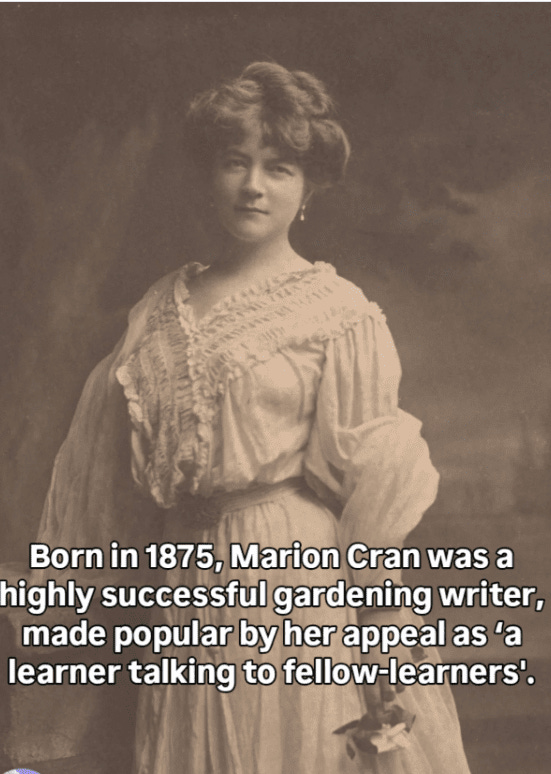
But here’s a picture of Marion Cran. Anything like you imagined?
And here’s something completely different: a programme about Veddw Garden. In Welsh, with English subtitles.
Comments
Nothing yet. Say the first thing.
Sign in to join the conversation.