
This is a very long - longer than your email will allow you - and serious piece. Mostly, I believe, about America and gardening. (so far?) By the writer, podcaster and gardener, Marianne Willburn.
Only those who don’t have brain rot from too many videos and doom scrolling will be able to read and take it in. Consider your self a true winner if you can, and even better if you can also manage a comment. One, two three: GO!
This post is a culmination of growing concerns that voices gentler and more knowledgeable than mine have articulated for some time; but that nevertheless continue to be ignored or reframed. The issue is complex, and it deserves meaningful discussion. I hope we can have it. -MW
_____________________________________
On its face, ecological gardening is a marriage and a movement made in heaven – the joining together of ecology and horticulture to inform the creation of gardens bursting with life and beauty. But when one spouse is always the loudest at the dinner table, and aggressively subverts the aspirations and perspective of the other, a marriage suffers.
While many gardeners, including myself, have been eager to embrace a deeper understanding of the complex systems that underpin our artistic endeavors in horticulture; we are deeply concerned that this sea change, for all of its positive overtones (or perhaps because of them), is having a net-negative effect on responsible gardeners and gardeners-to-be who increasingly view gardening not as a joyful pastime, but as a never-ending performance review — a moral obligation by which they will be judged and found wanting.
We are slowly losing our voice at the table as gardener-artists. Do we have the courage to stand up and reclaim it?
If you’ve been to a horticultural conference or attended a webinar in North America in the last five years, picked up a magazine, sat quietly in the back during a Master Gardener meeting, or witnessed the social media evisceration of someone who dared challenge the new hive mind, you too may be:
Feeling as if there are more rules than ever before in your gardening life;
Self-censoring for fear of being judged;
Puzzled by conflicting studies fuelling viral memes;
Exhausted by the buzzwords;
Amused by the corporate opportunists using the exhausting buzzwords;
Annoyed by experts redefining subjective concepts like ‘beauty’;
Suspicious of exclusive biodiversity & dogmatic nativism in a post-Darwin world;
Wondering why human beings are treated like alien visitors;
Confused because you thought that uptight gardening and pearl clutching went out with the last millennia; and,
Genuinely wondering if there’s space for you anymore…
If so, you are not definitely not alone – though it may seem like you are. Welcome to what fellow GardenRanter Susan Harris terms the “Just Stop Gardening” Movement. A new space where the gardener’s perspective is subjugated to favor the ecologist’s perspective; and which saddles everyman gardeners (whether they wished to grow Hemerocallis or fill a raised bed with herbs) with the burdens of past and present ecological damage to our planet, the saving of species from extinction, and the reversal of climate change.
That’s a heavy lift.
Let’s travel back a decade or two and define two related terms as we used to understand them:
A horticulturalist practices the art and science of gardening – cultivating and managing plants for ornamental, edible, or medicinal reasons.
An ecologist is a scientist concerned with the complex web of relationships of organisms to their environment.
Leaving everyman gardeners out of the equation for a moment, formally trained horticulturists & ecologists are called to their disciplines for different reasons. And they see gardens differently.
Whereas an ecologist can find a garden beautiful, they are much more likely to find it fascinating – an object of deep study where the aesthetic desires and practical needs of the human gardener who tends it are secondary to the creatures that inhabit it.
And whereas a horticulturist can find the complex systems of organisms within their garden fascinating and helpful, their interest is weighted more heavily toward the practical and aesthetic manifestation of the garden serving their lives and the lives of those in their families and community.
Gardening is fundamentally subjective just as ecology should be fundamentally objective.
You can visualize this as a Venn diagram of sorts. Two sets of people drawn to Nature for different reasons. And where they overlap, characteristics that are common to both sets fueling a synergistic exchange of ideas.
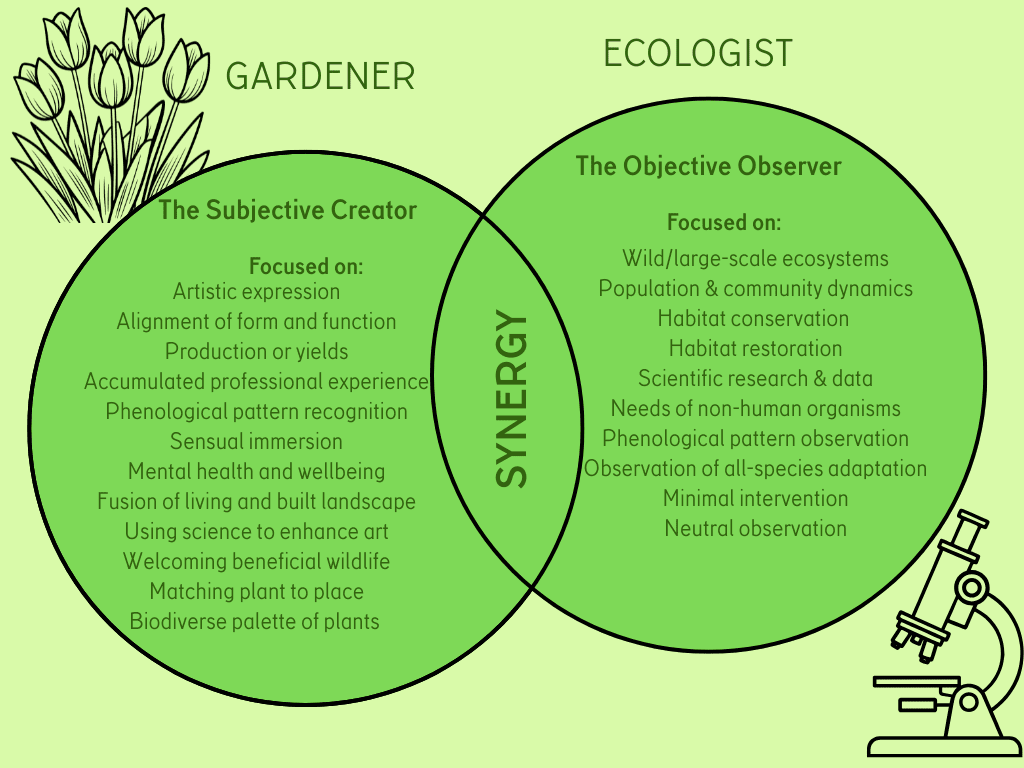
Professor Nigel Dunnett of The University of Sheffield (of The Barbican and The Tower of London SuperBloom fame) beautifully expresses the synthesis of these two perspectives as an opportunity to “capture people’s imagination” in a conversation with Gardens Illustrated editor Stephanie Mahon:
“…being in a natural place where you feel that you’re part of something bigger…to me, that’s the power of what a garden can be. It can create this world that’s separate from everyday life. And I think it liberates childlike feelings of joy and just kind of, well, ‘liberation’ is the word. It just takes away the constraints of everyday life.”
In the beginning, gardeners like myself recognized this exchange and welcomed more of it, naively confident that the priorities of each discipline would be respected – not redefined.
Now it feels more like the diagram below – the gardener’s voice subsumed by the ecologist’s. Except the aggressively emotional portrayal of complex systems, anti-human rhetoric, and strident native plant dogma from dominant voices in the ecological gardening movement have sadly called into question the objectivity of the new “objective observer.”
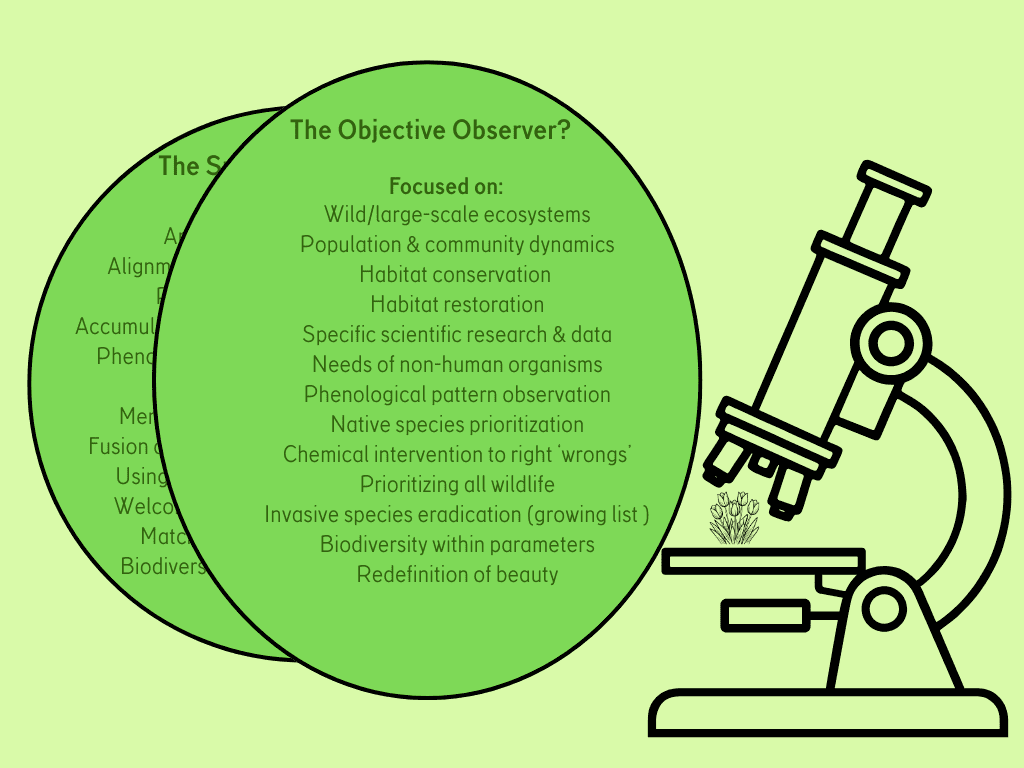
Not too long ago we understood the difference between a gloriously wild or post-wild space – province of the ecologist and naturalist; and a cultivated garden – province of the gardener; and we loved both in equal measure — differently.
Smart gardeners who worked with the complex web of life in their gardens and who studied their plants’ ecotypes had a leg up in creating a breathtaking garden rich with life and energy – whether formal or wild.
Smart ecologists who opened the garden gate and studied the adaptations of native organisms to a gardener’s more exotic palette in a changing climate could similarly have their minds opened to research that mattered when dealing with public lands and restoration projects.
Those of us who gardened, unapologetically gardened – especially as expectations of perfection, and pesticide-heavy guidelines relaxed as we neared the end of the 20th century. And we had media heroes to guide us and commiserate with us – the Henry Mitchells and Allen Lacys, the Anna Pavords and Beth Chattos.
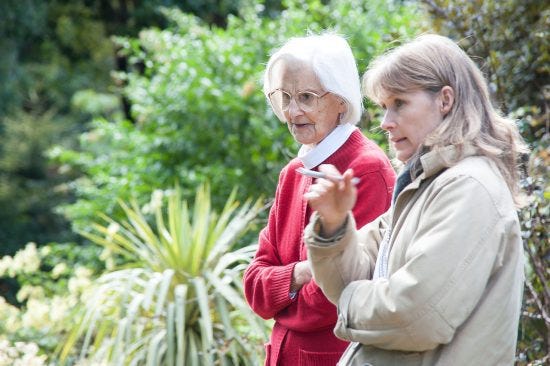
One of my beloved garden heroes — the late Pam Harper. (photo credit Daniel Weil)
Many engaged gardeners were fascinated by the organisms that inhabited our gardens, but we were not ruled by them. We were allowed to dislike the sawfly larvae that defoliated our dogwoods; or delight in our mother’s joy at her Buddleia covered in swallowtails, as we walked barefoot on the mown grasses and weeds she happily called lawn.
The more curious amongst us looked to the native lands of the plants we loved, studied their communities, and attempted to match them where we could. And at the same time, this was not a period without difficulty. We had little in common with consumer-gardeners who sprayed first and asked questions later; and the real effects of a changing climate on our gardens made our jobs more challenging.
But a lot of us put our heads down and navigated a new era with flexibility, adaptation, curiosity, commiseration, and a certain amount of positivity.
That was – wait for it – okay.
The mainstreaming of a more ecological approach to gardening accelerated around 2007 with Dr. Doug Tallamy’s Bringing Nature Home, which linked the use of native plants to the support of insect and bird populations.
Tallamy was a respected entomologist and professor at the University of Delaware, but his name quickly became shorthand for a massive gardening movement. The fact that I can mention him by last name only to a group of inexperienced gardeners, and see instant recognition in their eyes; but need to explain who Dan Hinkley or Fergus Garrett is, tells me a great deal.
The fact that they can invoke his name to end a discussion tells me more.
Tallamy had many good things to say that made a great deal of sense. Here’s one from his third book and New York Times bestseller, Nature’s Best Hope: A New Approach to Conservation That Starts in Your Yard (2019):
“Gardening is like cooking. It is tempting to cook only with the goal of achieving great taste, with no thought of healthy eating, but that often results in tasty concoctions so full of fat, sugar, and salt that they are deadly in the long run. Similarly it is tempting to garden only for beauty, without regard to the many ecological roles our landscapes must perform.”
I’d swap out ‘could’ for ‘must,’ but the analogy was a good one, and the lesson, clear: Be responsible. Many gardeners shared his concern for the steep declines in bird and insect life — including me. I was a GenX kid who remembers windshields gruesomely splattered with bugs before the expansion of no-till herbicides and Roundup-ready corn in the 1990s transformed American agriculture.
But although Tallamy lamented dead fields and development, the overall message of remediation and responsibility was instead directed at gardeners to use primarily native plants in their landscapes to “save Nature.” And “to set an example, maybe even proselytize a bit” to convince their neighbors to work within the concept that “life begins with natives (and ends with aliens).” (from Bringing Nature Home)
“What if each American landowner made it a goal to convert half of his or her lawn to productive native plant communities?” he proposed in Nature’s Best Hope.
Tallamy’s wish was beyond aspirational. Most engaged gardeners would be dancing in the streets if 20% of their neighbors stopped treating their lawns with chemicals and planted a small non-native tree — much less replaced the lawn with a native plant community that required skill to implement successfully.
Some of us carefully read Tallamy’s imperative- and pejorative-laden books (curiously at odds with his gentle demeanor), and justifiably wondered what would happen if gardeners continued to be guided to use chemicals sparingly; and the indignation, research, and activism was instead directed at bigger fish.
Specifically — the corporate agricultural practices that chemically deaden tens of millions of acres of green, buzzing life in spring; genetically modify the subsequent crops and their pollen; and finish with yet more chemicals in autumn to desiccate cereal crops.
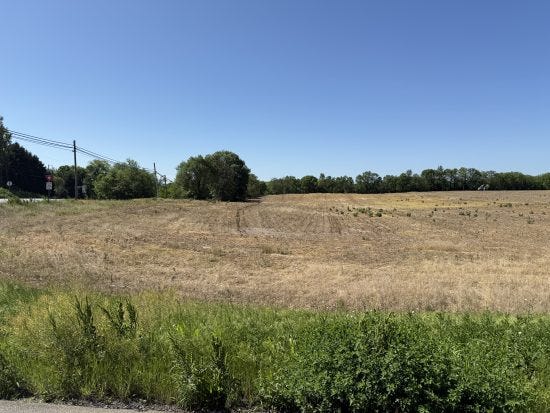
What if we stopped focusing on old Mrs. Taylor’s desire to plant an exquisite Wisteria floribunda ‘Alba’, or use a teaspoon of glyphosate to paint a resprouting stump because she couldn’t afford the help to dig it; and instead focused on the 200-gallon vats of glyphosate, Dicamba, and 2,4-D killing everything on the farm next door?
Tallamy assured us that, if the task of converting our gardens was beyond us, we could simply hire someone who was an expert.
“There is a multibillion-dollar landscaping industry ready to do whatever we ask to our properties if we are not interested in puttering ourselves.” he wrote.
Poor Mrs. Taylor.
Compassionate gardeners are a much easier target than BigAg when building a big, new, movement. (FYI Tallamy’s latest book is How Can I Help? Saving Nature with Your Yard.)
For one, there is that multibillion-dollar landscaping industry that Tallamy mentions and Mrs. Taylor can’t afford, just waiting to push the next trend on those who can afford it. And another multi-million-dollar herbicide industry is very happy to paradoxically pivot, and provide ecological gardeners and policy makers with righteous vats of the stuff for the invasives Tallamy confidently terms “ecological tumors.”
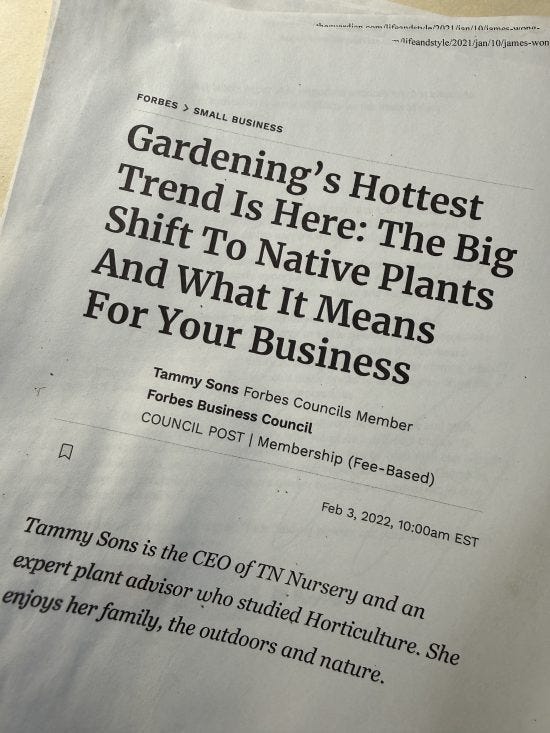
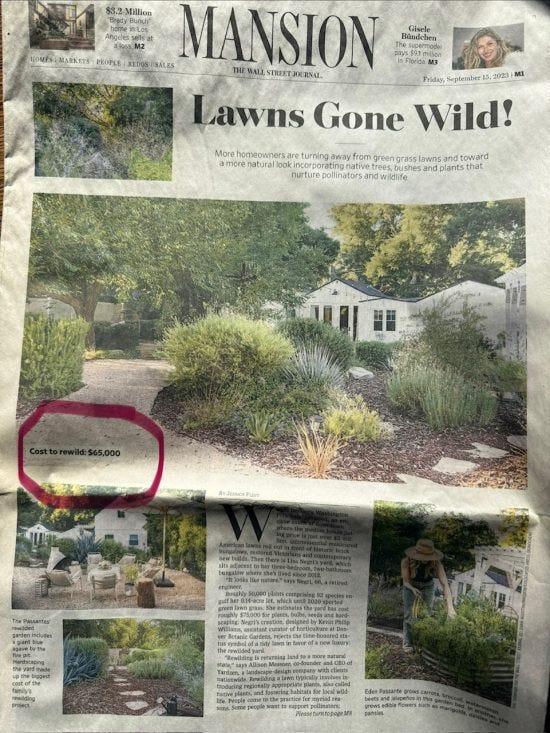
But it’s more than that. Not only are gardeners intrigued by the natural world and navigating a changing climate in real time, their individual voices are much smaller than Monsanto’s.
Old Mrs. Taylor is easier to influence; and probably content to do less gardening and more observing anyway. Her 35-year-old granddaughter who loves birds and butterflies and never liked topiary is excited to be part of a good cause. Gardeners in general are anxious to do the “right thing.”
And what is the “right thing?” Good question. In Nature’s Best Hope, we found out.
Building on broader ideas generated from his work with graduate students in the Mid-Atlantic, Tallamy shared a study conducted by one of his students researching one species of chickadee in 159 nest boxes placed during the nesting season in the Washington DC metropolitan area. The three-year observational study utilized data collected by technicians and volunteers and concluded that the Carolina chickadee achieved replacement rate in gardens with less than 30 percent introduced plants.
The study hasn’t been replicated, and several confounding variables that could bias the results existed, but that did not prevent an energized audience specifically tasked with proselytizing from creating a new math assignment for gardeners.
From that point a 70/30 natives to non-natives guideline (Epic Gardening gushingly calls it a ‘rule’), began to surface at every Master Gardener meeting from Oakland to Philadelphia. Never mind the fact that, even at a broader Level II perspective, California gardened in four ecoregions as close to Washington DC’s Southeastern USA Plains, as Chile was to Belgium.
Gardeners were now tasked with creating a minimum of approximately 70% native plant biomass (by cover or composition) in their suburban, urban and rural landscapes to sustain breeding bird populations as a whole, prevent the sixth mass extinction, and prevent censure from their peers.
Raise your hand and question the new math as an experienced gardener with a buzzing, but inclusively biodiverse landscape that featured many non-natives, and you were assured (often with a big smile), that it represented great compromise. After all, if life ended with aliens, you should be happy you had 30% to play with.
“I’ve heard somewhere that there’s a 70-30 rule. You know where that 70% figure came from? My lab. So yes, I agree, there’s room for compromise. No compromise on invasives, they’re ecological tumors. But you can have your ginkgo tree, just don’t let it dominate your landscape.” – Dr. Doug Tallamy in conversation with Zane Irwin of GRID.
How gracious. Later, in 2023, in the Growing Greener Podcast with author and Ranter Emeritus Thomas Christopher, Tallamy would back up a little, discuss keystone species research, and admit that it might not be as simple as a reductive ratio:
“…we have found that it’s not just native versus non-native, it’s particular natives versus everything else. I could build a 100% native landscape that supports very few insects because there are a lot of natives that just don’t support a lot…86% of our [native] plants are not driving that food web.”
But the horse was very much out of the barn by that point.
With the new 70/30 super formula, an onerous and moralistic goal was laid in front of any gardener who had the temerity to plant something non-native that excited them – only to find that, not only was it not recommended, it was frowned upon. Gardening became a homework assignment, and there was no shortage of catastrophizing instructors with red pens in hand.
If you were determined to plant it, “you should consider” planting two times as much of something else that you had no interest in growing in order to offset the ecological harm you were obviously causing to the entire planet.
And again, ladies and gentlemen, please avert your eyes from the browning field across the road.
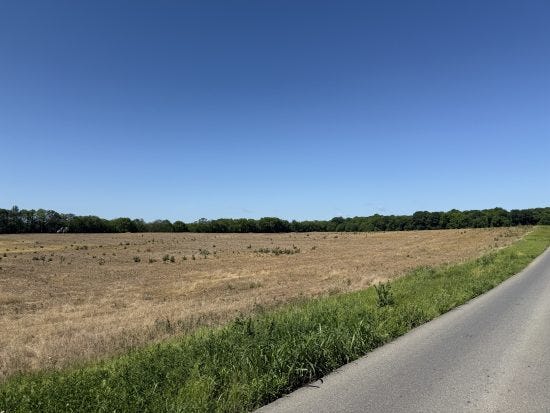
Garden columnist and podcaster Margaret Roach unintentionally illustrates the gardener’s new burden in her bio for the New York Times.
“As our climate evolves, and with it our environmental awareness, the art and practice of gardening are evolving, too. Once a subject that emphasized the ornamental, gardening now increasingly pursues ecological goals, requiring plant and management choices that are not merely aesthetic.”
It should be noted that Roach does not specify “ecological gardening”, but “gardening.” That’s an important omission. And ‘requiring’ is a powerful word.
Then social media got involved, and nuance went out the window.
Further guidelines spread virally in easy-to-share memes from big organizations — messages such as ‘Leave the leaves!’ and ‘Leave the stems!’ And while both were compassionate ecological statements fully justified in post-wild spaces, and with merit in garden situations (particularly for those with bigger properties), they were not universally applicable.
They were also less workable than it first appeared. Recent observational research has suggested that you may need to leave stems a lot longer than you thought, and that there is no magic moment when everything evacuates the leaves smothering your lavender. That’s not a problem for the ecologist, but another source of guilt for the gardener.
All of this of course makes it impossible for gardeners seeking a quiet life and a butterfly bush to argue against new rules for maintenance, new authoritative policies, new definitions of beauty, and new motivations for gardening that have ever-so-slowly edged the actual gardener/artist out of his or her own painting — even if that painting happily included native brushstrokes and organic methods.
To garden for oneself and one’s family is to be obviously selfish, irresponsible, ignorant, uptight, out-of-touch, and, most recently, privileged – with all the subtle and not so subtle implications therein. Who has the stomach to go toe to toe with that?
Over-exaggeration? Here are just a few quotes from New York Times writer Margaret Renkl’s 2021 piece “What you may not know about those April flowers.”
“The typical suburban yard is actually worse than a wasteland. It’s a deathtrap.”
“In the American South…any tree or shrub that is greening up or blooming [in March] almost certainly doesn’t belong.”
“It’s not too late for you to do the same [plant native trees/shrubs] in your yards and in your towns.”
Or Washington Post columnist Dana Milbank, from his 2023 article “I’m no genius with genuses, but your garden is killing the Earth.” (No really, that’s the title.)
“I did almost everything wrong.”
“I am part of the problem.”
“I am sorry to say that if you have a typical urban or suburban landscape, your lawn and garden are also dooming the Earth.”
Renkl goes on in her piece to angst over all the plants given to her by her late mother that once gave her joy but which must now be destroyed when she can work up enough righteousness to overcome pointless sentimentality.
Milbank spends 1000+ words in a struggle session worthy of Mao, and follows up later with another extraordinary article “To save the birds, I’m killing my farm” where he directs a drone flying at 30 feet to deliver a dose of poison to those “ecological tumors” and every other living creature within range of the nozzle.
Including — amusingly — himself.
Mary McAllister documents the evolution of this political writer gone native plant ideologue and proselytist much better than I have done here on the website Conservation Sense and Nonsense. I urge you to read her summation, his article(s), and more importantly, all the comments — many of which betray a deeply disturbing religiosity that I and others have commented on in the past.
That’s just legacy media. In new media, we’re in for more focused self-flagellation (presumably using whips made of native species such as Salix nigra or Cornus sericea).
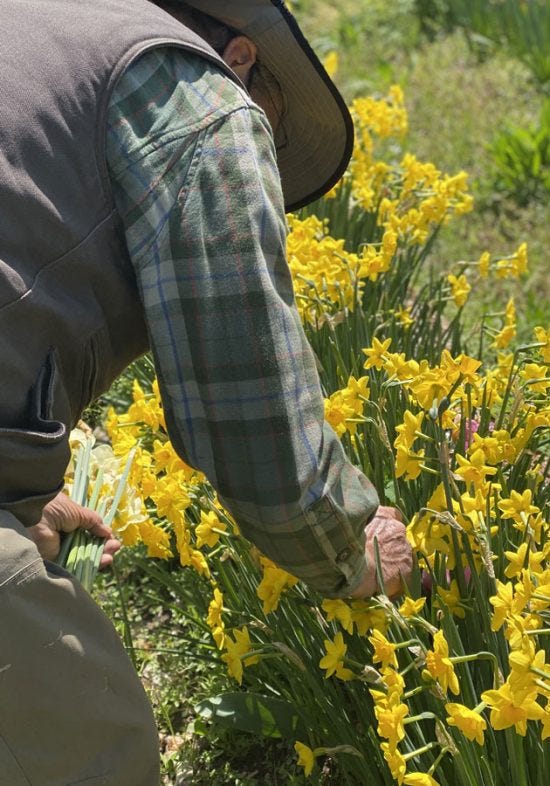
Author Benjamin Vogt from his piece “On Daffodils, Climate Change, and Colonization” on his former blog Monarch Gardens:
“We need a deep, deep rethink and daffodils, at least in the hort world, often become that flashpoint as we reckon with how hort is a part of our privilege, and how our identities are so wrapped up in it we feel we need to defend that privilege because we assume we’re being personally attacked when larger systems are being critiqued”
Question the new orthodoxy and it proves your complicity. Guilt awaits no matter how you answer. Brilliant. Though Vogt’s piece assures us that the daffodil police aren’t coming to arrest us, he gives us the distinct impression that if it were up to him, they would.
Or writer and “ecologically obsessed horticulturist” Rebecca McMackin, who provides her readers with plenty of pejoratives and politics, right along with horticultural information, in her Grow Like Wild Substack newsletter; and adds a trigger warning for the Rutgers University link that helps gardeners find pollinator-attractive plants. “Be warned.” she tsks, “The database also contains exotic plants.”
Shockingly, Rutgers meant all of the pollinator-attractive plants, regardless of origin.
Or at least it does for now, until enough pressure is applied from loud, ‘concerned’ ecological gardening voices within and without academia.
Then it might go the way of Penn State’s “Center for Pollinator Research”, which has evidently scrubbed the idea of objectively studying non-native and native plants as part that research, or making it transparently clear that this is what they are doing.
Their extensive “What to Plant” materials for gardeners makes no mention of this fact, and provides only native plant species without divulging this key (and usually lucrative) variable. Hmmmm. From the website:
“The Center for Pollinator Research has created taxa-specific plant guides for gardeners that want to support pollinators. Plants were selected for a high degree of attraction in most temperate North American landscapes, using data from entomologist Charles Robertson (1887-1916). Each guide includes herbaceous perennials, shrubs, and deciduous trees. Planting a variety of flowering plants will support a diversity of pollinators.”
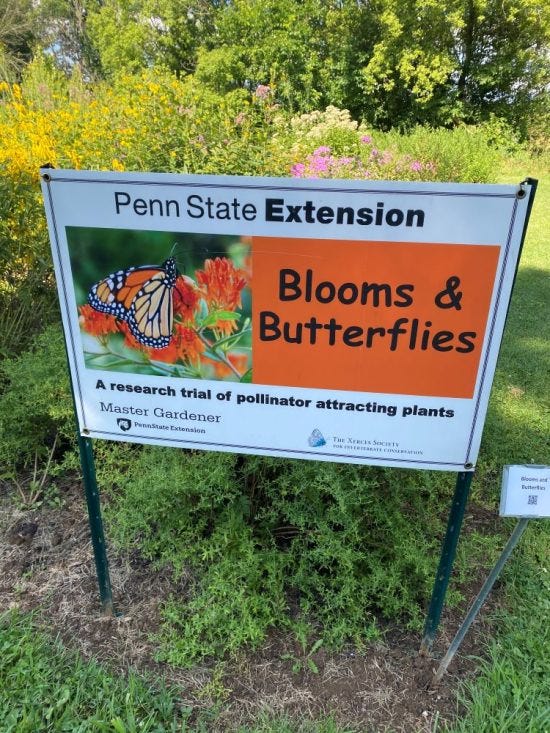
Objectivity and trust goes out the window when you create and study a subset, then package data as if you aren’t. They need a rebrand – may I suggest “The Center for Native Plant Pollinator Research?”
If they’re not naturally cynical, gardeners subjected to this unrelenting message begin to feel that perhaps they should spend the rest of their gardening lives:
Eradicating non-natives and invasives;
Planting natives. Any natives;
Encouraging all wildlife (such as white deer, rabbits, gophers, tics, & sawfly);
Redefining their deeply flawed perception of beauty; and, most critically,
Making others around them do the same.
And I suppose, if most were truly happy in this strident place, it might make sense to lose one’s voice, trade in one’s heroes, and join them. But it is patently obvious that this is not the case.
Instead there is a preponderance of negative emotion suffusing the literature, the memes, the forums, the newsletters, the comments, the lectures, the podcasts, the books, and the webinars – anxiety and unease draped in a thin veil of professed joy. Much like a stressed employee smiles through clenched teeth.
If you specifically question the joyful despair online or across a table as I have, you’ll likely encounter another circular argument –
“Of course I’m despairing, not enough people are following the rules…”
“Maybe you’ve made too many rules…?”
“Because our very existence is on the line, and people need to follow the rules!” etc. ad nauseam
Meanwhile, many of the laudable pioneers and often moderate, truly joyful, voices in the native plant, organic lawn, and ecological gardening movement lose out – because there’s no traction in moderation. Their important message of stewardship and synergy is tarnished by the bad data, bad journalism, and catastrophizing of others.
And it makes it that much harder for them to reach once-curious gardeners who feel as if they have been backed into a corner; and who have no desire to practice or preach the “existential multitasking” now required of them — regardless of the speaking fees it commands.
There is another way.
When we choose to garden with optimism, curiosity, and resilience, we don’t have to pretend to be joyful. We just are.
We can welcome the valuable perspective, observations, and research of an ecologist, and create something truly special in that synergistic space. But we can also reject absolutes and political labelling, study adaptation, call out bias, question inconsistencies, and refuse to engage with botanical xenophobia – moving toward a more balanced ecological gardening movement that many of us were happy to sign up for in the first place, and which still has gentle, knowledgeable, leaders.
When you speak up, you’ll find that it breaks the internal, uncomfortable, tension between what you want to question and what you feel you cannot question – allowing you to find more nuanced answers, no matter where they lead. Don’t let others redefine that uncomfortable tension as evidence of your inherent selfishness. Or treat your questions with condescension or contempt.
The gardener’s voice matters. It celebrates the artist, just as it champions the steward; and it deserves respect in a world that is increasingly artificial, anti-human, and littered with distractions. If we do not defend it, we will lose it. And we run a great risk of turning off gardeners who were once turned on. I entreat you to speak up with courage in your gardening circles – your voice empowers others who do not know how to reclaim their own.
This post originally appeared on Garden Rant and is reproduced here by kind permission of Marianne Willburn.
Comments
Nothing yet. Say the first thing.
Sign in to join the conversation.