
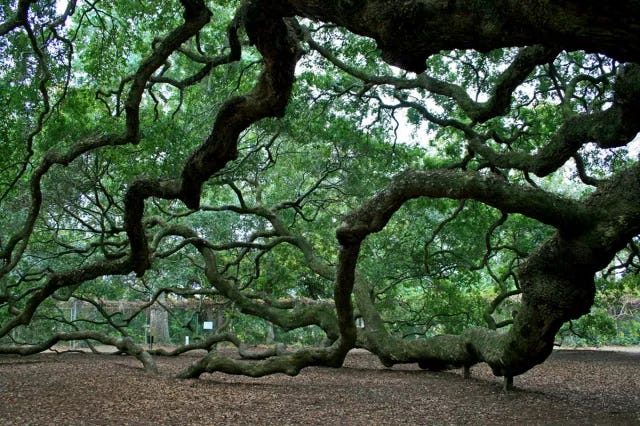
I promised to write more about one of my favorite trees which I introduced in last week’s blog post.
The last time I visited Angel Oak, in January 2026, I bought a little book at the adjacent gift store: The Angel Oak Story (Ruth M. Miller with Linda V. Lennon).
The first thing I found annoying was the fact that this booklet was published in 2018 but gave tree measurements taken in 1981. Couldn’t someone have measured the circumference of the trunk and the length of its largest limb since then? Seriously?
The author went into some detail about Britain’s King Charles II granting his loyal supporters tracts of land in the “New World,” back in 1663 when Europeans first came to this area which is now South Carolina. By 1700, Baptists, Huguenots, Jews, Presbyterians, Puritans and Quakers kept flooding in. The sea islands at that time were the lands of the Cussoe Indians. The author only briefly mentioned how their land was “bought” in exchange for cloth, beads, and other merchandise. No mention of what happened to the original inhabitants after they were dispossessed of their land. Where did they go? Did they understand that “selling” the land by accepting cheap goods would mean they could no longer fish, hunt and raise crops there?
Jacob Waight, a Quaker from London, obtained large land tracts on Johns Island where Angel Oak is located. Along with his brother Abraham, they became prosperous planters by growing rice, corn, and indigo. But wait - they didn’t exactly grow these crops themselves. Even though Quakers were opposed to slavery, the Waight Brothers ended up owning enslaved people. According to the author: “the Waights bowed to the realities of life in Carolina and worked their plantations with slave labor” (p. 19). Well, wasn’t that a convenient bypassing of your religious beliefs excused by economic “realities.”
The Civil War destroyed most of the buildings on Johns Island. The freed slaves settled there after the plantation owners left. An African-American woman, Septima Clark, was a school teacher on Johns Island between 1916 and 1970. She lived in Charleston but, as a Black woman, was not permitted to teach in the city’s schools. So she came to Johns Island for six months each year to teach Black children there, one of only two teachers for 132 students. Ms. Clark described the impoverished and unsanitary conditions during those times. She remembered the children playing around Angel Oak tree, a favorite tree to climb and have picnics underneath. She also mentioned that some people still saw the ghosts of those who had been killed there during slavery. The author chose the word “killing” over the likely more accurate word “lynching.” The white lady who owns the Angel Oak property vehemently denied that any such killings took place there.
Who do we believe - an African American woman who taught there for over 50 years and heard all the old stories or a white landowner who may be inclined to sugarcoat her family’s slave-holding past?
Angel Oak is able to hold it both: grandeur and joy and awe, along with a certain melancholy, a vibration of a past that saw much pain and suffering. She has seen it all…
If you are looking for an escape into nature with delicious guided activities to immerse yourself deeply, take a look at my upcoming retreats:
Nature Reconnection Retreat: Crafting a Deeper Bond with the Earth
June 12 - 14, 2026, Yogaville, Virginia. Click for more details & registration
Between Tides: Nature, Creativity & Renewal, October 8-11, 2026, Chincoteague Island, Virginia. Click for more details & registration
If this is the first Seasons of a Wild Life post popping into your inbox, you can find out more about me and my mission here: How Did You End Up Here.
If you are a follower on the app, please consider becoming a subscriber by providing your email. Each new post gets delivered directly to your inbox!
Comments
Nothing yet. Say the first thing.
Sign in to join the conversation.