
Dear Nonnie Friend,
In my rush on Tuesday, I got confused. I thought this weekend was July 4th which, obviously, it isn’t, and I told you there would be no post today, which, obviously, this is. I could blame my goof on the Gnomes, but that would be cowardly and dishonest, so, yeah, my bad. In short: Here I am!
As for July 4? I’m taking off this coming week, giving me catch-up time to work on NBH posts and Ye Dreaded Book. Don't feel you're missing out: For you as a Nonnie, the entire collection of more than 650 NBH posts is open for browsing whenever you like, another great way to enjoy NBH.
And now . . .
My Odes to Joy
You're not imagining things: Joy turned into a bit of a theme at Non-Boring House in the past week or so. On Tuesday, I wrote about a gay couple who turned derelict miners’ cottages and Cornish pasties into theatre in a small Midwestern town. This was decades before TV cook Julia Child introduced America to French food, and the gay liberation movement became a thing. And the guys launched their cheerful project during the Great Depression.
Meet Bob Neal, Edgar Hellum, and the magical world of Pendarvis:
I know it must seem insane of me to write about Cornish pasties, two theatrical pasty-baking blokes in Wisconsin, and Scottish comedian Will Fyffe (as I also did last week). Aren't I supposed to be a historian? Don’t I have more important, more serious things to write about for you?
Writing about song, dance, and joy may not be as whimsical as it looks. We don’t often think of the past as a happy place, do we? Of course, it often wasn’t, just like the present. But history is at least as much about people doing things as it is about people having things done to them. The stories that many historians—including me— love the most are those that show ordinary people taking an active leading role, as individuals and groups, and often without even meaning to. And that includes reviving joy.
I mean, look at all the Scots who just cheered up Boston! Tragedy and disaster happen, of course, but agency—taking action— rather than victimhood defines human history. And all through the past, community and even joy happen amid stress and sorrow.
Joy isn’t just distraction from serious issues or selfish indulgence in hard times. Joy is the best part of life. Joy recharges our batteries for dealing with life’s more rotten bits. How, I thought, have people without loads of money found joy in life in the past, even during hard times? Is there a history of happiness? I’m happy to say that the answer is yes! I’m putting the book I have in mind near the top of my reading pile so I can write about it for you. For historians, joy is serious stuff!
Meanwhile, thinking about joy, I thought of music. I realized this was a great moment to write about long-ago Scottish comedian (and my distant relative) Will Fyffe. His songs blended empathy, humor, and joy, especially during the Great Depression, and, developed b for a music hall (vaudeville) act, they encouraged singing along.
When it comes to Will Fyffe and joy, I especially think of The Belle O’the Ball, better known as Bonnie Wee Jeannie McColl. This song’s about a young man’s joy in meeting his true love at a wedding. Will Fyffe wrote it in 1929, right before the Great Depression. This song was perfect for its times, and it is still good now.
I know many of my readers don’t like to click on links, but there are some things I just cannot put into words, and music is one of them. I beg you: Please have a wee listen below.
Fyffe’s short song and his monologue, sandwiched in the middle, are both in Scots. Even if the words confuse you, I bet you enjoy Will’s cheery enthusiasm and Dundee dialect. The song is meant to be sung along with, so go for it if you’re in the mood, and just make up your own words if you like. That’s joy!
Bonnie Wee Jeannie McColl has just done the rounds among Scottish World Cup football fans with revised lyrics. Instead of “a nice wee lass, a fine wee lass” we get “a fine wee team, a bonnie wee team”. That’s what makes this a folk song, a song sung by people for their own pleasure, a song that people make their own. Any song can be a folk song!
Thinking “joy” “folk” and “Cornish” together got me humming a tune from an event believed to be among the oldest cultural celebrations in the UK. Then I thought of the joy this event inspired in a young spectator, an outsider. She in turn, wrote a song about that day, called The Floral Dance, which (with or without its words) became one of the most popular folk tunes in 20th century Britain, even experiencing a revival when it almost beat Paul McCartney to the top of the charts.
The Joy of Flora Day
Whether they’re having good times or bad, on one day every year, usually May 8, the people of the English town of Helston (population 11,000 or so) take to the streets.
Led by the local band playing the same simple but catchy tune over and over, Helston’s people parade through their town, dancing in pairs, changing partners at regular intervals, even dancing through homes, shops, and offices.
Everyone gets to join in: The first dancers start at 7 a.m., many of them folk who need to be at work that day, women in cheerful flowery dresses, men in shirtsleeves and ties. About 9:30 a.m. the local children, more than a thousand of them, dance through the streets in white uniforms.
Then, at noon, comes the big event: Thousands of Helston people take to the streets in their finery, wedding hats and best frocks for the ladies, top hats and tails for the gents. Thousands more people, visitors as well as townsfolk, line the streets as spectators.
Finally, the last dance is at 5 p.m., the end of the workday, when the morning dancers return. And that concludes the annual Furry Dance, on Flora Day, in Helston. After that (I assume) all the adult dancers head to Helston’s pubs for more celebration of community
History of this event? A lot, I'm sure, but hard to know any of it. I can tell you Helston is in Cornwall, home to Cornish pasties, and the Cornish language, which is descended from the language spoken by ancient Britons, and related to modern Welsh and (more distantly) Scottish and Irish Gaelic. Declared dead in the 1970s, Cornish has since had a bit of a revival, with some people learning it as a second language. Otherwise, it survives in fragments. One of those fragments is in the name of the Furry Dance.
One day every year, the people of Helston dance the Furry Dance, and they have done so for centuries. “Furry” has nothing to do with people dressing in animal costumes, but may come from a Cornish word for festival, which makes sense. The dance is also known as the Flora dance, referring to spring.
Telling you it's a spring festival dance doesn't really do much to explain what this is about. Why do Helston people take one day every year to dance together? The official explanation is that Flora Day is a celebration of the Archangel Michael, Helston’s patron saint, but that doesn't tell us much, either. Is Flora Day an example of the medieval church’s co-opting an ancient pagan rite of spring? Probably. Customs do not come down to us unchanged from an unchanging past: What we call tradition is almost always surprisingly recent. And in a modern secular England, which it has been for longer than you think, people need a better reason to keep up a tradition.
Flora Day is definitely a celebration of the town itself. Between dances in the morning, townspeople stage a historical pageant called Hal-an-Tow (nobody quite knows what that means), which tells its story in song.
How far pageant and song go back is also unknown. As is often the case in cultural history, clues can mislead us. A disparaging reference to Spaniards in the song might not be random, but refer to the attempted invasion of England by Spain in 1588, or a 1595 Spanish raid on a nearby town. A reference to Shakespeare was added no earlier than the mid-1950s. A mention of the Archangel Michael was added to the play only in the 1930s, and the most recent religious reference to a medieval Cornish bishop snuck in in 2005. This recent history shows that the song has changed, no surprise, but the very fact that Helston reminds itself every year that it has a past—no matter how dodgy the actual history described—is very cool.
Who knows when all of this started? Documents don't help much. A letter made a passing reference to Helston’s dance in the 1790s, and suggested it was old even then. But this custom belongs mostly to heritage, to people's ideas about the past, not documented history. This is why we talk about things dating back to “time immemorial”. That literally means before memory, or even the documents on which historians rely.
Most of all, Flora Day and the Furry Dance are a celebration of being together, of community. The marching bands’ music frequently prompts everyone to change partners as they parade through town. No doubt, everyone finds themselves dancing with people they don’t know, or do know and don’t like, so dancing is a great way to cement and repair community. Maybe they see and greet each other in town a few days later. Maybe they start a conversation. Maybe they plan a date.
The dance as it's practiced today also reveals community divisions. The early morning dance was reportedly introduced for servants who had to get to work. The noon dance was at some time reserved for the posh people—hence the top hats and tails. This ensured that the local gentry didn't have to dance with riff-raff.
I suspect this exclusive dance for the posh likely was not that old of a custom. Many old folk festivals were about “the world turned upside down”, with poor men as king for a day, or otherwise papering over class differences, rather than reinforcing them. And the top hats and tails certainly aren't old —very 19th century.
Today, the top hats and tails remain, but all the town’s adults are welcome to dance together at noon, and my guess is that the top hats are borrowed or rented. The town’s children are also involved these days, with a dance of their own in the morning, a custom started in the 20th century. Everyone wears a flower, a lily-of-the-valley, the symbol of Helston.
Flora Day is also about keeping up a sense of place. By the time the day is done, you know where you live. You know what the people look like, the streets, even the insides of a few homes and businesses.
This reminds me of the medieval custom of the beating of the bounds. Traditionally (whenever that was) boys were taken on a walk around the boundaries of their village, and whipped along the way to help them remember the invisible walls around their community. Over time, the whipping went away: As early as the mid-18th century, a writer in a village in the nearby county of Dorset noted that the poor wee souls were slipped a half-penny coin to make them feel better after they were beaten.
Today, beating of the bounds is still observed in some villages and towns in England, including Cornwall, only now the kids (girls, too) are handed sticks with which to hit the boundaries themselves, not each other. Why do this strange thing at all? These are reminders of community, of a sense of place. This custom was on the books, sort of, in America, in parts of early New England, applied only to local politicians strolling the boundaries, without whipping (pity). Even so, like so many such customs in America, so large, so diverse, and always on the move, it has faded away.
The Band Plays On
Even as times and places and people have changed in so many ways, modern recording tech show us how the music and dance on Flora Day in Helston have stayed largely the same over the past century plus.
Here’s 1921, three years after the end of the First World War. The film was made a few years before sound came to movies, but the dancing is clearly on show, and it really hasn't changed much. I cued the film to a cool bit for you:
There had been change, though: There always is. I wonder if there was any shortage of male dancers after the First World War took three-quarters of a million British men? The children’s dance was added in 1922, Dress and hat styles changed to reflect flapper fashion.
Here’s the joy and pride of the Furry Dance thirty-five years later in glorious color, in an increasingly prosperous Helston (and Britain) still recovering from World War II, in 1955:
And finally, here’s Helston in May, 2026, a time in which Brits yearn to be cheered up. I'm struck by changing bodies, just starting to be understood as the product of the over- processed modern diet:
There are similar customs in some towns and villages in Cornwall, and elsewhere in England, joyous community events still hanging on in an age of miserable isolation. Hard not to see them as part of the remedy to what ails us. Well, that, and people getting out more in general.
From Flora to Floral
How did news of this local tradition and tune go national? That’s a story of 20th century Britain, of vacation travel, of recorded music, and of the never-ending human yearning for joy.
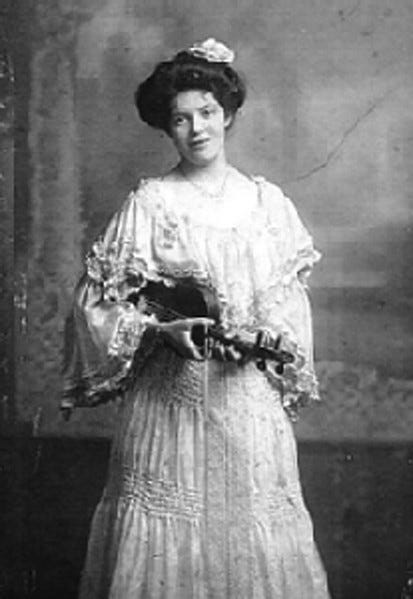
In 1911, just three years before British joy and optimism were blasted to smithereens in the trenches of France, professional singer and musician (not supermodel) Katie Moss took the train from London down to Cornwall for a holiday. She stayed in Helston, where she witnessed Flora Day. She was enthralled.
On the way back to London on the train, a besotted Moss started writing the music and words for a song based on the simple tune for the Furry Dance that's played by the Helston Band. She named her song The Floral Dance (maybe she didn’t know its real name, maybe this was deliberate to avoid confusion, no idea).
The first recording of Katie Moss’s song was made in 1912. Her music is sublime, but put together with her lyrics, the song captures the singer’s excitement, yearning to join the community of dancers, and joy when she (or he) does. For any musicians or singers out there who want to give the Floral Dance a go, here’s the original sheet music, including gender variations.
Here’s one version of the words:
As I walked home on a summer's night,
When stars in heaven were shining bright
Far away from the footlights' glare
Into the sweet and scented air
Of a quaint old Cornish town
Borne from afar on the gentle breeze
Joining the murmur of summer seas
Distant tones of an old world dance
Played by a village band perchance,
On the calm air came floating down.
I thought I could hear the curious tone
Of cornet, clarinet and big trombone,
Fiddle, cello, big bass drum,
Bassoon, flute and euphonium,
Far away as in a trance
I heard the sound of the floral dance.
And soon I heard all the bustling and prancing,
And then I saw the whole village was dancing,
In and out of the houses they came,
Old folk, young folk all the same,
In that quaint old Cornish town.
Every boy took a girl by the waist
And hurried her off with tremendous haste,
Whether they knew one another I care not,
Whether they cared at all I know not,
But they kissed as they danced along.
And there was the band with the curious tone
Of the cornet, clarinet and big trombone,
Fiddle, cello, big bass drum,
Bassoon, flute and euphonium
Each one making the most of his chance,
All together in the floral dance.
I felt so lonely standing there,
That I could only stand and stare,
For I had no maid with me,
Lonely I should have to be,
In that quaint old Cornish town.
When suddenly hastening down the lane
A figure I knew I saw quite plain
With out-stretched hands I rushed along
And carried her into that merry throng,
And fiddle and all went dancing down.
We danced to the band with the curious tone
Of the cornet, clarinet and big trombone,
Fiddle, cello, big bass drum,
Bassoon, flute and euphonium,
Each one making the most of his chance,
All together in the floral dance.
Dancing here, dancing there,
Jigging, jogging, everywhere,
Up and down and around the town,
Hurrah for the Cornish floral dance!
That’s the version from my absolute favorite recording of Katie Moss’s song, which was produced by His Master’s Voice (HMV) Records in 1934. This explains why the guys in the photo below are awkwardly posed with a little dog staring into the horn of a record player, a living rendition of the HMV logo.
The Floral Dance was sung by the guy on the left, popular bass-baritone Peter Dawson (1882-1961), born in Australia to immigrant Scots, resident in London for many years, and one of the world’s first recording superstars.
Age and looks were no barrier to musical success in the 1930s: Music and personality were the keys to popularity. We can hear Dawson’s Aussie accent break through occasionally in song, as in how he pronounces “bass”. Dawson was classically trained, but he didn't like opera, so he turned to singing popular music instead.
While Peter Dawson’s singing style, once normal, seems odd to us, associated with classical music rather than pop, Dawson's enthusiasm in channeling Katie Moss’s joy remains infectious. He’s absolutely worth listening to with an open mind and ear, through the crackles of an early 78 record from nearly a century ago:
Forty years later, in the height of the era of rock and roll, the Floral Dance (instrumental version) was an unexpected hit for the Brighouse and Rastrick Brass Band from Yorkshire, in the North of England. Brass bands were founded throughout that region in the 19th century, by working-class communities (often in mining villages) as a channel for joy in a hard life. This was the theme of the movie Brassed Off, which I highly recommend.
The Floral Dance recording was intended as a band fundraiser. But DJ Terry Wogan, a wildly popular Irishman in Britain, promoted the record on his radio show, and reminded everyone that the Floral Dance was a song, too. Speaking of joy, Terry Wogan brought a lot of it to Brits.
That's how The Floral Dance, written in 1911 and based on a very old tune, ended up the second best-selling record in Britain for six weeks, cheated of the #1 spot only by Paul McCartney’s Mull of Kintyre, which heavily featured bagpipes. These were both very unlikely smash hits in 1977.
The Brighouse and Rastrick Band came down to London and played The Floral Dance on Top of The Pops, the long-running BBC show featuring hit music with live performances, and an audience of dancing teenagers. The kids happily bopped along to the brass band, and why wouldn’t they? We young ‘uns had all bought the record, and for one moment in that year of punk rock and the Sex Pistols, our adults got to hope we weren't a lost generation. I wouldn't listen to the Sex Pistols now if you paid me, but I am happy to still listen to this:
Leap forward a half-century, to just a few weeks ago in 2026, and here’s The Floral Dance carrying on in faraway Queensland, Australia, played by the Townsville Brass Band:
Last but not least, let's step back ten years, and check out the entire audience in London’s Royal Albert Hall (about 6,000 people) singing the chorus to the Floral Dance with lead singers, band, and choir, thanks to helpful lyrics on a screen. Brits still love to sing together—and by Brits, I do mean England, Scotland, and Wales, even if they’re always threatening divorce.
Hurrah for the Cornish Floral Dance, indeed! (And for the late Terry Wogan, too)
Good luck getting that tune out of your head. But no apologies: I hope you find yourself humming and singing this ode to joy, or another song of your choice, and share it with others. I just moved the paywall so everything is visible, after I sent it to you, so you can do just that.
This week of all weeks, Americans are meeting millions of football fans traveling America, delighted by your country, and most of all, delighted to meet you. I invite Americans to remember the Declaration of Independence, to think of life, liberty, and the pursuit of happiness, of joy.
Comments
Nothing yet. Say the first thing.
Sign in to join the conversation.