
So you're driving along through a rural area when you see a sign: HISTORICAL MARKER. Maybe, like most people, you just keep right on driving.
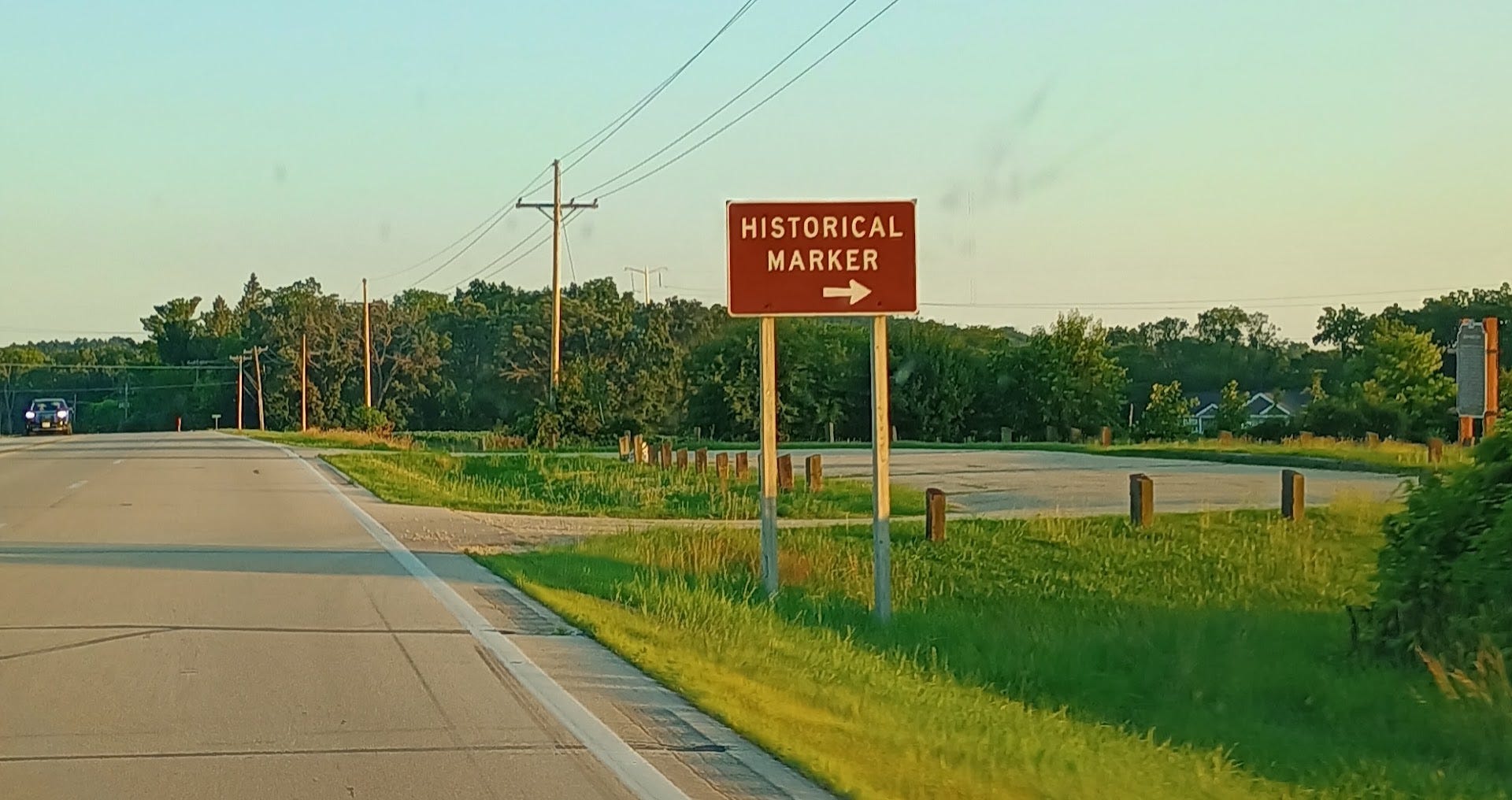
Or, if there's somewhere to pull over safely, you stop and take a look. The Historical Marker (yes, I’m using capitals on purpose) looks something like this:
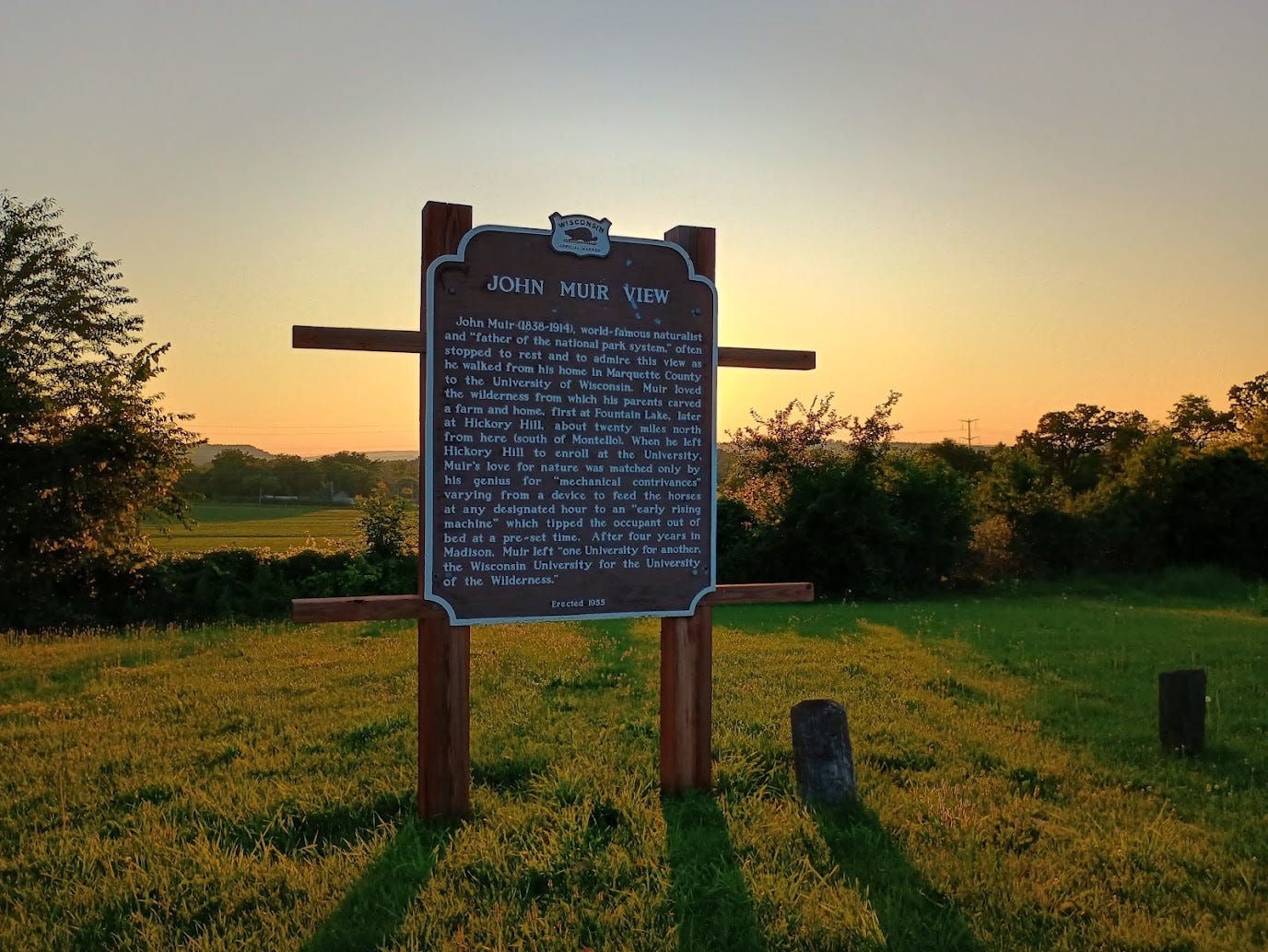
If you now find yourself peering at the marker text above, and getting interested in John Muir, you might enjoy the Non-Boring History posts this marker inspired:
A Solitary Man's Family
·
October 21, 2023
Annette and Hoosen visit the home of a pioneering environmentalist who spent a lot of time in the wilderness . . . and whose home was a big-ass mansion near San Francisco. Hold on, though, it's waaaaay more complicated than that--and the story of John Muir, his wife, and daughters is way more interesting than fiction.
All Who Wander etc.
·
Mar 28

Right after the Civil War, young Scotsman John Muir walked from Wisconsin to Florida, via the former Confederate states. Learn what he left behind, and how this walk marked the interval between his old life, and his new life, the one that made him a legend.
The John Muir View Historical Marker (above) in rural Wisconsin is unusually interesting, and it brings the lovely landscape around it to life. Not all Historical Markers are so thrilling.
Excellent question! All sorts of signs about history are plastered all over the US, but Historical Marker (my capitals, it’s an Annette thing) is the official name for a particular type of solid, official-looking, and apparently immovable sign.
“I’M HERE TO INFORM YOU,” they seem to say, “AND I AM HERE TO STAY.” They kind of look like stone tablets with the Ten Commandments, passed down via some historical Moses. How comforting! How authoritative! How informative!
If you’re a member of Non-Boring History, you know history is always more complicated than that. Like, waaaay more complicated (and that’s what makes for the best and most worthwhile and —dare I say it—most genuinely entertaining history for the public, not just for historians)
So here’s what typically happens to most of us who stop for a Historical Marker (and I include myself in this):
We read the text (sort of). We think either “Hmm, okay”, or “Wow, that wasn’t worth the stop, or maybe I’m just too tired/stupid to get it.” We get back in the car, and leave. Most likely, we never think of said Historical Marker ever again. I HAVE BEEN INFORMED, we might grimly flatter ourselves as we drive away, before amnesia sets in.
Well, maybe we have been “informed”, but we haven’t been entertained or educated. We were likely not inspired to look hard at the landscape, or excited to learn more, or caused to think critically about history. That, alas, is just how these things go. And it’s a shame, because Historical Markers at their best can be a fast, painless, and “Wow!” opportunity that makes us think and ignites our curiosity.
Thing is, permanent official Historical Markers like these, all heavy and imposing, have always bothered me a bit. They don’t invite us out loud to think about history, and, well, they’re just so permanent.
The past doesn’t change, facts don’t change (unless they aren’t actually facts, but are wrong to begin with) but history changes. That’s because history (the proper kind written by academic historians) isn’t just a bunch of facts. History is the interpretation of the past, based on facts and evidence, and grounded in the context of other scholars’ work. I realize that might be confusing, but unpacking that idea is a big theme here at Non-Boring History! That’s why I do my best to get readers to want to stay with me for the long haul. That’s very different from Historical Markers, which present quick nuggets of history, at the places where the things they describe happened. That doesn’t mean that Historical Markers are inherently bad. Think of them as the history version of fast food, easily accessible from the road, and not always unhealthy.
History is dynamic, always changing to stay relevant to us. Historical markers, though, are permanent. Or at least they look permanent.
No matter what, a Historical Marker might resonate with you, maybe because of timing, or who you are, where you live, what you care about. But here’s a question that might change everything: Who puts up a Historical Marker? When did they put it up? And why?
In 1999, the late writer James W. Loewen, who was concerned about the accuracy of much of the dodgy history aimed at the American public, published a book with the provocative title of Lies Across America: What Our Historic Sites Get Wrong. This book included his critiques of plenty of Historical Markers. That provocative title is your clue that Loewen himself was not a historian. He was a sociologist, and an activist who cut his teeth in the Civil Rights movement. Most historians aren’t activists, or separate their history from their activism, making sure that ideology—what we wished had happened- doesn’t trump evidence—what actually happened. Fortunately, facts were very much on the side of the Civil Rights movement, which is why this Plain Old Historian made time to hear Jim Loewen speak when he gave a talk at my university.
Jim Loewen’s myth-busting tone in his books drove me a little crazy, but he told me things I didn’t know, and he did know his limits. He was careful to consult many historians, and he used facts to make his points. Dr. Loewen found a lot of Historical Markers lacking, especially the older ones.
Good man that he was (and he really was) Jim Loewen, a sociologist, was an iconoclast, a debunker. As an old-school historian, I’m less interested in sensationally pointing fingers, and more interested in who puts up Historical Markers, when these started, and how —unlike most markers themselves— Historical Marker programs have changed.
I plan to write more about Historical Markers in future here at NBH, but for now, here are some questions my US readers may want to think about when you next consider stopping at a Historical Marker:
Who puts up Historical Markers?
Who suggests them?
Who writes them?
Who verifies them?
When was a marker put up, and why does that matter?
How does all that work today?
Non-US readers may find these questions useful too, for comparable kinds of public markers in other countries. Don’t worry, there are no tests at NBH, and it’s ok if you don’t have the answers to these questions, or know how to get them. Even just asking such questions makes us think!
Enjoy today’s post? Sign up now (free or paid) for more of the varied, entertaining, and thinky things historian (and normal person) Dr. Annette Laing writes:
That said, I decided to make a trip behind the scenes to talk with a public historian who manages the historical marker program in one US state, to get some answers for myself, and for a project I’m working on. We had a fantastic conversation, and I decided to share it with paid subscribers at NBH. This Bonus is visible below to annual, monthly, and patron members, in case you’re interested in eavesdropping on our chat about how Historical Markers in one state come to be. I bet you’re really surprised which state she works in—They have a particularly strong program, and, no, it’s not in somewhere obvious, like Massachusetts (nothing against Massachusetts!)
Change With the Times?
·
Aug 18
A nerdy doctor who collects everything. The addictive drive of sugar that ruins millions of lives. Trafficking of adults and children. What defines slavery. One extraordinary and troubling life in troubling times.
Are you a historical marker fan? Or a sometimes stopper? Or do you pretty much ignore them? What draws you to historical markers, or turns you off?
Comments
Nothing yet. Say the first thing.
Sign in to join the conversation.