
The sky was a jeweled earthly blue as my husband and I walked along Nedonna Beach. I was on a mission, perhaps a folly over the years, to somehow plant my feet in every inch of Oregon coastal sands. A nearly impossible mission, given the shifting of grit, but a mission nonetheless that I had only stated aloud to him in that moment.
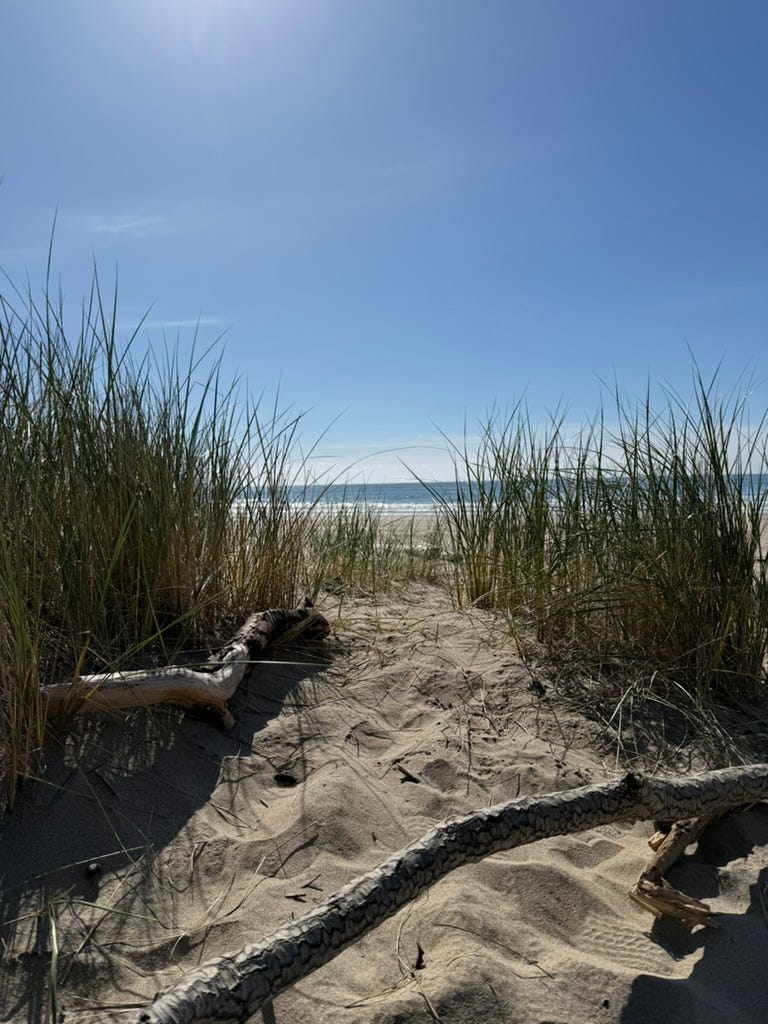
The wind tempered to match our moods. I removed my trail shoes and socks from my Ohio winter-white feet, with toenails painted to match the sky. Despite warnings from my orthopedist about going barefoot due to a torn ACL, my naked feet sunk willingly in the soupy sand of between ocean and land. Thwuck, thwuck, thwuck. The silt between my toes was a welcome irrigation of emotional and physical toxic buildups. The sucking went on in near desperate measures, as if the sea were unable to let me go.
Stepping alongside of me, his feet not in the water, my husband asked, “What is it that draws you toward the ocean?”
At first, I laughed. This man I’ve lived with for twenty years did not know how I worshipped the spirit of life in a different sort of way? For me, everything that comprised of this oceanic life held magic for me.
But what, specifically, was it that drew me in?
The ocean is a universal being I can believe in.
The ocean’s temperament is predictable—and yet unpredictable.
The sea keeps things hidden forever; one could hide within it, and outside of it.
The sea takes things away, and bring them back in another form.
The water body is a metaphorical Savior and salvation.
It is always there, reliable, dependable, even its unpredictability is dependable.
The waves wash in like a large eraser wiping clean the slate of my messy mind. One doesn’t have to think here. One actually can’t.
My list continued on for some time. We passed from beach access number 24 to number 25. The yellow highlighter signs delineated entrances for emergencies. I wanted to mark my own passages between these markers on land, simulating or somehow replicating the breadth of sea.
In the past 30 years, over several hundred “sleeps” as children might say, there had been so few stretches of time, seasons of believing and transformation, when I had relished in the depths of what this ocean, each access to this body of water, each particular picturesque seascape, meant to me.
The first, when I was pregnant and gave birth. The second, when my first husband was diagnosed with cancer and died. This now, within the ticking clock, the birth of a granddaughter, Harper Jo, bringing alive to me all the sorcery of the sea. Harper Jo and the Magical Coast. Titles for children’s books often write themselves, don’t they?
*
Several days of blue, like a cranky blue, a gray whale blue, and a blinding blue—without wind—are rare along this coast. Pacific gusts gather their energy from the Arctic and blow their cold breaths down the skeleton spines of shoreline. I’m reading the book, Astoria, about the founding of the port of Astoria, Oregon. The men (and a few women) in the overland and seafaring parties sent to establish the new outpost in the late 1800s and early 1900s, without a thought, hopped aboard East Coast frigates or stretched dead horses’ skins across canoes to port themselves through the titanic wilderness or entangled waves, all to establish a trading post. Adventurers they were.
I, on the other hand, was easily transported here by Uber, plane, and a ghastly experience of a rented Dodge Hornet, arriving fully intact, no bludgeoning, no bullets, no trading of fur pelts, having only travailed through the overland and high seas of life events.
For four days, my loyal mate at my side, we traversed many trails and tracks of the Oregon coast.
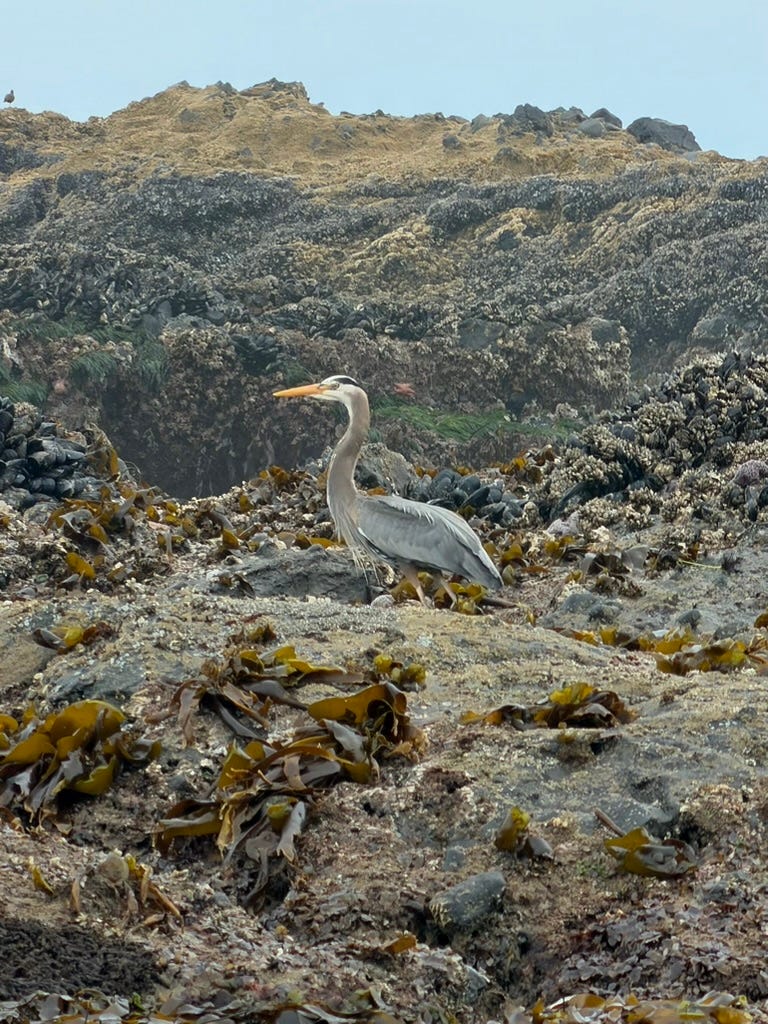
We had risen early our first morning to drive to Cannon Beach and welcome the Tufted Puffins in this annual rite of their return to one soaring sea stack. But the list of marine life and marine animal life we witnessed was more than those parrots of the sea: a pair of herons, each eyeing the other across the basalt rocks, an eagle patrolling like a Coast Guard helicopter, a pod of pelicans in early morning in wait mode yet to dive into the icy water so soon before coffee, and raft of common murres, a floating congregation of them, preparing to plunge upwards of 400 feet to fish. The sea sparkled as they bounced on the waves. Seals starred in the circus as their shiny proboscis, like little hose nozzles, waited to playfully squirt the murres.
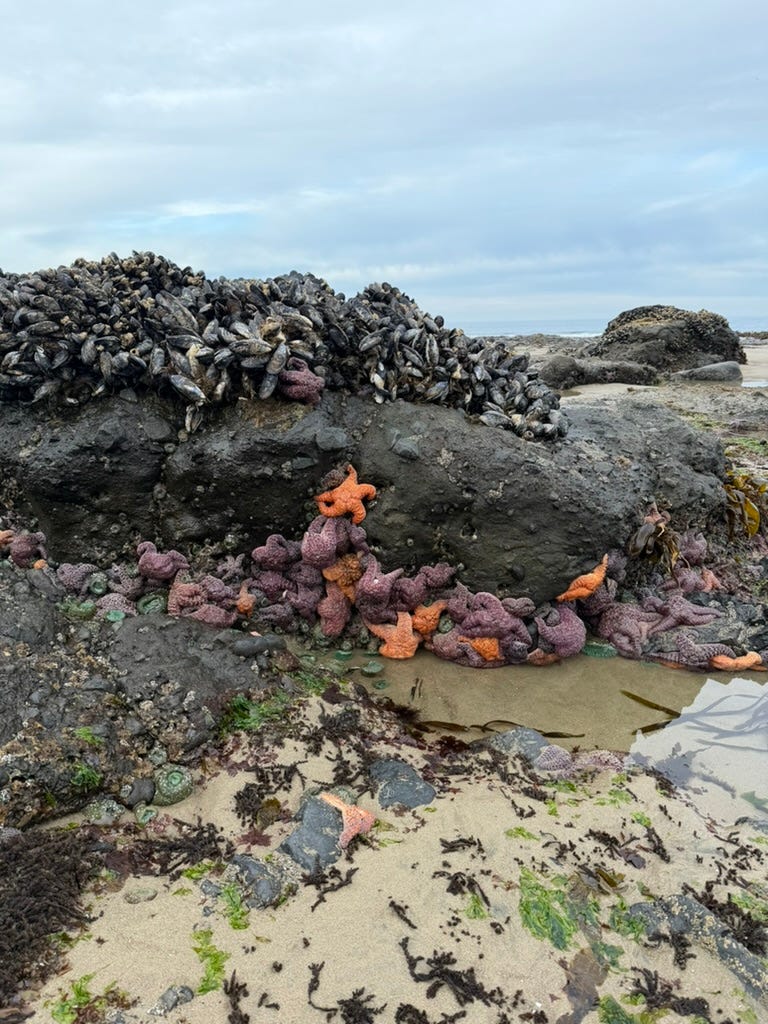
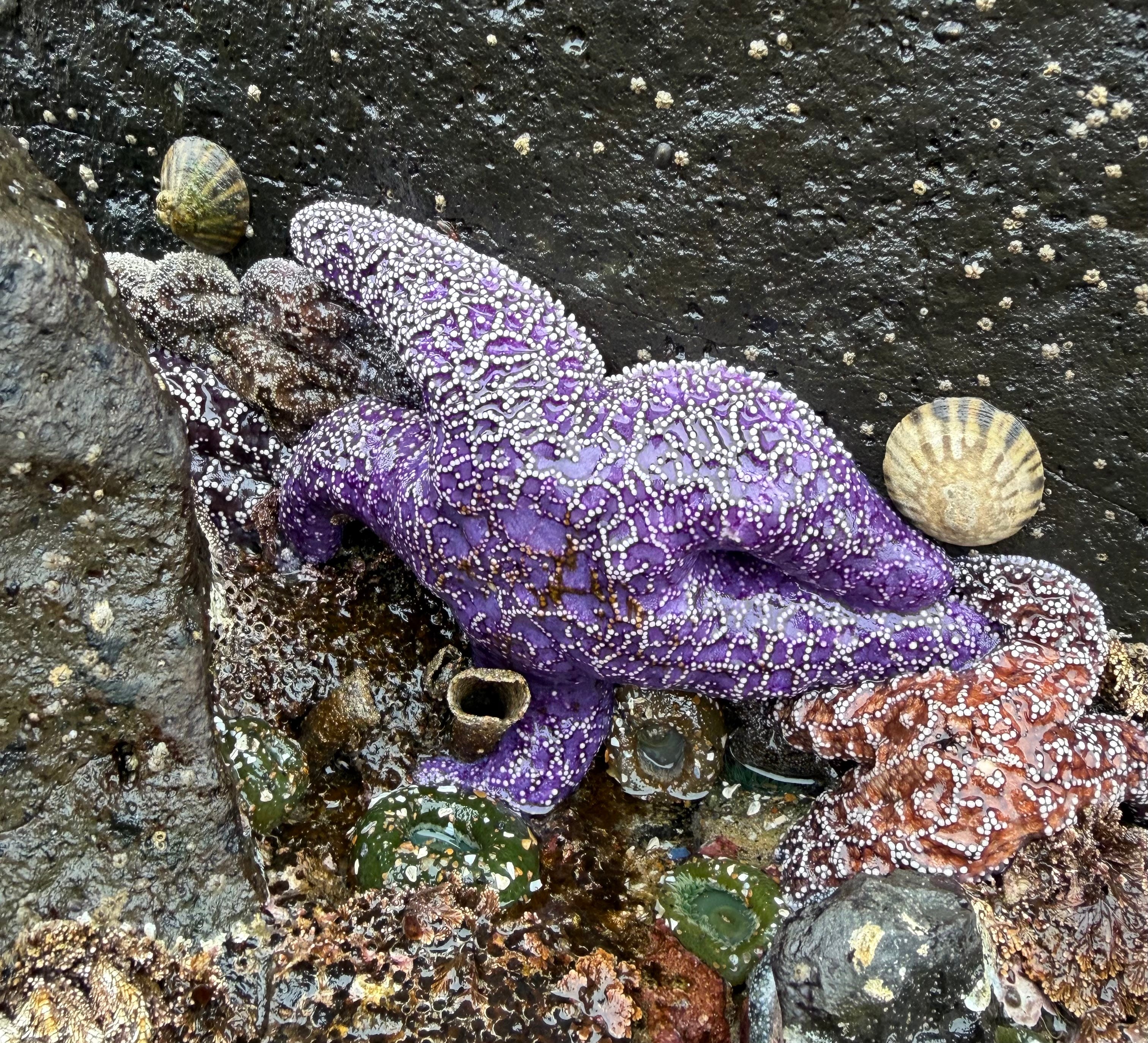
A larger-than-my-fist-anemone. Extra plump sea stars hanging over top of one another, rarely uncovered at normal tides suddenly revealed at negative low tides, their lumpy arms like old Italian women, flabby, flapping, dishing out the scoop on what was happening below the surface. The crustose stage of Turkish red seaweed, (Turkish washcloth) tarring the rocks, bull weeds yanked from their kelp beds by monstrous swells. All the little lives that addled me, in a good way, in my adventures. Yet they all existed for themselves and their own ecosystems. Not mine.
A talk I’d attended—at the Cincinnati Zoo—only a week earlier about the effort to restore the sea otter population along the Oregon Coast was also lodged deep in my sea psyche. Sea otters were last seen in Oregon in 1910, following the outcome of the brutal fur trade. They still swam in my imagination as I drove roads, walked paths, and came upon the names of Otter Rock, Otter Crest, Otter Beach. The ghost of the sea otters lived on, might again.
*
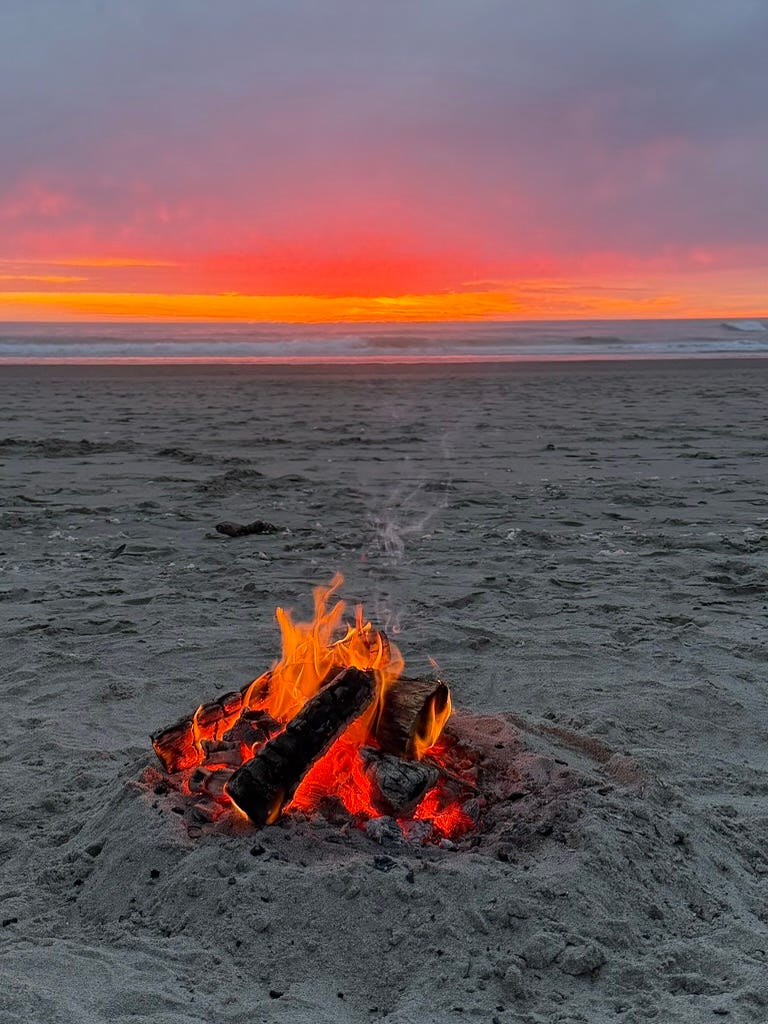
Each night, we found our way back to the same roost, like the puffins, to stop and refresh, to let down from any letdowns for the day, spark a fire or wait for mother nature to light the match.
On our second to last night, I didn’t want to make a campfire, mainly because this involved some trekking back and forth and up and down 50 stairs with chairs, wood, and a bag of s’mores supplies. Mark offered to carry the burden. Begrudgingly, I helped.
The sun dipped at 8:07 a.m. Right on time. The air cooled quickly, quietly. But the campfire burned fierce, the strands of firewood thicker than those from the cord the night before.
We didn’t talk much, each of us content in our coastal captivity. Mark poked at the fire with sticks we’d left behind the night before. A marshmallow burned, an apple core was thrust into the embers to add to the burnt sugars that tickled my nose. My nose too was in the book Astoria. Or maybe it was Lázár, a fictional generational family saga written by a 22-year-old. All family stories are sagas. It’s where we find our most primordial emotions. There, and the sea.
My eyes stung, grew weepy. I looked up to avert the smolder of smoke. And screeched.
Surely my voice sounded for miles up and down the shoreline. I jumped up, knocked over my beach chair, ran around the fire accidentally kicking sand specks into the bag of near-stale marshmallows.
Beyond the roundness of the earth, the sun’s rays spread into arms of red, fuchsia, orange, golden, flames. And with all its brilliant muscle, lifted up graying skies heavy with a low-hung fog and, if one can imagine, pressed back the dark seas. A glimpse into another world where I could slip away.
After 453 photos of sunsets in western Oregon (not including ones earlier than 2016), I didn’t know how to properly celebrate this marvel. I’d like to think there were no words for the phenomena. Only a breath taken away and returned in answer to what draws me here.
May 10 - Mother’s Day, Something Italian is the perfect gift for Mom! Paid subscribers will receive an opportunity to purchase a signed copy of Something Italian at a discount rate. Something Italian. Look for an upcoming information in the next post coming this week!
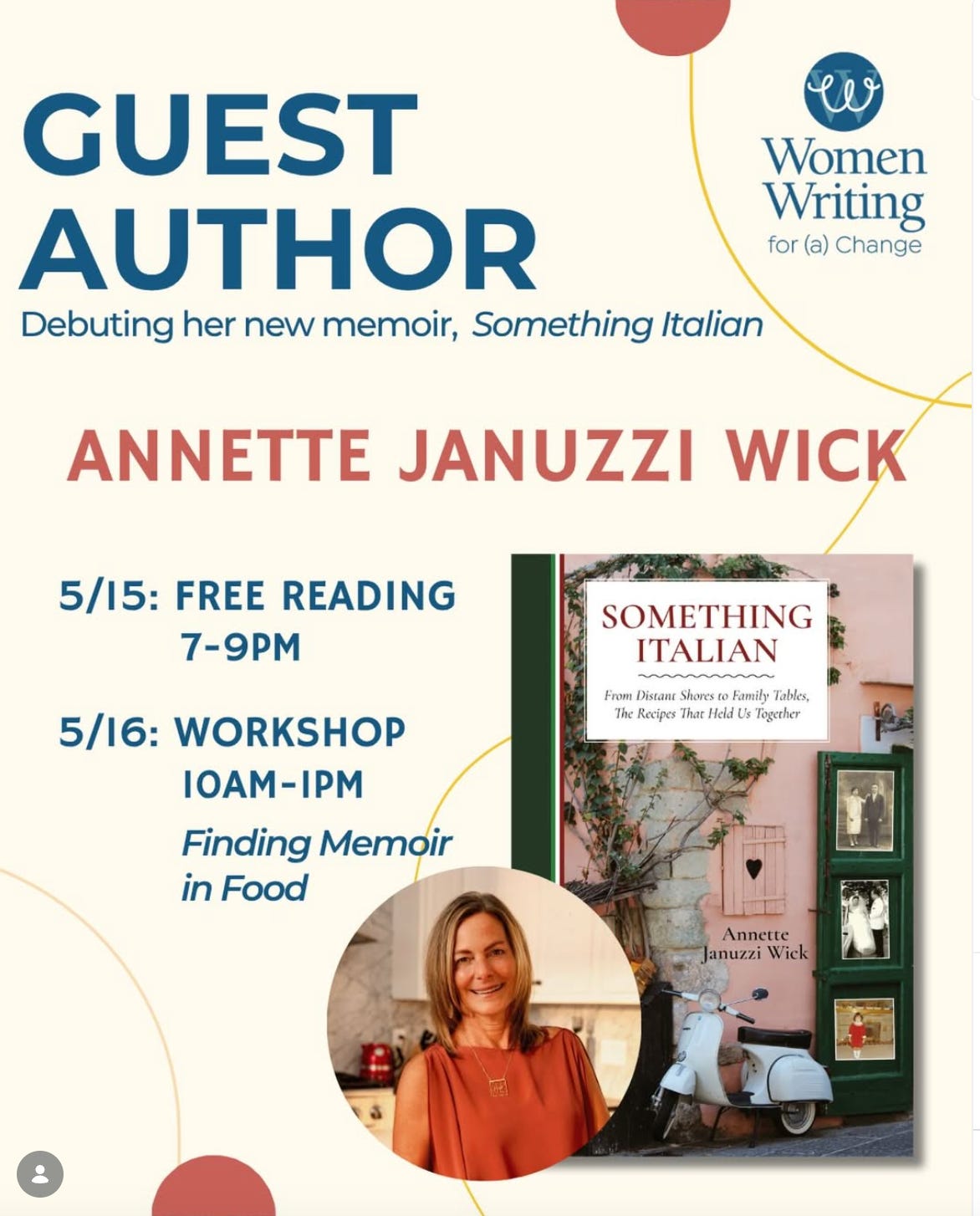
May 15 - 7 p.m. Women Writing for a Change - Friday evening book talk.
May 16 - 10 a.m. WWfaC - Finding Memoir in Food writing workshop. Renowned chef James Beard writes, “Food is our common ground, a universal experience,” providing us with a center as we seek commonalities among others.
July 28 - Caring for the Caregiver Writing experience, virtual, FREE. REGISTER. Contact Kara Pierson Harper. Phone: (513) 244-5494. Email: kpierson@muchmorethanameal.org.
Oct 15, Oct 29 - LitCleveland - Finding Memoir in Food. Sign up for LitCleveland here, or return here for details.
October 21 - Lloyd Library and Museum in partnership with Fotofocus, Presentation - Chestnuts: The New Comeback Kids.
No posts
Comments
Nothing yet. Say the first thing.
Sign in to join the conversation.