
“One does not go from the darkness of ignorance to the light of knowledge without rereading with ever more ardent love the works of the Ancients.” - Peter of Blois.
In my previous post, I highlighted three authors who laid the vital foundation for the intellectual life of the Middle Ages. In this post, I will focus on three historical “renaissances” that took place before the Italian “Renaissance.”
The terms are more convenient than strictly accurate, perhaps, but I will use them with the caveat that this is a glorified blog post and not a scholarly article so I will prefer clarity over pedantry.1
The reason for these more historical posts is that I find it easier to understand the history of education in its larger context of the historical movement of Europe, and it is hard to escape the conclusion that being a member of the educated class revolved around studying the ancients in some way, whether first or secondhand. However, the way in which education developed through the centuries heavily depended on what was available.2
For that reason, I have been focusing on what ancient Greek and Roman authors were available and how various authors interacted with them.
The authors I highlighted in my last post particularly represent the 4th and 5th centuries AD, and I touched on the Carolingian “renaissance” of the 9th century AD, but there are two other time periods I would like to put in play with the Carolingian Renaissance. The time period would be roughly the 600s-1100s AD, in what used to be called the “Dark Ages” (to varying degrees and for many different reasons).
But what was going on, exactly? Was it “dark?” We have ceased calling this time period “the Dark Ages” simply because that doesn’t describe it very well. All evidence points to the fact that it was decently well-lit.
Francesco Petrarch, the luminary Italian poet and early figure of the Italian Renaissance, appears to have coined the term when he realized how little he knew of the classical world. He felt as though he was bumbling in the dark and that his predecessors must also have been doing the same to at least some extent. His remarks have been very important in the historiography of the Middle Ages, and it is only more recently that scholars of the time period have moved away from using the term.
In the twilight of the Roman Empire, we encounter men like Boethius, Cassiodorus Senator, Chalcidius, Macrobius, Lactantius, and Martianus Capella. All of them were learned men who had access to the scholarly texts of Plato, Aristotle, Cicero, Quintilian, Augustine, and others. Boethius was a significant figure because he translated Plato and Aristotle into Latin, and one of his intellectual projects was reconciling Plato and Aristotle.
All of these authors will resurface in various ways over the following centuries and play a role in the unfolding of history and I will take a brief look at three “mini-Renaissances” that took place before the Italian Renaissance: the first in the 700-800s AD, the second in the 900s, and the third in the 1100s.
I touched on some of these historical periods previously, but I will revisit them again as they provide helpful context.
In the 6th century AD, Benedict of Nursia founds Montecassino and the Benedictine Order. The creation of monastery culture was very important for the intellectual world as it created the environment in which books and learning could be promulgated. Monasteries will be of absolutely central importance to the development of education and intellectual life through these centuries after the fall of Rome.
The Benedictine Rule contains nothing about copying books, of course, nevertheless, the institution of the monastery would become the culture that would allow for the preservation of knowledge as many monasteries would come to house valuable libraries, and even produce texts of their own.
An important author from this same timeframe (570-636 AD) was Isidore of Seville who wrote what amounts to an encyclopedia called Etymologies. This oft-cited classical encyclopedia spread rapidly through Europe which marked the end of the Roman encyclopedic tradition.3
Now, what seems to have happened on the continent during the 600s onward is that many in the intellectual world just lost interest for awhile in the texts of Greek and Roman authors, largely due to their perceived threat to morals and doctrine. Also scarcity of parchment and writing materials would have played a role as well, leading to the greater prioritization of Christian texts over classical ones.
As I wrote in a previous post, scholars in England and Ireland had far fewer qualms about these classical texts and seemed to have treated them like artifacts rather than as threats which enabled the texts to remain preserved somewhere. The slow disappearance of knowledge of classical antiquity on the continent was a sad event, and averted only by what sometimes seems like nothing short of a miracle. We have the English and Irish to thank for preserving classical learning.
One testament to the slow erosion of classical knowledge is the existence of palimpsests, many of which come from the monasteries of Luxeuil and Bobbio which were founded by Anglo-Saxon missionaries who were trying to reestablish the Christian faith in a darkening Europe. Because of the scarcity of parchment, old texts were effaced and reused. Thanks to modern technology like infrared imaging, we can read underneath the later text, but that is a modern innovation.
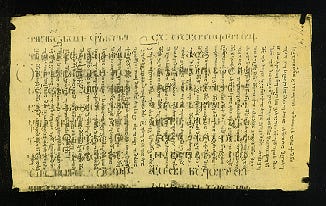
Plautus, Terence, Cicero Ovid, Vergil, Juvenal, Livy, both Plinys, Sallust, Seneca, and others were scrubbed in favor of other, Christian texts. We only know any of Cicero’s De Republica because it was palimpsested, and overlaid with Augustine’s Commentary on the Psalms. For a Christian who is also a classicist and loves both Cicero and Augustine, this causes complicated feelings.
If there is any point that we might consider “dark” from the very narrow perspective of classical texts, it might be this. Perhaps also because Europe was perceived at this time to have already lost Christianity and needed to be re-evangelized, leading to the establishment of new monasteries that would eventually help the revival of classical learning.
In the midst of these “dark ages” of the 600s, however, we find scholars such as Aldhelm and the Venerable Bede, around the same time that the great monasteries at Iona and Lindisfarne had already been around for a century in Scotland and had kept a little spark alive. English scholars would carry the day now.
Aldhelm, the abbot of Malmesbury Abbey, was a scholar of Latin poetry who wrote prolifically. He studied with a certain North African scholar named Hadrian who had become the bishop of St. Augustine’s in Canterbury. Aldhelm apparently learned quite a lot about Roman law and poetry from his teacher, and also according to some accounts had learned a smattering of Greek and Hebrew as well.
The Venerable Bede is the “father of English history” and is the one who popularized using the “Anno Domini…” system of dating to which I stubbornly cling. He is the most important scholar in that period between the end of the Roman Empire and the Carolingian Empire. He knew some Greek, and certainly had familiarity with the giants of Latin literature and the Church Fathers, though it is unknown how much direct access he had, or whether he had gotten his quotations from encyclopedic works like that of Isidore of Seville. His best-known work is The Ecclesiastical History of the English People, which is written in a clear, lucid Latin style and is undoubtedly one of the most important texts written in this time period.
The English intellectual world had a healthier respect for the classical tradition during this century, which resulted in Bede, Aldhelm, and also Alcuin.
Now we come to the first of the “little renaissances.”
The English intellectual world, about a century after Bede, produced the scholar Alcuin (735-804), who would return to the continent to serve as the court scholar for Charlemagne and would also be instrumental in the formation of the cathedral schools. But more importantly, he would be a part of a movement that would encourage the careful re-copying of these Latin texts and the establishment of cathedral schools and a general increase in literacy.
There is a book that most likely comes from the court of Charlemagne that provides a collection of sayings, poems, and a partial catalog of the court library (Diez B Sant. 66), which was certainly magnificent and filled with rare gems of literature. We believe that many of the best surviving manuscripts we have now were ones produced at the palace scriptorium in Aachen, modern-day Germany. In this way, many Latin texts survived. After Charlemagne’s death, however, many of the books in his magnificent library were dispersed to various monasteries.
After this first “mini-Renaissance” there was a Saxon revival in the 900s (sometimes called the Ottonian Revival after the three kings named Otto who belonged to this dynasty). During this second European renaissance more libraries were created, more copying was done, and more cathedral schools were founded in Germany and abroad. The development of the Germanosphere is especially marked during this time. Furthermore, certainly political developments in the Ottonian dynasty brought Europe into closer proximity with the East (which meant contact with Greek language texts and eastern art).
The monastery of Bobbio in Italy was especially important for this small Ottonian “renaissance” because it supplied many of the texts that were carefully studied. We know during this time that Boethius’ translations of Aristotle surfaced during this time, in a collection called Logica Vetus, as well as some titles by Cicero. We know of one nun named Hroswitha of Gandersheim who wrote verse dramas based on the Roman playwright Terence. She is also considered the first German female poet, though she only wrote in Latin. From this we can see that there was a vigorous culture for a brief time and that it continued to revolve around study of the Roman authors, and secondhand knowledge of Aristotle.
This Ottonian Revival also sparked a greater interest in the quadrivium subjects, and spurred on scientific innovation. This is also the time when Arabic numerals were introduced by Fulbert of Chartres, so it was generally a fertile time for the development of science and technology.
But there was yet another “renaissance!”
This third revival is sometimes called the “Twelfth Century Renaissance.” This is the time period that belongs to Geoffrey of Monmouth, Abelard and Heloise, Scholasticism, Gothic cathedrals, and the vernacular German epics like Parzifal and the Nibelungenlied and Tristan. Aristotle and Boethius are revered at this time.
(Boethius even appears in carved effigy on Chartres Cathedral in France, and the west portal of the Cathedral even displays a depiction of the 7 Liberal Arts).
![West portal, tympanum of left door. It depicts Christ on a cloud, supported by two angels, above a row of figures representing the labours of the months and signs of the Zodiac[33]](https://substackcdn.com/image/fetch/$s_!31jA!,f_auto,q_auto:good,fl_progressive:steep/https%3A%2F%2Fsubstack-post-media.s3.amazonaws.com%2Fpublic%2Fimages%2Fc3a7d70c-5417-45d1-81d3-fd74f62f12da_800x700.jpeg "West portal, tympanum of left door. It depicts Christ on a cloud, supported by two angels, above a row of figures representing the labours of the months and signs of the Zodiac[33]")
Another interesting aspect of the 12th century renaissance was the role of Islamic scholars. Spain had been conquered by the Umayyad Caliphate from North Africa between 711-720 AD. These Muslim scholars had translations of Aristotle into Arabic that they studied very carefully, and which would soon spark a translation craze that would emanate from Toledo, even after Toledo was recaptured by the Christians in 1085.
During this Twelfth Century Renaissance, the first universities begin to form in Europe, and the members of these institutions try to collect what little Greek learning is left at this point, largely from Boethius’ commentaries on Aristotle. Some Greek learning was also preserved in the 1000s via Italy and Sicily, which maintained a curious trilingual culture with Greek, Latin, and Arabic represented.4 Sicily maintained friendly relations with the Greek-speaking East, which allowed some important Greek texts to trickle through, like Claudius Ptolemy’s Almagest, a treatise of mathematics and astronomy.
However, this twelfth century “renaissance” was very heavily concerned with science and mathematics and astronomy.
Scholasticism also begins to develop during this time beginning with Anselm of Canterbury the “father of Scholasticism.” Scholasticism is of course famously lampooned through history for various reasons but what it really seems to have represented was yet another attempt to reconcile Catholic Christianity with the pagan past, particularly philosophy, culminating in Thomas Aquinas’ Summa Theologica. This movement was largely centered on Aristotle’s various works on logic, though it had a smattering of influence from the Neoplatonists and whatever else filtered through from antiquity. It was a serious intellectual movement, and one that was yet again centrally concerned with the place of the pagans in a Christian world.
Besides Boethius, someone who also reappears during the twelfth century is Martianus Capella, through the works of a certain Bernardus Silvestris, a Platonist and a poet. Silvestris wrote a very Platonic work called Cosmographia which is about the creation of the universe, in a prosimetric style like Capella’s De Nuptiis which I touched on in my last post. It is clearly very heavily influenced by Boethius and Capella, among many others. Silvestris also wrote a commentary on De Nuptiis which testifies to its enduring importance as a guide to general learning and philosophy.
What was most important about these little “renaissances” is that they were a further means of preservation and they do also prove that the classical works never really died or passed out of knowledge. The Muslim scholars of Spain were instrumental in preserving knowledge of Aristotle, and they also produced a huge body of Greek scientific and medical work that was soon being translated out of Arabic into Latin. Some translation from Greek into Latin was also taking place in Venice, beginning with Aristotle’s complete Organon which was all of his works on logic.
One of the most famous of the Muslim scholars was Averroes (Ibn Rushd) who left an enormous body of texts including thorough commentaries on Aristotle. His translations helped reawaken Europe to the world of Greek thought especially as Toledo suddenly became a hugely important translation center. This spate of translations in Toledo was instrumental in preserving a lot of the scientific and medical knowledge of classical antiquity such as the writings of Aristotle, Galen, Hippocrates, Hiero of Alexandria, and Archimedes.
The Twelfth Century Renaissance and the emergence of Scholasticism are the backdrop against which the Italian Renaissance takes place. Many things are all happening simultaneously in Europe in the course of these centuries, and the center of gravity for intellectual life shifted frequently. England maintained its intellectual centers in places like Canterbury and Malmesbury, while for a time in the Carolingian Renaissance, Aachen Germany was the center of gravity, and the Ottonian dynasty would promote intellectual culture for a short time after that. Then the center shifts to Spain and Italy although complicated by the constant state of warfare entailed by the Reconquista, which took several centuries (~720-1492).
What I hope is clear from this post is that the importance of the ancient authors was never fully forgotten, and everything that happened in Europe was built on the foundation of classical antiquity.
For this reason, Latin education became the central concern of a cathedral school education. Clergy needed to know Latin not only as the universalizing language of the church, but also as the language in which science, medicine, theology, philosophy, and literature was being produced, even while vernacular languages were also developing rapidly.
Latin education that taught students to read Latin (truly read, not just diagram sentences like we do nowadays) provided a fertile intellectual soil for literary talent of all kinds, though there is also evidence that the study would wax and wane, depending on time and place.5
As we move closer towards the Italian Renaissance, something interesting happens. Dante Alighieri’s Divine Comedy represents a serious break from the expectation that a poet as brilliant as Dante would write his epic in Latin. Dante made a risky choice by writing in the Tuscan dialect (so argues the scholar Dr. Jason Baxter in his various classes and writings on Dante), which indicates just how entrenched the expectation for Latin and classical models was at least in some intellectual circles.6
After Dante’s lifetime, however, Italian humanism would promote a new passion for the texts of classical antiquity and their preservation and create a new generation of Latin poets (such as Angelo Poliziano who also learned to write beautiful Greek verses as well as Latin). Italian humanism would lead to the highly scientific work of textual criticism that would go a long way to restoring the integrity of classical texts so that future scholars could keep the spark alive.
Exegi monumentum aere perennius
regalique situ pyramidum altius,
quod non imber edax, non aquilo impotens
possit diruere aut innumerabilis
annorum series et fuga temporum. Horace Odes 3.30.1-5
“I have built a monument more lasting than bronze, higher than the regal site of the pyramids, which neither the biting storm nor impotent Aquilo can topple, nor the endless passage of years and the flight of the times.”
(Some) Sources:
A Beginner’s Guide to Dante’s Divine Comedy by Jason M. Baxter. Baker Academic: 2018 Intellectual Life in the Middle Ages: Essays Presented to Margaret Gibson
Intellectuals in the Middle Ages by Jacques Le Goff trans. Teresa Fagan. Blackwell: 1993
Petrarch and His World by Morris Bishop. Indiana University Press: 2002.
The Bookseller of Florence: The Story of the Manuscripts that Illuminated the Renaissance by Ross King. Atlantic Monthly Press: 2021.
“The Greek Element in the Renaissance of the Twelfth Century.” Charles H. Haskins The American Historical Review 25, no. 4 (1920): 603–15. https://doi.org/10.2307/1834924.
“The Rise and Fall of the Latin Classics: The Evidence of Schoolbook Production in Twelfth-and-Thirteenth-Century Italy.” Robert Black Aevum 91, no. 2 (2017): 411–64. https://www.jstor.org/stable/26497009.
The Twelfth Century Renaissance by Christopher Brooke. Harcourt, Brace and World: 1969
Scribes and Scholars: A Guide to the Transmission of Greek and Latin Literature by L.D. Reynolds & N.G. Wilson. 3rd edition Oxford UP: 1999.
I try to keep the footnotes and citations to a minimum in these posts because I find them distracting in Substack articles, but pretty much every claim in this article can be found reinforced in the books I cite in my source material.
There seems to be a deep-rooted misapprehension in some popular history that Greek authors like Plato all but disappeared during the Middle Ages, which is not true at all. According to Charles Haskins (cited above) there were Latin translations of the Meno and the Phaedo available during the Middle Ages.
Ancient Roman encyclopedists would include Pliny the Elder, Varro, and Aulus Celsus, all of whom wrote volumes of general knowledge with the idea of trying to encompass as much human knowledge as possible.
Haskins (1920): Amalfi maintained a very well-developed trade with Constantinople and Syria in the 1100s and 1200s.
It did wax and wane depending on the time period. One scholar argues that there was a marked decline in the study of Latin classics in Italy in the 1200s, though there were still many works being written on topics such as classical rhetoric for example Buoncompagno’s Rhetorica Novissima written in 1215.
I learned this primarily from a webinar he taught in 2023 for the House of Humane Letters where he advanced the argument about Dante’s risky move in choosing the Tuscan accent which was at the time seen as the accent for country bumpkins. After Dante, the Tuscan dialect would be the prestige dialect.
No posts
Comments
Nothing yet. Say the first thing.
Sign in to join the conversation.