
These thoughts are derived from a larger project I have been working on, which necessitates reading a lot about the history of the study of Latin and Greek through the centuries, which has always fascinated me.
Today I was struck by the part of the historical narrative I was working on and thought I’d share part of it here, particularly the human impulse to “preserve” in the midst of cultural darknss, and a phrase from Petrarch that sums it up rather well.
There is something of the miraculous in the history of Latin literature after the fall of the Roman Empire, given the fact that Europe disintegrated into a complicated tapestry of warring tribes and tongues leading to the destruction of architecture and cultural, which certainly includes books (which until recently have always been extremely valuable commodities).
Books and libraries historically belong to cultural centers of power and influence and those are always among the casualties when power shifts and previous centers are destroyed to make way for new ones. One man in particular had rare foresight in a perilous political situation in the 5th-6th centuries AD as the remans of the Roman Empire had fragmented.
Cassiodorus Senator was a scholar-administrator who had served under the Ostrogothic king Theodoric the Great. After his career at Theodoric’s court, Cassiodorus went on to found a monastery called Vivarium at present-day Squillace, Italy. For various political reasons, he was not allowed to found a Christian school in Rome, so he founded one on the fringes elsewhere in southern Italy because he recognized the need for some kind of institution dedicated to preserving knowledge.
Intellectually Cassiodorus is the successor of the great Roman polymath Boethius who wrote during the twilight of the Roman Empire. His most famous work The Consolation of Philosophy is one of the most beautiful examples of prison literature that exists, and a vital link between classical antiquity and the Medieval era.
Also forming part of that link between the eras, Cassiodorus wrote one particular work in which he offers his defense of the study and preservation of secular (read: pagan) literature, carefully contextualized under the Christian aegis. This work Institutions of Divine and Secular Studies represents a significant cornerstone in educational philosophy moving forward because it shows us the Medieval answer to the challenge of pagan literature, and the deep synthesis of thought that took place in this time. Pagan authors were worth preserving, he argues, because they had very real human wisdom to offer the world, but they were ultimately not the final answer in the same way that Christian scriptures were. They were travelers by night who never saw the light of day.
The pagans still asked the most important questions that humans can ask: “What is a human?” “What is humanity here for? How do we live?” For Plato and Aristotle, the answers are various and confusing. From the Stoics and Epicureans and Cynics and Academics you would likely find as many answers as adherents to those philosophies.
The answer for the Christian philosopher in the 6th century is that man is made in God’s image, and that man exists to worship and serve God. The Fall severed mankind’s relationship with God, but man finds redemption in the person and work of Christ, who restores and heals the effects of the Fall. Nevertheless, pagan myths and philosophical systems still grasped at aspects of the truth and could offer wisdom to students, especially once properly explained. This was the final revelation and the final illumination for humanity beneath which all other human knowledge is operating in a subordinate role.
"Philosophy is the probable knowledge of divine and human things insofar as it may be attained by man,” Cassiodorus writes.1 He then writes at length on the philosophy of Plato and Aristotle and Porphyry, and the four subjects of the quadrivium. At the same time he quotes liberally from the Christian Scriptures, continually relating secular learning to the precepts of the pagan philosophy he had clearly learned very deeply.
Towards the end of his Institutes he concludes: “…it becomes clear that these studies possess no little utility in bringing about an understanding of divine law — a fact which has been pointed by certain holy Fathers as well.”
He provides an eloquent defense for the continued study of pagan literature, which was certainly very apropos in his day as the Christian church continually wrestled with the question of what to do with their pagan heritage. Even the great Augustine expressed a desire to be rid of the pagan tradition because of how it affected his thinking about divine matters. Tertullian, one of the crankiest of the church fathers, is the one who famously asked “What has Athens to do with Jerusalem?”
Cassiodorus’ voice rang out clear as a bell on this topic at a critical moment. Secular learning was not to be cast aside as worthless, but put in its proper place. Thus, Latin literature had to be preserved alongside Christian works. So the modus operandi of the intellectual in the post-Roman world was to preserve.
After the death of Cassiodorus, we know very little about what happened to the Vivarium and its books, but we know that it was important for the eventual “rebirth” of classical learning later on. Cassiodorus was not the first, but he was as far as we know the most systematic when it came to the preservation of knowledge, and his thought had considerable influence on the Middle Ages. It’s easy to see from reading his Institutes of Divine and Secular Learning that he had a very systematic and logical mind (which is probably why he was such a good administrator under Theodoric), and he had the vision to establish a monastery culture that included a scriptorium. This was the bridge over which Latin literary culture would pass into the future through many a dark night of European history.
Tangentially, these “bridge” figures between antiquity and the Middle Ages are really fascinating and deserve their own post, but they are Boethius, Cassiodorus, Martianus Capella, Chalcidius, Macrobius, and Pseudo-Dionysius, all of whom belong to what CS Lewis calls the “seminal period” in The Discarded Image. They transfer some of the key images and ideas from works like Plato’s Timaeus into the Medieval world, recontextualized into a Christian world picture. These ideas and images shape the literary tradition in innumerable ways.
Besides Cassiodorus’ Vivarium, there were two other historically important events that contributed to the preservation of Latin literature: Gregory the Great sending out Augustine (not Augustine of Hippo) to England as a missionary, which led to the founding of Canterbury with Augustine as its first archbishop. Establishing a core of Christian culture in England was key to the preservation of Latin literature. Not too long afterwards, two more missionaries by the name of Theodore of Tarsus (Greek) and Hadrian of Niridanum (from North Africa) made an evangelical sortie into England to further create links between the continent and England, which meant books could flow more quickly between the two. Little could they have known how important England would be for preserving Latin literature.
The other important event was the missionary work of the Irish Columbanus, whose own poetry was influenced by the Roman poets showing the extent of his learning, and the importance of the cross-cultural bridge formed between the Latin and Irish traditions. Columbanus “blazed a trail” in Europe that led to the founding of the monasteries in Luxeuil (590) and Bobbio (614) and St. Gall (c. 613) all of which would be key to the Italian Renaissance and the remarkable rediscovery of Latin texts as these monasteries would house many manuscripts over the years.
But back in the turbulent times afflicting continental Europe in the 6th-7th centuries and beyond, England and Ireland were quietly keeping a little spark of the Latin literary tradition alive. They even developed their own “insular” script, and were copying down authors like Pliny the Elder. Below is a representative example of insular semi-uncial script.

As another example, the Book of Kells is written in an uncial style called “Insular majuscule” which we know originated in Ireland.
This quiet habit of preserving texts in England and Ireland would bear fruit later as the re-transmission of Latin authors came back to the continent in time to spark the Carolingian Renaissance of the 8-900s AD, spearheaded by the Northumbrian scholar Alcuin who was interested in reviving “true” Latin style, and promoted widespread literacy. Alcuin was invited to serve at Charlemagne’s court in Lombardy as the court scholar and teacher.
Alcuin was, evidently, primarily influential in teaching people how to read. His educational system produced the monastery and cathedral schools, partly due to the pressure from Charlemagne himself. Charlemagne was convinced that the clergy needed to be highly educated in order to function properly, and so demanded a system of education that could produce an able and educated clergy.
Alcuin was also a very able rhetorician and poet and clearly quite indebted to the Vergilian bucolic tradition. His verses on the cuckoo bird are delightful.
In the scribal tradition now emerging, there was also a new type of script that began to appear, just as the “insular” script developed in England and Ireland. This script came to be called the “Carolingian miniscule.”
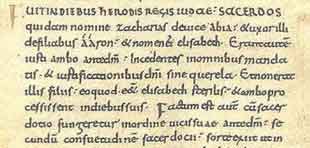
The continued development of scribal culture is hugely important because it meant there was suddenly a great need for books. In the prosperity of Charlemagne’s reign, parchment was more freely available and led to the freer copying of texts in the new, more legible script. More importantly, books could circulate.
Once Charlemagne’s reign was over his empire was partitioned in the Treaty of Verdun, which gave way to a new era of turbulence and the shadows of uncertainty, especially for the preservation of literature. Nevertheless that glimmer of light from the classical past now illuminated a new path forward for preserving classical learning.
Many of our extant classical manuscripts come from the Carolingian era, attesting to the fruitful time of preservation that occurred then, even though the peace was short-lived and gave way to new factions and fragmentation. Many of these manuscripts were tucked away in monasteries until they were rescued, removed, or even purloined by Renaissance humanists (Poggio Bracciolini didn’t let scruples stop him from rescuing Quintilian from a sad fate). And there in those monasteries, largely forgotten, many of these texts languished until the time was right for them to appear.
Some centuries later, the Italian Renaissance humanist Petrarch complains of being “in the dark.” His remarks on this are apparently somewhat misconstrued, and many have blamed Petrarch for coining the term “The Dark Ages” which is not a fair accusation. Few people now use the term “Dark Ages” to describe that period; it isn’t very helpful to begin with.2 Petrarch meant something different.
It was not that classical learning had altogether disappeared, but more that Roman authors were largely known as murky figures who could only be accessed secondhand through quotations by more recent authors, or in encyclopedic works like Etymologies by Isidore of Seville (570-636). Authors like the Venerable Bede had secondhand knowledge of Pliny and Livy, but had not likely read much of them in Latin due to lack of access to texts.
As someone who wallows in the riches of Latin and Greek all day long in the age of the internet, I can barely imagine the frustration that a brilliant scholar like Bede might have felt at not being able to read these authors in completion.
For this reason, perhaps, Petrarch himself felt like he was shrouded in intellectual darkness, even amidst his famous rediscovery of Cicero’s letters. He wanted more than he had access to. He had a manuscript of Homer but he never managed to learn Greek in order to read it. He knew that Cicero had written far more than he had found, but he didn’t have it or know where to find it. One could hardly blame him for feeling like he was bumbling about in the dark, and that his predecessors were likewise bumbling in the dark.
The people of this era also had the Black Death to contend with, and sporadic outbreaks for decades afterwards with all the economic and social consequences that came with it. They had political strife and constant physical danger as loyalties constantly shifted in Renaissance Italy, even while this great movement of classical learning burgeoned and seemed to flood European intellectual circles with so much light (at least, so it goes in our historiography).
What changed, perhaps, was the growing direct access to these Roman authors and eventually the Greeks (after the fall of Constantinople in 1453 and the flight of Byzantine intellectuals to Italy), which will eventually lead to the systematic development of classical philology as a whole discipline and the appearance of certain brilliant individuals who knew Plato and Homer backwards and forwards, and could write perfect Ciceronian sentences. This newfound discovery of classical learning wasn’t without its negative effects, but students of this tradition began to feel like they could see more than they had before, and perhaps even recreate this past glorious age.
Suddenly it became possible to do the kind of philological work that was only dreamed of centuries previously. Collecting manuscripts was the first step, begun by Petrarch in the 1300s and continued by later generations of Renaissance humanists ransascking monasteries (sometimes literally) who took these manuscripts and created critical editions and made key corrections, and developed the techniques that allow classicists to create new texts for easier reading and study.
Of course this development presented new challenges for the life of the mind and for the life of faith. Many of the Renaissance humanists would come to worship Plato or Aristotle more than the Christian God, or let the romantic ideals of the pagan past lead them up the primrose path. Many also blame the Renaissance for the Reformation and all of its consequences. This “rebirth” of classical learning is not without its challenges and complexity and temptation. But there is something about this classical philological tradition that refuses to die no matter how dark it is, and gathers lovers in every age. In her proper place, she is a great light. Out of proportion, she is destructive. Just as Cassiodorus says.
The preservation of classical philology, the love of words, however, was the result of hundreds of years of mishap, chance, the dangers of war and economic uncertainty, and the unseeing intellectual faithfulness of men like Cassiodorus and Alcuin who likely knew they would never taste the fruit of their labors, but undertook it anyway, like Petrarch and his own sense of himself as a “nocturnus viator lumen in tenebris gestans.” A traveler carrying a light in the darkness. Not unlike ourselves.
(Some) Bibliography:
An Introduction to Divine and Human Readings by Cassiodorus Senator, trans. Leslie Webber Jones. W.W. Norton & Co.: 1946
De Descriptione Temporum, the inaugural address by CS Lewis on receiving the Chair of Medieval and Renaissance Literature at Cambridge in 1954. https://homepages.uc.edu/~schaefdw/temporum.html
The Bookseller of Florence: The Story of the Manuscripts that Illuminated the Renaissance by Ross King. Atlantic Monthly Press: 2021.
Scribes and Scholars: A Guide to the Transmission of Greek and Latin Literature by L.D. Reynolds & N.G. Wilson. 3rd edition Oxford UP: 1999.
The Discarded Image by CS Lewis. Cambridge UP: 1964.
Translated by Leslie Webber Jones. https://archive.org/details/introductiontodi0000cass_e8m2/page/206/mode/1up?view=theater
Petrarch states this best in one of his letters to Cicero: https://la.m.wikisource.org/wiki/Epistole_familiares/24.3
“Heu et fraterni consilii immemor et tuorum tot salubrium preceptorum, ceu nocturnus viator lumen in tenebris gestans, ostendisti secuturis callem, in quo ipse satis miserabiliter lapsus es.”
“…like a noctural traveler holding a light in the darkness…” Petrarch clearly viewed his own time as a continuation of the dark times in which classical learning had receded. Petrarch himself was on the forefront of the rediscovery of classical texts, especially with his rediscovery of Cicero’s Epistulae.
No posts
Comments
Nothing yet. Say the first thing.
Sign in to join the conversation.