

Are we ordinary citizens powerless to do anything about endless wars?
I got a master class in the answer to this question yesterday in Nagasaki from Dorinda Makanaonalani Nicholson and Chiyoko Motomura at an event organized by the Nagasaki Atomic Bombing Survivors’ Association.
A 91 year old Native Hawaiian, Dorinda traveled alone and at her own expense to Nagasaki to be here for the August 9 commemoration. At age 6, her family lived adjacent to Pearl Harbor. She told of the terror of that attack, from a six-year old’s perspective—hiding in the sugar cane fields as the pilots dove so close that she could see their eyes; wondering if her beloved dog would survive; sleeping in a shelter; later wearing gas masks, living under censorship and marshall law, watching Japanese-Americans, Germans and Italians being sent off to internment camps.
Chiyoko, 87, was also six years old at the time of the bombing. That day, she was playing on her porch while her grandmother cooked lunch inside.
We were a farming family — two cows, two pigs, six chickens, that kind of life. It was 11:02, and I was out playing before lunch when the blast slammed me against a rock. Even so, I kept my eyes and ears covered. I was crouched down. My grandmother rushed over and threw herself over me, shielding me with her body. Thanks to that I came away unhurt, but my grandmother took glass shards, [pottery fragments], all sorts of things flying at her — she was wearing thin summer clothing and she took all of it on her back, with her own body.
Her grandmother died soon after of the burns she suffered as she covered Chiyoko.
For many years, Chiyoko admits she was bitter. She hated Americans for killing her grandmother and forcing her to live the rest of her life with the memories of that day— “the feeling that [my grandmother’s] life was exchanged for mine has stayed with me for 80 years. It has been here, it is here, and I think it will continue to be, going forward.”
Then last year she joined a trip to Pearl Harbor, and met Dorinda.
“I looked into your eyes, and it is as if we had always known each other,” Dorinda recalled. “You and I, we are children of war. Me, where it started, and you, where it ended….In war we think about the soldiers…but we forget about the children.”
As the MC asked journalistic questions, these two elderly ladies struggled a bit for words. Then, Dorinda said, tentatively,
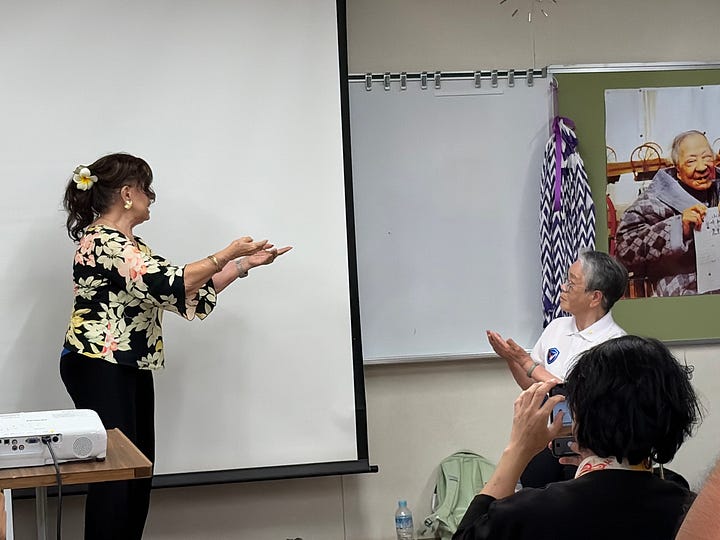
“…Could I dance for you?”
She asked if someone could play “Love Song of Kalua” on their cell phone. The old hula crooner began to stream out.
Dorinda stood, pushed the desk and microphones away, and began to dance for Chiyoko. Looking directly into her eyes, she swayed and made gestures of love. Chiyoko sat, looking up at her, responding tentatively at first with her arms, and then with passion. It was as if time had unwound and these two old ladies were children again, dancing together.
The entire room—activists, journalists, students, academics like myself—crackled. When she had finished, Dorinda said, matter of factly, like someone whose work was done and dusted: “We don’t need Japanese or English. We just need Aloha.
A young student raised her hand: “But what can we do about all these wars?” Dorinda’s answer surely will seem preposterous as I tell it now, but for those of us who witnessed this miraculous moment, it was right then an empirically-tested fact:
”We have governments and leaders obsessed with their own power. We don’t like power, but we have to recognize that we do have a great power, the power of love.”
Then, she added: “And it matters who we elect to office.”
Comments
Nothing yet. Say the first thing.
Sign in to join the conversation.