

Writing a memoir is difficult on so many levels. For one, you have to be willing to excavate yourself, removing the outer layers that people usually see—the parts you choose to present to the world—and digging into the depths that you may not want to show anyone. That is the brutal fact of memoir.
In my old life I wrote books that were about other people, long dead, all based on research. If I didn’t have a source for it, it didn’t go in the book. I loved doing research because I loved to learn. Writing was about digging into hidden corners and finding out what I was burning to know.
Now that I am focusing on writing creatively, I have to mine my own life and inner world for material. And that has been both exhilarating and hard. Sharing that work with readers presents a whole other layer of difficulty. It’s rather terrifying, to be honest.
This newsletter shares my life as I navigate living abroad and living a creative life after 30 years in academia. I’m so glad you are here! We have an amazing community of subscribers. Join them or considering upgrading to get all the benefits of a paid membership.
In my MA program, I shared my fiction with my teachers and fellow students. I had become a student again, out of my depth, navigating a sea of (sometimes conflicting) advice. But the work I shared didn’t have anything to do with me. Some other students were clearly writing autobiographical fiction, but my work was about Kay Boyle, the writer about whom I had been writing a biography before I left. So even though I didn’t relish being critiqued, I welcomed the lessons without feeling so personally attached to the story I was telling.
Writing my memoir about my year of travel around Europe, following in the footsteps of bold women writers and artists who redefined their lives on their own terms as I pieced together what kind of life I want to have now, was something very different. It was an entirely personal and a rather private affair.
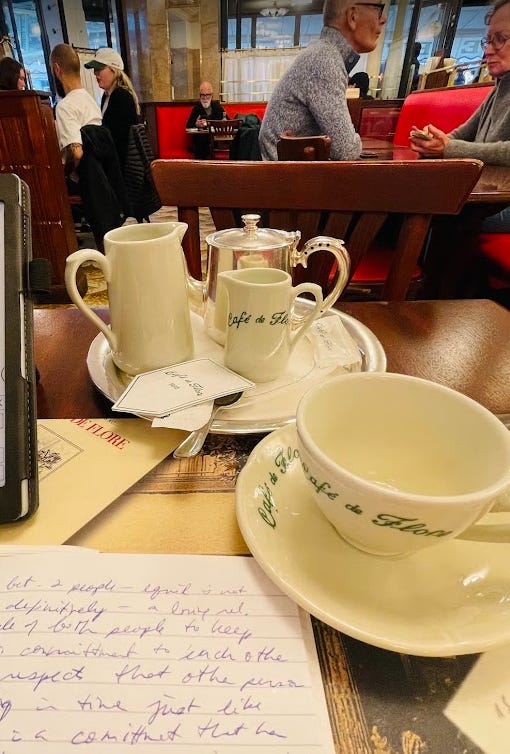
I kept voluminous journals over that year of travel, as my agent had encouraged me to do: “You know you’re doing what most people wish they could do. I hope you’re keeping notes!” I also started writing more substantial pieces while I was in Provence on a writing residency, during my first full month on the road.
After that, I found it difficult to keep writing while I was traveling. I discovered that moving around, adjusting to new environments and languages, always meeting new people and discovering new places were not conducive to any kind of focused writing. So my journal just grew and grew.
Then in 2024, while I was living in North Berwick outside of Edinburgh for four months, with a view of Bass Rock and the North Sea, I began to put it all together and write a proposal. For the first time, I spent most of my days writing and began to feel like a writer.
After moving to Edinburgh, into my first real long-term apartment, I carried on and eventually shared it with my agent. She loved it. But the editors she sent it to did not love it enough to buy it. So it went into the proverbial drawer.
Last week, I began serializing the memoir I wrote here in this newsletter. As I began to reread the opening parts and prepare them for ‘publication,’ I thought seriously for the first time about people reading it. Not just random publishing people but actual readers of this newsletter, who are smart, well-read, and many of them great writers themselves. Some are also friends, people I know whose opinion really matters to me.
I decided to put the memoir mostly behind a paywall for a couple of reasons. One is that I’m not quite ready to share everything with 10,000 people every week. Another is that I still hope to get it published someday, and the jury is out about whether publishing on Substack could disqualify it for editors. (I’ve heard varying opinions on this.) So it’s a much smaller group of readers, but still, lots of people I admire. Plus, there are family members.
How many writers quake in their boots at the thought of their parents or their children reading their writing—especially their memoirs? Just about all of them. Well, mine are my greatest supporters, so they are sitting there in the front row, so to speak. Hello!
When you publish a book, you kind of hold your breath and wait for the early reviews and eventually, after what feels like forever, you hear from actual readers, but not as much as you would like. Publishing a weekly installment is different.
It has been so great to get responses from people to specific parts of the story, something you rarely get when someone reads your entire book. And it’s been wonderful to hear that they are enjoying it, are ‘riveted,’ and can’t wait to read more. What author wouldn’t love that?!
But I also know that there may be weeks when I won’t get much response. And how will that feel? I will remind myself that people are super busy and don’t always have time to sit down and read and respond every week, and that’s okay. It’s not just about the feedback. It’s mostly about honing my craft and making this the best story that I can.
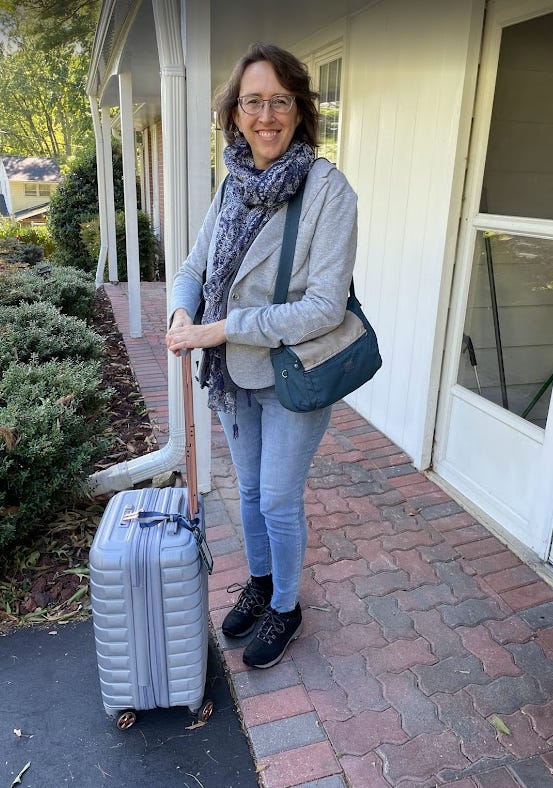
In the first two installments, I wrote about my life in New Orleans, before I left. It’s not pretty. I knew that I’d need to share some perspective on why I left. No one chucks an entire life and runs away with nothing but a suitcase and backpack unless they are trying to save themselves. Readers will be curious. It’s the elephant in the room you can’t ignore.
People ask, when you move abroad, are you running from something or toward something? It’s probably always both. And while I wanted to focus on my travels and the struggles of imagining and creating a new life, I knew that I couldn’t ignore what I ran away from.
I don’t go into the toxic world of academia—and my institution in particular—or why I gave up tenure and threw away everything that related to my old scholarly life. But I felt I needed to say something about my 20-year marriage and why it ended. That was hard to encapsulate, and I didn’t want that story to take up too much space.
In All the Way to the River, Elizabeth Gilbert says she will not tell the story of her failed marriage (as she did in Eat, Pray, Love), and I respect her for that. That was not the story she had to tell. But it is part of my story. I don’t think I can tell it without that piece. It’s the background for everything really. Living in a dead marriage for so many years deadens you as well. And I wanted to live again. My search for something better is also part of my story.
So this week I shared the abbreviated version of how bad my marriage got. I worried that readers might wonder why I stayed so long if it was like that. Or why I let him treat me like that. I’ve wondered that too, and I’ve come up with some answers in recent years. But again, that is not the story I’m telling.
The memoir looks at the pressures that broke us apart. But it doesn’t go into how we navigated the divorce. We did pretty well, all things considered. He respected my decision, we stayed in the house together for our daughter’s final year of high school, and he developed a closer relationship to her than he had had before.
While she was in college, we had weekly group calls with her, still a family of sorts. I was so glad that we could still be her parents, and we tend to agree on what advice to give her, which really helps. We still occassionaly have group calls together. It’s great to connect when we do.
Neither of us seems to have lingering resentments or regrets. We raised an amazing young woman, who just graduated from Bryn Mawr with copious honors. We were so proud of her!
We also spent quite a bit of time together over those days and afterwards, helping her move out of her apartment and setting her off on her travels to Southeast Asia. Neither of us is the person we were then. We still care about each other and want to support each other. We’ve decided to be friends, which felt really nice. I am grateful that we can honor the bond we had for twenty years (plus six before we married).
I’d love to hear your thoughts in the comments. Have you written a memoir or personal essays? Or would you like to? Have you shared or published them? What has that been like for you? Are there things you struggle to write about? I’d love to know! As well as anything else on your mind.
As a reminder, on Saturdays I’ll alternate between sharing reflections on FLIGHT (the process, what I’ve shared recently, etc.) as well as paywalled travel tips related to the places I visit, with my regular letters about my current life. There is much to tell about what I’ve been going through in recent months and how I’m navigating my persistently unstable life abroad as well as my writing life.
If you upgrade to become a paid subscriber, you can also read all of the installments of FLIGHT as they appear each Thursday. Check out the options below:
Until next time,
Anne
P.S. If you enjoyed this post, please click on the heart at the bottom or the top of this email/post and help others discover Audacious Creative Lives. And it helps me know what kinds of content you value, which is important to me!
Anne Boyd was a literature professor in New Orleans for 23 years before embarking on new life abroad as a creative writer. She is the author or editor of seven books. She has been writing this newsletter since December 2022. You can learn more about her on her website.
Comments
Nothing yet. Say the first thing.
Sign in to join the conversation.