

“Life falls apart. We try to get a grip and hold it together. And then we realize we don’t want to hold it together.”—Deborah Levy, The Cost of Living
It begins in October 2021 with a dream—it being the unraveling of my life.
For years I’ve had no dreams. My sleep is so irregular and disrupted that I get very little REM sleep at all, I imagine. Then one night, I have the most vivid dream of my life. When I wake up, it is still playing in my head, the film my subconscious won’t let me ignore.
In my dream, I quit my job, pack up all my stuff, and put the boxes in the trunk of my car. I drive to the house where I grew up. No one is there. I put the boxes on the front porch and drive away.
Suddenly, I’m on a coast somewhere, and I drive my car onto a ferry. Surrounded by other cars, I sail off into the sea, open water stretching to the horizon, without a clue where we are going. Then, all of a sudden, the other drivers, who apparently know we have arrived, begin to pull ahead. It’s time to leave the boat. But there is no land in sight.
I wonder, will our cars turn into submarines? Or boats? Or is this a suicide mission? I have no idea.
I watch as the cars in front of me dive into the water. There is no choice, I have to move ahead. I wake myself up just before my own car hits the water.
It’s clear to me as soon as I wake: I have to leave everything behind. I have to get on that boat, and sail off into the unknown—although I have no idea where I’m going, or if I will survive the journey.
I’ve always been afraid of drowning. I never quite learned how to swim. But the idea of jumping into the water appeals to me. I imagine myself dissolving, like a tablet dropped in a glass of water breaking apart into nothing.
I want to let every dead piece of my life fall away, layer upon layer that has built up, calcified, and made it nearly impossible to breathe.
I want the pieces to break off and just float away. I loosen my grip. But it’s not that easy.
You can have your life taken from you. But you can’t simply let go and expect it to drift quietly away. . . . You have to break things. . . . And then you have to push them away, each shove a wrenching, a slicing, a violent shaking off.
I tell my husband I want a divorce, days after our twentieth anniversary. I leave my job as a literature professor. I give up tenure, pack up my office, say goodbye on a zoom meeting. (We’re just coming out of Covid.) The house is the last to go, along with everything inside. I raised my daughter here, built this whole life around her, but there’s no point anymore. She is grown, and she’s getting ready to leave.
It takes nearly two years to dismantle my life. I break everything. And I get what I want. There is nothing left. . . . Not even me.
Some people get tattoos, take younger lovers, or buy sports cars. I get a one-way ticket to Paris.
I love telling people that, seeing their faces light up.
“Whaaat?! That’s amazing!”
But then it gets more complicated. I have to explain that no, I’m not moving to Paris. I’m going to travel around Europe for a while. And I’m not planning to come back.
Their initial excitement turns to confusion. “Wait, so you’re going to travel . . . and then what? Where will you live?”
“I don’t know yet.”
They nod, taking this in, then ask, “How does your daughter feel about this?”
A mother doesn’t drop everything and go off on her own adventure when her only child leaves home to go to college. A mother is supposed to keep the hearth warm, light a candle of devotion to her departed offspring, and adjust gradually to her new childless state. She’s supposed to start taking Pilates or renovate the kitchen, not break up the family, sell the house, quit her job, and leave.
“She seems fine,” I say, hoping that’s true.
“She’ll have a room in her dad’s new apartment,” I tell my friends, most of them mothers themselves whose children are preparing to leave them, too. They can’t imagine not having a home anymore for their kids to return to, although they don’t say this. And I can’t imagine living in ours without mine.
We’d cried when I told her that when she left I would leave too, flying off across the ocean on my own. I could come back anytime, if she needed me, I said. And we’d text regularly, and have video chats whenever she wanted. She’d be right there in my pocket the whole time. Then I drew an invisible line with my fingers between her heart and mine.
“This will always be here,” I said.
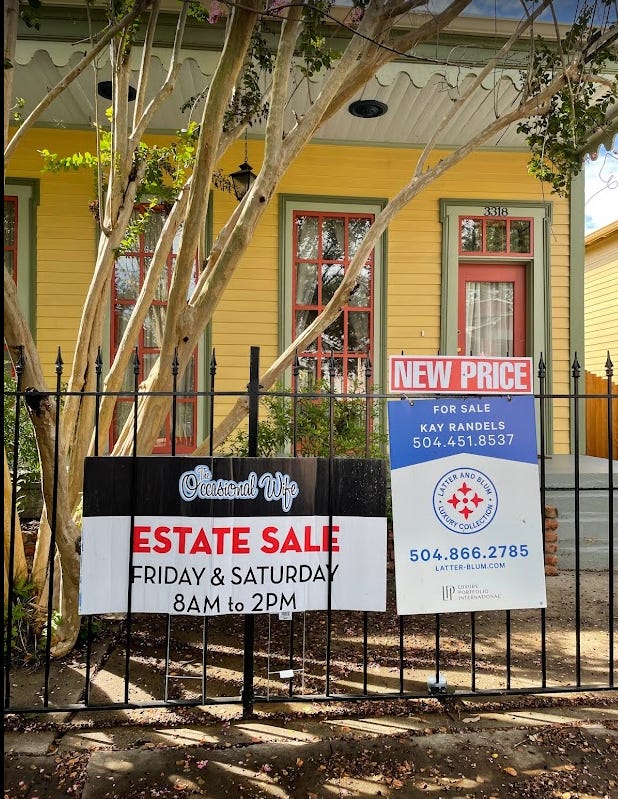
“I’ve done it a bunch of times,” a guy named Jason says as he walks through our house, stopping to take pictures for the estate sale.
It’s August 2022, just a week before the closing, and two weeks before I take my daughter off to college.
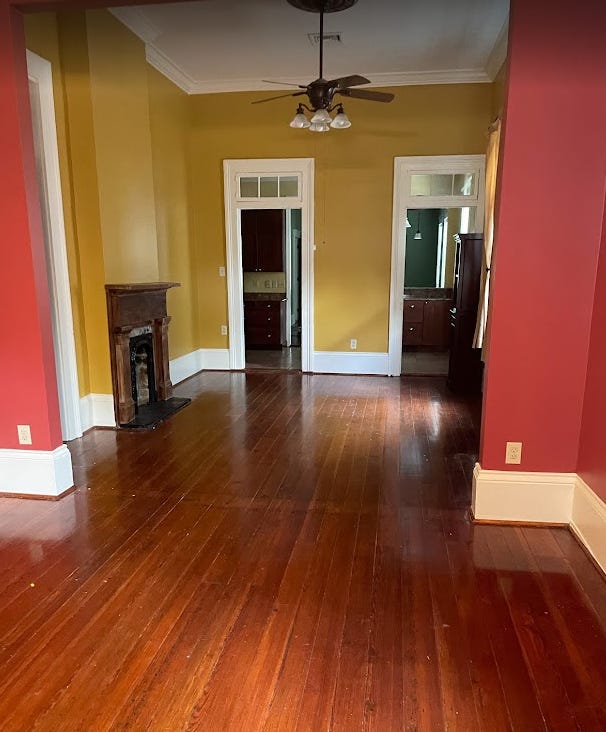
The home that contained our family for sixteen years is about to be handed over to a young bachelor, a lawyer, who will, as we did, paint over every surface and fill it with the things that are supposed to make a life complete. Until that life breaks apart—and the house has to go with it.
“Every time a relationship ends,” Jason says, “I just call up an antique dealer and have him haul it all away, and then I move on. It’s very freeing.”
He takes pictures all round, in closets, in drawers, in every room. Our lives together have been reduced to a houseful of stuff we no longer need. Clothing and shoes I rarely wore. A sectional sofa, stained and lumpy from years of use. A kitchen full of gadgets—air fryer, crockpot, salad spinner, a few keepsakes from long-dead relatives. Four large bookcases full of books—biographies, essays, novels, memoirs, letters—by and about the women I’ve admired and tried to be like. It hurts to let them go. But I have to free myself from everything, even them.
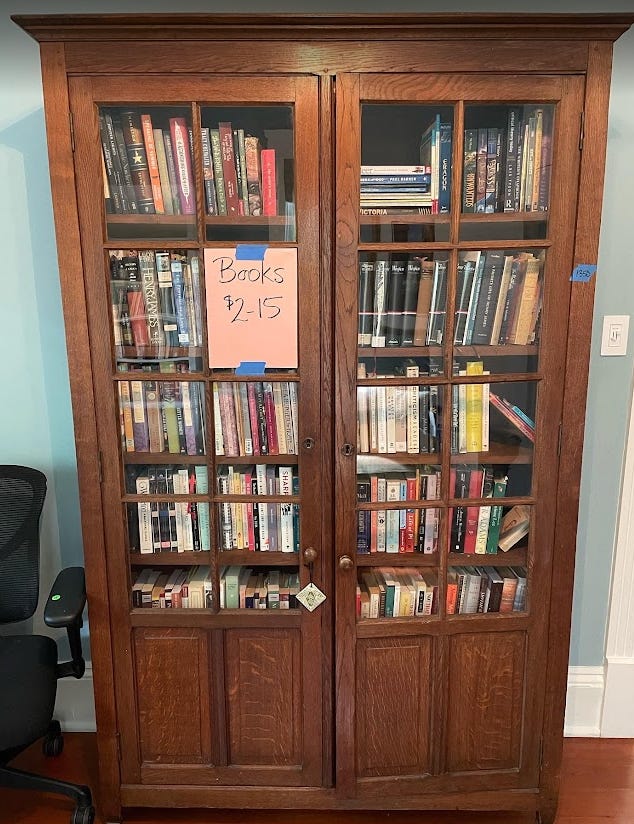
All of this stuff has accumulated since Hurricane Katrina. Nothing remains from the first thirty-five years of my life.
It’s not so hard to let everything go once you’ve had it all taken away from you before. And seen a thriving city laid waste—house after house an empty, rotting shell. You know nothing is forever anymore. Absolutely nothing. It can all change in an instant. You’ve always known that theoretically, but not in your bones—not until you’ve seen it happen.
Jason lifts the dining room tablecloth to take a picture of the scratched, stained mahogany underneath. He moves strategically placed pillows to see what condition the furniture is in. He walks toward the French doors that look out on the backyard. He stops. It’s too damn hot to bother going outside.
“What about the fountain?” He raises his phone.
“I think that stays.”
“Too bad. That would sell first thing.”
He lowers his phone and talks about how relationships seem to come and go. I wonder how many times he’s done this sort of thing himself, but I don’t ask. “After a while, you know the signs,” he says. “I’m single again now.”
He turns to walk back toward the kitchen and says over his shoulder, “But it’s very freeing, you know. Feels good to just start over with a clean slate.”
I hope you enjoyed this first installment! I’d love to hear your thoughts, as always. Pop them in the comments below. Connecting with you all is the thing I love most about writing this newsletter! And sharing this memoir with you is the most vulnerable thing I’ve done yet.
Look for future installments on Thursdays.
Up next . . . More about why I left, heading off, and my first night in Paris!
Thank you for supporting this work!! I’m so honored to have you along for the ride.
Until next time,
Anne
If you appreciate my work, share this post with someone who would enjoy it. Thank you!
Learn more about me at my website, or read my transformation story from academia to a creative life:
Comments
Nothing yet. Say the first thing.
Sign in to join the conversation.