
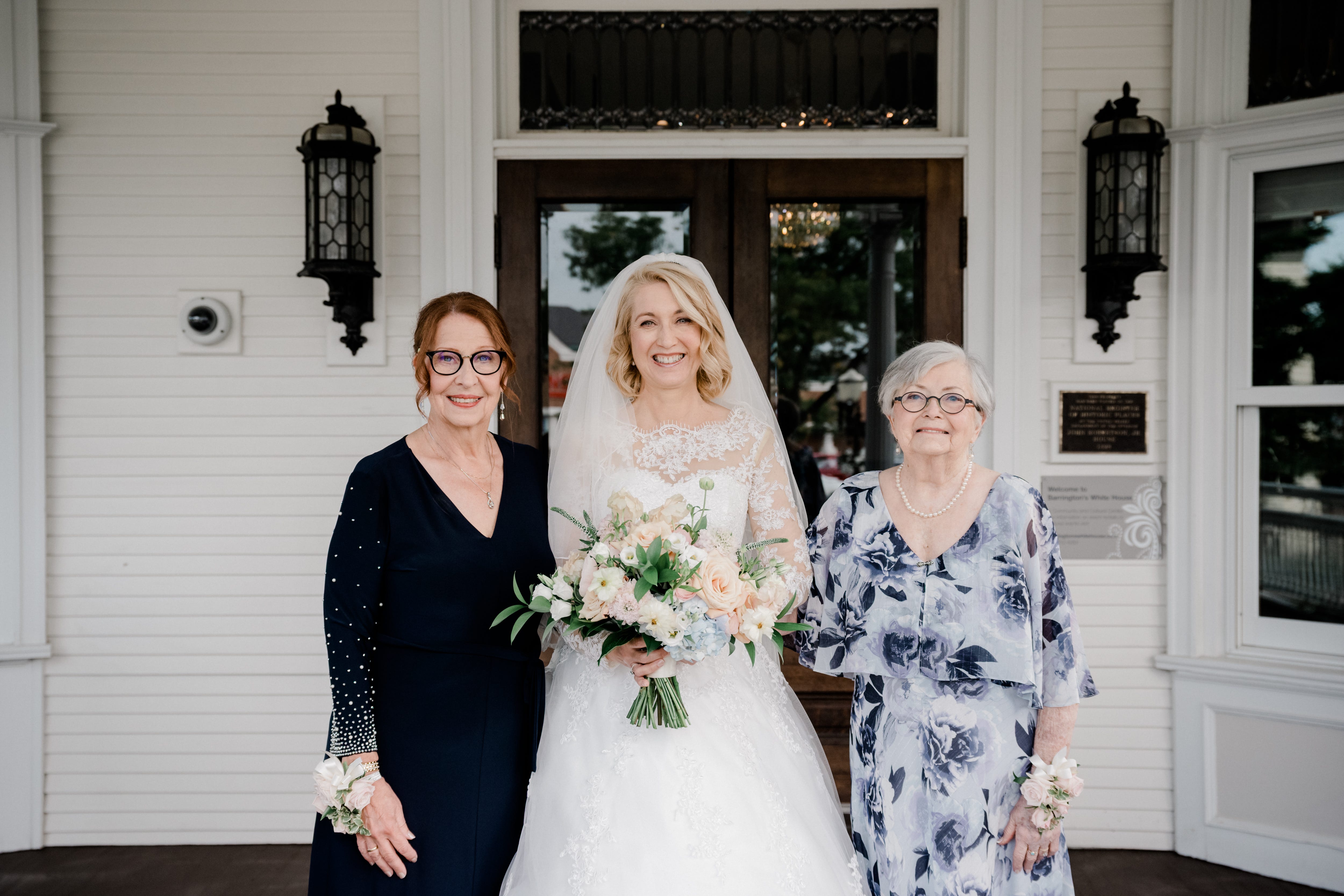
The author with her two mothers—Image courtesy of Joy Lyn Photography
The music began, and I clasped my stepmother’s arm with my left hand while holding my mother’s hand in my right. My mother was in a wheelchair, with my stepsister Kimmy pushing her down the aisle at my wedding. Traditionally, it’s the father who escorts the bride, but my dad had passed away nineteen years earlier. These two women had shaped my life in profound ways. It seemed fitting that as I entered this new phase, I would honor them both.
They had both been central mother figures in my life, and they had both loved my father. At different points, I had lived with each of them, and I called them both “Mom.” They taught me some of the most important lessons of my life.
My earliest memories of my birth mother are of a woman who struggled. When I was around six, she tried to ride her bicycle to work because my father had the car. She fell in traffic and hit her head. When I visited her in the hospital, she had a bandage wrapped around her head. After that, she complained often of headaches and feeling unwell. Even as a child, I worried about her constantly.
Another memory is from a family vacation in New Zealand. My sister, my dad, and I were admiring the geysers while my mother lingered behind. Tears streamed down her face as she looked at the forest floor.
“Mom, what’s wrong?”
“Nothing. Nothing,” she said, wiping her face.
Even at seven, I knew she was battling things I couldn’t understand. Later, I would learn she was deeply unhappy in her marriage. My father’s lack of financial success weighed on her. She had grown up poor, hated working as an administrative assistant, and felt that perhaps a more affluent lifestyle would make her happy.
She was also very depressed. In the 1970s, mental illness wasn’t discussed, but I knew something was wrong. I remember her saying, “I have special problems. I’m not like other people.” Perhaps that’s why I became a research psychologist—to understand people, to ease some of their suffering.
Not long after, my mother left my father for a more successful man who could offer financial security. I watched her transform from hiking boots and ratty clothes to silk dresses, makeup, and high heels. She reveled in her new lifestyle.
At the time, I resented it. Divorce was less common, and I wanted my parents to get back together so we could be “normal.” But looking back, I see her choice differently. Leaving was brave. She showed that leaving an unfulfilling marriage was an option.
But her new marriage was tumultuous. Chip was an alcoholic—charming in public, volatile in private. One night, he pushed her down the stairs. She filed charges, then dropped them. The woman who had seemed brave now seemed trapped.
She had sought financial security and found something else entirely. He provided the lifestyle she wanted, but he controlled everything—where they lived, what they did, even who she became. My mother, who had never been athletic, became a golfer because that’s what he did.
Although they separated and even divorced at one point, they stayed together for forty-two years. Her feelings about that life were never simple. At times, she spoke with a kind of nostalgia about my father—the kind professor who had loved her—and told me leaving him had been a mistake. At other times, she seemed resigned, as if she were simply doing the best she could with the life she had chosen. She once told me, “It wasn’t at all what I expected. I thought it was going to be much happier.”
I felt compassion for her—caught between longing and resignation, living a life that never quite became what she had hoped.
Her life haunted me later, when I found myself in an unhappy marriage. I stayed longer than I should have, paralyzed by doubt. What if I left and regretted it the way she did? What if I was the problem? I left several times and returned. It was a cycle of fear and second-guessing until I finally found the courage to say goodbye. Even then, I wasn’t sure I had made the right decision.
My mother taught me that marriage is a gamble—that you can lose things you didn’t even realize were at stake.
While my mother struggled, my father moved on. He remarried when I was twelve, and Barbara quickly became an important part of my life. Before long, I was calling her “Mom.”
Barbara couldn’t have been more different. A career woman before the term was common, she was the principal of a high school, spoke fluent French, and held a master’s degree. Seeing a woman like that was transformative. She showed me that women could be ambitious and self-sufficient.
She was also a take-no-shit kind of woman. I remember a telemarketer calling. She picked up and said, “Who is this and why are you calling? I consider it an invasion of privacy. Take me off your list.” The tone alone made it clear this wasn’t a request. And they didn’t call again.
Watching her, I realized women could assert themselves unapologetically. Barbara didn’t manipulate or placate. She was direct, and she expected respect. If my birth mother showed me what not to do, Barbara showed me what was possible: a life of independence and control.
I took her example to heart. I spoke up. I challenged things. I wasn’t always popular, but I believed standing up for yourself mattered.
Barbara never saw herself as a victim. When people framed their lives that way, she would say, “I’m not a victim. That’s not how I see it.” That stayed with me.
She also modeled something I had never seen before: a true partnership. She and my father were equals. They talked about everything—music, books, ideas. They held hands. She sat on his lap after dinner. Their love was obvious.
Once, while hiking, she lost her wedding ring. “Stop. Everyone. Stop. We need to search for my wedding ring.” She stayed calm, and we found it—but then she burst into tears at the thought of losing it. Another time, when my father returned from a trip, she ran out the door shouting, “Dad’s here!” She loved him deeply, and it showed.
From Barbara, I learned that a marriage could be a partnership—built on respect, affection, and shared interests like music, hiking, art, and reading. That model stayed with me and gave me the courage to eventually leave my own unfulfilling relationship and seek something better.
When I met my eventual husband, Michael, I recognized it. He was my intellectual equal, someone who could engage with me fully. It felt like the relationship I had seen between my father and Barbara. And that mattered.
Barbara and my father stayed married for over thirty years. When he was diagnosed with bipolar disorder, she stood by him, and they bought a house in Wisconsin to renovate as he managed his illness. When he later developed stage four lung cancer, she spent four excruciating years caring for him. During periods of remission, they traveled to places that meant the most to them, like England. She knew he was dying. But as she told me, “We were living in the moment. And it was glorious.”
She taught me that love isn’t supposed to be easy. It’s about staying with the right person when it isn’t.
So, as I walked down the aisle, Barbara was on my left and my birth mother on my right. My birth mother taught me the courage to leave—and the danger of losing yourself. Barbara taught me independence, strength, and what a true partnership looks like.
And for that, I will always be thankful.
No posts
Comments
Nothing yet. Say the first thing.
Sign in to join the conversation.