
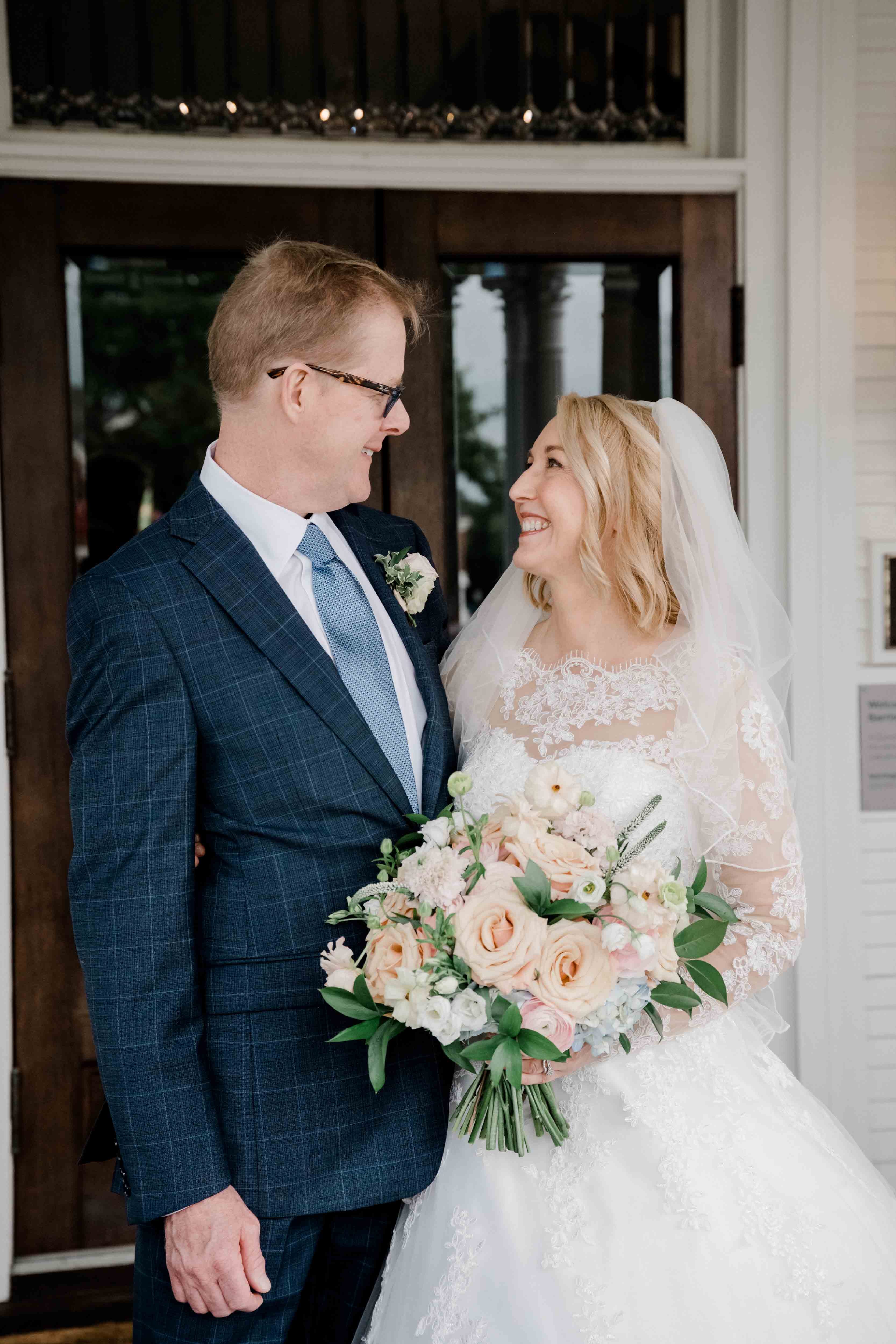
Photo of the author and her husband by JoyLyn Photography
I met him on Match.com, and I didn’t have high hopes when we met at a local bar. I’d been doing online dating for two years, and it had been nothing short of disastrous. Men claimed they wanted relationships only to get you into bed. Men were enthusiastic and said they wanted to get together soon, but then you would never hear from them again. And then there were the men who were really not suited for any kind of romantic relationship. Men who lied about their age, their fitness, their jobs, etc. One man spent an entire date describing every woman who had ever done him wrong. It was a long dinner.
So, when I met Michael, I didn’t expect a lot. And I didn’t even know what he really looked like because his pictures were so blurry.
But after one beer and the realization that we had a lot to talk about, I broached the topic of whether he wanted another drink or if we wanted to get dinner. The reality is that some men on dating websites stack their dates. One woman for drinks, one for dinner, another for after-dinner drinks. I’d had more than my share of men who were running off for another “appointment.”
“So, do you want to get another drink or something to eat?” I asked warily. “I’m not sure if you have other plans this evening.”
He looked at his watch and then back at me.
“I’m free until 6:30 tomorrow morning.”
I laughed and then smiled.
We ended up having another drink and then dinner. He told me about his work as a professor of African history and that he taught classes on gender and Africa.
“You sound like a feminist,” I joked.
“Well, I think of myself that way,” he responded.
“How is it that you’re not married?” I asked.
This guy seemed too good to be true.
***
Before I met Michael, I’d had several serious relationships. I was always drawn to men who were very attractive and a bit unattainable. Some of these relationships lasted for years. But looking back, I can see something was often missing.
I remember telling one man that a woman in our friend group had been unkind to me on several occasions.
“Oh, well, she’s always been nice to me,” he said.
I was struck by his response. It seemed as though only his experience with this person mattered. The fact that she had been unkind to someone he loved didn’t appear to change his opinion about her at all.
Another time, I called a partner in tears after an especially stressful day at work. A client had taken a dislike to me because of some office politics. I hadn’t done anything wrong, but she had said unpleasant things about me to other clients on the project, and I was devastated.
“I’ve had such an awful day—one of the worst of my career.”
“Sorry to hear that. Well, bad stuff happens sometimes. Anyway, I’m watching a movie right now. Bye.”
The relationships that were most challenging were the ones in which disagreements could never be resolved. I would try to explain how something had affected me, only to keep explaining why I’d gotten upset in the first place. It was always a version of this conversation.
“I don’t understand why you’re making such a big deal out of this,” he’d say.
“But I’m trying to tell you why it hurt me.”
“Well, it wouldn’t have bothered me.”
What can you say to that?
For a long time, I didn’t recognize the pattern. I was often frustrated in these relationships and I often felt unseen. I didn’t realize something specific was missing.
***
I don’t remember all the topics Michael and I talked about on our first date, but I remember that conversation flowed easily. Because we both had PhDs, we talked about our paths from graduate school to our careers. I’d taken a nontraditional path, going into business, whereas he had become a professor. He told me about his research on enslaved people and their resistance to slavery.
When dinner ended, I didn’t want the date to end.
“Would you like to go for a walk?”
“Sure.”
I learned later that Michael wasn’t wearing walking shoes, but he didn’t want the date to end either, so we headed toward the lakefront.
We talked about the books we were reading, the true-crime show I’d watched recently, and the things we liked to do in our spare time—run, walk, go to movies.
We walked for so long that I eventually needed a bathroom break, so we headed toward an outdoor café with a public restroom.
And that’s when I saw a long-term ex-partner.
I almost froze.
“You know, let’s not go to that restroom,” I said. “A long-term ex of mine is sitting outside.”
I turned around, and Michael followed.
I tried to pick up the thread of our conversation and return to being my sparkly, attractive self.
As we retraced our steps, Michael slowly put his arm around me.
“Are you OK?”
It was such a simple question.
In just a few hours, Michael had shown me more empathy than I’d experienced in many years of romantic relationships.
I had a name for what had been missing.
***
If you had asked me what I was looking for in a life partner, I would have said intelligence, a sense of humor, a successful career, good looks, and someone who didn’t dislike cats. I might have described this person in detail, but I would never have used the word empathy. Never.
And yet, I believe that this is one of the most important attributes in a marriage partner. And it’s one of the things I found in Michael, which has made all the difference. When I explain to him what I’m experiencing, he doesn’t look at me like I’m an alien. He doesn’t like people who are unkind to me. And he doesn’t blame me for my difficulties, but he will point out times when I don’t exactly help myself. He’s not immune to some of my challenges. But he sees me for who I am—good and bad—and loves me anyway.
The first time Michael stayed the night with me, I woke up and he wasn’t next to me. I wondered if he had left, and then I heard him in the kitchen. What was he doing? I wandered out there and found him cleaning up after my cat, who had an upset stomach and had vomited. I just stood there looking at him. I’d never had a romantic partner do something like that for me.
We married three years after we started dating. We’ve been together for seven years.
Being married to a man with empathy makes the hard days less difficult. He can comfort me in a way that is heartfelt. And being married to someone who can understand a perspective other than his own makes resolving issues much easier. We don’t always agree, but at least he can see another point of view. Life isn’t always easy, and tough days are coming as we get older, but knowing that Michael will be at my side makes the journey so much better.
This realization about the importance of empathy changed my life and is part of the reason I wrote The Compassionate Writer. Compassion is about seeing other people—and ourselves—more fully and trying to understand them. And life feels different when you surround yourself with compassionate people. It changed my writing, too, but that’s a story for another day.
I didn’t know to look for empathy when I was searching for love.
Now I can’t imagine love without it.
Comments
Nothing yet. Say the first thing.
Sign in to join the conversation.