
"Fellow believers, 'There is no safety in the threefold world; it is like a burning house.' – Record of Rinzai
Diana’s life parallels my own. We both met Leonard when we were children, through the classified mind control project known as MKULTRA. As children, both of us were placed in a special program for psychically gifted children. Diana’s secret career in the military began on bases in New Brunswick. Later, she says, her mother moved to Montreal and worked for the Cohen family as a domestic. At 18, at Expo 67, someone introduced her to Leonard, then a rising star and darling of Canadian media. She went on to have a brief career in regional television, back in New Brunswick. By the mid-70s, she had met a number of people in the entertainment business, including John Lennon and Yoko Ono, at whose suggestion she moved to in Denver, CO, and got involved in Primal Scream Therapy. Her therapy sessions were unearthing early childhood memories including sexual abuse and military programming.
In early September of 1979, just after the summer on Hydra, around the time I returned to Canada from Germany after saying goodbye to Annu, Diana claims she met Leonard in Denver where he performed in a small club. She doesn’t remember the name of the club, only that man suggested she come to the concert. Later, Leonard would claim it was love at first sight.
Here is where it gets terribly interesting, or just plain terrible. Soon afterwards, another man asked Diana out on a date, took her back to his place, and assaulted her. In the midst of this violent rape, the door to the apartment burst open, and Leonard Cohen walked in with a camera crew. The men began filming a scene that quickly turned into a gang rape. Then she says, Leonard held a gun to her head. “You like to be hurt, don’t you? Say it!” Another man pulled out a pile of bills and told Leonard to “snuff her.” As she was crying and pleading for her life, a little girl was brought in. Leonard told them to “get her out of here – and bring her to me later.”
It had to have all been planned beforehand, with Diana the chosen victim. Snuff films brought in tens of thousands, and Leonard in those days was short of cash. One of his Montreal contacts, involved in the pornography business, had been on Hydra a few weeks earlier, but mysteriously vanished at around the time she encountered the film crew in the Denver apartment.
Leonard refused to pull the trigger. He told the crew to leave, and take the child with them. He and Diana were left alone to spend the night together. They fell in love.
In a further fairytale twist, worthy of Hollywood’s cocaine-fuelled fantasy-factories, the would-be pornographer and his intended victim stared into each other’s eyes and fell deeply in love. A cosmic romance was born that would span more than two decades and unleash a string of Greatest Hits – beginning with Hallelujah, which Leonard began writing that very night. Offers of marriage, a promised house: “What kind would you like?” he asked her. “A wooden one,” she replied, wondering if she even liked him.
This is her story. I didn’t drag it out of her – she told it to me in response to my simple question: “How did you meet him?” It doesn’t much flatter either of them. She says Cohen appeared “clinically depressed” and was on “mind-altering drugs.” His split-second decision to spare her life – if that too was not a setup – probably came with a heavy price tag, but I’m speculating.
To Diana, a free spirit, whose magnificent breasts and tiny waist made her a magnet for male lust, it was obvious almost from the beginning that they were incompatible. Not surprising, considering their first meeting was the result of a criminal rape on the set of a pornography film, later released under the title “The Nazi and the Dog.”
Soon after that first, terrifying encounter in Colorado, and all through their early courtship, she says, he criticized her wardrobe, consisting mostly of lumberjack shirts and jeans. “Why did you have to come to me in the body of a slut?” he complained in between hints that he was soon headed to London to meet the Queen. He suggested she enroll in charm school, so she could accompany him to Buckingham Palace. This was in the autumn of 1979, when he was preparing for the Field Commander Cohen Tour which ended three months later in mid-December on a rainy morning in London where he checked into a posh hotel, a stone’s throw from Marble Arch and the headquarters of the Royal Family. I know, because I was there.
The following evening, December 20, 1979, discredited DJ and notorious pedophile Jimmy Savile was in London, hosting Top of the Pops. Even back then Savile moved in elite circles, and often spent Christmas with then-Prime Minister Margaret Thatcher and her husband. It was a little late to introduce the ageing folksinger to his teenaged audience, but did this close friend of Prince Philip and the Queen play a role in connecting Leonard, who was already acquainted with the Rothschild family, to the Windsors and Prince Charles, who would invite him to perform at the Prince’s Concert in 1988?
Meanwhile, he stayed in touch with Diana, who lived nomadically, a traveling Muse, moving to Oakland, then to the Sunshine Coast of British Columbia, where she became involved with other stars, notably Neil Young and Joni Mitchell. Leonard wrote the songs that would characterize his neo-conservative Middle Period, culminating in I’m Your Man – the album he would dedicate to D.I. – Dominique Isserman – in 1988. Although Diana had made it clear he was not Her Man, she believes many of these songs were written for her. As proof she claims she mailed him a money and plywood violin, for which he thanked her sarcastically in First We Take Manhattan.
Diana recalls a bizarre showdown on the west coast, where Leonard brought Isserman and an older woman friend to confront Diana, once and for all, in what must have been a humiliating scene for all concerned. Leonard was paralyzed by ambivalence while Isserman was getting impatient for commitment. “What do you have that I don’t have?” she demanded in her charmingly French-accented English. Diana, who speaks no French, was embarrassed at this breach of feminist protocol. Bowing out of their ten-year romance, she told them all to go away. Dominique Isserman emerged victorious becoming Leonard’s public love interest, only to break off the relationship a short time later.
The absurd saga of Leonard’s reluctant Muse does not end there, either. Seventeen years later, when he was in his seventies and had allegedly lost all his money to a plundering personal assistant, Leonard Cohen came calling again. This time showed up in a camper which he parked at a homeless people’s camp where Diana was living in a tent. He had driven up from Los Angeles in a last-ditch attempt to win her heart. Well into her fifties by then, and suffering from post-traumatic stress accumulated over a lifetime of abuse, she had long given up hope of ever collecting on the house he promised her back in Denver during the fateful summer of 79. By now “their song,” Hallelujah, was a massive success, a manic-depressive hymn sung at funerals, weddings, and on American Idol -- the most over-covered song of the decade. Leonard by now was a grizzled shadow of himself, chain-smoking in the park all day and looking “just like an old bum.” For the last time, he abjectly proposed, and true to form the principled feminist, now a seasoned street person, once more gave him “da boot.”
Here her story takes a final, bewildering twist. Faced with the ultimate rejection, the desperate singer went down on both knees and pleaded for mercy and understanding. In a fruitless attempt either to gain her sympathy, or to shock some sense into her, he uttered this astonishing confession: “I shot John Lennon because of what he did to you.”
The heavens failed to open, however. La Belle Dame sans Merci withdrew to her tent, and her knight-at-arms went back to his camper and drove back to L.A.
***
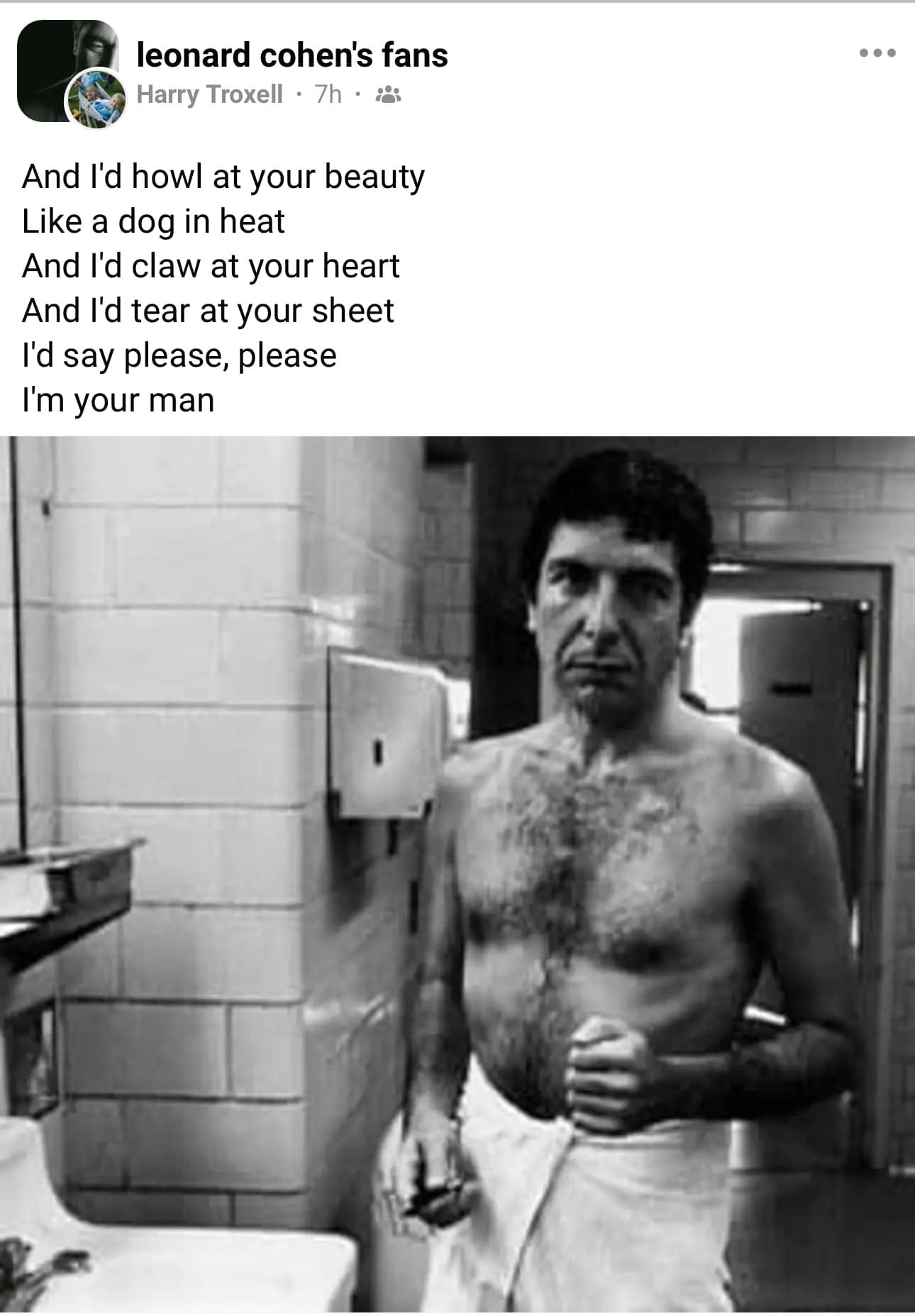
Having finally come to this strange twist in my long tale, I can’t deny its unbearable irony. I suppose they call that catharsis. It’s certainly a step up from total absurdity.
Diana appears to have spent much of her strange life rubbing shoulders with rock stars, biker gangs and Hollywood wannabes, a world through which she moved with stunning innocence. Denver could be a dangerous town for women like her. For a time her new singer-lover became her saviour. As Annu might say, he had much in common with Shiva, the god of Creation and Destruction.
It sounds as if the Hollywood Cult had plans for Leonard Cohen. Like Hunter S. Thompson, who allegedly made snuff films to finance his career as a writer of gonzo journalistic exposés, sometimes a man has no choice – or rather, he must choose between carrot and stick. In Thompson’s case, his choices ended in sudden death by “suicide” just as he was preparing to expose the pedophile ring that runs America.
Diana’s memory of those days in Denver is, understandably, somewhat fragmented. She recalls Leonard’s “gay lover” showed up in the bar, before or after. She remembers meeting Suzanne, who told her “The singer is attracted to you. You look like a good person. Be careful.” The children were there as well. She’s not clear about dates, but she remembers it was Adam’s birthday and Leonard gave his son a guitar with Suzanne protesting he was too young. She says this concert, for which I can’t find any record, happened a few weeks before the European tour of “Recent Songs.” Did all this really happen? I have only Diana’s word, and why would she lie? Some of the details support her story. In her account, our hero refused and the universe blessed the union of the singer and the unwitting movie star. Perhaps this shows there was still a soul living inside the body of Leonard Cohen. For all I know, it may still be in there hiding in one form or another.
Who set up the shoot? Barrie Wexler had just produced a successful soft-porn film (In Praise of Older Women, -- the “older women” were, ironically, also about 30, Diana’s age). Four years later in 1983 he would produce I Am a Hotel – a glorified rock video featuring performances by an iconic Canadian ballerina and a famous figure skater –on an endlessly repeating theme of sex and loneliness. Awful to warch, the film makes it seem Wexler and co-producer Moses Znaimer decided to declare Cohen officially dead by shackling him to this albatross.
Wexler and Cohen later fell out, according to Leonard’s ex-manager Kelley Lynch, who also claims to have been disturbed by her former employer’s interest in violent pornography. She is not the only one to notice that. With enough cocaine in him, I can imagine Leonard agreeing to make a porn film to finance his upcoming tour. The gun might have been a prop that escalated into a life-or-death proposition. Such a scene would be hard to stop once in motion.
Faced with a brutal choice, our hero/director did the gentlemanly thing. He turned down the wad of bills and sent the crew packing. He chose to spend the night with the woman whose life he’d just saved. The irony is: she didn’t choose him. Their cosmic embrace, born of post traumatic stress, soon fell apart, according to the Muse. They became just another bickering couple, like the lost and found lovers of I Am a Hotel.
On the plus side, he’s still singing, and some day maybe his songs will seem less mysterious, less fraught with nameless angst. Maybe someday they’ll be a lesson in how not to be rich and famous.
With so many others pulling the strings, it’s not surprising Leonard’s career has had its ups and downs. He was never the type to stand up to authority. Born into a “Great Generation” that believed and obeyed, and could recite The Charge of the Light Brigade from childhood, he has always equated Rebellion with rude behavior. Resistance was not part of his toolkit -- conformity was. Nevertheless, when it came to exposing the non-conformists as the hypocrites they sometimes were, Leonard really was an iconoclast. Which brings us to John Lennon.
Over the years, Leonard Cohen has made a number of public comments about wealthy rock stars who called for revolution. In 1974, he remarked that he hoped Lennon lived long enough to become an “elder.”
What had Lennon done to Diana that could explain the alleged statement made to her in a campground where she and Leonard met for the last time: “I shot John Lennon because of what he did to you” ?
Primal Scream Therapy, one of the “self-centred therapies” that sprang up in the 70s – had, according to Yoko One, helped John deal with childhood trauma and his own history of violence against women. Diana was following his advice and example in moving to Denver to do primal therapy with a therapist John recommended. She says she’d come to know John and Yoko quite well, in California, after she wrote John a letter sometime in the early 70s. He’d liked this letter so much, he’d asked to meet her in person. Diana, then in her 20s, was not yet at the make-or-break age of 30 when mind controlled women are sometime suicided to pre-empt their memories of childhood programming.
Perhaps it makes a kind of sense to blame John Lennon and Primal Scream Therapy for bringing Diana to Denver and starting a process that could unravel her MKULTRA programming – which she claims to have had as a child. But deprogramming could also expose her to danger. Later, she says, Leonard complained: “Why did you have to come to me in the body of a slut?” In time-honoured male fantasy, women must be Goddesses or Whores, a dichotomy few women manage to straddle.
When his own programming broke down a decade later, manifesting as anxiety and agoraphobia, Leonard would avoid therapy like the plague, instead choosing what he knew best: psychotropic drugs and a tune-up from the very institution that had programmed him in the 1950s.
Remaining Cohen's long-distance Muse, Diana would continue down her path, meeting others in the Hollywood circle: Joni Mitchell, Neil Young, Lily Tomlin. The whole scene is Satanic, she insists. Maybe Leonard didn’t know that, back in the summer of 1979. Maybe he was as much in shock as anyone who finds himself on the set of a snuff movie. Hallelujah is about the irony of encountering God or the Devil, or both in a single night. It’s the elaboration of one of Sabbatai Zvi’s core kabbalistic beliefs: that great good can come out of committing evil acts.
Extreme irony can act like a paralyzing drug in a world of absolute negation, and Leonard knew how to balance dark and light to maintain control. Poetry and song-writing were realms where truth was attainable. And there were drugs and women that needed buying. Bird on a Wire is a nicer image than rat in a maze and almost as accurate.
Diana also says she Leonard spoke to her once or twice about a woman who had “betrayed” him. She says this was just before he left on his European tour in October 1979. She says he cried when he told the story. She thinks it was me he was talking about -- at least, the names match.
Are her stories true? Women will say all kinds of things about men who disappoint them. Would our stories hold up in a court of law or be labelled slander? In normal society, some truths can only be mentioned in a whisper.
Diana’s testimony has kept me awake at night, and left an indelible impression Like the trash heap on which poetry grows, it keeps expanding. While Leonard ascended to wealth and fame, Diana and I became marginal wanderers and spreaders of scandal. But the final judgment may still be a way off.
One other thing she told me lends credence and hope. She mentioned “light babies.”
She said she started making them with her hands, on the night Leonard wrote Hallelujah and on other nights, when they were and were not together.
She says Leonard saw them. So did I, in my room on John Lennon’s 39th birthday. That’s 3 x 13, by the way. On the night of October 9, 1979, I had the dream that launched my career as a frequent flyer. In it, Leonard and Roshi appeared, seated together, with a baby on their lap. Not a real baby: one made of light. I’ve been looking for that baby ever since.
I tried to meet Diana after she emailed me the story. She failed to show up in the café and later sent me an apologetic note. She probably has every reason to be frightened. Her situation is, to say the least, precarious and besides, she does not know me.
My memoir, which began as the story of how I met Leonard Cohen, might end up being about the death of John Lennon. The devil is in the details where most people would rather not go. John Lennon’s alleged killer, Mark David Chapman, confessed in 1981 to killing Lennon, pleaded guilty, and was sentenced to life imprisonment. The case was hurried through the courts, and reported in the media, without an autopsy or real investigation. As often happens, there were problems with the official story, which alleges that after Chapman shot him in the heart, Lennon ran 40 feet and up a flight of stairs, finally collapsing in the lobby of the Dakota Residence. Three bullet holes in the wall behind the front desk suggest they were fired from the vicinity of the service elevator where another shooter was standing.
The biographies tell another story, and I am almost the lone witness to the fact that Leonard did not fly direct to Manhattan after the Tel Aviv concert in late November 1980, but instead went to Hydra. The other witness is Alberto Manzano, Leonard’s Spanish translator, who stayed on Hydra through December, and photographed Leonard and his children for a book of interviews. He may even have interviewed me – I can’t remember if he did or not, although I remember I had him over to my pension for dinner where I cooked Eggplant Parmesan.
“Alberto praised your eggplant parmesan,” Leonard told me, a few days later when we met in the port.
So there is definitely a problem. The biographies put Leonard in New York on December 11, in a religious mood, buying candles to celebrate Hannukah with his children -- but Hannukah had ended on December 10, and his children were living in France.
The biographies say Leonard began writing a new song, If It Be Your Will, on December 15. However, I saw him get off the hydrofoil in the port of Hydra on the afternoon of Sunday, December 14, with his children and their French nanny. The line “From this broken hill” which Simmons says was inspired by the rocks at Mount Baldy Zen Centre in California, more likely describes the view from his Hydra terrace which faced out on a hillside dotted with old stone ruins. Both biographies move events which happened in 1981 – like Leonard’s meeting with Dominique Isserman – to the following year, 1982. So, unless Leonard has a double, something is wrong with this picture.
Alberto Manzano’s photos from Hydra 1980 show a bearded, exhausted-looking Leonard who seems huddled into himself, as if recovering from an illness. Alberto recalls Leonard had the flu when he arrived, and their planned interview never happened.
Alberto carried his camera to the beach in Kamini one windy afternoon late in December either before or after I cut off my hair with nail scissors. I still have those photos somewhere. I am smiling, wearing a headscarf and look cold in my thin cotton pants and black jacket with its Bedouin embroidery. The photo I took of Alberto is oddly tilted and shows him elegantly dressed with shoulder-length curls, holding a cigarette as he exhales a large puff of smoke. He has been called Leonard’s best biographer.
As for my other witness, Diana wrote me her whole history with Leonard and then told me to delete it. She believes she’s being monitored by the intelligence services, who hack into her thoughts and read all her emails. She says Leonard has hired people to harass and threaten her, including the desk clerk at the library where she uses the public computer. She often fears to leave her apartment where she mysterious strangers often taunt her and say they are organizing another gang-rape. She also believes Leonard administered the powerful shot of heroin that killed Janis Joplin in 1970. I have looked into that, too: a case could be made based on songs, statements and recordings he has made over the years, which suggest he didn’t really know her at all and wouldn’t have liked her if he had. Joplin was not his type: too outspoken.
Diana is Leonard’s type: “half-crazy,” like Suzanne in the song. Her memories triangulate with mine, offering glimpses of a shadow world I never entered. Her stories have a lingering power, whether one believes them or not. Denver is an occult hub for the elite cult that allegedly controls Hollywood. And Diana just happens to be exactly the kind of woman who often ended up dead in one of their rituals.
There is much anecdotal evidence to suggest Leonard moves in such circles, but no one has asked him about his relationship with, say, “The Illuminati Council of 13 Bankers who Control the Federal Reserve.” Such things are beyond the scope of this memoir. Still, knowing Leonard’s background and general outlook, I feel he might be open to a quasi-religious, extremist agenda that welcomes Armageddon. He certainly expressed those opinions to me at least once, in 1990 over spaghetti Bolognese.
There may be many Leonard Cohen’s roaming the earth. I happened to live next door to one of them.
But again, there is no proof, at least not until more witnesses come forward. In the meantime, we have the legends. Whether the deep agenda comes from God or the Devil, is up to each of us to decide. Perhaps the future hangs on our answer to that. Maybe our elite really do know what’s best for us all, although I never thought so.
As my late grandmother used to say: Curiosity killed the cat. As my late father used to say: mind your own business.
In the back of my mind is the mansion where all this began. Not quite real, yet more than a dream, perhaps it’s based on some lost childhood memory. Not unlike the Allan Memorial Institute, this mansion had a forbidding front door that opened into a hallway, and a staircase leading upward to a series of rooms, seven in all. I was allowed to enter the rooms and explore them one by one, as long as I didn’t take any of the objects, rare books and paintings and furniture and every kind of mysterious memento gathered from around the world and over the centuries. Each room could take a decade to explore, but I had to hurry. I moved through them, absorbing and memorizing, and ascending higher in the mansion as I went. Finally I came to the sixth room, which was so dark it could stop a heart.. Here everything seemed to converge and shift. It was in this darkened sixth room that I realized that everything I had learned and memorized, everything the man had collected, believing it to be of the highest value, was counterfeit and a lie.
As this realization dawned on me, I felt myself being raised into a perfectly blue sky. From my place in the air, I looked down at the roof of the mansion which was in flames. A dark-hooded man was standing on burning roof. He was not trying to save himself. He paced back and forth but refused to leave the house and possessions, even as the whole structure collapsed underneath him.
That vision seemed to sum up so much. The perfect spokesman for the End Times agenda, Leonard Cohen has become one of its most celebrated doorkeepers. At some point his songs stopped being a muffled scream for help and became an ongoing apology for silent surrender, and presto: he was popular again, writing musical Prozac for the defeated. Lullabies for broken minds.
In the early days he was less glib and more edgy. In A Bunch of Lonesome Heroes he refers to a sinister band who – after committing some unmentionable crime -- are quarrelling over the spoils. The youngest speaks out: “I’d like to tell my story before I turn to gold.” Then the song turns nonsensical: “And I sing this for the crickets…” Who were these lonesome heroes, and what did they do that was “so very wrong” it can’t be mentioned? At least it exists as a place-marker, reminiscent of the Bay of Pigs adventure that preceded the assassination of Kennedy. To exist as a performer is to wear many cloaks and disguises.
Knowing I sometimes fretted that he might be going to hell, Leonard told me not to worry. “Heaven and hell are the same place.” Those of us who are polarized to the light often fail to prosper in this world where sociopaths rise to the top.
His songs were psychological puzzles I was glad to leave behind when I left the neighbourhood. I put them behind me like old dreams, although some go on repeating. In one dream, I return to the apartment where I spent those 13 years. To get through the door, I have to pick my way through concrete and rubble but once inside I find it renovated and transformed into a place where I can begin my life over. That’s when I realize how happy I’d been during the years I lived next door to Leonard. I had space back then to live and write, my own garden, the company of musicians. It was there in the late 1980s that I first heard “Hallelujah” wafting out of his kitchen door and up to my balcony.
He once asked me: “Why do you hate me? I never helped you.” In fact, he often treated me like some rare recovered treasure. I never knew why. He has done us all a favour by recording fragments for posterity. For all his flaws he has played the game brilliantly, like a classic anti-hero, almost in a class with Thucydides. But not quite.
In closing, I should mention that Leonard can be very kind to stray animals, and he was awfully kind to me.
THE END
No posts
Comments
Nothing yet. Say the first thing.
Sign in to join the conversation.