
This post is part of the ERC Starting Grant series
The ERC Starting Grant selection follows a two-step process. In the first stage, the panel reads your shorter proposal (the B1 form) and decides whether to pass your project on to the second step. The second step involves sending out the full proposal, including the longer B2 form, to external reviewers and inviting the applicant for an interview. These decisions are communicated to those selected for the second step around March (at least they were in the cycle when I was involved, in 2025).
This is a dreaded moment: it decides the fate of your proposal in more than one way. If you’re selected: congratulations, but also prepare for a nerve-wracking few months. If you’re not selected, there are different types of non-selection that may lead to a resubmission ban of one or two years, depending on the score your proposal received.
Applicants whose proposals are not selected for Step 2 will receive the reviews within a few weeks of the decision. Those moving on to Step 2 will not see these reviews until after the interview.
If you receive disappointing news, the reviews are still something to treat as an achievement. You can use them to improve your proposal and apply again, either to the ERC or to another grant. You’ve fished out something valuable; even if it’s no real consolation at the moment, it’s something. In my experience, these reviews are quite constructive and respectful, even though all critique hurts, especially at first. Don’t read them right away. Take some time to calm down, and return to them when you’re ready.
It’s also good to remember that ERC grants are extremely competitive, and increasingly so. The process inevitably contains an element of lottery. But you didn’t do this for nothing: use the reviews you received.
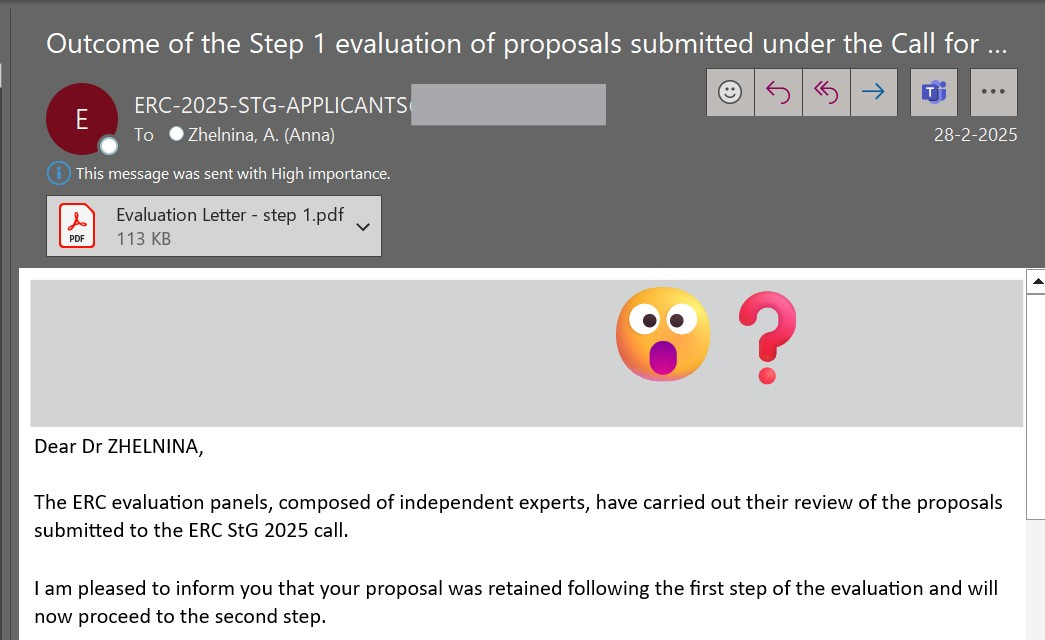
If you are invited to Step 2: congratulations! You won’t know what the panel wrote in their reviews until later in the summer. You’ll have no written feedback to guide your preparations; only the (very welcome and exciting!) message that your proposal was convincing enough to be sent to external reviewers (“retained” in ERC lingo; I feel like I had to learn a new language to understand the emails the ERC system sent me). You’ll be in the dark about what the panel liked and what they found less convincing, and you’ll have to anticipate possible questions and critiques on your own.
The interview (I’ll write another post about the interview itself and how to prepare for it) is an opportunity to present your research again and respond to critiques and questions from both the panel and the external reviewers. Since you won’t yet know what those critiques are, the best strategy is to anticipate them.
Here are a few things that helped me:
I re-read my proposal carefully to remind myself what I had actually written. A few months had passed since submission, and the distance helped. I could look at my own text more critically and formulate questions to myself.
I asked several people to read the proposal with a critical eye and write down questions they had.
I organized mock interviews. I ended up doing two with different people, though I know some applicants do more. I asked mock panel members to prepare questions but not to share them with me in advance, so that the situation would resemble the real interview as closely as possible.
In my case, interview preparation took place during my teaching-heaviest months, so I really had to start early and spread out the workload. June, when the interviews were scheduled, seemed far away at first, but I was very glad later that I had started early and worked in small bits here and there. More on that later.
Comments
Nothing yet. Say the first thing.
Sign in to join the conversation.