
Why I’m writing this
I thought I'd write this long-ish post to describe my experience of writing (and getting) an ERC Starting Grant. This may be of use to someone – I know I obsessed about people’s experience posts while I was in this nerve-wracking process myself.
I'll start with a disclaimer on my positionality and privilege that might put these tips in perspective. I fully realize that not everyone will have the resources and the relative peace of mind that I had while working on their proposals, and that may require some additional stoicism from them.
Positionality statement
I started working on my ERC Starting Grant proposal in my first year in a new, permanent Assistant Professor job. It was a stressful time, nonetheless: for this job, I moved to a new country, was still finding my way in it, and struggling a bit from the loss of networks of personal and professional support I had before my move.
Still, in this new position I enjoyed what many applicants don’t have: the certainty that my job didn’t depend on the success of the application. I always thought: it would be extremely cool to have the grant. I would never have the resources and people I need to make this ambitious project possible without it. And the grant gives you the opportunity to hire people, covers fieldwork expenses, and, importantly for teaching staff, it can buy you out of (some of) your teaching duties. All that was super important for me to establish myself as a research entity in the new country and just spend time doing what I love – research. So, my job situation and happiness would improve immensely if I had this funding, but they didn’t depend on it completely.
The stakes are different for scholars in precarious job situations, for whom obtaining such funding is a matter of having a job in academia. I’m fully aware that the toll on one’s mental health is quite different with such pressures.
Another important piece of context is that my job is in the Netherlands: Dutch universities have a good rate of acquiring ERC funding, and there’s a good chance that one has at least some colleagues who have applied for or received this grant at some point. The research support offices are also quite experienced with the application process and can help you, which may be very different in other academic contexts, where universities don’t have the experience or resources to support their applicants to the same extent.
In any case, it is important to have people to ask for feedback and help; they may or may not be your immediate colleagues, but I can’t stress enough how important it is to seek help while applying for this funding.
Now, to the steps.
PART I. Idea and development. Timeline
For an ERC grant, you need a clear and fresh idea. Where do you get one? Ideas are elusive and subjective: someone may find your idea new and clear, others will struggle to see what’s the value. Therefore, it is important to be convinced yourself that your idea is worth it.
My idea did not come out of nowhere: there is a decent literature on the relationship between mental health and activism, emerging from research conducted by social psychologists and sociologists. I had a personal interest in this nexus: researching activism, I noticed that it can be very rewarding, but also requires a lot from people. Reading sociological and psychological work, and peeking outside the usual social movement domain into feminist thought led to a moment when suddenly things clicked and I found an angle I thought was ripe for exploring but was not yet explored enough: I needed to bring all these strands of thought together through the lens of care. This click was aided by scrolling some activist Instagrams, too – so no source of inspiration is irrelevant.
I felt the first inkling of an idea around February–March 2024. The idea started vaguely brewing in my head. I registered my interest with my university’s research support office, and participated in their preparatory events around June. At the time, I didn’t have a draft or even a fully fledged vision for the project. Participation in these workshops helped me get into the proposal mindset: the ERC has a specific lingo when it comes to different elements of the proposal, and it definitely helped me start seeing my idea through this lens. I took detailed notes: excellence, breakthrough vs. groundbreaking, timescales, structuring the project into work packages/subprojects, and so on. I returned to these notes later when I already had a clearer idea of what I wanted to do, but needed some structure and language refresher.
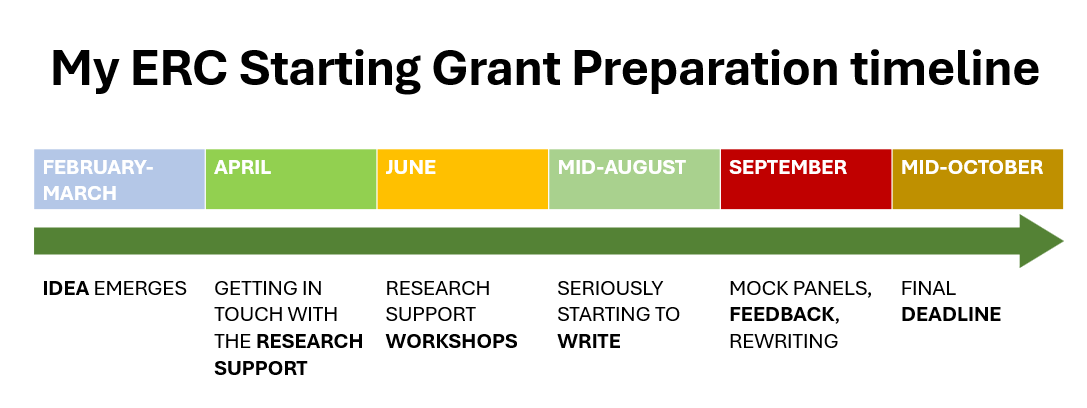
I actually started working on the proposal text later, in August. It was helpful to have internal deadlines in September set by the research support office: they organized mock panels to read our proposals and arranged for professional language editing, which forced me to come up with a working version of a proposal much earlier than I normally would at my natural pace. This gave me some precious editing and polishing time, when I could take in and really digest the feedback that I received. I also had a version to show my colleagues and friends, who also gave me important feedback that I incorporated in the final proposal – because I had the time. The actual, final version was not ready until the very last days, and I was still making some changes in the narrative budget on the last day before the deadline, but overall, this extra buffer time forced upon me by the internal deadlines was extremely important to improve the quality of the text that I submitted in the end. [More on feedback here]
The first thing I produced when I started actually shaping the proposal was a diagram, in which I tried to tie in the concepts and approaches from the literature I had just read, placing the concept of care at the center. I’m a visual thinker, so this early version of the diagram was key for me. To start writing the proposal, it was extremely helpful to see some examples: and I am very grateful to two colleagues in particular, who shared their applications, and one of them even shared the evaluation results for their (unsuccessful) proposal from several years ago. Also, I would not expect everyone to share these materials easily: it is a very generous gesture, as people may - and will - feel vulnerable sharing their ideas and not always positive feedback they received on them.
The ERC proposal format doesn’t give you any clear structure: basically, you can write whatever you want in these 5 pages of the B1 and 14 pages of the B2 (the B2 is going to be only 7 pages, starting this year). So it was very good to see how others had organized their pages for inspiration and some guidance. Seeing the evaluation results of my colleague’s proposal was very revealing: it helped me get into the mindset of a potential reader, who may not be an expert in the specific field, but is expert enough to see where things are missing or not sufficiently explained.
Overall, I spent half of August and almost all of September and the first half of October writing and rewriting, getting feedback and rewriting again. Here, again, I was very fortunate: I did have this time to write and think. My teaching load, luckily, was relatively light in the first quarter of that year, so I could concentrate. I know not everyone has this luxury.
The deadline was mid-October, and in the last days I was polishing the proposal, obsessing over the charts and tables. I included my slightly changed original diagram and a version of a timeline chart in the B1, and a fancy chart of my subprojects overlaid with the project objectives in the B2. I created these diagrams myself using PowerPoint, and pestered my friends and loved ones with questions about the hue of a specific grey I used and whether the table looked better with or without internal borders.
Thank you for reading, and consider subscribing:
to read my next posts about applying for an ERC Starting Grant: I will talk more about writing, receiving feedback, and editing the proposal; shaping your budget and project structure; staying sane while waiting for the results; and preparing for and surviving the interview.
Thanks for reading Anna’s Substack! Subscribe for free to receive new posts and support my work.
Comments
Nothing yet. Say the first thing.
Sign in to join the conversation.