
We just wrapped up sunshine week that was created by a nonpartisan group to shed light on the importance of public records and open government. You might be here because you have watched my ongoing battle with the Village of Holly over violations of transparency laws or you saw I was charged $100,000 for a public records request from Grand Blanc Township. Not only do I speak out about this blatant attack on government transparency, but I act on them. I am in my forth lawsuit over violations of these laws.
So why do these transparency laws matter, what are they, and why do I fight so hard to protect them?
*Note: I am not an attorney. I’ve become an expert in this area from getting involved in government and through litigation.
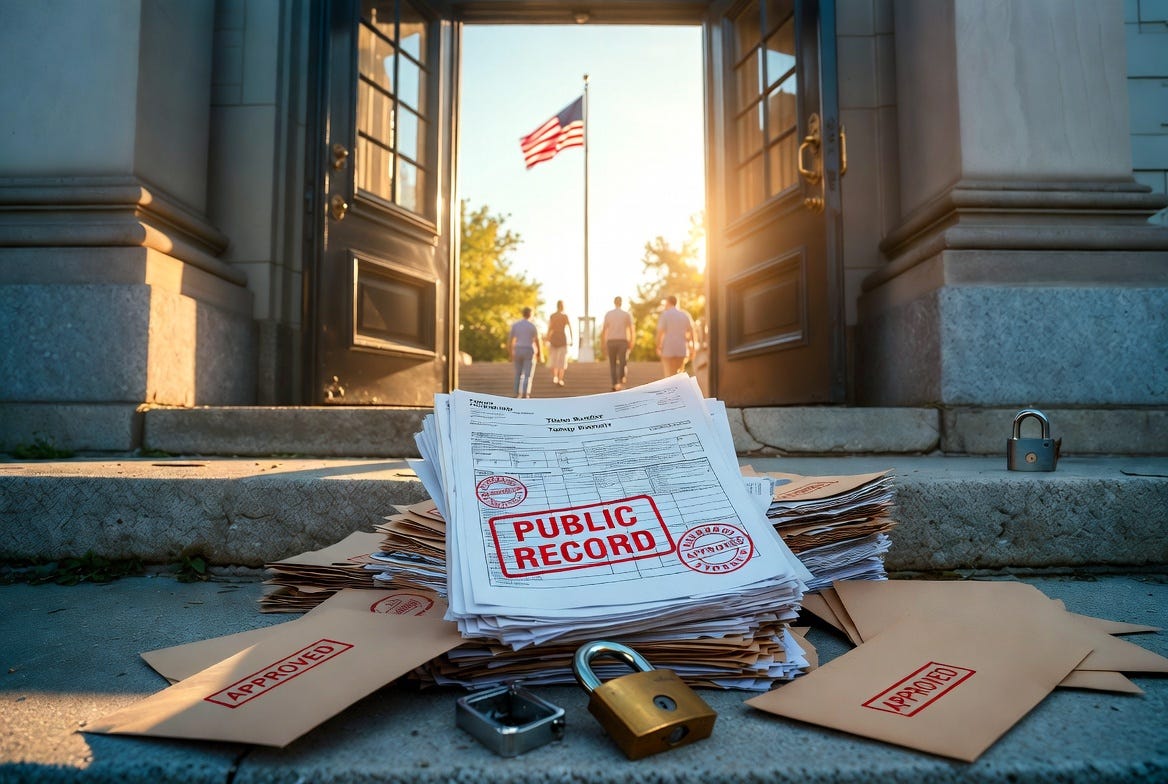
To explain why transparency laws matter, I need to briefly explain why I got involved in government in the first place.
When I bought my current home, I was shocked by my property tax bill. I went from paying $1,200 a year in my previous home to $6,500 a year. At my old home, we had nicer parks, better-maintained facilities, and even a community pool. In my current town, the roads are crumbling, the parks are underutilized, and the government office is constantly having issues.
So I asked a simple question: What am I paying for?
To find answers, I started attending council meetings. After six months of showing up to every meeting, I still had more questions than answers. That’s when I turned to public records requests to find out what information my local government was not sharing.
Years later, those efforts have uncovered how money has been mismanaged and brought attention to issues that otherwise would have remained hidden.
This is the power of transparency laws in action. Any citizen can see how their money is being spent and hold their government accountable.
So what are these laws?
Every state has laws that allow you to request public records from a public body. These requests can be made at the local, state, or federal level. While each state may call it something slightly different, most people know it as the Freedom of Information Act, or FOIA. View this article to see what your state calls it.
Generally, it is any writing (digital or paper) that the government creates or maintains while performing an official function. This can include police reports, property tax assessments, contracts, emails, text messages, and even social media messages from elected officials, staff, or appointees—as long as they relate to government business.
For example, if you email your mayor about road conditions, that communication becomes a public record that others can get access to.
There are, of course, exceptions. Information protected by attorney-client privilege, personal privacy, or active investigations can typically be redacted.
Even when you request public records, some government bodies will try to avoid releasing them. The two most common tactics are overcharging and wrongful denial, both of which I have experienced multiple times.
Recently, one of my public records requests made headlines across Michigan. A fire chief in Grand Blanc Township was placed on administrative leave and was expected to be fired on National First Responders Day.
Not only did I want to know why, but the entire community did. I submitted a FOIA request for records related to that decision, including communications between the chief and the township superintendent. The response? A bill for over $100,000. While public bodies are allowed to charge for records requests, they can only charge actual costs, they cannot make a profit.
These records did not cost $100,000 to produce, but the township hid behind a six-figure price tag. Government bodies often rely on the assumption that most people can’t afford to challenge it.
In that same case, the township also denied my request for communications with their public relations firm, claiming “attorney-client privilege.” But a PR firm is not an attorney.
While I’m most familiar with Michigan’s process, many states follow a similar structure. If you believe your request was wrongfully denied or overcharged, you typically have two options: appeal or litigation.
In Michigan, you can appeal the decision. In practice, this rarely works. The same entity that denied your request is the one reviewing and deciding your appeal.
That leaves litigation.
Public bodies often rely on the fact that most people don’t have access to legal representation or the financial ability to sue. My journalist friend Tiffany Cianci always says, “you get the justice you can afford.” It’s unfortunate how true this is. I’ve been fortunate to work with a strong legal team, but many people don’t have that option.
That’s why I continue to report on these issues, so residents understand what’s happening and can hold their officials accountable. If all else fails and your government still refuses to be transparent, you have two choices: elect people who will be, or step up and run yourself.
I am happy to say that some states take a stronger approach. In Florida, for example, there is no appeal process, but violations can lead to criminal charges for public officials who knowingly break the law.
The second most important law, outside of the Constitution, is open meetings laws. Again, each state has its own version. In Michigan, it’s called the Open Meetings Act.
This law requires that government decisions be made in public. While many decisions are still attempted behind closed doors, the law makes that illegal.
It also requires meetings to be properly noticed, allows for public comment, and gives residents the right to record proceedings. There are limited circumstances where a board can enter a closed session, typically for active litigation or certain personnel matters.
When these laws are violated, decisions can typically be challenged and even overturned in court. Violations can also result in civil lawsuits and, in some cases, criminal charges against public officials.
In fact, I am currently suing my local government and each individual board member for making secret decisions and holding illegal closed sessions.
Transparency laws are the foundation of a functioning democracy. They are what stand between the public and abuses of power. I firmly stand by what President Abraham Lincoln said, government is made “of the people, by the people, for the people.” Secret meetings, unaccounted spending, and unchecked power goes against those principles.
The reality is, these laws only work when people are willing to use them. So ask questions, show up, and push back when public officials do not have the public’s interests at the forefront of their decisions. Because at the end of the day, the government only gets power from the people and what we give them, we can take away.
No posts
Comments
Nothing yet. Say the first thing.
Sign in to join the conversation.