
Kia ora tatou —
There are just 89 days until the New Zealand election, and it seems like anything could happen. While foreign affairs is never top of the political agenda, I think we’ll be talking more about our place in the world over the next three months because New Zealanders have felt the tangible effects of Donald Trump’s misadventure in the Middle East. I guess that makes it a cost of living issue, but still. I’m beginning to think about how I write about the election so if you have ideas or requests, please let me know. Also feedback. I love feedback (especially constructive criticism.)
I’m very excited that the New Zealand International Film Festival starts this week and have a bunch of films booked, including a “surprise” one on Saturday night. I love being transported from Brazil to China to Estonia through this festival.
Here’s what I’ll be keeping an eye on in the meantime.
Things I’m watching this week
Vietnam’s strongest leader in decades, To Lam, is now in Australia and will arrive in Auckland on Wednesday. He’s likely to sign several agreements while here. Prime Minister Christopher Luxon, hailing a big increase in bilateral trade, said: “We want to build on that growth across food and fibre, education, tourism, technology, aviation and investment, supporting more exports and jobs here at home.” I’ll have more on To Lam in my next newsletter.
The Cook Islands hold elections on Wednesday, with Prime Minister Mark Brown seeking re-election and his Cook Islands Party fielding the highest number of candidates at 20. Here’s RNZ’s election preview. The Cook Islands News reports that the race is tight and Brown can’t be assured of getting back into office. Brown is the prime minister who signed a “comprehensive strategic partnership” agreement with China without disclosing the contents to New Zealand before ratification, leading Foreign Minister Winston Peters to cut off almost $30 million in annual funding. That funding was reinstated earlier this year when New Zealand and the Cook Islands forged a defence and security declaration. Cook Islands United Party leader Teariki Heather, who strongly opposed Brown’s deal with Beijing and lack of consultation with Wellington, is running against Brown.
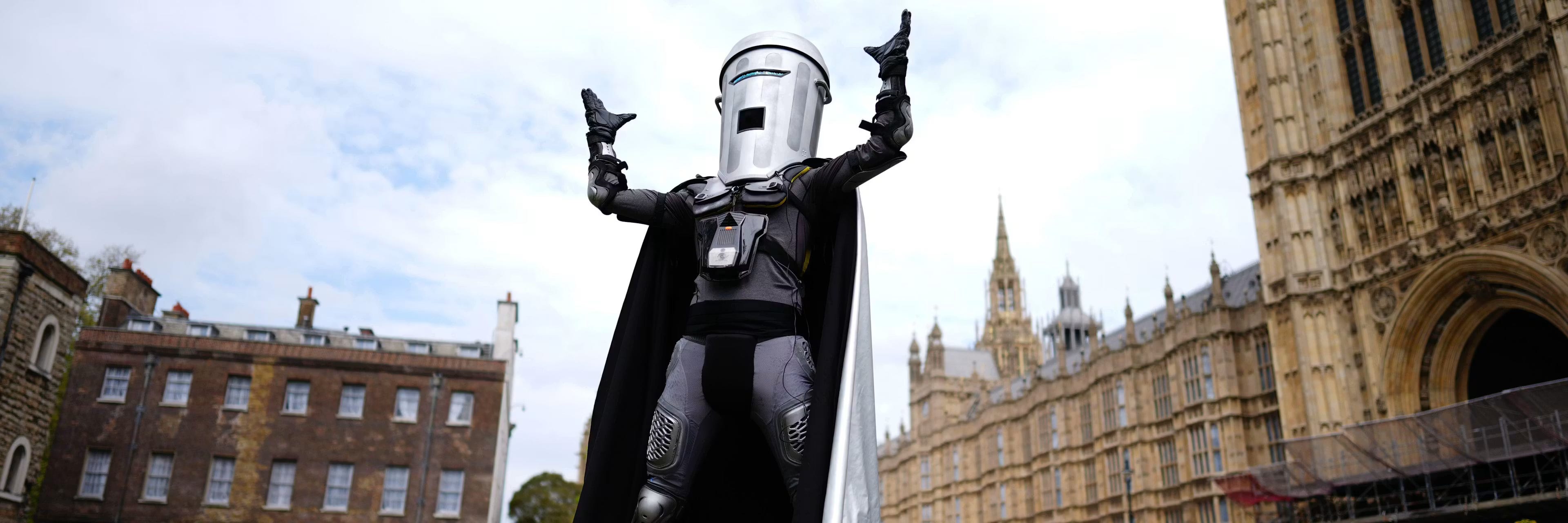
And an election of a very different sort: A by-election will be held in the British constituency of Clacton after Reform UK leader Nigel Farage resigned his seat and immediately stood again. The stunt came before parliamentary authorities could decide whether he should have declared a £5 million (NZ$11.5 million) gift from a cryptocurrency billionaire that he received before his election as an MP. The scandal has only widened since then. He’s asking the people of Clacton to decide in a vote that the other political parties are boycotting. That means Farage’s main rival is Count Binface, a self-proclaimed space warrior who wears a bin-shaped helmet. There are also three candidates from the Official Monster Raving Loony Party and several independents. Polls suggest the Count will get one-fifth of the vote. Results will be out Friday night NZT.
Three things I enjoyed over the weekend
Evan Osnos, one of the greatest journalists of my generation, has written excellent books on China and the United States (and his most recent one includes a chapter on New Zealand, based on his trip here to chronicle why the ultra-rich were buying up property.) He's just back from Beijing and has written this masterful piece in the New Yorker: The Future, Made in China. It looks at China's incredible technological advances, and the political calculations both Washington and Beijing are making in the race for the future. The piece implicitly warns, as Elon Musk did in 2011, about underestimating China:
“In July, the Chinese firm Moonshot released an A.I. model that performed comparably to its American competitors, at a fraction of the cost. Microchip stocks plunged, on fears that China will dominate A.I., much as it now dominates hardware. China produces at least seventy per cent of the world’s drones, electric vehicles, lithium-ion batteries, and solar cells. It deploys more industrial robots than the rest of the world combined, and, in medicine, it has surpassed the United States in the number of registered clinical trials. Its shipbuilding capacity is roughly two hundred times that of the U.S., and some observers in Washington worry that American stockpiles of munitions would not match China’s in a war over Taiwan.”
It’s long but I highly recommend this piece for its big-picture context framing the technologies that will shape much of our future. (Pro-tip: You can readthe New Yorker through the Libby app, connected to your local library.)
Last week I moderated a webinar for the Helen Clark Foundation, following Helen's recent trip to the West Bank. Her descriptions of what's happening on the ground were chilling: Benjamin Netanyahu's far-right coalition is dramatically stepping up support for illegal settlements across the West Bank that are clearly designed to deprive Palestinians of their ability to go to school and work, to make a living and have any kind of dignity. A negotiated two-state solution seems so far away, and people listening were clearly hungry for some kind of hope (as was I.)
Two glimmers: Helen talked about the Israeli civil society groups trying to bring about change from the inside, and the polls for the Oct. 27 election are pointing to a very difficult race for Netanyahu. What comes next is another question. So I really enjoyed this piece by , the former editor of the Guardian: Inside Haaretz, Israel's voice of dissent. He writes about how the liberal newspaper has arguably become more leftist as the country has moved further to the right, including reporting on the huge increase in violence in the West Bank. But Rusbridger asks whether it can continue in this vein — not least because devoting pages to Palestinian suffering is hardly the way to commercial viability. I tip my hat to the journalists of Haaretz for telling Palestinian stories when (almost) no one else in Israel is.
This was an electrifying listen: Richard Flanagan on heresies and hope, talking to on ABC Saturday Extra. The Tasmanian author (who lists Albert Camus as his favourite Tasmanian writer!) is so compelling in his commentary about climate change, journalism, politics and this moment we find ourselves in. I am always looking for reasons to be positive (see above) so I really appreciated his call and reasons for hope at the end.
In defence of independence
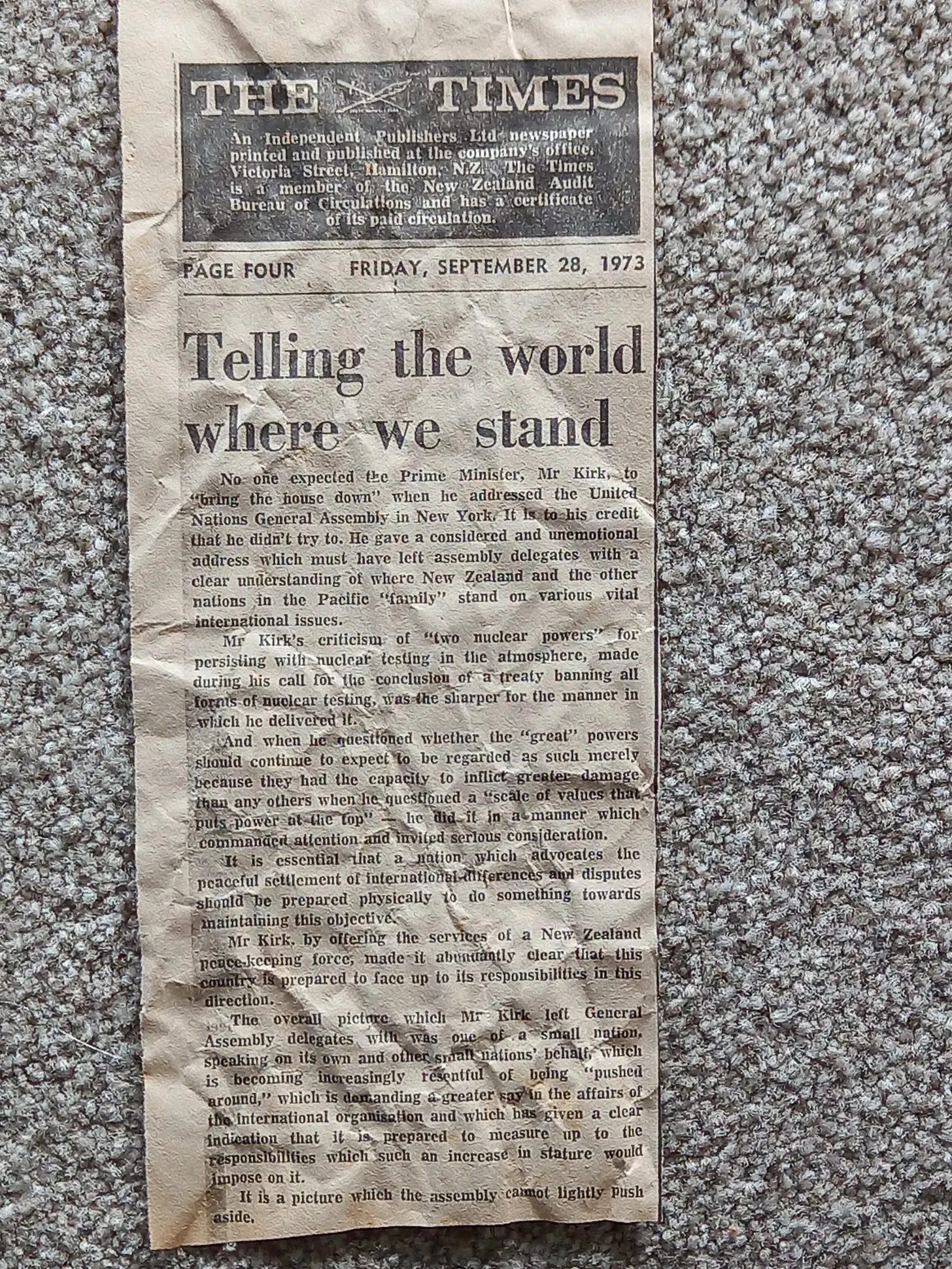
Finally, this made my week: In my latest column in The Listener, I argued we need to become more resilient if we are going to get back to have an independent foreign policy. A lovely reader sent me this clipping from the Waikato Times in 1973, after Norman Kirk delivered an address to the United Nations General Assembly, in which he criticised nuclear testing and offered New Zealand troops as peacekeepers.
The overall picture which Mr. Kirk left General Assembly delegates with was one of a small nation, speaking on its own and other small nations' behalf, which is becoming increasingly resentful of being “pushed around,” which is demanding a greater say in the affairs of the international organisation.
These sentiments are still salient today (and the world has pretty much given up on the UN being able to make good on them.) But the first line made me laugh: “No one expected Mr. Kirk to bring the house down.”
James Curran, a professor of modern history at the University of Sydney who has written about great Australian political speeches, recently asked me about the best political speeches in New Zealand history. I immediately said David Lange’s “uranium on your breath” speech, and thought of Jacinda Ardern’s “they are us” speech after the Christchurch mosque shootings. Peter Fraser probably gave an important speech or two, I thought.
Are there speeches you think belong in a New Zealand compendium of great political speeches? I’d love to know.
That’s it from me for now
-anna
Between Giants, by Anna Fifield is a reader-supported publication. To receive new posts and support my work, consider becoming a free or paid subscriber.
Comments
Nothing yet. Say the first thing.
Sign in to join the conversation.