
Nobody who’s been reading this blog for long can be unaware that fibre-optic FPV drones – drones with a cable that allows the operator to see where they are going and strike a particular target – are an increasing threat to soldiers and civilians alike. Drone detectors don’t sense them, because there’s no radio signal.
The best defence is an old-fashioned shotgun:
But net guns are increasingly used as well. This device was invented in New Zealand in 1969, and has been used since then to capture animals, criminals and other fast-moving objects… such as drones. This US vlogger has compiled a video of a Ptashka (meaning ‘bird’) net gun, the main brand, in action. The firing range is 25-30 metres, and the net fully opens at about 15 metres. The net itself is 3.5 x 3.5 metres square.
Why use a net gun instead of a shotgun? Well, if you’re a civilian in Ukraine you don’t have a legal right to carry a shotgun: Bogdan and his team have one because they prioritise staying alive over strict legal compliance. Another factor that doesn’t weigh heavily with many Ukrainian soldiers but may appeal to readers is their non-lethality. But there are situations in which the military prefer net guns to shotguns too.
Illia of 3Druk explained why: “On the zero line, where there are swarms of drones and a full-on combat situation, a shotgun is the best option. But a net gun weighs about a quarter as much [less than 1kg, as opposed to 3-4kg], making it easier for an already overloaded soldier to carry.
A drone hit by a bullet or buckshot may explode, causing collateral damage to whatever it lands on. So net guns are safer for use in areas where civilians are present. Plus if an enemy drone is netted rather than destroyed, it can be taken for analysis.”
So humanitarians increasingly carry net guns, and so do many soldiers. But Ptashkas cost minimum 17,000 UAH (£282/$378) for the most basic model and you have to keep buying replacement net capsules.
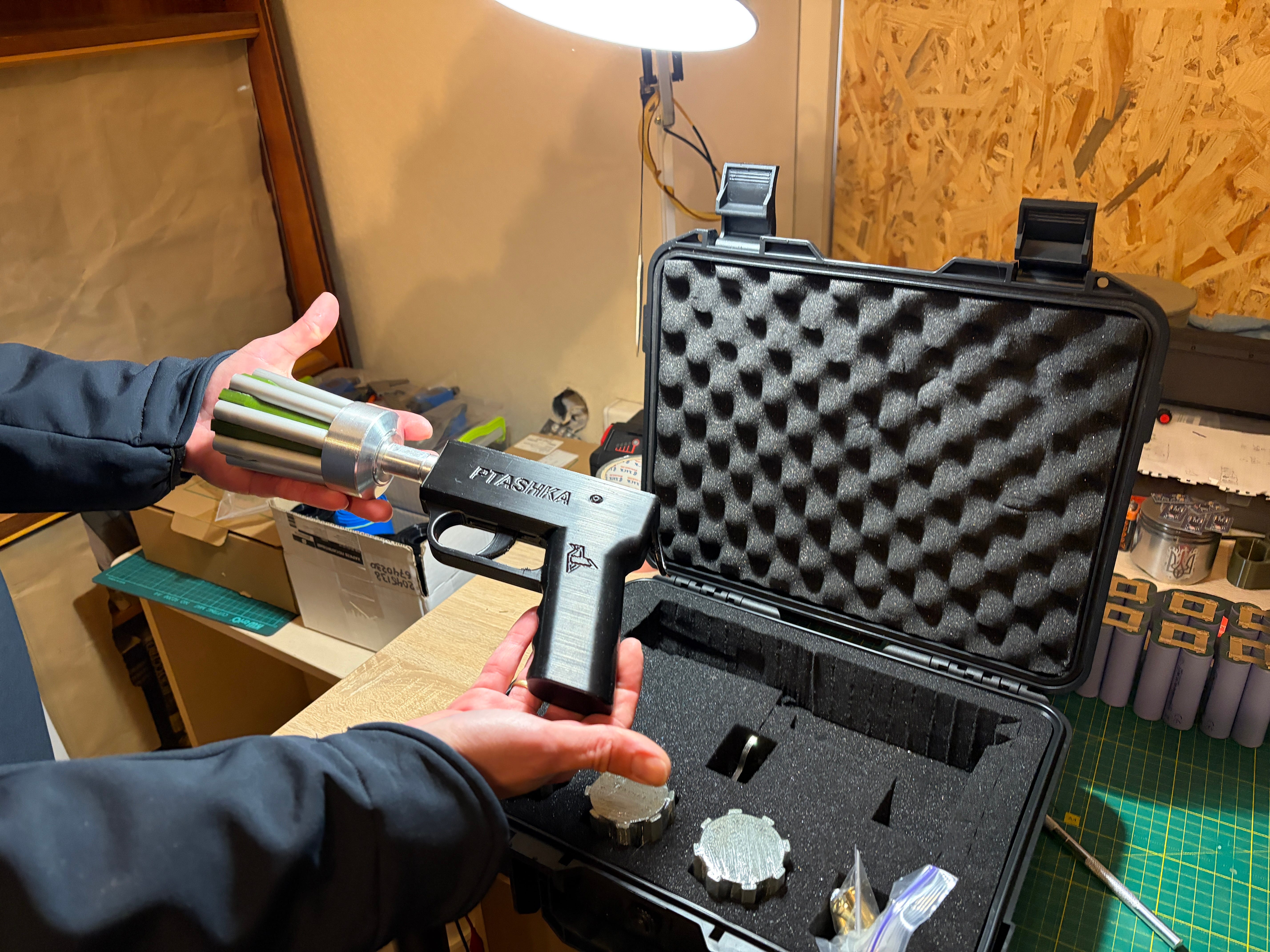
This, as often happens, is where Illia and his brother Georgii come in. When I visited their workshop back in April, they had just taken delivery of a Ptashka. They later did an unboxing video for their Ukrainian Telegram channel. It’s six minutes long so I haven’t subtitled it fully but the visuals are easy to follow.
00:20 - Illia explains that the lads and lasses from a military unit came and said they need a net-launcher module for an unmanned ground vehicle (i.e. drone on wheels). The soldiers ordered this Ptashka for Georgii and Illia to use as a model to copy.
01:08 - There’s the pistol-like launcher with eight barrels, three net capsules and a bottle of lubricant. The five blanks contain propellant [pressurised gas] and a primer. When the primer is struck, it releases the pressurised gas. There’s a special tool for separating the gun into two parts. Then you can insert the blank.
02:25 - Illia opens the side to show that the firing mechanism is quite simple, but he’s not showing it in full, because no doubt there will be Russians watching and he doesn’t want to make it too easy to copy.
03:11 - The firing pin strikes the primer in the blank cartridge, pushing the propellant gases into the barrels. If the gun is loaded with a net capsule [Georgii then shows a capsule still sealed in plastic wrap] the weights emerge with great force.
03:55 - The net is attached to the tips of the eight weights, so that when they spread out in the air (thanks to the angle of the barrels) the net stretches wide. The special tool allows you to insert the weights to exactly the right depth.
04:55 - It’s not very convenient for rapid reloading in the field!
What’s not in the video is the upgrade that addresses that final point. The manufacturers have since updated the Ptashka to a quick-detach barrel design which greatly speeds up the process of reloading. Because the devices are 3D-printed, all this required was a change to the digital model; no need to retool the production line. They also added a safety catch!
While I was in their workshop, the lads took a good look at the kit themselves.
Georgii: The [soldiers] asked us to copy the plastic part. Someone else will probably make the metal components, it’ll need a lathe. I don’t know who, I didn’t ask.
They want this part in two versions: one as a handheld pistol-type launcher that people can use directly, and another version mounted on a drone so drones can catch other drones.
We do a lot of this kind of work: someone brings us something and says, ‘Make the same thing, but cheaper.’ We’re not entirely copying it, we’re doing our own thing, but fundamentally they’ll be similar.
How many are you making?
Georgii: We haven’t started making them yet, because this Ptashka only arrived earlier this morning.
We thought about demonstrating it to you, but we thought the neighbours would think someone was shooting, because it really sounds like that! And we might damage the room.
We’re not going to sell these. What we’re doing doesn’t violate copyright because we’re not making exact copies and we’re not making money. We just give them away. Some manufacturers dislike us for that. That happened with the Tsukoroks [a brand of drone detector] too. They were making money and we were interfering like Robin Hood.
Our goal is for soldiers to receive things free of charge, in large quantities. That’s all. If we wanted to make money we could buy a sample, copy it and sell it for half the price. Because I think they’re made for a third of the price they’re sold for. We try to make things as cheaply as possible.
To be fair to manufacturers, expensive Ptashkas aren’t the only option, Illia told me later when I was writing this post:
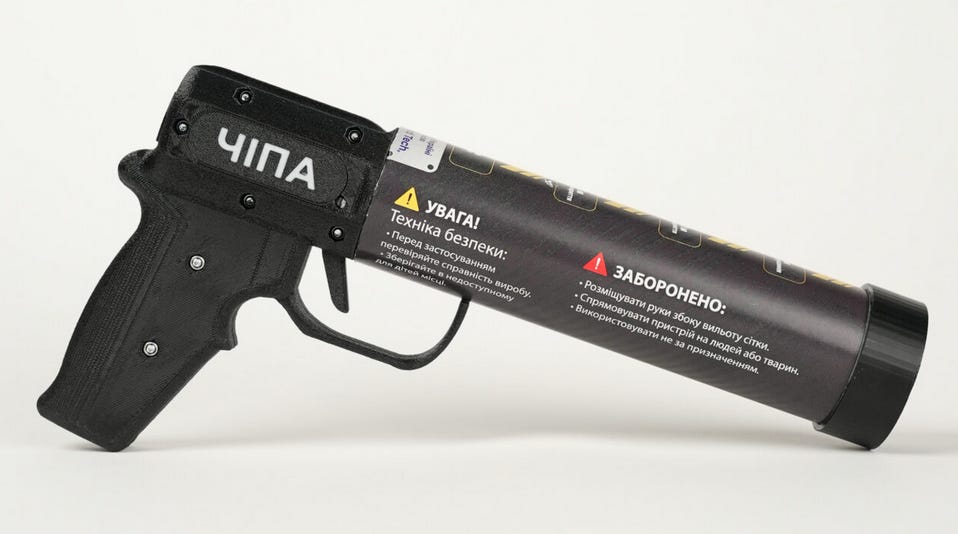
Illia: Another option is the Chipa from Bluebird Tech, which is lightweight and about five times cheaper than the Ptashka. However, it’s also disposable; and the price of one Chipa is about the same as that of two Ptashka cartridges.
Nevertheless, however cheap some commercial models, only volunteer groups like 3Druk supply the army entirely for free. You can donate to their PayPal using this address: donate@3dryk.pro. Please select Friends and Family, and add a note with this wording only: ‘3D printing supplies’.
To receive new posts and support my work, please consider becoming a free or paid subscriber.
Comments
Nothing yet. Say the first thing.
Sign in to join the conversation.