
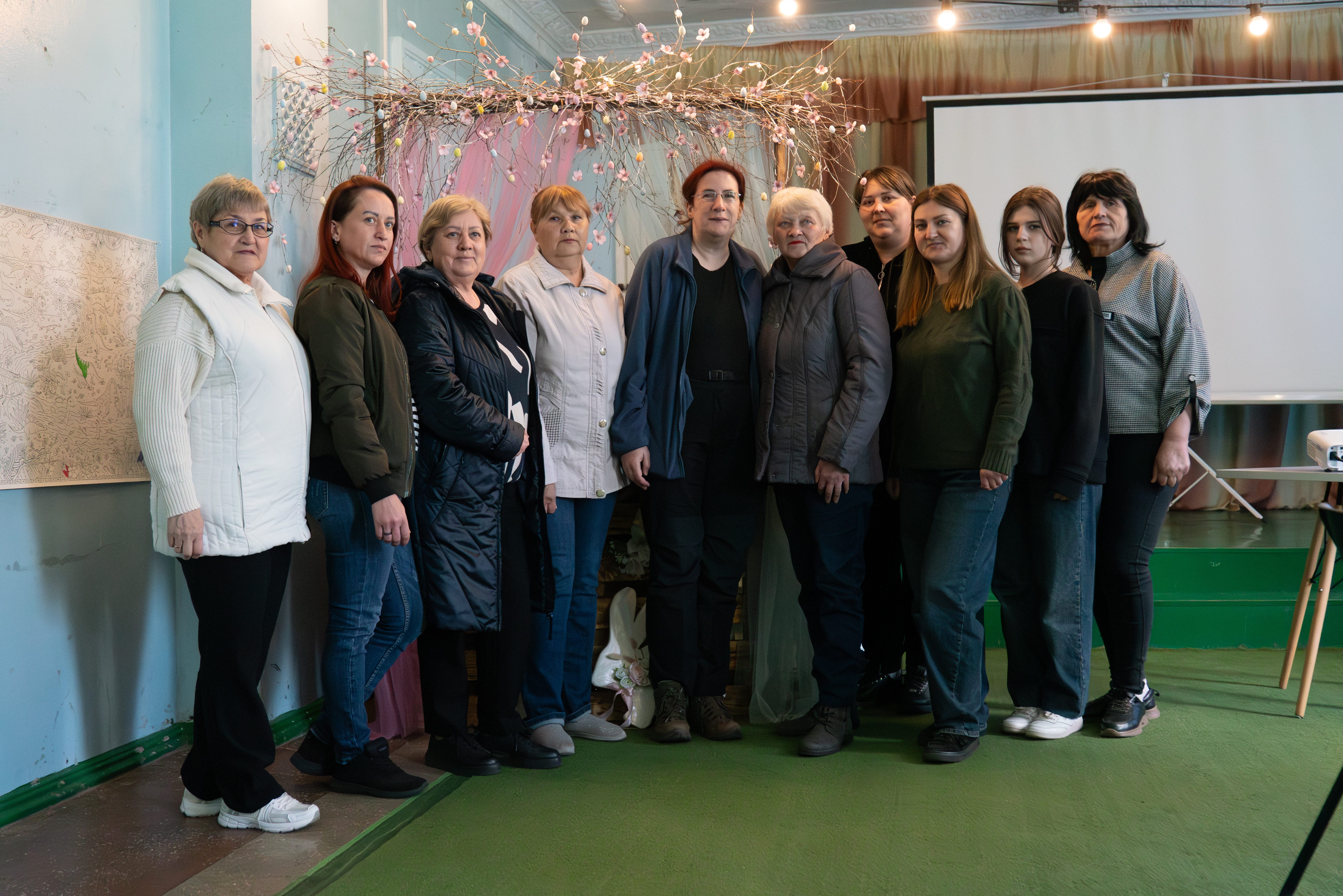
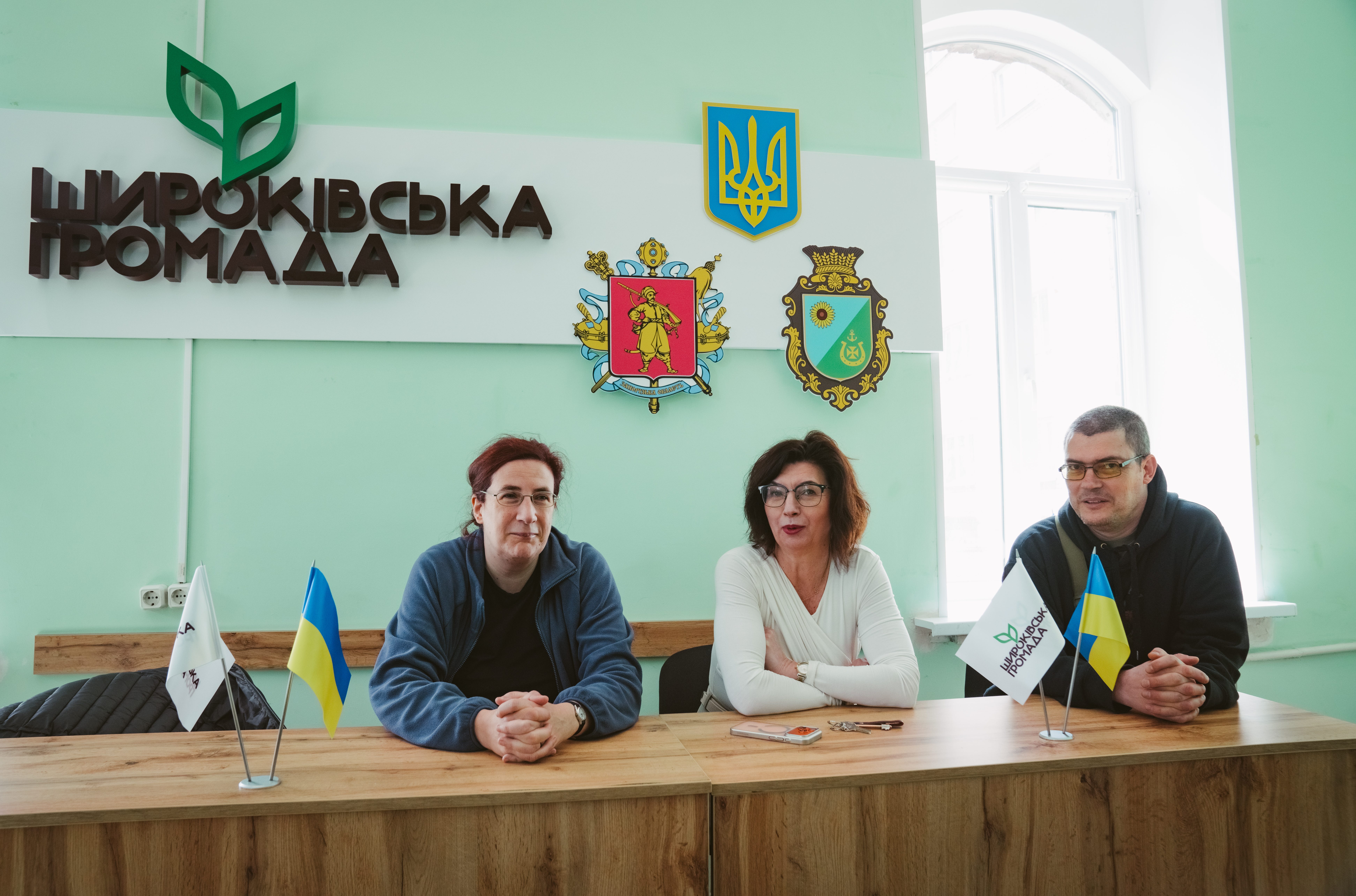
Nadia, council staff: We have a social service called the University of the Third Age1 here [in Shyroke hromada]. People gather in different villages, wherever there are Soviet Houses of Culture, which we call leisure centres now. I guess you could call it intellectual recreation because a lot of women in particular have been sitting at home on their pensions. They come here and we offer training and workshops.
The [Ukrainian] Red Cross and Médicos del Mundo conduct first-aid training, for example. That’s very relevant for us because we live in a frontline area and sometimes people go to the city so they need to know how to help one another.
There are also many workshops run by psychologists. Because many people have anxiety, or are traumatised by terrible events. A lot have sons or daughters at the front. They don’t all need a professional psychologist; sometimes it’s just someone listening to them, a chance to express themselves and spend time with other people.
We have a group of about 180 on Viber. People advise each other on what to do, how to rest, how to spend your time, what to do in general.
Whenever someone new arrives in the village, I try to find out and invite them. There was one woman who had been here a couple of months before I saw her by chance. I said, ‘I don’t know. Come join us!’ She’s here today. We try to support displaced people in particular, so they feel welcomed and comfortable. Maybe we could do even more, but within our means we do our best.
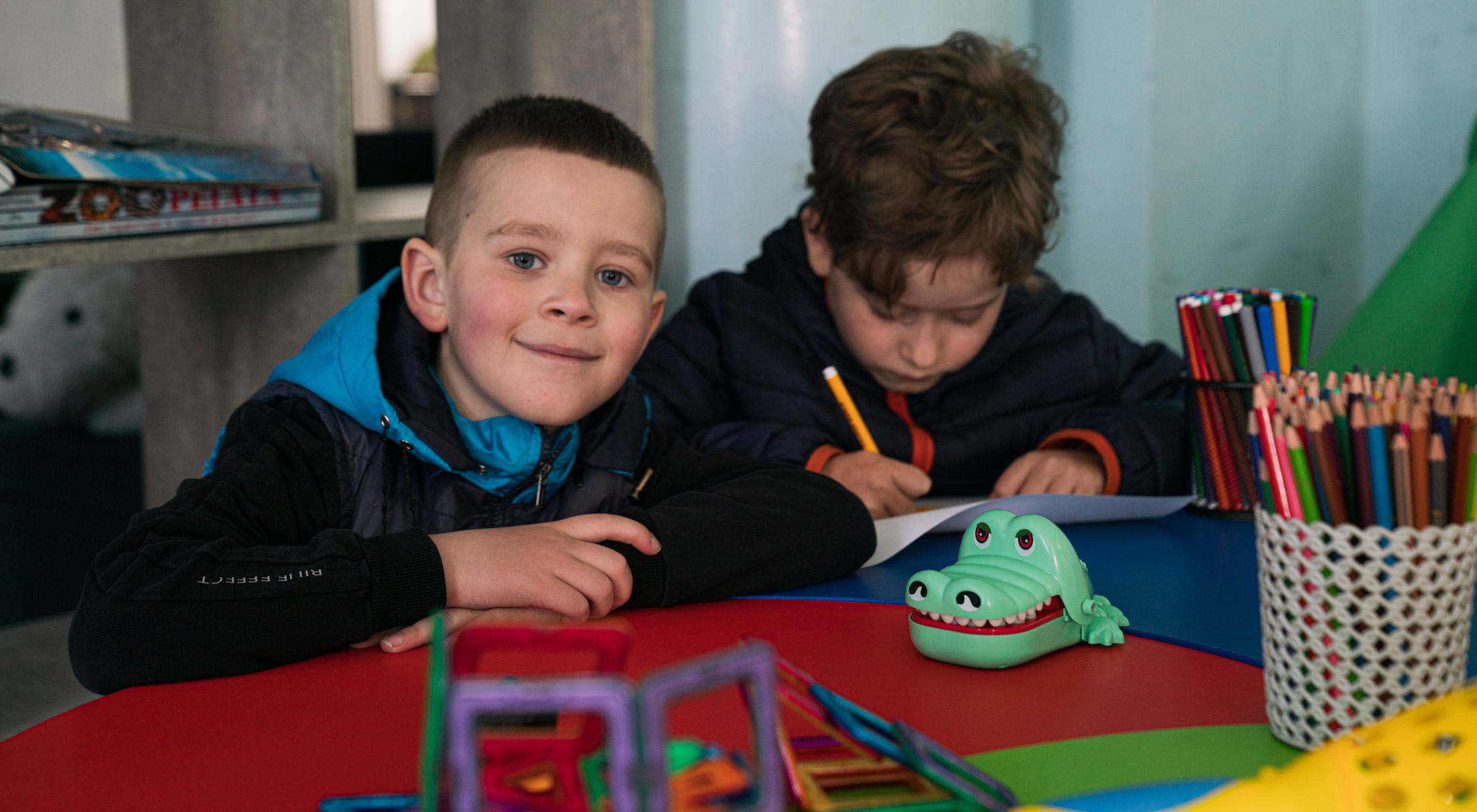
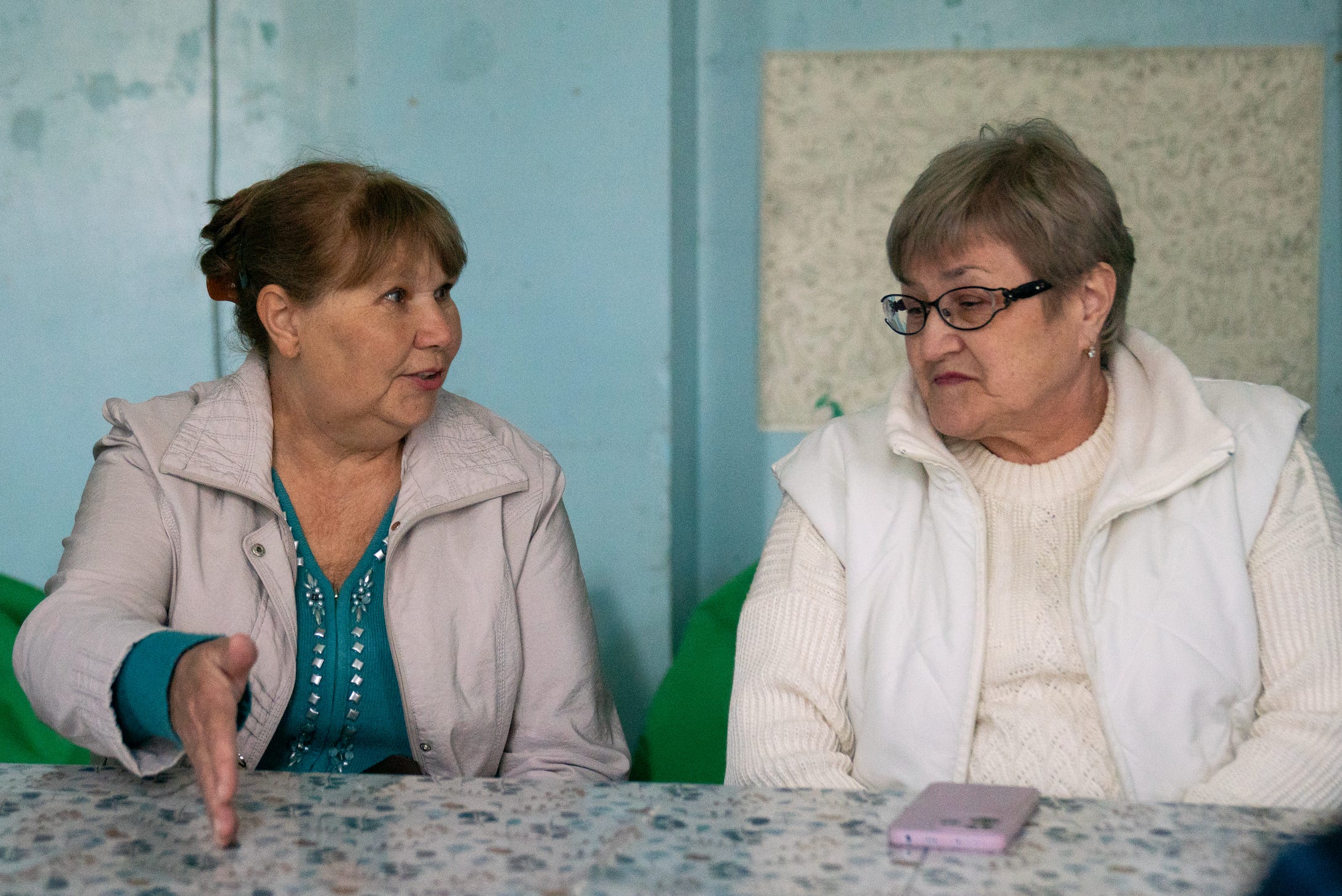
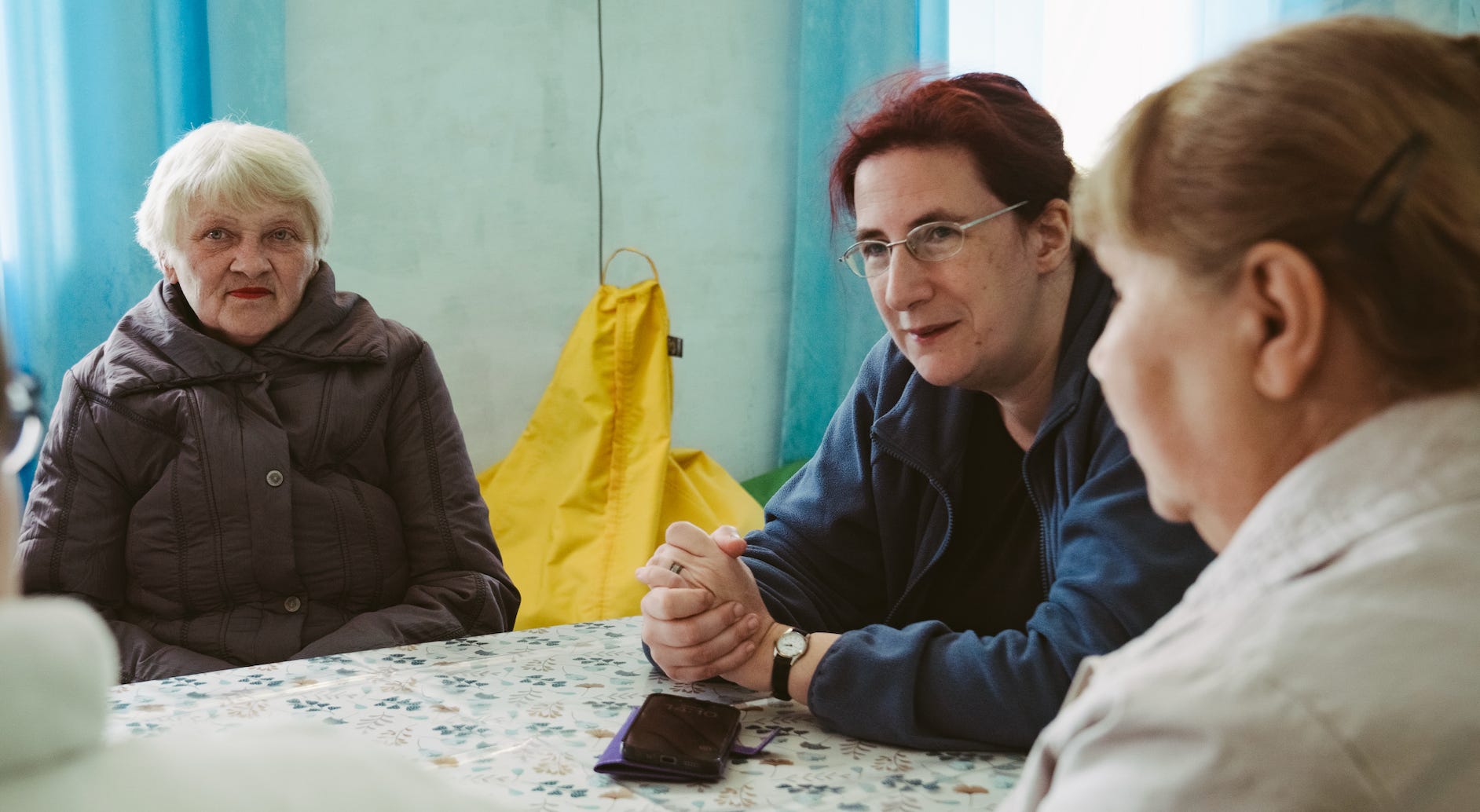
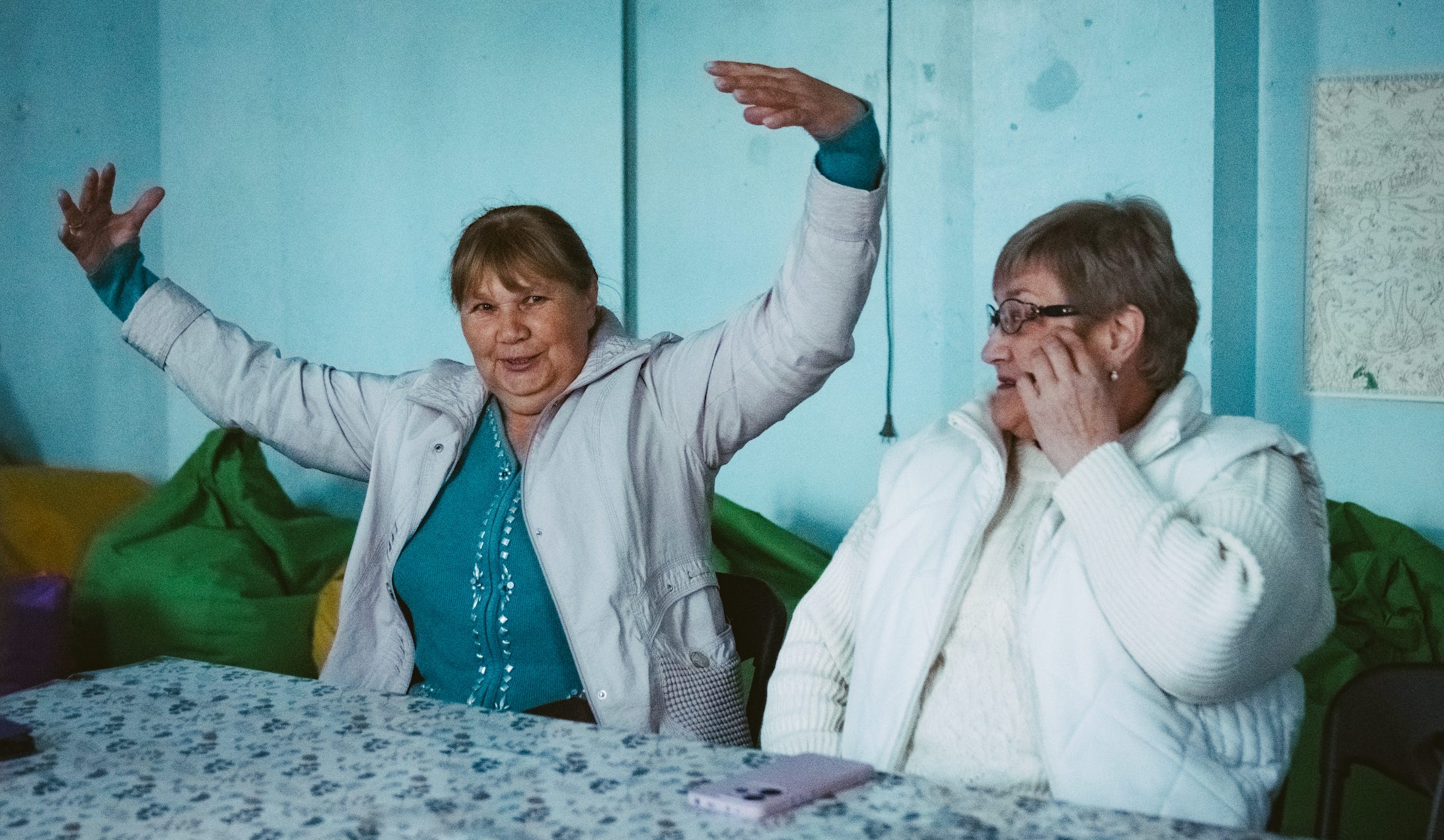
Freefilmers feel it’s very important to help Internally Displaced People, of whom there are 11,000 in Shyroke hromada – about a third of the population. The hromada authorities make a point of using the term ‘new resident’ rather than ‘IDP’. Realistically, not all these people are going to integrate, and I’m suspicious of any claims of total harmony, But the connectionn between Lyuba and Lyuba (above) was obvious.
New resident Lyuba: Coming here is a psychological relief. We talk. One person talks about their health issues, another person offers advice. Another person talks about their relatives at the front. It’s a distraction from your problems.
Have you ever wanted to leave Ukraine?
Resident Lyuba: I don’t want to. If I did, I’d have gone four years ago [laughs]. People don’t go abroad. They come here to Zaporizhzhia region. Their own land. It’s quieter here. We haven’t had shelling in our village, thank God.
RL: It’s moral support, when you’re old, to come here and socialise and do something with your hands. We’re all friends, it’s like one family and we have the University of the Third Age – which they call the golden years, not old age! [Laughs.]

One thing that’s absolutely vital for new residents is to feel listened to. After some relatively light conversation, Zheta, who is from Luhansk which was occupied in 2014, opened up.
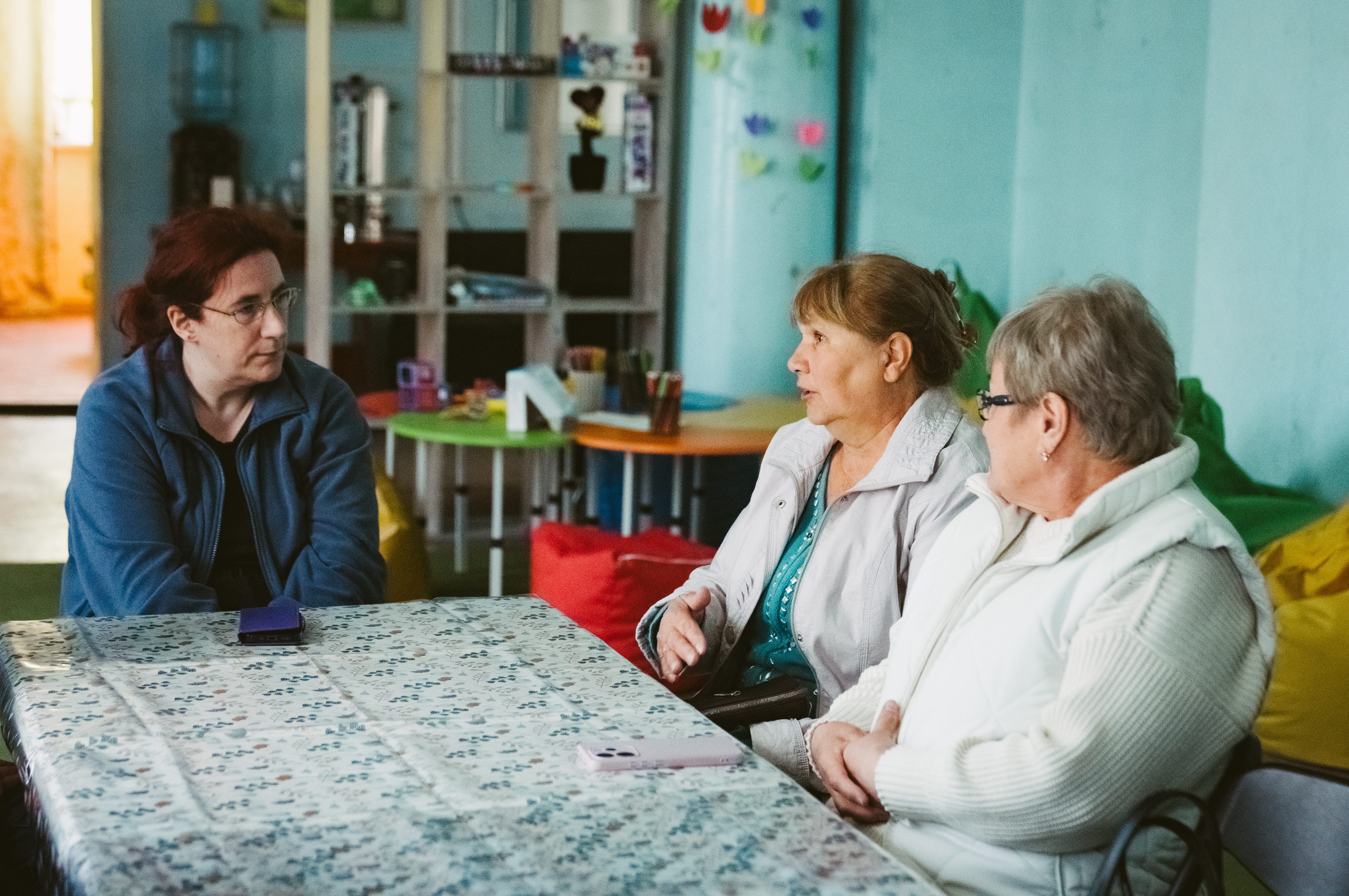
Zheta: It’s very hard for me as an IDP. I’m often depressed [her voice cracks]. I often take antidepressants and when I fall down emotionally, sometimes I can’t go anywhere for two months. Then somehow I recover. The girls help me pull myself out of it. When I come here I start doing something. At first I don’t want to, but gradually, step by step, I wean myself off the pills. We are like antidepressants for each other.
RL: These clubs are like antidepressants.
Z: If wasn’t for these groups in the village I’d have nowhere to go and I’d end up in hospital. I wouldn’t be able to go out on my own. Without the collective I wouldn’t survive. That’s why these clubs are essential for me. Not just for the locals but for me.
Are there other IDPs in these villages?
Everyone at once: There’s a lot! They don’t all come here.
RL: Most are younger and have already found jobs. We pensioners look after each other.
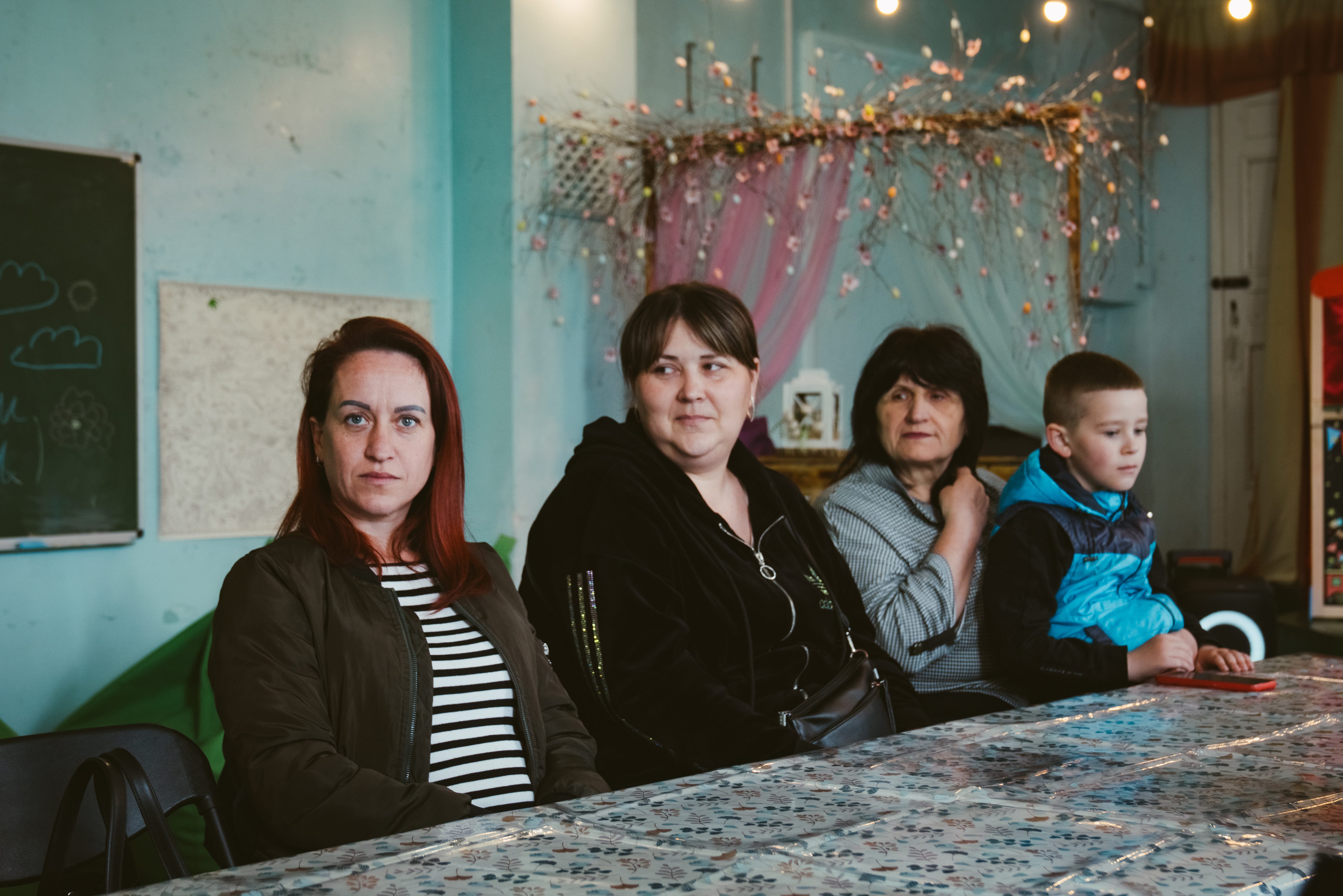
New resident Lyuba, who is from a village near Orikhiv, told her story too.
Why did you decide to leave? Was it a difficult decision?
NRL: Yes, it was very difficult. But all the houses in our village were destroyed, only a few remained. The village head and the military commander decided on evacuation. Everyone was evacuated. We were badly hit by glide bombs, multiple rocket launchers, drones. It was terrifying. God grant nobody here has to experience that.
Maybe we wouldn’t have left if a shell hadn’t fallen just fifteen metres from the house. That was the deciding moment. Enough. We had to leave.
[..] We learned to recognise the sounds of Grad and Uragan systems, and to work out roughly where they will land. We got used to it, and eventually it wasn’t even scary any more. Recently one flew so close to us that we jumped out of the car and ran. […] The really important thing is it’s not phosphorus bombs.
The use of white phosphorus bombs in civilian areas is classified as a war crime. It sticks to skin, causing severe burns which are extremely difficult to extinguish, as it reignites on contact with oxygen. Inhalation is also deadly.
They used phosphorus bombs on your village?
NRL: Yes, three times. The first time it was what they called incendiary ammunition. It burned wherever it fell. Then they used phosphorus bombs. The grass was burning, and if it had hit your body… Well.
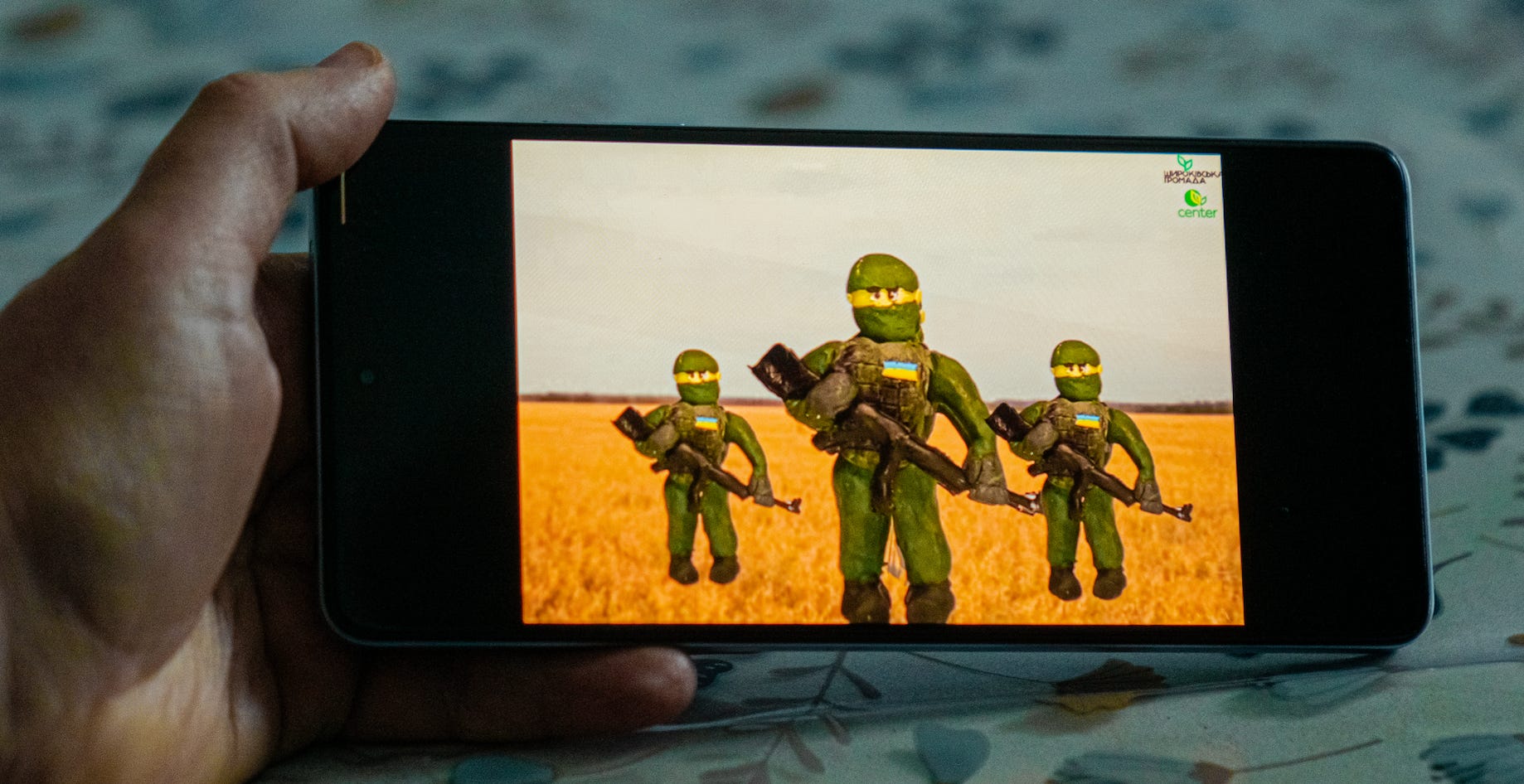
Once, a piece fell in our yard. It made a small hole, and the earth was burning. We stood around looking at it, we couldn’t work out what it was. A bright fire in the ground. Then it went out. We didn’t touch it. We went to the lads [soldiers] and they said, “Don’t worry. It’s burned out.”
Do you want to go home?
NRL: Yes… My husband and I are here, we have a daughter in Zaporizhzhia. Yes, we want to go home but we’re not allowed. There’s a lot of mines, it’s too dangerous. Until they clear it, no one will let us return to the village. There are glide bombs almost every day. On 8 March, eight bombs fell.
RL: They will probably be evacuated by force, because civilians are no longer allowed there.
NRL: Civilians aren’t allowed into Komyshuvakha any more. The area is considered too dangerous. The enemy doesn’t allow people to put nets up, even. There’s always drones flying around. Recently a police checkpoint was struck and one man was killed, others were injured.
The land is mined. Farmers can’t work because the drones watch the fields. People have died while working. There is almost nothing left there anymore. Some villages are completely destroyed, only rubble remains.
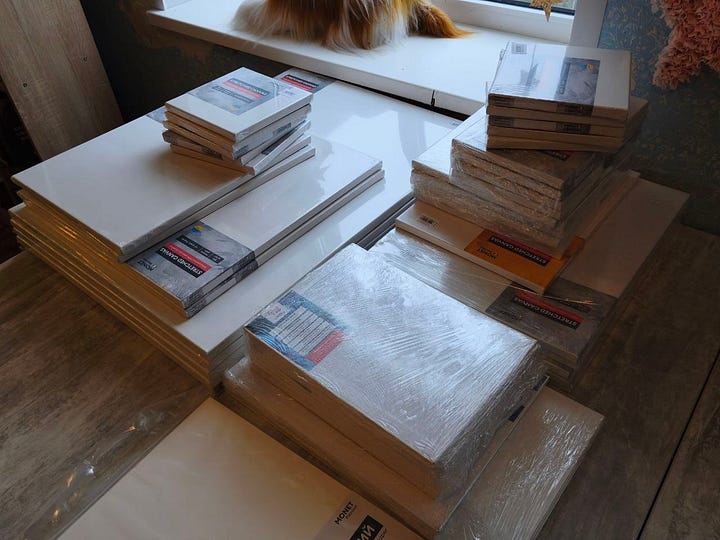
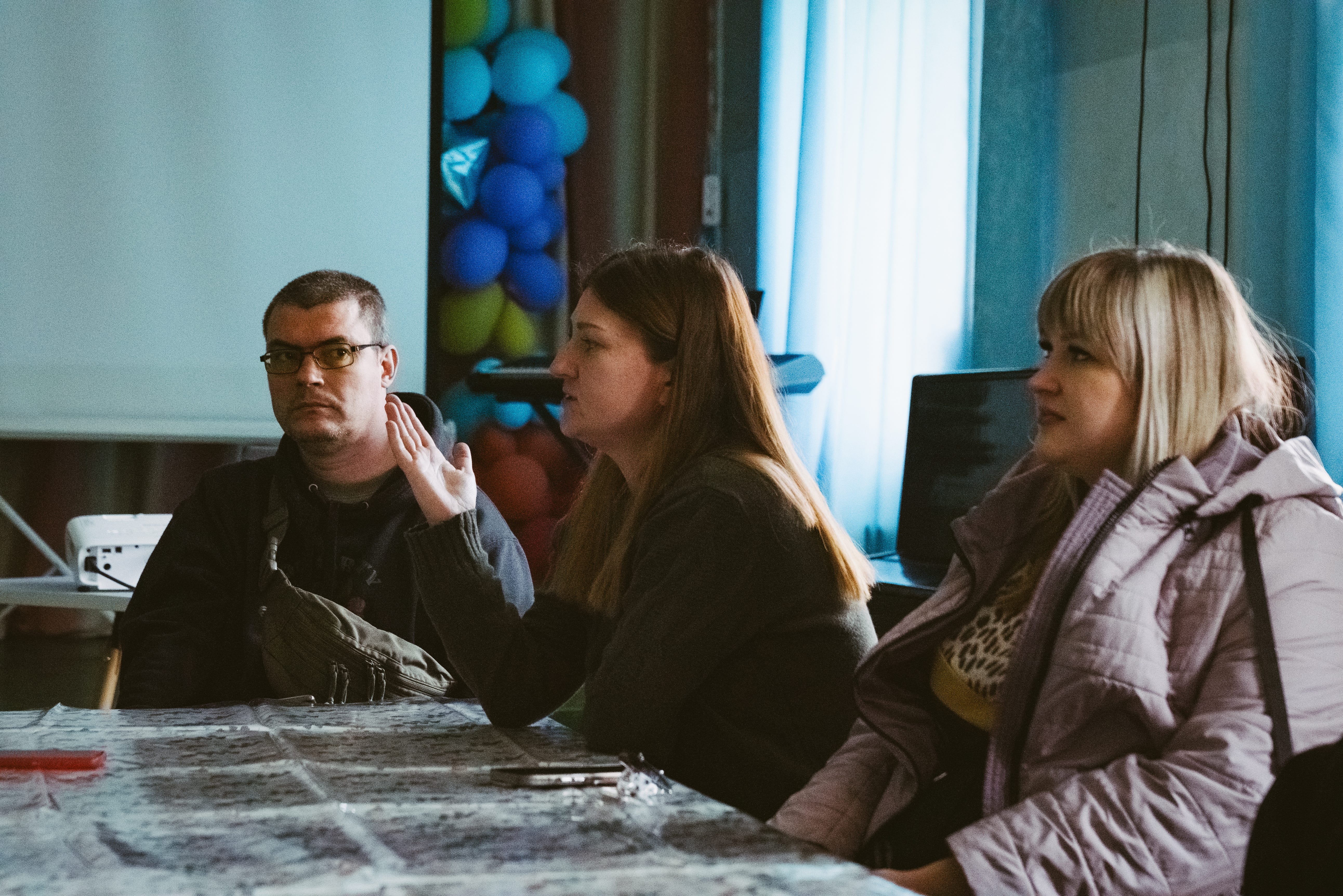
After the successful day of aid deliveries, Freefilmers (in this case Sashko Protyah, Yulia Appen and this bonus Briton) returned to the flat we had rented in Zaporizhzhia for a few days. Sashko told me his thoughts on support for the Shyroke hromada community.
Sashko: We had previously worked with the Shyroke community and they talked about a brass band, an art club and a gym. The music teacher said he hadn’t received any musical instruments since the 1990s, so it’s a case of long-term underfunding. The community centre where they practise is partly repaired, with funding from UNICEF. The authorities said their budget policy is that building underground schools is the first priority, repairs the second, and equipment like musical instruments definitely third. So kids don’t get them.
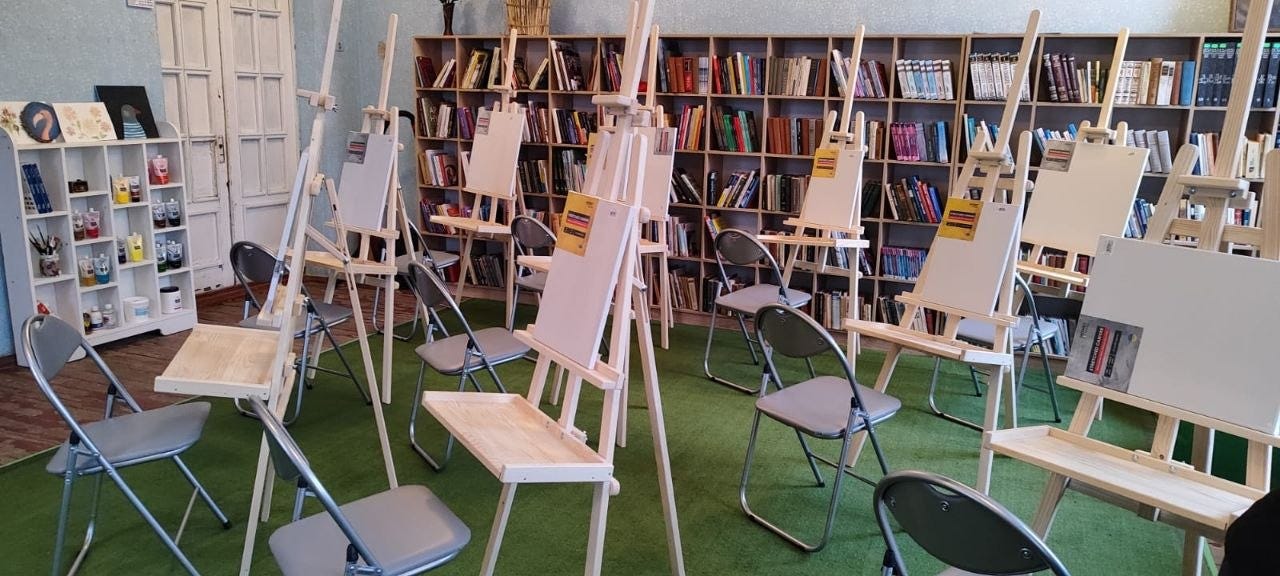
In Mykolai-pole the community centre had been repaired too, but it doesn’t have heating and there were no art materials. The art teachers work with both kids and adults and sometimes have intergenerational activities. They’d already tried all kinds of traditional local crafts and would like to try oil painting and working with animation. We co-ordinated with them and they decided what to buy. For example, canvases, which are not normally affordable for them, and easels that will last for decades. It was very important for us to see lots of IDPs involved in activities in this club, both kids and women. And we were also impressed by the community’s attempts to avoid discriminatory language.
Yulia: For animation, [the art club] were using a phone and some improvised lighting. Since they already understand the technology and have figured out some basics, it would be good to help them with more professional equipment for this, such as lighting and cameras.
Sashko: The underground school is very well equipped; it was primarily funded by UNICEF. Gym kit is not our specialisation but we brought quite a lot of stuff for working with kids who require special attention in PE lessons.
These locations are relatively safe at present. It’s not really possible to work in the kind of places you used to work before any more?
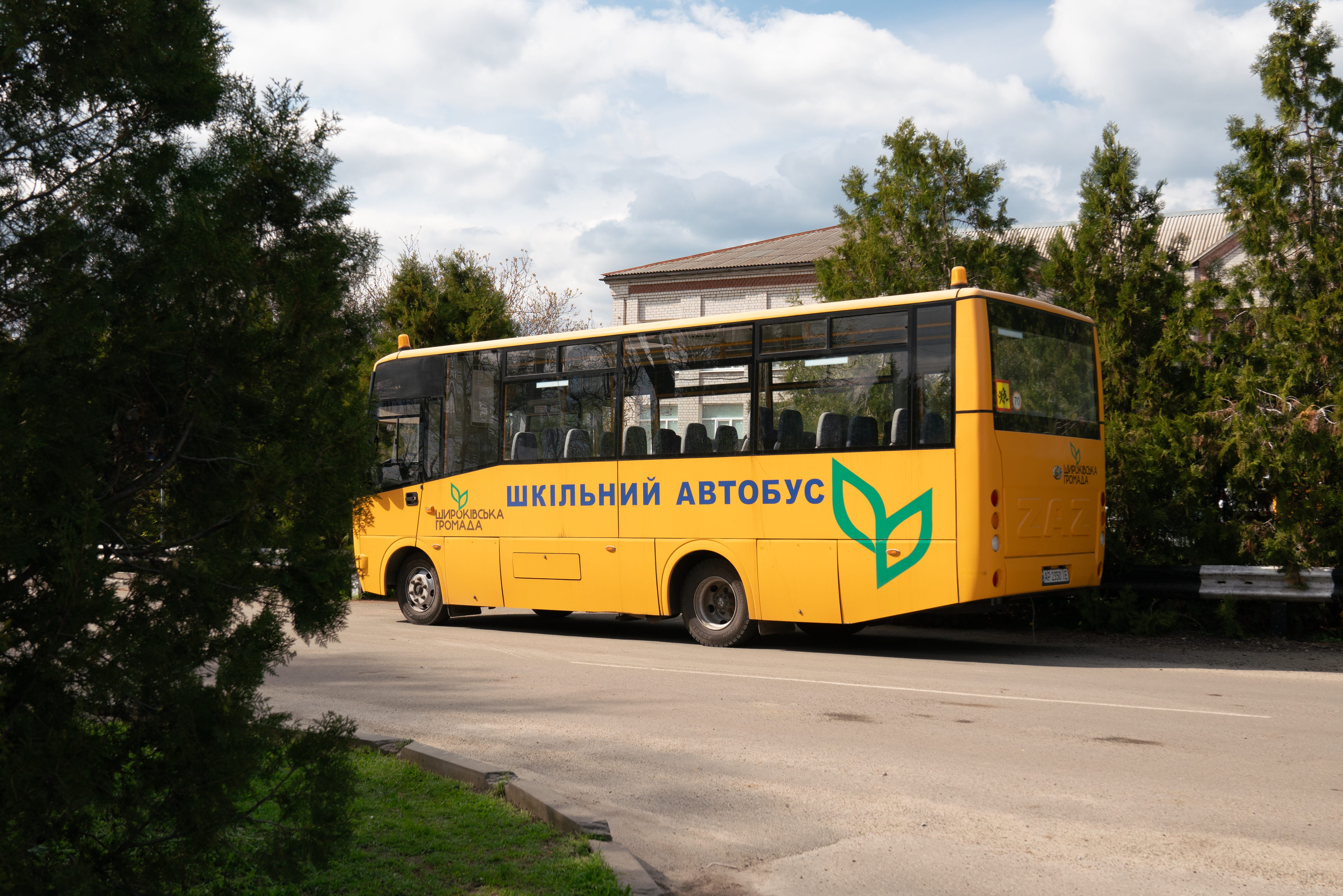
Sashko: These villages have only been attacked on a few occasions since the beginning of the full-scale invasion, so they are relatively safe… But it doesn’t really matter whether the front line advances near Zaporizhzhia or not; very soon, technologically, they will be within easy reach of FPV drones. And I’m worried about the school buses we saw. Underground schools guarantee security but buses are vulnerable.
The community is huge, with 35,000 people overall and 11,000 IDPs. They told us that 7,000 people require help with basic needs, like food packages and hygiene items. So on the one hand we didn’t see any ruins in these villages, but on the other they are very vulnerable. We’ve seen many times how quickly such areas can be transformed into intensive combat zones, or drone attack zones.
It’s sustainable help because the music teacher said kids need at least one year to learn to play in the orchestra. It builds a connection with the older generation. These instruments will matter for the community for a long time. The easels too will last a long time, and the village is likely to accept even more refugees in the future, people from further south in Zaporizhzhia who want to remain in the region.
The overall project was about equality, because kids in other parts of Europe, and other parts of Ukraine, have better access to education than these kids. It’s very difficult to develop education when your first priority has to be moving underground, safety rather than investing in equipment. Our help with third priority items created some level of equality.
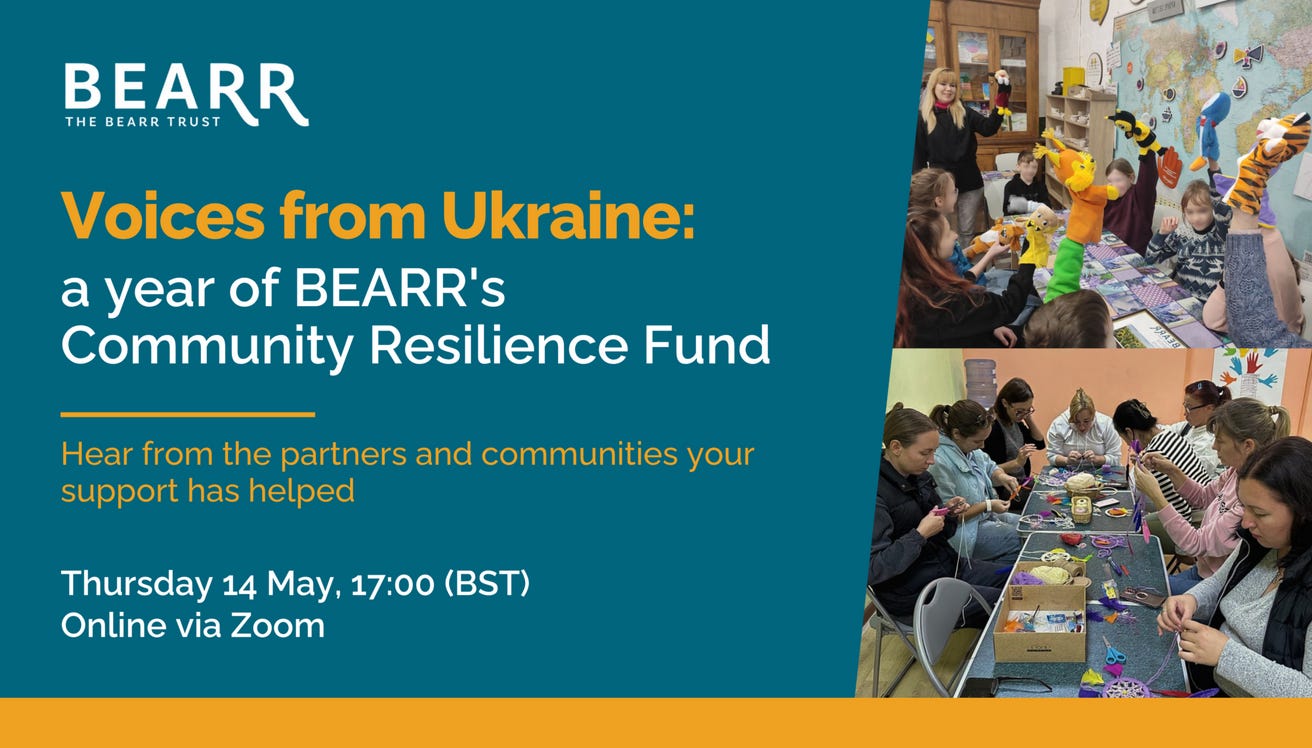
A certain number of you will have been reading this two-parter and thinking ‘not more *!&!ing “resilience”!! The term is actually increasingly controversial, because it’s often used in the West to praise Ukrainian survival. So far, so good… but praise, however earnest, is no substitute for practical support. And that is harder to come by.
On Thursday 14 May, at 5pm BST, BEARR will be holding a webinar to mark one year of their Community Resilience Fund, and reflect on how we can effectively support Ukrainian resilience as well as praise it, with representatives of grassroots NGOs, including Sashko. I will be moderating. Please join us.
I’m pretty sure this is not affiliated with the official UK institution…
Comments
Nothing yet. Say the first thing.
Sign in to join the conversation.