
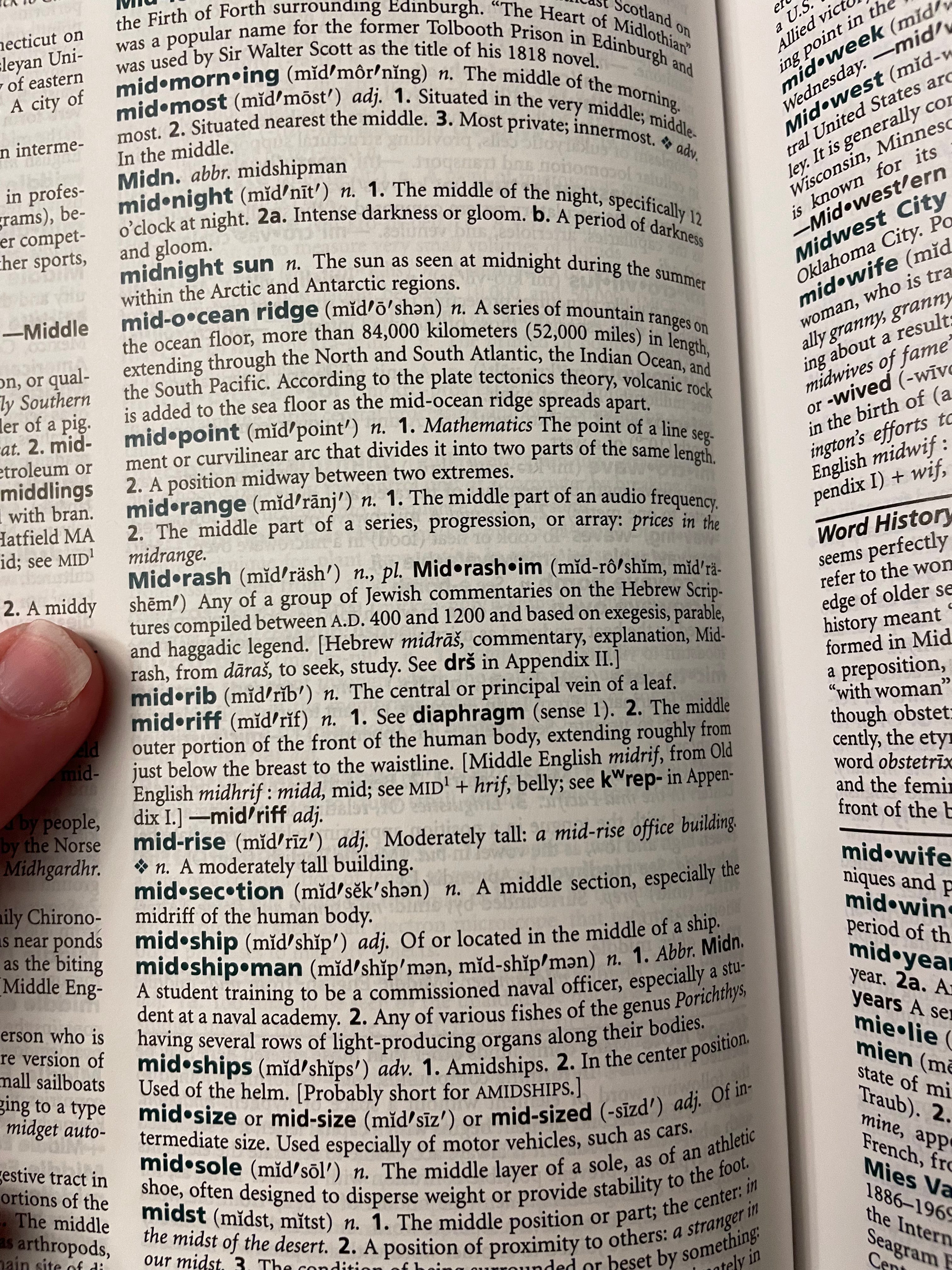
I was torn this week as to whether I should keep on sharing Aaron’s epic or share some other poems I’ve been working on. Unusual inspiration has come upon me in the last few days, and I’ve started 6 new poems! They’re Overness-adjacent, not explicitly part of this project, but they are also midrash-ic. Y’all, can you believe it —it has taken me this long to realize I write poetry akin to midrash? If that’s not a familiar term to you, here’s a definition from my actual physical copy of The American Heritage Dictionary of the English Language 4th ed.:
Midrash: Any of a group of Jewish commentaries on the Hebrew Scriptures compiled between AD 400 and 1200 and based on exegesis, parable, and haggadic legend.
Granted, I’m not a rabbi, I’m not Jewish, and I’m not writing between AD 400 and 1200, but my goodness this hit me like a slap upside the cranium as I listened to Scott Cairns recently describe modern, midrash-ic poems. THIS IS WHAT I WRITE.
I’m in the Image intensive on poetry this spring that Scott is teaching, and one week in, it’s already been incredibly fruitful.
The wonderful poet Benjamin Myers did tell me once that my series of prophet poems (soon to be collected into the book Yahweh Loves a Desert and Ben is writing the foreword, hooray!) seemed like midrashim to him, and I was struck when he said it, but it didn’t stay with me for some reason. Isn’t learning interesting like that? Things don’t all land in the same way at the same time. So here I am pretty far into this “riffing off the Bible” poetry endeavor…and my goodness I feel so humbled and (I think) embarrassed that I haven’t quite acknowledged this. There exists this very old, very beautiful, Jewish, established, and pleasurable art form called midrash. And y’all, I’m just dipping my Protestant Christian baby toe into the strong, ancient current.
After such a revelation, it seems right to share all 6 parts of Aaron’s epic thus far. In the video below I read through the whole thing, along with some off-the-cuff thoughts about it. But the voice recording is only for part VI.
If you’re new here and looking for more notes on each section of this poem, here’s my original newsletters for parts I & II, parts III & IV, and part V.
Text within this block will maintain its original spacing when published
I.
Come to love Aaron
whose first appearance
included a kiss.
Watch for this: he walked
the wilderness long before his brother
led the way
To the mountain of God—a phrase
that can tell his whole story.
II.
Look back with me to when
he was three—the edict, the terror,
the cries of his new baby brother.
Their wide-eyed mother, emboldened by midwives
and whispers, built an ark for this son
(not for Aaron).
Jochebed’s Exalted mountain of strength
was not Drawn from the water
until eighty years later
On the far edge of the Sea of Reeds,
where walls of water stood at attention,
where a multitude followed him through.
Already he’d turned the River
to blood, at Yahweh’s word—choking
The Pharaoh, fouling the kingdom that once
left his mother, milk-swollen, weeping.
III.
The mouthpiece of Moses (hear him out-
maneuver Pharaoh), staff-in-hand (watch the snake
devour at his command)—here is the someone else
his brother begged God for—
beside him in the fear of Egypt,
beside him in the great Exodus,
beside him leading men and women
into the Desert of Sin. What becomes
of him?
IV.
We’d better not miss the meal on Mt. Sinai—
the pillars, the elders, the sprinkling of blood.
Aaron and his sons, Nadab and Abihu,
saw God. And they ate. And they drank.
Let every reader pause here. Please. We rush
to the calf made of gold—bright
ridiculous lie—and we lose
The significance of this: God set the table.
God beckoned him up to a feast, friend, heaven
on earth! This Aaron lifted a glass.
V.
The golden calf we must come to at last. The heat
of the moment. The heap in the fire—
it leapt out! We laugh.
But Moses, enraged, watch him come down
the mountain. Hear him speak disaster
in verse—the new song
Being sung? Rattled out from stiff throats
as loosened limbs shook to the folly.
A man stood between
the people and the flame—a priest
of great peril, who could redeem
This? The truth is three thousand
fell by the Levite sword
Set apart for slaughter (clean linens,
bloodied hands). Ready yourself, Aaron,
for the offerings, again and again.
VI. Aaron prays:
Lapis Lazuli clouds my dreams, O LORD
—the brightness under Your feet we call
heavens holds Your glory out
across the desert in blue relief.
You are proved holy.
Then shame—the blue-flame spark still hot
in my eye grows to melt the gold,
consume the calf.
Our salted garments’ embroidery—made for me,
for Abihu, for Nadab (whose height made
the weavers laugh)—blues and purples, LORD,
Fill our tents! My sons and I so cinched
and wrapped in sky ensuring we will hold
the breath of irreverence.
HOLY TO THE LORD across my forehead in the rich
blue You ordained—so how could I see the sign
when my sons fell? Blinded, burning, did I mean
To lay these ritualled hands on them—
as if Nadab, as if Abihu, were to You
Bulls of purification? Strange fire.
You have eaten them up, my God. O to be
cloud, to rise silent as smoke.
0:00
-1:37
*Here’s that reference from Exodus 24:9-11
9 Moses and Aaron, Nadab and Abihu, and the seventy elders of Israel went up 10 and saw the God of Israel. Under his feet was something like a pavement made of lapis lazuli, as bright blue as the sky. 11 But God did not raise his hand against these leaders of the Israelites; they saw God, and they ate and drank.
*O to be cloud is the phrase I thought I borrowed from Denise Levertov, word for word, but when I went back to search it out, I realized it was significantly different. Her line, from the poem “Wanting the Moon (II)” in Relearning the Alphabet, is simply “To be a cloud.”
These videos are quite long, I’m sorry to say. One of my sons came home in the middle of the first one, so then I had to finish in a second one. These are not essential to enjoying the poem, just me practicing talking about my poetry. And as always, it is a goal of mine to try to make poems a bit more hospitable! I made these before the big “midrashim revelation” so that’s why I didn’t mention it.
Further up & further in,
Anna
Comments
Nothing yet. Say the first thing.
Sign in to join the conversation.