

That’s what my school reports said, year after year. Sometimes it was dressed up a bit - she could be great if she actually applied herself - but the verdict never changed. I was bright - the kind of bright that gets flagged early. But I also turned up to school with odd shoes on, forgot my homework routinely and lost every textbook. They said I was mildly dyslexia, because I was functioning and left it at that. I’ve never written about this properly before. Partly because I didn’t want it to become The Thing I’m Known For. But I get asked about it constantly - by readers, by friends, by strangers in my DMs who’ve just started wondering about themselves - so here it is, in one place, unpaid, because I want anyone who needs it to be able to find it and pass it on.
One caveat before I start. The ADHD landscape - diagnosis routes, waiting lists, what support even exists - varies wildly by country and region. There are so many complexities that can be layered on top of an ADHD diagnosis too, with other co-morbidities (things like dyslexia, OCD, autism etc) along with other intersections like culture, race, class, gender and sexuality that all make everyone’s stories deeply individual. So my story may or may not resonate, but I hope it’s helpful…The kid who was “away with the fairies” at school
Nobody thought I was hyperactive, because I wasn’t, outwardly. But I was always daydreaming and so chatty in class that I was told off daily. Underneath that, though, was a brain that never really slowed down or stopped - and hyperactivity shows up in so many ways, aside from the physical inability to sit still.
There were other signs something could be…different. I couldn’t tell the time properly until I was around 13 (I still panic when anyone asks me what the time is…) Maths defeated me on a whole new level. I was disorganised in a way that looked like carelessness but felt, from the inside, like genuinely not being able to hold the pieces of a day in my head at once. I’d sit at my desk for hours trying to force information to stay in my brain, and it just wouldn’t stick - my memory was (is) terrible. All of which made exams brutal and disappointing. I turned all that angst on myself, at my inability to function like everyone else.
There was extra pressure on top of that, too: I’m the daughter of two doctors (and a family of many more) from a second generation Indian family (i.e. my parents were born in India and moved to the UK) where academic achievement wasn’t really optional. Struggling with parts of formal education - I’ve never liked being told what to think (and still don’t) - while coming from a household that measured success in exam results was its own particular pressure.
Missed signs…
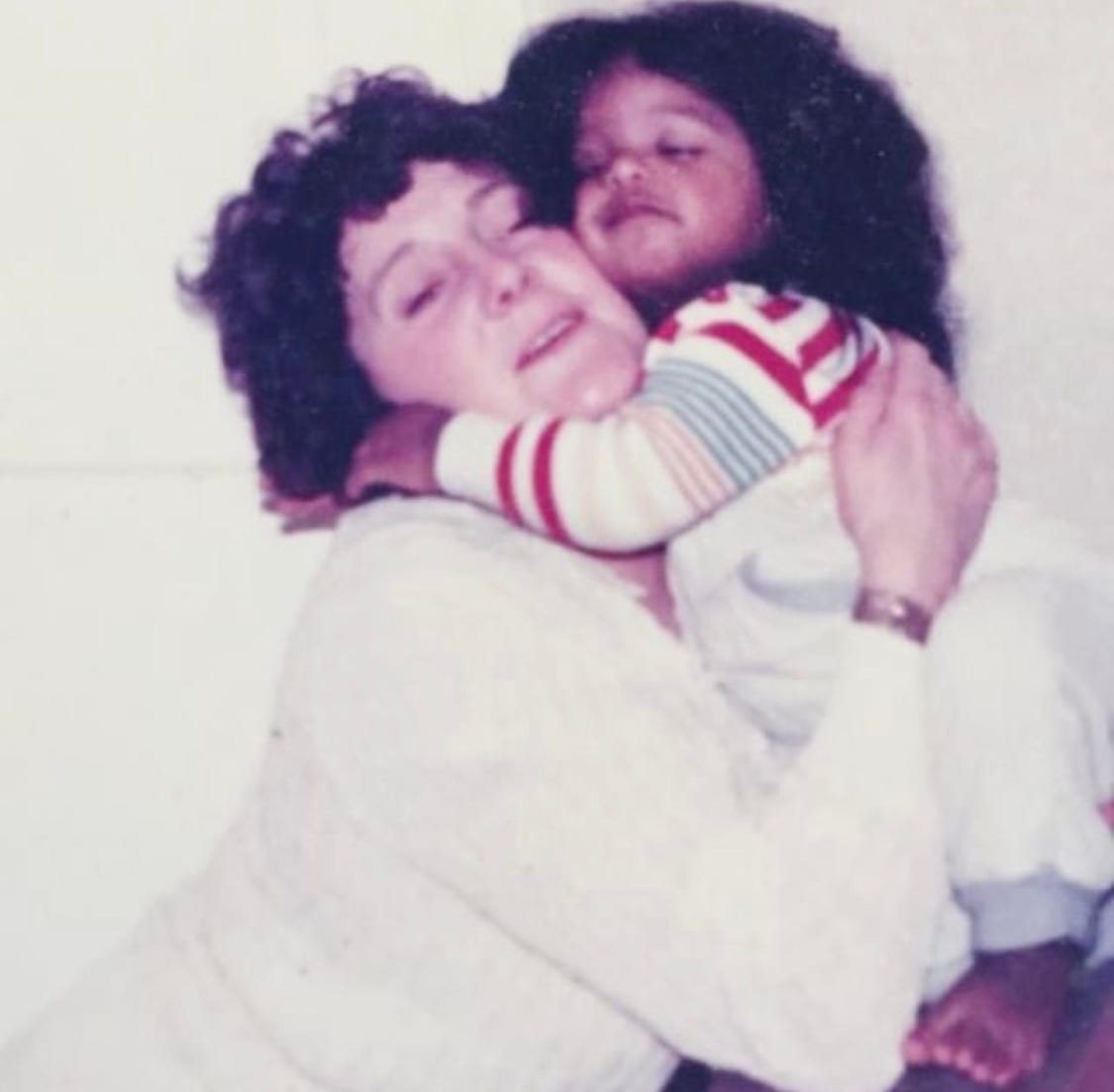
There were so many ADHD flags pointing towards me, I now see. As a small child I was obsessed with the Romans, while other kids were reading like actual children’s books. Later as a teen my hyperfocus became music, which felt like the first real release I’d found for all the angst I have growing up in a part of South Wales that wasn’t especially diverse and as a second-generation Indian kid who never quite felt like “enough” of either culture.
I also started writing for national music titles and national papers at 15. That’s an unusual age to have that kind of drive. It’s also, I now understand, exactly the kind of overcorrection ADHD can produce when you’re also terrified of being pushed into careers like medicine or law unless you can prove, fast, that you’re already brilliant at something else. That drive also fuelled something else in me; perfectionism. I wouldn’t want to use pens that didn’t match, I’d start whole notebooks again if I made a mistake. I have to really push through that to this day. It took me a year to buy a new stapler because I wanted one that was beautiful…a lot of my perfectionism is stationery related, which I now know is quite a common ADHD thing. Tied to the promise that your new diary/notebook/pen will suddenly fix all your organisational issues and executive dysfunction.
One of those issues was time. I’d routinely miss things - lessons, the school bus - without realising. Time blindness is a much less dramatic term than it sounds, it means difficulty sensing how much time has passed or how long something will take. To me 5 minutes and 60 minutes feel the same, and when it’s doing something I don’t like, it can feel excruciating. Often time optimism comes in too - thinking you can do a million things in that 60 minutes or that you’ll be able to get ready, eat and travel to an event that’s the other side of London in 20 mins. When, in reality you need at least two hours to fit it all in.
Navigating rejection
One thing I’ve always known about myself, long before I had language for it, is that rejection doesn’t roll off me easily. If a friend at school decided to favour somebody else, as kids often do, it would wreck me and felt like a visceral pain coursing through my body. The same applies to break ups - they seem to floor me in a way that feels like it shatters my entire nervous system taking my self esteem with it.
I know now that this has a name: rejection sensitive dysphoria, or RSD - an intense, often disproportionate emotional response to perceived rejection or criticism that’s widely reported among people with ADHD. It isn’t a formal diagnostic category in the DSM, but it’s one of the most consistently described experiences in the ADHD community, and reading about it retrospectively reframed almost all my relationships and friendships, that I’d quietly catalogued as evidence that I was too much, or not enough. I’m a deeply loyal person, so betrayal, or perceived betrayal, means you’re dead to me. And I now understand that loyalty and rejection sensitivity are often two sides of the same ADHD coin. In reality, it comes from the fear of being hurt, again. Research consistently finds that adults with ADHD are considerably more likely than neurotypical adults to have an
RSD is really just the sharpest edge of something bigger: emotional disregulation, the broader difficulty ADHD brains can have modulating any big feeling, not just rejection. Frustration that arrives at full volume, joy that tips into overstimulation and hyperfocus, anger that feels seismic and uncontrollable. The American Psychological Association reports that somewhere between 30% and 70% of adults with ADHD experience clinically significant emotional disregulation. I felt everything at full volume for most of my life and had no idea that was a symptom rather than a personality trait.
Hiding all of the above, and everything else that comes with ADHD is called masking. It’s the largely unconscious work - disproportionately done by women and girls - of building elaborate coping systems and social performances to hide neurodivergent traits, often because girls are socialised to be organised, agreeable and easy, and punished more harshly when they’re not. I like a lot of people with ADHD - loathe small talk but love deep chats. The kind of conversations you don’t want to leave, filled with random tangents and exposing vulnerability over shared stories. So as you can imagine, the amount of launches/dinners/events/parties I attend for work means that being able to do small talk is a big part of my life. In reality, it means I’m masking around 80% of my week. But unmasking can be hard; it’s why I have to have spaces and ways to be myself; like going to a gig, being with my mates or having my own to breathe and re-energise.
People mask in a lot of different ways and these are some I relate to. People pleasing, over-preparing and over-researching, camouflaging by change of dress in social situations, fidgeting to hide hyperactivity, scripting conversations in advance, tuning out of conversations but nodding and smiling (lol, see above, I barely even know what I’m saying i’m so nervous/burnt out/exhausted) front-loading work or arriving early to hide time-management struggles. The constant, quiet outsourcing of memory to alarms, notes and reminders so nobody realises how much is actually falling through the cracks underneath or how much stress you’re under. (That was pretty tough to write…maybe I’m masking more like 90%.) All if it takes place to stay under the radar, to fit in and to avoid that RSD.
One way that masking also manifests is with revenge bedtime procrastination, a funny name for the compulsion to stay up staking a claim on time for yourself precisely because the rest of the day felt like it belonged to everyone else. I know it’s bad for me, I’m exhausted but I still fight going to sleep most nights. Being in a relationship helps with this, and other things strangely, because you have a body double and the accountability to make you go to bed/function. But that can also be why we stay in/enter the wrong relationships, too because the body doubling feels too hard to let go of.
ADHD and poor mental health…
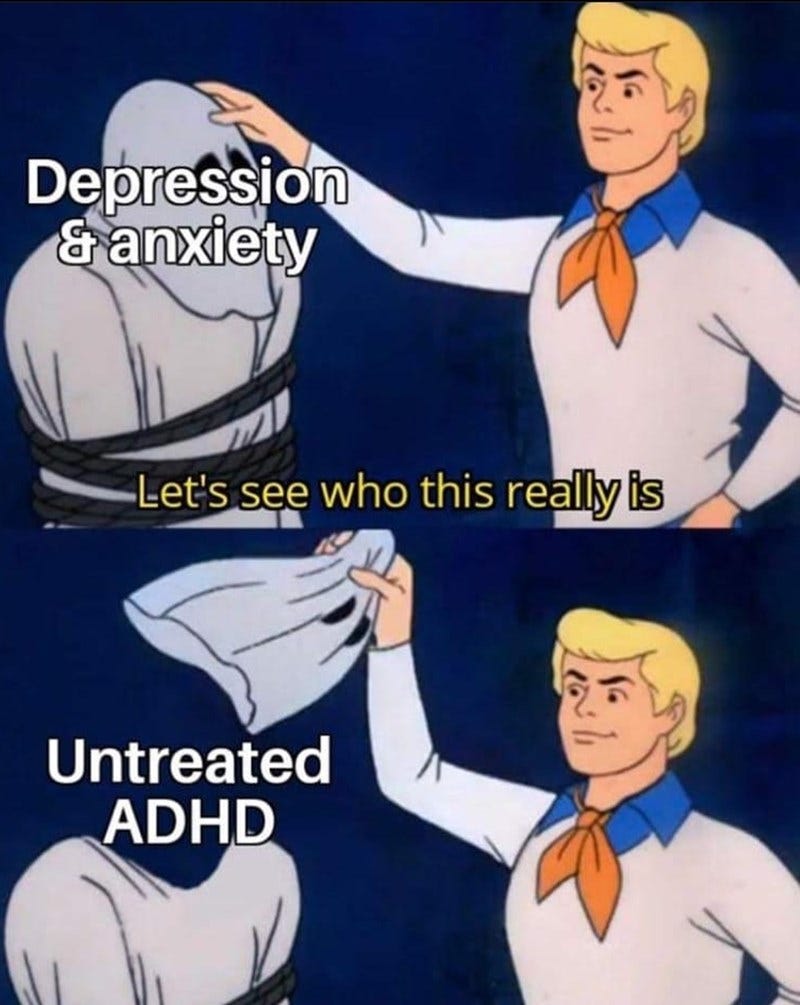
I’ve always - still, to this day - had this strange sense of foreboding, like I was about to be told off, like I’d done something wrong, that everything could crumble in an instant and ultimately, that I was never good enough. I thought this was a me thing, until I met other people with ADHD who had the same uneasy feeling. Why is that the case? It’s likely because children with ADHD are estimated to receive 20,000 more negative or corrective messages than their neurotypical peers by age 12. That’s anything from “sit still,” and “pay attention,” to a silent lack of praise compared to others, and disappointment in their behaviour. This constant stream of criticism often leads to shame, rejection-sensitive dysphoria, and low self-esteem.
From around 14 this self esteem issue manifested as disordered eating, and there were points where it was genuinely awful. And bulimia can also be very easy to hide. I didn’t know it then, but the overlap between ADHD and disordered eating in women is well documented: one Harvard-led study found girls with ADHD were nearly four times more likely to develop an eating disorder than their peers, and impulsivity, emotional disregulation and using food as a coping or self-soothing mechanism all show up repeatedly in the research on women with ADHD specifically. I’ve also had periods of intense depression, that felt like it came out of nowhere. I’d be put on anti depressants which did so little because that wasn’t the real issue, had endless therapy that did nothing - until I got my diagnosis and those things I struggled with started to make sense.
It’s not a coincidence that so many ADHD stories brush up against addiction somewhere along the way. CHADD, the US’s leading ADHD advocacy body, points to the self-medication hypothesis: the same dopamine-reward circuitry that’s disregulated in ADHD is exactly what nicotine, alcohol, cannabis and stimulants act on, so substances can feel - briefly, chemically - like relief from symptoms nobody’s named yet.
Untreated adult ADHD is linked to substantially higher rates of substance use disorder and the later the diagnosis, the longer that self-medication tends to have been running quietly underneath everything else. Those vices could be less obvious too - like shopping, thrill seeking/impulsivity (even at a grocery store…which is a common trope, see above) and even never letting yourself stop and rest. It’s the same impulsivity and reward-seeking that shows up in disordered eating, just pointed at a different substance. The same for behaviours like impulsivity or sex or love addiction too. Worth knowing, if you’re piecing together your own pattern: it’s rarely just one thing and anything you get a dopamine boost from, can fuel it.
The burnout cycle…
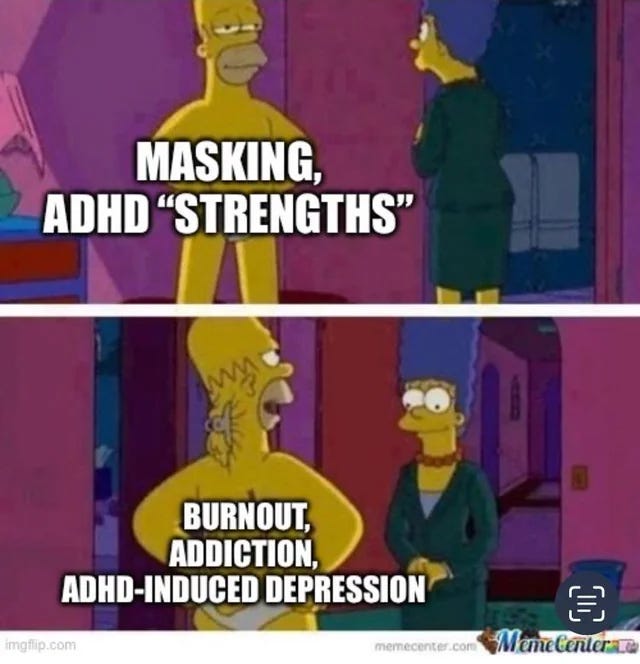
Structure had been holding me together for years, and I didn’t know it until it was gone. At home and at school I’d been told what to do, but University removed all of it at once. I routinely wrote entire dissertations the day before the deadline, missed lectures because I felt overwhelmed and anxious, slept all day and partied all night - I didn’t know how to take care of myself, and regulate my nervous system at all. I still managed to get a philosophy degree and an MA in Journalism, but none of that was easy. And most of it was abject chaos that then carried on as my baseline, into my early career. Although it wasn’t visible. I got a job. Then got another, better one and kept going. I won awards, I think around thirteen by the time I was only 7 years into my career, had viral features, did consultancy work most people don’t get near for another decade. From the outside, it looked like none of the earlier chaos had cost me anything.
But from the inside, I was still struggling with things nobody clocked: admin, prioritising, remembering to book my own flights on the right dates, the unglamorous detail-work that keeps a career running underneath the visible achievements, like the serenity of a duck gliding across water (masking) with its legs furiously treading water (my ADHD.) That really should be a meme… The first real breaking point came when I was beauty director at a major title, running a big team in a genuinely difficult environment, and my
At the worst point, I remember staring at my screen and feeling my mind simply not turn on. I couldn’t type or think. It was frightening - like somebody had turned the light off in my brain. Without realising it, I’d slipped into depression too, masking to cover it up, all whilst having suicidal ideation that I brushed off too. Coupled with an awful break up (from an actual narcissist, they always seem to find people who are vulnerable and empathetic) I took mental health leave, then went freelance without ever properly naming what had happened. It took watching a YouTube video on inattentive ADHD, months later, for the penny to drop - and even then, I didn’t act on it.
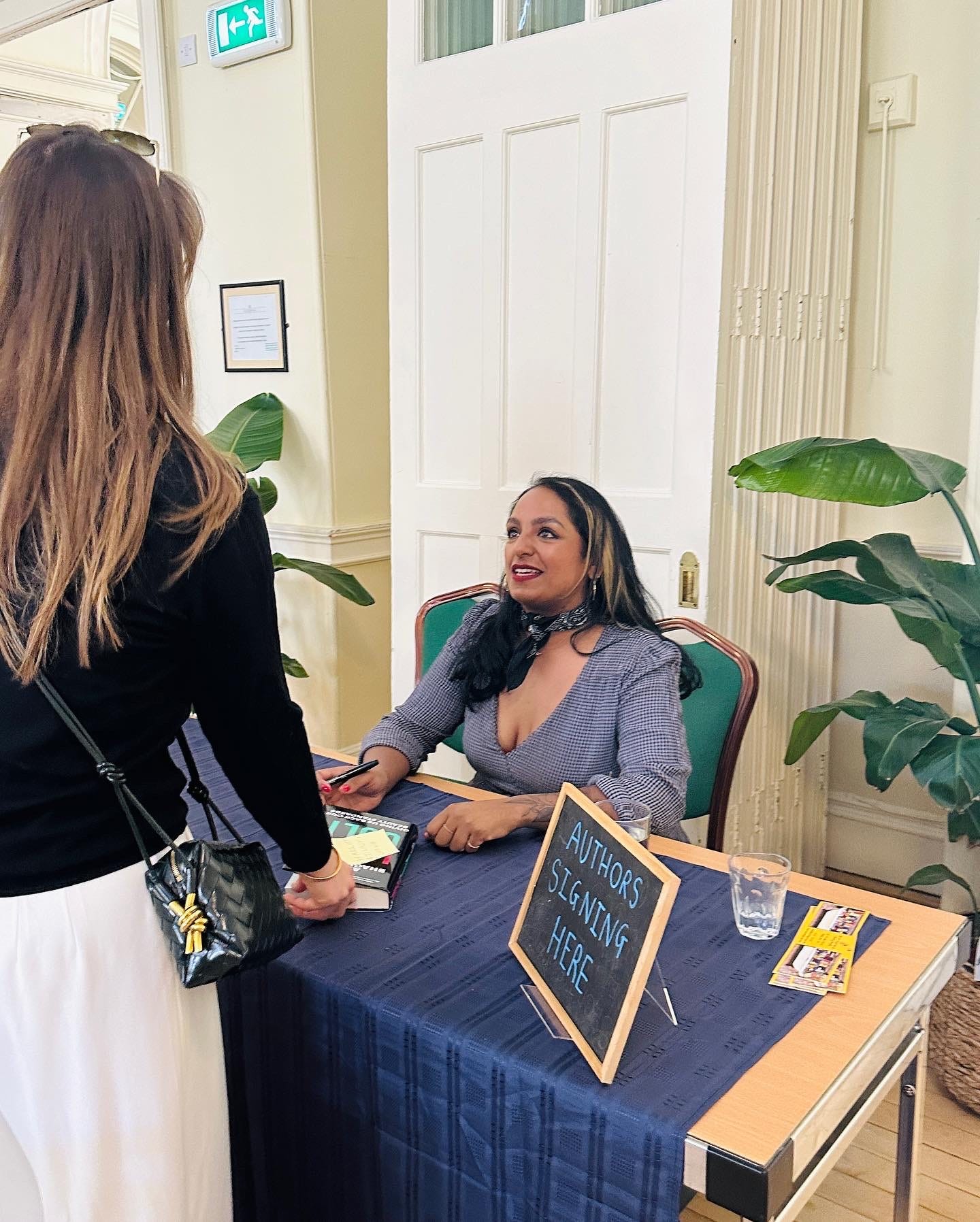
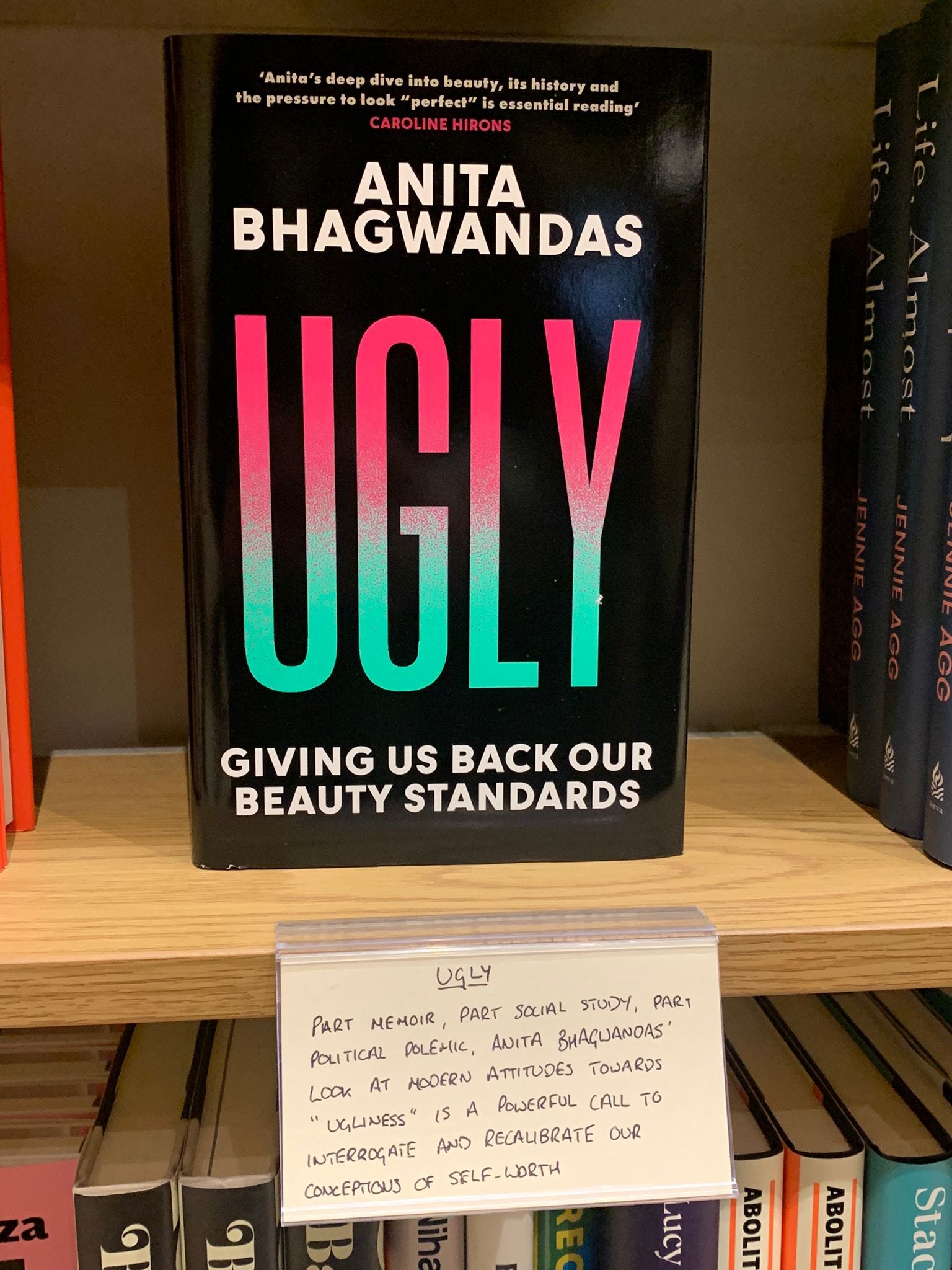
The second breaking point came a few years later, writing the first chapter of my book UGLY. Writing a single page, some 500 words, was something that had always come easily to me after years on weekly magazines and punishing deadlines. But suddenly felt insurmountable. I couldn’t understand why my brain seemed to be shutting down again when I needed it the most. That was what finally pushed me to pursue a diagnosis - something was off and I needed help. I worried it was Alzheimer’s - which is something many people diagnosed with ADHD think is the problem, before realising it’s something else entirely. And, I’m still struggling with the effects from this period burnout on my nervous system now, years later.
That burnout cycle can happen for so many reasons. But for me it was a result of perfectionism which was largely due to low self-esteem. Over years of being compared to neurotypical peers at school, falling short by a measure that was never designed for your brain in the first place, I was overcompensating so much I just ran out of steam. Overworking becomes the compensation: if you can’t trust your own internal sense of whether something’s good enough, you just keep going until an external source confirms it for you. That’s the part I recognise most in myself - outsourcing my sense of my own worth to other people’s approval, because I’d learned early that my own judgement of “is this okay” couldn’t be trusted.
Getting diagnosed, and the grief nobody warns you about
I went private to get a diagnosis after seeing the 5+ years long waiting lists. The process involved an interview with a parent - in my case, hilariously my own mother, who is a psychiatrist - plus a separate interview with a friend I’d previously lived with, to corroborate patterns over time.
I scored highly across the board (the perfectionist in me rejoiced!) The surprise, for me, was hyperactivity - I’d always filed myself as “sleepy,” when actually my brain has apparently been in fairly constant overdrive; the tiredness was the exhaust fumes, not evidence against it. And, even if I’m daydreaming, I am always, in some low-level way, in motion.
What I hadn’t braced for was the grief. I cried, properly, for weeks. I was angry - at my parents, at school, at the entire system that had processed me for years without ever asking the obvious question. My core beliefs about myself, the ones I’d absorbed as simple fact rather than as symptoms, were that I was stupid, ugly and lazy. That is a genuinely brutal way to spend your childhood believing things about yourself, and it isn’t a coincidence that it was also the feedback, more or less, that I’d been given.
None of this should have taken this long. Women are diagnosed with ADHD, on average, nearly five years later than men, despite symptoms starting at the same age - a gap researchers attribute largely to the fact that ADHD in women more often presents as inattentive rather than hyperactive, and is therefore easier for everyone, including clinicians, to miss. Race compounds it further. Large US cohort studies have found Black, Hispanic and Asian children are all significantly less likely to be diagnosed with ADHD than white children, with the average age of diagnosis for Black patients was over eight years younger than for White patients diagnosed as adults. Once I had the diagnosis, things that had never made sense before suddenly did. Why my brain craves stimulation and novelty. Why other people can lie on a beach on holiday and switch off, while my brain goes into a low, anxious spiral - but a city, somewhere loud and full of things to notice, calms me down. None of this is universal, though - and that’s another thing that makes people think, “well I don’t have it” when they might, actually. Broadly, people with ADHD share similar traits, but how those traits actually show up varies hugely - depending on how you were raised, what co-morbidities you’re carrying, and whatever else sits at the intersection of your specific life. It’s also worth flagging that ADHD and
Medication is not the fix people want it to be…
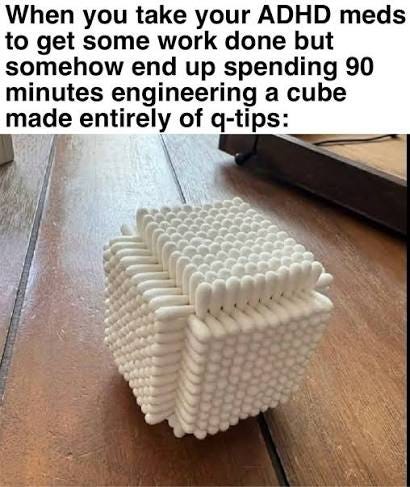
I started on Elvanse (branded Vyvanse in the US) and the initial effect was extraordinary - like seeing clearly for the first time. I often leave doors and jars open without realising - but on the first day on Elvanse I noticed them for the first time. But I had side effects that weren’t on the official list: extremely bad eczema, which I’ve since found other people reporting anecdotally too (gotta love reddit) and a level of anxiety that gave me my first panic attack. It also made me
This is the first question everyone asks, because everyone assumes medication is the fix. It isn’t. It can help enormously, but it can also cause real problems if that’s the only solution you choose.
I now use it occasionally rather than daily, because it does genuinely help with memory recall, which has always been one of my hardest struggles. Day to day I take a short-acting version in the mornings, mostly to cut through brain fog, and I’m generally okay unassisted for the rest of the day. I also tried a couple of other medications that simply didn’t work, or that I couldn’t get through the trial period for. This is very much still evolving, and I’m also exploring what I can manage more naturally - I’ve heard promising things about lion’s mane, for what that’s worth. (PLEASE NOTE - Medication response is completely individual and this isn’t medical advice at all. Always speak to your doctor.) What actually helped…
More than medication, honestly, it’s been the support structure around me.
ADHD coaching - made the biggest difference. I initially found a coach through Access to Work - a UK government scheme that funds workplace support for people with disabilities or health conditions, including ADHD. My coach Stephanie of Empower ADHD is how I got through my book writing process in a way I genuinely don’t think I’d have managed alone. I still see her because freelancing removes every external deadline and every person checking in on you, which is a nightmare for a brain like mine.
Group coaching is also brilliant, especially in the early days when I was learning about ADHD and the issues connected to it. For those at the start of their journeys, or otherwise I’d highly recommend ADHD Collective run by Michelle and Lucy. I still pop into the group sessions occasionally - it’s so so helpful.An ADHD therapist who actually understands it and can help piece the parts of your childhood together to give you some peace and understanding. I’ll say something slightly controversial here: I think only people who actually live with ADHD really get the workarounds and the complexity of it on a felt level, rather than a textbook one. I’ve had coaching and therapy with people who didn’t have it, and it was a genuinely different experience - competent, well-meaning, but missing something that’s hard to name until you’ve sat across from someone who simply I also have an
And where I can, I outsource: an amazing VA, Kellyanne at Neurosparks who handles the admin my brain simply finds too much (the company works with neurodivergent people so is fully clued up on everything I’ve mentioned above) plus an accountant and a cleaner.
I’m conscious that not all of this is available to everyone, cost-wise or otherwise, and I don’t take that for granted. It’s also worth naming plainly: this is a hidden tax of having ADHD. Outsourcing shouldn’t be the only route to functioning properly, but for a lot of us, it quietly is - and that’s a structural problem as much as a personal one.
Tools that help me…
These are a few tools and small systems that have made a real, tangible difference to me.Notion - I’ve built my own templates for daily to-dos. I still handwrite my day on paper too, but Notion keeps everything else in one findable place.A digital calendar with reminders for everything - I put in extra travel time, block out hours for admin, and put two notifications on everything important. I also put birthdays in, plus a two week warning for those birthdays to make sure I send a card.
Time Timers - I have one in nearly every room. They show the passage of time visually rather than numerically, which sounds small but is a gamechanger. If you struggle with time blindness, seeing time drain away in front of you does something a digital clock simply can’t. It’s weird, but it works.
Body doubling - working alongside someone else, even virtually and in silence, purely because having another person “there” makes starting and sustaining a task dramatically easier. There’s lots of apps to do this on. Flow Club lets you set up a session with one or more people and feels very intentional. I’ve just paid for the app Dubbi, which is more of a group one (and good, albeit quite loud and less personal, but useful on the go.)
Alexa dot - genuinely useful as an external voice reminding me to go to bed, and for tracking food and other routines I can’t hold in my head unaided. Although slightly awks when it tells me to stop working at 6pm and have a walk, and I’m in the middle of a meeting.
Boomerang for Gmail - reminds me to chase replies to emails which is so helpful.
Brick - a newer one for me, gifted by a performance coach friend. It physically locks you out of chosen apps at set times of day, which sounds extreme until you realise how much of your own scrolling isn’t really a choice. It’s been helping with bedtime for sure.Heights - the multi vitamin was formulated for brain health and contains omegas all in one capsule (good for ADHD.) The magnesium puts me to sleep super fast - and it’s the only one I’ve noticed a real difference from. I actually have a code for it to share purely because I rate it so much and it’s a subscription so saves you the hassle of replacing them. Here’s the code for a discount ANITABHAGWANDAS. Gousto - if left to my own devices I’d eat tacos every day from a nearby Mexican place. So when things are busy I get gousto. The recipe kits that are genuinely amazing, there’s high protein/dietary options too. Here’s a link. Use it to get 70% off your first box, 40% off your second box, PLUS 25% off all other boxes in your first two months. Or use code ANITA18586142.
None of this fixes anything on its own - it’s all scaffolding. And needing it was never the same thing as being lazy, stupid, or not trying hard enough.
If any of this struck a chord, I’d love to know. And if you’ve got questions about any part of the diagnosis process, medication, or the support side of things, drop them in the comments….
Love and adhd superpowers….

Comments
Nothing yet. Say the first thing.
Sign in to join the conversation.