
On January 12, 2026, the FDA approved Zycubo — copper histidinate — for Menkes disease. Menkes disease is a genetic disorder of copper metabolism that kills most children who have it before their third birthday. There is no other treatment. The approval was based on 66 treated patients and 17 untreated patients, showing a 78% reduction in mortality risk. It was not a randomized controlled trial. It did not need to be. The disease kills children. The drug saves them. The evidence was sufficient and the people running CDER understood why it was sufficient.
The people who built that approval pathway — Marty Makary as FDA Commissioner, Tracy Beth Høeg as Acting CDER Director, Vinay Prasad as CBER Director — are all gone now. Makary and Prasad resigned. Høeg was fired after she refused to resign. Whatever bureaucratic label to tag on each departure, the effect is the same: the entire intellectual leadership of the most coherent FDA reform agenda in a generation was cleared out within weeks of each other, for reasons that had everything to do with politics, and nothing to do with whether children (or adults) with rare diseases were getting access to desperately needed medications.
It’s worth reiterating. These departures were not for scientific failure. Not for regulatory malfeasance. Not because the approval times were getting worse, or the rare disease pipeline was stalling, or the reform agenda was producing harm. They left because the political environment was massaged by a coalition of FDA lifers, industry executives with White House access and an interest in a more predictable FDA, and reporters who had spent years treating FDA press releases as news. Makary, Prasad and Høeg were portrayed as blocks to progress. The record will show that nothing could be further from the truth. The real story is that an FDA that had become too slow, too captured, and too hostile to innovation was finally in the hands of competent people who were fixing the bottlenecks at breakneck speed.
The coverage was more interested in scalps than in the approval record. STAT News and the Wall Street Journal, both of which produced wall-to-wall negative coverage sourced overwhelmingly from anonymous FDA staff with an institutional interest in the status quo, should not have their account be the only historical record of what happened here. A press that highlighted non-approvals as chaos while ignoring eight rare disease approvals in five months does not deserve the last word. What follows is what actually happened — what was accomplished, what was built, and what to watch for now that the wolves are once again guarding the sheep.
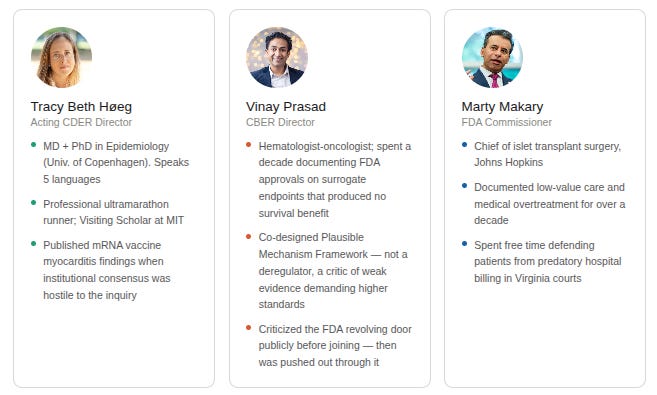
Tracy Beth Høeg is a physiatrist and epidemiologist — though her path there was anything but straight. She matched out of medical school into ophthalmology, one of the most competitive specialties in medicine, then walked away from it, moved to Denmark, and earned a PhD in Epidemiology and Public Health at the University of Copenhagen. Her doctoral work was not theoretical — she designed, fundraised for, and ran a 4,000-participant population study on visual impairment. She completed a postdoctoral fellowship in clinical biochemistry, a PM&R residency at UC Davis, and a sports medicine fellowship through UCSF. She ran professionally for Salomon and competed in two world championship ultramarathon events. She spent five years in independent small-group practice in Grass Valley, California while conducting research at UC Davis and UCSF and serving as a Visiting Scholar at MIT. She speaks five languages.
She published peer-reviewed work on myocarditis risk in young males from mRNA COVID vaccines when doing so was professionally costly and the institutional consensus was actively hostile to that line of inquiry. She was right, and the institutions that tried to suppress that work were wrong.
By any objective measure: brilliant.
She was not a political operator. She was not an industry plant. She was a scientist with clinical experience, epidemiological training, an independent track record, and a demonstrated willingness to follow data wherever it led regardless of whether the destination was convenient. That is a difficult combination to find in the wild. The FDA had her, and now it doesn’t.
Marty Makary was the chief of islet transplant surgery at Johns Hopkins University, who spent his time not operating documenting low-value care, medical overtreatment, and the gap between what medicine claims to know and what it actually knows. His other passion was defending patients from outrageous bills from non-profit hospitals. As told by former White House health policy adviser Katy Talento — Makary used to visit a Virginia courthouse every other Friday because that was the day the local tax-exempt hospital reserved the docket to sue its poorest patients. Makary and a young lawyer he brought with him would intercept these mostly working-class patients on the way into the courthouse, and review their bills on the spot for free. Makary and the lawyer would then represent the hapless patients in court against the hospitals, and win. So yes, we had an FDA head that was a transplant surgeon at Johns Hopkins University who in his free time defended patients from being bankrupted by predatory hospitals.
Vinay Prasad is arguably the most prolific critic of low-evidence FDA drug approvals in American medicine. His career before FDA was built on documenting exactly the kind of surrogate-endpoint accelerated approvals that produce no survival benefit — cancer drugs approved on tumor shrinkage that don’t extend life, drugs reaching market on biomarker improvements that don’t translate to outcomes patients can feel. The fact that Prasad — not a deregulator, not an industry friend, the person who spent a decade arguing the FDA approved too many drugs on too little evidence — is the one who co-designed the Plausible Mechanism Framework tells you something important about what that framework actually is. It was not a loosening of standards, but rather a recalibration by someone who has spent his career demanding higher ones.
These were not people who wanted to rubber-stamp drugs. They wanted the FDA’s evidentiary standards to be scientifically defensible — which means proportionate to the disease, the patient population, the mechanism of action, and the quality of available evidence. That is a more demanding standard than the current one when applied to the extraordinarily weak therapies that have been approved in recent years, but it is a lower standard for game-changing therapies that do actually work. The problem with the current standard was that it was simultaneously too lax and too strict.
When Makary, Høeg, and Prasad arrived, the average time from sponsor submission to approval at CDER was 553 days. In 2022 it had been 539 days. Before that, in the pre-COVID baseline years, it had been 319 to 338 days. Something had gone badly wrong with the agency’s operational function and nobody in the prior leadership had fixed it.
Meanwhile roughly half of all CDER New Molecular Entity (NME) approvals were for rare diseases — diseases affecting fewer than 200,000 Americans, often far fewer, often children, often without any alternative therapy. The FDA was applying the same evidentiary template to a drug for a disease affecting 1,063 people globally that it applied to a drug for hypertension or Type 2 diabetes. The requirement that drugs demonstrate efficacy in two adequate and well-controlled trials was never in the statute. Congress wrote “substantial evidence.” FDA practice turned that into a two-trial default through decades of interpretive accretion, and nobody had seriously challenged it.
Animal testing requirements for preclinical safety assessment had not been systematically reconsidered since the frameworks were established. Organ-on-chip systems, computational toxicology models, and advanced in vitro assays now outperform rodent models for predicting human toxicity across multiple drug classes and yet the FDA was still requiring animal studies whose predictive validity was demonstrably inferior to available alternatives. This meant thousands of animals were being euthanized annually to generate data that was less useful than what modern biology could provide.
Then came the layoffs. On April 1, 2025, 3,500 FDA employees — roughly 20% of the agency's entire workforce — were terminated as part of the broader DOGE-driven HHS restructuring. At CDER specifically, reportedly more than 800 positions were eliminated, according to agency staff. The administration maintained that drug reviewers and inspectors were protected. Whether that distinction held perfectly in practice is debatable. What is not debatable is the bottom line: Makary, Høeg, and Prasad inherited a broken agency, then lost roughly a fifth of its staff, and still drove approval times down, hit 100% PDUFA compliance, and pushed through eight rare disease approvals in five months. That is not chaos. That is competence.
These were real problems with real costs — measured in years of patient waiting, in drugs that never got developed because the path to approval was too expensive and too slow for small patient populations, and in animals killed to produce inferior data. Makary, Høeg, and Prasad came in with a coherent agenda to fix them. It turned out, they only had about sixteen months of runway to work with.
The Commissioner’s National Priority Voucher (CNPV) program approved six drugs between December 2025 and April 2026 at a median filing-to-approval time of 54.5 days. The standard PDUFA goal is ten months from the 60-day filing date — roughly 300 days. The CNPV program compressed that by roughly five times. The fastest approval was 44 days: zongertinib, branded HERNEXEOS, for HER2-mutant non-small cell lung cancer. The slowest was 61 days: lunsotogene parvec-cwha, branded OTARMENI, a gene therapy delivered to the inner ear for congenital deafness caused by mutations in the OTOF gene. Children who cannot hear because of a specific genetic variant in a single gene now have a treatment, and the FDA processed the approval in 61 days instead of 300.
FOUNDAYO — orforglipron — was the first entirely new molecular entity to clear the CNPV program. It is an oral GLP-1 receptor agonist. No injection. For the millions of patients who cannot or will not use injectable semaglutide or tirzepatide, an oral agent in this class is not a minor convenience — it is the difference between treatment and no treatment. It cleared in 50 days.
PDUFA goal compliance — the rate at which CDER meets its statutory review deadlines — reached 100% as of April 12, 2026, up from a low of approximately 89% in 2023. Average approval times fell from 553 days in 2023 to 413 days in 2025 to a projected 397 days in 2026. The direction was right and the velocity was real.
On rare diseases: eight approvals in roughly five months between December 15, 2025 and late April 2026. Seven NMEs, one repurposing. All seven NMEs carried orphan designation. Five were indicated in children.
Zycubo for Menkes disease. Already described. A child who would have died before age three now has a treatment, approved on 66 patients with a contemporaneous external control, because the people running CDER understood that you do not need a randomized controlled trial to demonstrate that a drug reduces mortality by 78% in a uniformly fatal pediatric disease.
Wellcovorin — leucovorin calcium — for FOLR1-related cerebral folate deficiency, approved March 9, 2026. The approval was genuinely unprecedented in its specific form. The FDA based its decision on published literature including real-world case reports, as well as leucovorin’s mechanism of action. The FDA then requested GlaxoSmithKline (GSK) submit a supplemental New Drug Application (sNDA), then collaborated with GSK to update the drug’s labeling, effectively initiating and prosecuting the approval itself rather than waiting for a sponsor to bring a development program. The FDA effectively acted as the drug developer. That has essentially no precedent in the modern regulatory era.
Avlayah — tiyidenofusp-alfa-eknm — for Hunter syndrome, MPS II, approved March 24, 2026. Hunter syndrome causes progressive neurological deterioration. Existing enzyme replacement therapy does not cross the blood-brain barrier (BBB). The CNS manifestations are what kill patients and destroy quality of life. Avlayah is engineered to cross the BBB. It received accelerated approval on mechanistic grounds, with a confirmatory randomized trial already more than 95% enrolled. This is exactly what accelerated approval was designed for — not Aduhelm with a surrogate amyloid endpoint that didn’t predict clinical benefit, but a drug that corrects a known enzyme deficiency through a mechanism that directly addresses the CNS pathology that the existing standard of care cannot reach.
Then we have the animal testing modernization agenda — the iSTAND program made permanent, the Memorandum of Understanding (MOU) between the NIH and FDA, the first AI toxicology tool formally qualified, and the New Approach Methodologies (NAMs) acceptability database. NAMs is an umbrella term for any testing method that replaces, reduces, or refines the use of animals in preclinical safety testing. The category includes organ-on-chip systems, organoids, advanced cell culture models, computational and AI toxicology modeling, and high-throughput in vitro assays. The NAMs acceptability database is essentially a registry that documents which specific NAMs have been reviewed and accepted by FDA as valid substitutes for specific animal tests in specific contexts — so a drug sponsor can look up whether a particular organ-on-chip system has already been vetted for a particular toxicology question, rather than having to make that argument from scratch every time they want to use it. It’s infrastructure for normalizing NAMs use across the drug development pipeline.
The Plausible Mechanism Framework — draft guidance issued jointly by CDER and CBER in February 2026 — may be the most intellectually significant thing this FDA leadership produced. The framework proposes that for therapies targeting genetic conditions with known biological cause, mechanistic evidence of how the therapy corrects the molecular defect can support approval without traditional large-scale clinical outcome trials. The paradigm case is baby KJ Muldoon in Philadelphia — a child with CPS1 deficiency, a urea cycle disorder that would have killed her, treated with a bespoke base editor developed in months by researchers at Penn and CHOP using molecular machinery whose mechanism is fully understood. When you know the causal variant, the enzyme deficiency, and the correction the therapy makes, the mechanistic chain from molecular intervention to expected clinical benefit is short and well-characterized. Demanding two randomized controlled trials in a disease affecting dozens of patients globally is not scientific rigor. It is bureaucratic inertia that kills children.
Then there is daraxonrasib. A drug showing a 60% reduction in mortality risk in previously treated metastatic pancreatic cancer — arguably the most lethal common solid tumor in existence, a disease that kills most patients within twelve months of diagnosis. The phase 3 data is in hand. The NDA is being prepared for CNPV submission. And when Revolution Medicines submitted an expanded access application — allowing patients who cannot enroll in a clinical trial to access the drug while the formal review proceeds — the FDA turned it around in two days. Makary announced it himself: “Granting the request 2 days after receiving the expanded access application reflects the FDA’s strong commitment to facilitate early access to therapies for serious and life-threatening conditions, including pancreatic cancer.” Two days. For pancreatic cancer.
The Prasad-Makary NEJM Sounding Board piece published February 18, 2026 made the case for ending the two-trial requirement entirely. One well-powered pivotal trial — pre-registered, with adaptive design and Bayesian analysis — can constitute substantial evidence under the statute as Congress actually wrote it. The two-trial requirement was never in the law. It was an FDA invention, and it was past time to end it.
These were not just deregulatory gestures. They were scientifically grounded recalibrations of evidentiary standards to the actual epistemic situations they govern. That is harder to do than either blind deregulation or reflexive conservatism, and it required people who understood both the science and the regulatory machinery well enough to make the arguments credibly. Those are the people that were shown the door.
Makary resigned after months of a public pressure campaign that first focused on his CBER director Vinay Prasad. The departure of Prasad was likely supposed to ease the pressure on the FDA, but it was blood in the water for those critical of the new FDA. They came with fury for Makary next. When the political environment makes continuation of your work functionally impossible, when the people around you are being removed, when the agenda you were brought in to implement is being undermined from above, “resignation” is the bureaucratic label for what is in every practical sense a termination.
There is nothing in the public record suggesting that any of the three failed at their jobs. The metrics moved in the right direction. The approvals were defensible. The non-approvals that reporters chose to highlight as examples of chaos were actually exactly the right calls to be made by an independent FDA that doesn’t simply act as an extension of biopharma.
The structural reform agenda was coherent and being implemented. They left because an administration that had spent years talking about change and reform ultimately listened to industry executives with White House access and an interest in a more predictable FDA — and grew fatigued with the wall-to-wall negative coverage in outlets that had spent years treating FDA press releases as news.
The specific damage is structural. The reforms they built were not yet institutionalized. Draft guidances are not final guidances. Pilot programs are not permanent programs. Internal cultural shifts toward proportionate evidentiary standards are not codified in statute. Everything Makary, Høeg, and Prasad built exists in a form that is reversible by people who were not in the room when it was built and do not feel ownership over it.
The FDA’s permanent civil service will outlast every political appointee who has ever walked through its doors. It outlasted the reformers who came before this team and it will outlast whoever comes next. Institutions have a gravitational pull toward their prior equilibrium. They are designed to resist change. Not dramatically. Not with a press release announcing that the Plausible Mechanism Framework has been abandoned. Just quietly, in the comment responses to the draft guidance, in the advice given to sponsors in pre-IND meetings, in the willingness or unwillingness of division directors to accept an external control arm for a 70-patient rare disease trial.
The narrative that has emerged is an FDA that was obstructionist. This is complete nonsense. On April 23, 2026 the FDA approved OTARMENI for congenital deafness due to OTOF mutations. Sixty-one days from filing to approval. A child who cannot hear because of a mutation in a single gene now has a treatment that targets that mutation, reviewed by an agency that understood in 61 days what it used to take 300 days to understand.
That child can hear.
Three scientists — Marty Makary, Tracy Beth Høeg, Vinay Prasad — each with independent track records, each with demonstrated willingness to follow evidence against institutional consensus, each having paid professional costs for that willingness before they ever set foot in a federal building, built something together in sixteen months that the FDA has been incapable of building for decades. A coherent, scientifically defensible, operationally functioning reform agenda that was acting in real time to save children with fatal rare diseases and getting proven treatments to patients in weeks instead of months.
The Trump administration cleared them out anyway.
It is hard to escape the conclusion that the current FDA-media-political ecosystem doesn’t work for patients or tax payers. It is an organization that has been made the gatekeeper of what therapies Americans have access to through legislative authority, while simultaneously producing billion-dollar valuations for every company that gets the FDA stamp of approval. Regulators who play the game well get a golden parachute into biotech.
Take the case of former CBER head Peter Marks. He left the FDA after butting heads with HHS Secretary Robert F. Kennedy Jr. on vaccine policy. He parachuted into pharmaceutical giant Eli Lilly as senior vice president of molecule discovery and head of infectious disease. Lilly subsequently announced $3.8 billion in vaccine acquisitions — $1.5 billion for Curevo (shingles vaccine), $780 million for LimmaTech Biologics (staph infections), and $1.55 billion for Vaccine Co. (Epstein-Barr virus) — just months after hiring Marks.
Prasad, the man who replaced Marks, had previously been highly critical of the former CBER head and the revolving door from FDA to pharma, writing in July 2024: “FDA is broken. Peter Marks is approving gene therapies that don’t work, and the revolving door to Pharma is spinning so fast it hits you in the ass.”
Fast forward to May 2026 — the person who explicitly criticized Marks and the revolving door was himself pushed out. Marks is now a senior executive at Lilly with a $3.8 billion pipeline to run and an enviable list of FDA contacts on his phone. Høeg exited shortly after Makary “resigned”. The goal was clearly to rid the FDA of outside influence and return it to familiar hands.
Well, they succeeded.
If there is anything useful in this debacle, it is this: the obstacles to reform are now visible. FDA lifers, pharma lobbyists with White House access, and a press corps that treats anonymous agency sources as authoritative — these are the forces that cleared out the most competent FDA leadership in a generation. The next attempt will need to be smarter about all three. Because we either have an FDA that works — with the singular pursuit of promoting the health of Americans — or we should stop pretending it does.
Anish Koka is a Cardiologist who writes on medicine, healthcare policy, and the regulatory beauracracy. He hosts a weekly podcast about the same called The Doctor’s Lounge.
No posts
Comments
Nothing yet. Say the first thing.
Sign in to join the conversation.