
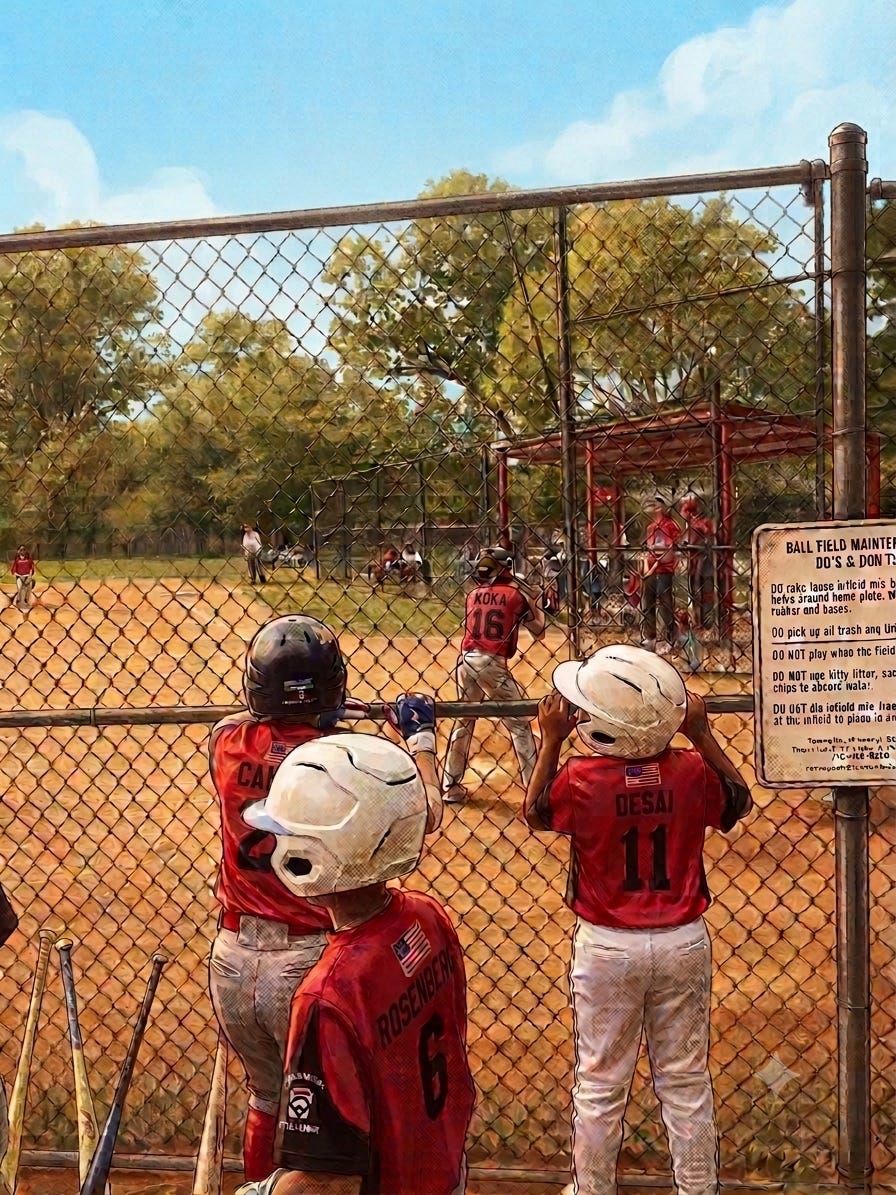
That’s my son batting in the picture. Watching young Koka are a young Cabot, Desai, and Rosenberg. It’s a scene from a recent little league gameg that played out in a leafy Philadelphia suburb (names on jerseys changed for privacy). It’s also a completely improbable picture the 10-year-old version of me who arrived in Pittsburgh, Pennsylvania, from New Delhi, India, could ever have imagined would happen.
I came of age in America, but the traditions were foreign to the brown kid with a thick Indian accent. I didn’t understand the culture of sports — my favorite sportsman was the great Indian Little Master, cricketer Sunil Gavaskar, a name that meant nothing to anyone in Pittsburgh. The computer lab is what thrilled me, and computers were a lot easier to talk to than the cute and bubbly girl who sat behind me. She wanted to be a cheerleader. I didn’t even know what that was. Kindly but strict Mrs. Broman kicked me out of the computer lab during lunch to play kickball with the kids. I vaguely recall marveling at how far Ben Lehman with his shock of blond hair and blond eyebrows could kick a ball.
I eventually came out of my little shell and thought I had plugged in. I mean I was playing pickup basketball under the lights in Mount Lebanon, Pennsylvania, and I was headed to Joe Paterno’s Penn State for college. But there’s a large difference between participating in American institutions and being American — a difference lost on me until I had children. My children were American as apple pie. I was like an Americanized butter chicken.
It’s hard to ignore the significance of those names on the jerseys — the Jewish-origin Rosenberg, Indian-origin Desai, and the WASP Cabot watching another Indian-origin kid bat. It’s beautiful precisely because no one cares. The same red jersey, same dirt, same chain-link fence on a Philadelphia ball field that’s been here for more than a hundred years. No one’s trying to assimilate. They’re just playing baseball in the uniquely American institution known as Little League.
It’s with this context that I approach the notion that some make of America as a creedal nation. This thesis holds that American nationhood is constituted not by ethnicity, ancestry, religion, or shared territory-over-centuries, but by assent to a set of propositions — liberty, equality, individualism, populism, and laissez-faire.
A younger version of me that hasn’t yet watched little Koka bat in Little League would be very susceptible to that argument. The idea that to be American is simply to believe in a shared set of propositional values is a comforting safety blanket for newcomers to the country. But would you give up your life for shared propositions? Canadians and Western Europeans broadly believe in the same values. Are they American?
Nations require trust, mutual sacrifice, intergenerational continuity, willingness to die for strangers, and acceptance of unchosen obligations. Propositions inspire none of these reliably. This isn’t an abstract statement. The Soviet Union was an attempt at a creedal nation built on Marxist-Leninist principles. It worked as long as the police state forced it to work. It dissolved along ethnonationalist lines the moment coercion was lifted.
The men who signed the Declaration of Independence in Philadelphia, just a few miles from where my son plays baseball 250 years later, were carrying forward the torch of an ancient Western civilization. The founders, giants themselves, stood on the shoulders of giants. English common law and liberty. The Roman idea of republic. The Greek idea of a constitution balanced against itself, so no single part could rule alone. The Christian idea that every soul stood equal before God, whatever the accident of birth — an idea Jefferson would later put in writing, as if it were self-evident, though nothing about it was.
For the entirety of its existence, America has been incorporating immigrants with a remarkable degree of success. The scene playing out on that baseball field is the visible proof of that.
Little League was founded by Carl E. Stotz, a Williamsport, Pennsylvania, lumberyard clerk born in 1910, who in the summer of 1938 began experimenting with field dimensions and rules in a Williamsport vacant lot, playing catch with his two young nephews, Jimmy and Major Gehron, and other neighborhood boys. There were no games that first summer — just Stotz figuring out, with a penknife and his sister-in-law sewing the first bases, what a scaled-down baseball diamond for children should look like. He set the bases at 60 feet apart and the pitcher’s mound at 40 feet from home plate (later moved to 46 feet) — roughly two-thirds the size of a standard diamond, the dimensions still used today.
The name was deliberately chosen to mirror “Major League.” Stotz wanted the boys to feel like they were playing real baseball, not a kids’ version of it. He designed a patch with a baseball diamond and waving flag inside a Pennsylvania keystone — the keystone is still on the official Little League logo today.
Little League operates in more than 80 countries, with approximately 2 million participants, supported by over one million volunteers. Little League’s defining feature — the one that makes it function as an assimilative institution — is the local geographic boundary. Rosters are constrained by guidelines that restrict the area from which leagues can draw players, a process that continues today. You play with the kids who live near you, whoever they are. The institution’s accidental anti-sorting feature is its civic genius. On the team are kids from elite private schools, home schools, public schools and Catholic schools who would never have punctured the bubbles their parents had built for them if not for that miniaturized baseball field they are all desperate to be on together.
The whole thing is a uniquely American invention. A lumberyard clerk in central Pennsylvania, working with his nephews and a sewing kit, built a national institution that Congress eventually chartered. There is no European or Asian equivalent — youth sport in most countries is run through schools or professional-club academies. Little League is a product of a specifically American voluntary civic tradition, the same tradition the visiting Frenchman Tocqueville noticed in his wonderful book Democracy in America in 1835.
The question of the moment is whether continued immigration threatens this experiment.
The fact little Desai and Koka are playing little league baseball tells you America is quite able to absorb people from remarkably different backgrounds. Those two kids are fully absorbed. They clearly aren’t diluting anything. But it would be intellectually lazy to stop there.
Not every immigrant group assimilates at the same rate, and some don’t assimilate much at all — at least not in the generational timeframe Americans are used to. The historical American success story is mostly a story about European immigrants between 1840 and 1924, plus the post-1965 inflows from Asia and parts of Latin America. Within that range, the substrate worked. Outside it, the record is mixed-to-poor.
There are at least three separate groups of immigrants worth considering. First, immigrants who can’t assimilate fast enough. Older first-generation arrivals — my father’s generation — typically don’t fully assimilate and are never going to. They retain accents, food preferences, religious practice, and social networks rooted in the old country. Their children do the assimilating. This is how it has always worked. The relevant unit is the family across generations, not the individual.
Next are the immigrants who choose not to assimilate but whose children will anyway. Plenty of first-generation immigrants live in ethnic enclaves, watch satellite TV from home countries, marry within the community, and never fully integrate. The Italians did this. The Poles did this. The Chinese in San Francisco’s Chinatown did this for a century. The pattern was: parents kept the old country alive at home, kids became American despite the parents’ wishes, grandkids barely spoke the heritage language. The enclave functioned as an assimilation airlock, not a permanent separation.
These groups are no threat to America, but the third group is. Immigrants who actively reject assimilation as a value, and whose children may follow them. This is the actual worry, and it’s narrower than the immigration-restrictionist coalition usually claims, but it’s clearly real. The relevant question is: under what conditions does the enclave stop functioning as an airlock and become a permanent parallel society?
The airlock model where you have a period of difference before complete assimilation breaks down under some very specific conditions that are worth exploring.
First, religion. When a group’s identity is organized around a religious framework that explicitly forbids integration with the host society — not just intermarriage but core civic participation — assimilation slows dramatically and can stall across generations. Hasidic Jews in New York have maintained largely separate communities for the better part of a century. Some Salafi-influenced Muslim communities in Western Europe (less so in the U.S.) are following the same pattern. Whether this is a “problem” depends on whether the group seeks political and legal carve-outs that conflict with the broader civic order, or merely lives separately.
Second, assimilation requires friction with the host culture. When a group is large enough to staff its own schools, businesses, media, religious institutions, and marriage market, the friction drops to near zero. These kids never have a Mrs. Broman “go out and play ball with the kids” moment because they never have to deal with anyone outside their community. This is the European problem with second- and third-generation North African Muslim populations in France and Belgium, and it’s the Mexican-American situation in parts of South Texas and Southern California, though the latter is much more like the historical European immigrant pattern than the European Muslim case.
Third, generous welfare programs reduce the economic pressure to learn the language, take a job that requires English, move out of the enclave, and deal with the broader society. Minnesota’s failure to integrate Somali populations is partly a story about welfare allowing permanent enclave economics.
Fourth, sending countries increasingly organize their expatriate populations to retain national loyalty rather than release it. Erdoğan’s Turkey has spent two decades cultivating German Turks as a political constituency inside Germany. Beijing runs overseas Chinese student associations at American universities that report back to consulates. Mexico’s push for dual citizenship in the 1990s was explicit about preserving political ties. The old assumption — that immigration was a one-way door — no longer holds. When the country of origin actively counter-organizes its diaspora, assimilation has to fight uphill.
Finally, and most importantly, assimilation requires an assimilating culture that believes in itself. When American institutions — universities, K-12 schools, corporate HR, mainstream media — actively tell immigrants that the dominant culture is racist, oppressive, and not worth joining, you should expect fewer of them to join. Multiculturalism as official ideology, in its strong form, is anti-assimilationist by design. The 1965-2000 immigration cohort assimilated faster than the current cohort partly because the receiving institutions still believed the immigrants were lucky to be here. That confidence has eroded, and the assimilation rate has eroded with it.
To summarize, most immigrants who fall into the “can’t assimilate” or “don’t want to assimilate” have children or grandchildren who will, as long as the institutional substrate is intact. That’s what Little League tells you. A minority of immigrants come from groups where assimilation is actively rejected as a religious or ideological matter. This minority is probably overrepresented in the public discourse in the United States because it generates news stories which now lead to handsome X payouts, but it is hardly the median immigrant experience. The conditions under which non-assimilation becomes permanent rather than generational are identifiable: religious totalism, critical mass, host-culture self-rejection, welfare buffering, diaspora politics. Immigrant volume matters, of course. No amount of institutional infrastructure and confidence will overcome unfettered, unrestricted immigration. Selection at the border matters just as much as total volume. America’s relatively good post-1965 assimilation record compared to Europe’s is partly about who got in. High-skilled, English-speaking, often Christian or secular Asian immigrants assimilated faster than low-skilled non-Western European immigrants did. This is uncomfortable to say but it’s true. If you select for people likely to assimilate, you get more assimilation. If you don’t, you don’t.
If America wants assimilation, it has to actually run the assimilation machinery: expect English acquisition, expect civic knowledge, run shared institutions like Little League and public schools that don’t sort by ethnicity, and have an elite culture that believes the deal is worth taking. The American substrate did this for 150 years. The elite institutions broadcasting how terrible America and its founders were aren’t run by immigrants. They’re the universities, foundations, and newsrooms that have spent a generation telling new arrivals the country they’re joining is fundamentally racist and not worth joining.
Au contraire, my fellow Americans. Yours is the first nation to found itself not on blood or crown but on the proposition that rights precede government — a written constitution enshrining them as first principles rather than concessions wrung from a king. Yours is the only nation to date that has landed men on another world. Yours is the country whose scientists led the campaign that wiped smallpox from the earth, and whose researchers built the vaccines that broke the back of polio. Yours turned Franklin’s curiosity and a century of European science into a continent wired end to end with electric light, and yours put the first machine into the sky under its own power at Kitty Hawk. Yours were the men who stormed Omaha Beach to help free Western Europe from Nazi occupation, and yours were the Marines who waded ashore at Incheon in a daring landing behind enemy lines, saving half the Korean peninsula from communist conquest. Yours is the culture that conquered every continent without firing a shot: Elvis and rock and roll, blue jeans, James Dean, Marilyn Monroe, Marlon Brando, Fred Astaire, Clint Eastwood, Top Gun, The Terminator. Even Superman was raised in Kansas. Be proud of your heritage. It is only little men with a poor grasp of history who frame America by its imperfections alone.
The threat to the substrate isn’t Desai and Koka in the batter’s box. It’s the people running the institutions that were supposed to teach us about American exceptionalism, but instead decided somewhere along the way to flatten American history to some weird binary of whites oppressing non-whites.
There’s a parallel in all this to what threatens Little League today. The danger isn’t little brown Desai or Koka playing the game. It’s travel ball. Travel ball sorts kids by skill and family willingness-to-pay across larger geographic areas, which means a kid in Lower Merion might play exclusively with kids from three suburbs over who share a class position rather than a neighborhood. The Desai-Rosenberg-Cabot-Koka photograph happens because a Little League roster is drawn from a specific township, not selected by a coach trolling for talent. Travel ball is the market eroding it. The threat comes from elites who don’t value the system.
The traditionalists are right to cherish America’s roots and right to push back on a globalist America that belongs to anyone, anywhere, who subscribes to a set of shared propositions. Canadians, Australians, and most Western Europeans assent to broadly similar liberal-democratic propositions. If creed alone made a nation, these would all be one nation. They are not. But a purely ethnonationalist perspective — the blood-and-soil version that says Desai cannot become American no matter how many innings he plays — excludes the kid in the foreground whose grandparents came from Gujarat and who is, watching his teammate bat, more “American” than any number of Mayflower descendants spending their time trying to tear down statues of George Washington.
The American substrate has been soaking immigrants up for a long time, and it’s valid to question whether that remarkable success story can continue. Will the substrate eventually be overwhelmed if the inflows from cultures and people who don’t assimilate are great enough? I don’t know the answer. What I do know is that the threat to the substrate isn’t primarily demographic — it’s a loss of confidence. A society that stops believing in its own assimilative project stops assimilating long before it runs out of room. The institutional scaffolding — Little League, the volunteer coaches, the parents in folding chairs, the unselfconscious sense that this is how we do things and newcomers join in — is what’s actually at stake. This little suburb in Philadelphia is still doing it. And it’s worth preserving.
Happy Birthday, America.
No posts
Comments
Nothing yet. Say the first thing.
Sign in to join the conversation.