
Content warning: bad language - you were warned, please don’t tell me off.
Funnily enough, being told to “grow a thicker skin” does not actually help one to do so.
In any case, I actually do have a fairly thick skin, despite what anyone who has witnessed one of my occasional meltdowns might conclude. My general, and possibly unhealthy, pattern is to have a sook, feel sorry for myself for a bit, perhaps cry in the car, and then dust myself off and charge back into whatever fight I was in before.
I have been talking about politics on the internet for more than a decade. In that time I have been called stupid, ugly, fat, evil, racist, fascist, communist, far right, a stupid liberal, a bitch, a TERF, a homophobe (despite being a lesbian), xenophobe, a meat sack, and most available variations of cunt. I have received numerous threats of rape, violence, and death. People have contacted previous employers trying to get me fired and I had one particularly creepy stalker in actual, non-internet life in Wellington. Bizarrely, strangers I have never met regularly hold lengthy online discussions about how terrible I am and recently somebody showed me page after page of Reddit discussions about me. Well, I say “about me”, but I do not recognise the woman they are describing.
So yeah, I am battle-hardened, but I am not impervious.
I am also very aware that I dish it out. I criticise politicians, journalists, activists, and political movements, sometimes harshly. I am sarcastic, make jokes, swear like a sailor, and I get irritated quickly. I have a stubborn streak that borders on pathological and a particular inability to back away once somebody tells me I should. Defiance has served me very well at various points in my life and caused me no end of trouble at others.
I am not asking anybody to imagine me as some gentle wee flower who has wandered innocently onto the internet and been horrified to discover disagreement there. People who voluntarily spend their lives arguing about contentious political questions in public probably have to be a little bit mental and I certainly am. Sane people would assess the risk-to-reward ratio and say, “No thank you very much.”
Some of my worst characteristics, including recklessness, impulsivity, and obstinacy, are also part of what allows me to do what I do. The traits I am most complimented on funnily enough overlap with the ones I get most criticised about.
However, if I say something stupid or unfair, I expect people to criticise me. If I get a fact wrong, I want to be corrected so that I can rectify it. I am well aware that some people think my politics are reprehensible because knowing what a woman is and left wing politics of a few decades ago are apparently now “literal violence”. I have stubbornly refused to bend the knee to fashionable identity politics and trans activism despite the social penalties that have come with it.
We all have opinions and beliefs and they should be fair game for criticism.
All of which makes my current situation rather complicated. There is a conundrum I want to talk you through. You may judge me harshly, but at least I will have laid it out.
As you may have seen in the news this week, I have taken Martyn “Bomber” Bradbury to Court under the Harmful Digital Communications Act. I have also spent several years on the governing Council of the Free Speech Union, an organisation that has repeatedly criticised that law and campaigned for its reform.
Anyone looking at those two facts and thinking, well, that looks a bit bloody hypocritical, is not being unreasonable. I grappled with it myself. I am not going to build some elaborate philosophical escape tunnel in which there is never any tension between those two things, because plainly there is. What I can do is explain what happened, what I sought, why I reached the point I did, and why going through the process has left me even more convinced that the HDCA needs reform.
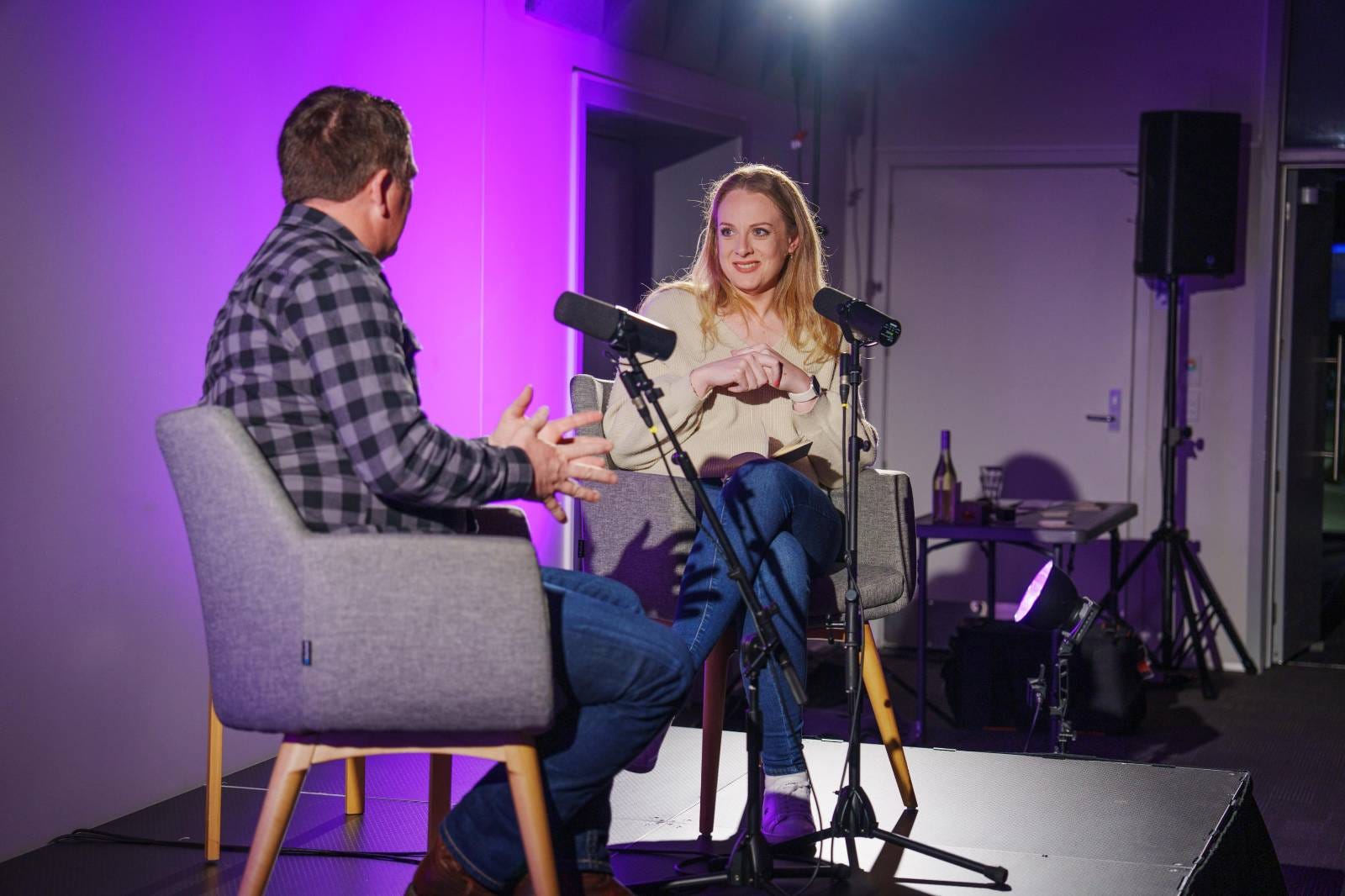
A while back I appeared several times alongside Martyn Bradbury and Damien Grant on their podcast The Working Group. Martyn and I disagreed about almost everything, which was the point of the thing, but it was civil. Friendly, even.
But at some point his attitude towards me changed. I still don’t know why. I don’t recall some great falling out or dramatic political showdown. His commentary about me simply became more frequent, aggressive, personal and, in my view, increasingly nasty and defamatory.
There were repeated defamatory references and posts about my employment, allegations about my involvement in various conspiracies, and other people’s misfortunes. Due to the ongoing legal case I cannot at this time discuss the exact posts and social media activity that is in question except to say it was very personal and nothing to do with disagreeing with me politically. The Court’s interim decision records some of that material and, importantly, also records that I explicitly said I was not seeking to prevent him from criticising my political opinions or my work.
It is in the affidavit I filed before this became a ridiculous national story:
“This application is not about political disagreement.
I fully accept that robust criticism accompanies public life and I have never sought to prevent criticism of my political opinions or my work.
It concerns a sustained and escalating campaign of targeted online harassment directed personally at me across multiple platforms over an extended period.
In my view, the respondent has become fixated upon me.”
Judge Kate Davenport KC later recorded that in her interim decision too:
“The applicant also says that while she is a political commentator she does not
seek to restrict criticism of her political opinions or her work but that what she
complains of is the sustained and escalating campaign of “targeted online harassment
directed at her personally across multiple platforms”.
I want people to know this because one of the more frustrating aspects of this entire saga has been the suggestion that I suddenly woke up one morning and decided a left wing blogger should be legally prohibited from calling me right wing.
If Martyn wants to say I am right wing, he can knock himself out. He is wrong because I am entirely too chaotic to be confined to one wing, but he can say it.
If he wants to say my arguments are stupid, fascistic, reactionary, liberal, neoliberal, conservative, deranged, or whatever adjective is fashionable on The Daily Blog that week, fine. I may respond and I may be rude back. But I do not think the law should prevent him from criticising my politics.
This case is not about political opinions or disagreement. Martyn is doing his very best to make himself a martyr, but really he is putting on a performance of Les Misérables because someone asked him to stop being a dick on the internet. It isn’t his first rodeo either. In 2011, he declared he was banned from RNZ which was news to them.
I contacted him directly before I went anywhere near a courtroom. I texted him and asked him what on earth he was doing and told him I was finding his behaviour abusive and explained that a number of things he had attributed to me were simply untrue. His response was horrible and he ended by saying that if I thought I was being abused I should go to Netsafe or the Police. So, feeling desperate and beaten up, I went to Netsafe.
“…he made further harmful comments and suggested if she had abuse then she should contact Netsafe or the police.”
INTERIM DECISION OF JUDGE K G DAVENPORT KC
By then I was at a very low ebb. I felt miserable, creeped out, and, at times, scared.
This is the point at which somebody will inevitably say “you are a political commentator. What did you expect?”
Quite a lot, actually! I have come to expect insults, for people to misunderstand me, for ideological opponents to assume bad motives, for partisan journalists to frame things in ways I dislike, and unfortunately I expect strangers to call me all sorts of names. None of this is a particularly surprising consequence of spending 13 years arguing politically on the internet. I ignore an extraordinary amount of weird, abusive, and creepy commentary about, and to, me.
This was different. Part of what got to me was the cumulative effect of being repeatedly portrayed to an audience as something not merely wrong but sinister; a Nazi, an extremist, some dangerous far-right creature operating maliciously behind the scenes.
People sometimes shrug at those labels because political language online has become so ludicrously inflated that everyone to the right of Chloe Swarbrick eventually ends up being Hitler. But there is still a difference between saying somebody is wrong and repeatedly telling strangers that somebody is morally monstrous. The latter is dehumanising. Charlie Kirk and Ann Widdecombe’s assassinations are the extreme result of this dehumanisation.
I am increasingly recognised in public and, thankfully, almost every person who has approached me has been lovely, but I cannot know what everybody who recognises me has read or believes about me. If they take Martyn at his word I am a person who deserves to be confronted, aren’t I? Who is going to care if a Nazi gets beaten up? Once you portray somebody as beyond the moral pale, you change the way an audience is invited to think about them. I do not think it is irrational to feel some nervousness about that.
The Court will ultimately decide whether my allegations meet the legal threshold. I am not asking readers to make that determination here. I am explaining my state of mind when I reached for the tool available to me, the law Parliament says exists to protect against behaviour like Bradbury’s.
I was hurt, overwhelmed, and I desperately wanted it to stop. There is no point rewriting myself as a tougher character after the fact. So I went to Netsafe and, eventually, to Court.
I want to clarify what I actually did, and didn’t, do and set the record straight on the “Martyn faces prison for free speech” theatre that followed.
I did not lay a criminal charge against Martyn Bradbury nor ask the Police to prosecute him for criticising me. I brought a civil application under the Harmful Digital Communications Act.
In response to my application, Judge Davenport’s initial ruling was expressly an interim decision. She found, on an interim basis, that breaches of principles had been established and that the statutory gateway for interim relief had been met. She ordered specific material be taken down, restrained further communications about me, and prohibited encouragement of other people to make similar communications pending further order. Clearly Martyn misunderstood those instructions.
The words “on an interim basis” are rather important. The Court has not held the substantive hearing and declared Martyn legally wrong for all eternity. Interim orders are temporary measures available while a matter proceeds toward full determination. Martyn has the opportunity to contest the application.
Unfortunately, the phrase “interim civil order” lacks revolutionary glamour so Martyn rapidly announced that he was prepared to go to prison for free speech. He called on mainstream media to descend on the Court, demanded everyone involved (that would be me, myself, and I) be exposed, said he would refuse to apologise or pay a fine, invoked The Shawshank Redemption, requested books should he be imprisoned, and generally accelerated through several acts of a political-prisoner drama before we had made it through a basic civil procedure. A short interim order somehow became the imprisonment of Nelson Mandela on The Daily Blog.
The possibility of criminal consequences arises separately because Parliament has made failure to comply with an HDCA order, without reasonable excuse, an offence. Disobeying court orders can create separate legal consequences and Judge Sharp in our initial callover hearing warned Martyn about the risks he was running due to the media circus he kicked off. He urged him to get legal advice because he could be looking at potential contempt of court and deferred our hearing another week.
I am not remotely saying that interim restrictions on speech should be treated casually. But scrutiny requires accurately describing what happened and he wasn’t being put in cuffs.
Ironically, his public campaign ensured that as much as I had thought the HDCA was flawed before I took the case, I am now more convinced it needs to be reformed. The case has demonstrated how the process fails those seeking protection and relief. My identity was meant to be protected, but instead, anonymity created a mystery. Martyn announced that somebody had secretly dragged him to Court. He did not say my name, but damn near drew a map to find me. Naturally people started guessing and I started getting phone calls.
He made the initial story all about the Free Speech Union. Martyn complained loudly that the organisation had not leapt to his defence despite, at that stage, not having even approached it for assistance nor being a member. This sudden demand for help was particularly curious because he has spent years attacking FSU.
Talking about the Good Faith Yarns tour I recently travelled around New Zealand hosting, he described the FSU as the “most disingenuous pricks in the game”, compared it to the “IDF media team” and wondered whether we would be inviting Genghis Khan, Caligula, and Joseph Goebbels as speakers.
It is crazy the speed with which we apparently transformed from Zionist Goebbels-adjacent propagandists into the emergency service responsible for protecting Martyn Bradbury’s civil liberties.
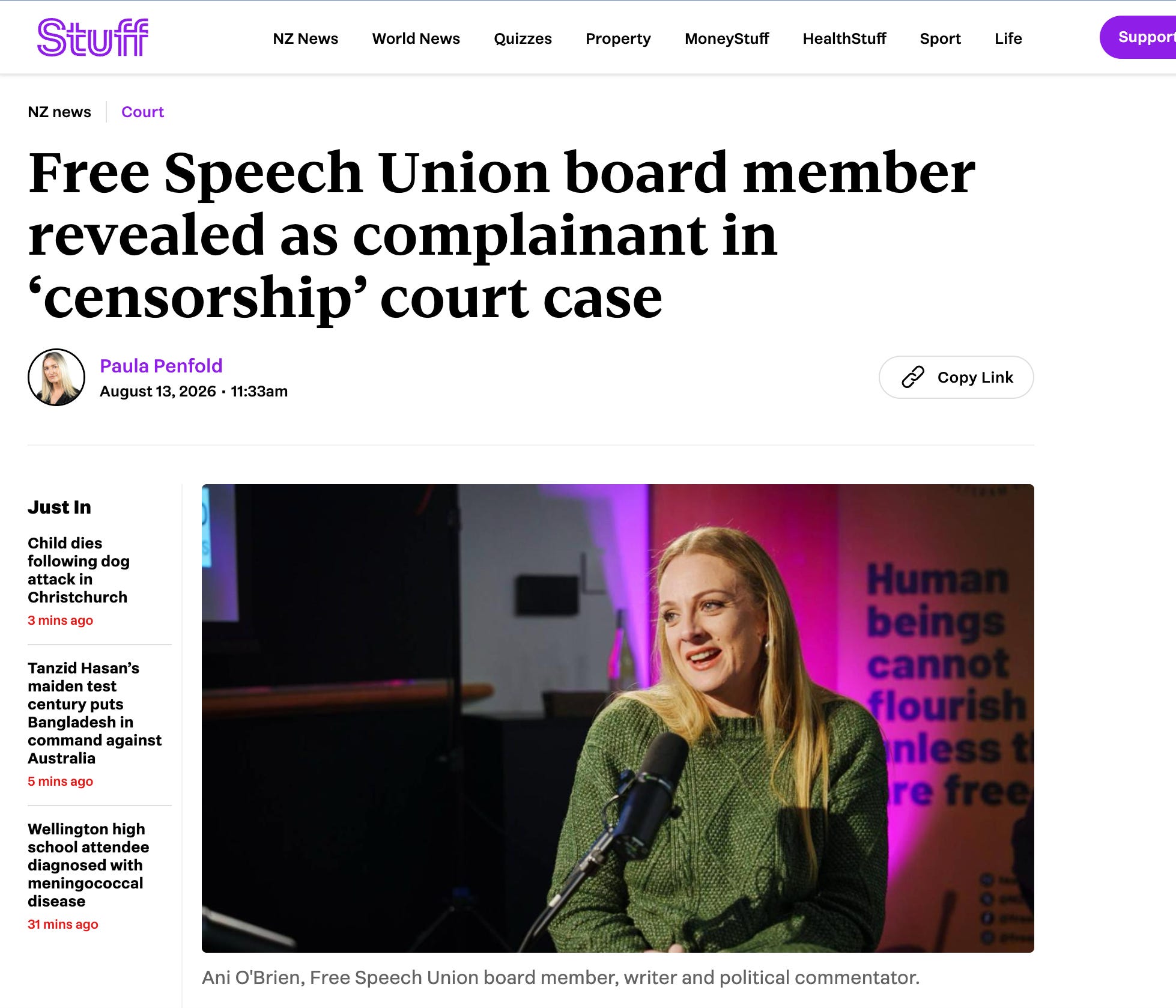
The media, of course, became intensely interested in the FSU angle Bradbury offered up. And something happened that left me and my newly acquired lawyers puzzled… Stuff applied for access to the court documents using the correct proceeding number (the mind boggles as to how they got hold of it) but naming the case Free Speech Union v Martyn Bradbury.
It is not Free Speech Union v Martyn Bradbury. The Free Speech Union was not the applicant, did not initiate the proceeding, did not fund it, was not directing it, and was not even a party to it.
Having the right case number attached to the wrong applicant demonstrated that information about the proceeding was circulating while the action was being wrongly associated with an organisation on whose Council I sit. Once that happened, people did not need to be Hercule Poirot.
After The Post/Stuff reporting I started receiving more messages from people who had correctly worked out that I was the applicant and others began asking people who know me. The protection around my identity was not only not protecting me, it was creating a Streisand effect and loads of speculation.
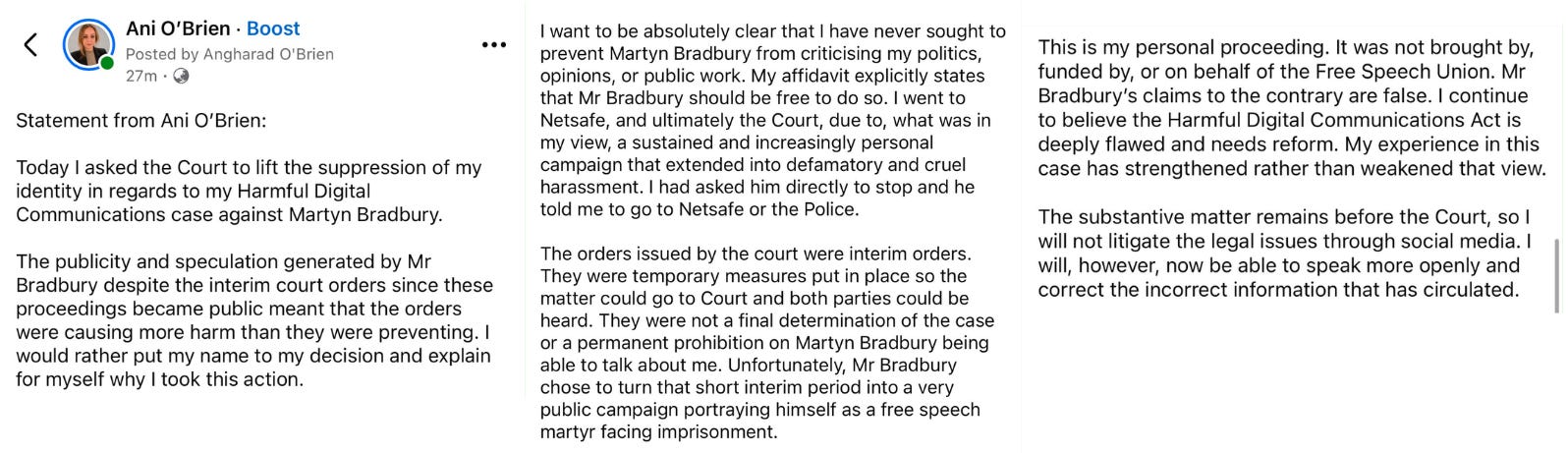
That is why, on Thursday, I asked the Court to remove the protection around my identity. I would rather say “yes, it is me”, and explain the decision myself than have people play Cluedo and construct their version of my motivations.
That brings me to a much longer term frustration. There is an “Ani O’Brien” who seems to exist in the imaginations of people online whom I find myself being asked to answer for. Sometimes it feels that those who are committed to hating me, and seeing me in the worst light possible, will deliberately attribute the worst most extreme positions to me even if I have not said anything remotely like it. I may have commented on a much narrower set of facts, but later the entire episode will be converted into “Ani said the worst thing”. The fictional Ani is easier to attack than the real one because she has conveniently done everything her critics already believed somebody like her would do.
I am perfectly willing to answer for my own actions, including the ones I regret. I am not willing to answer for imaginary ones.
The issue of Benjamin “Bussy” Doyle is perhaps the clearest recent example and one that Martyn Bradbury repeatedly invokes as justification for his behaviour toward me.
Yes, I drew attention to screenshots from then-MP Benjamin Doyle’s alternative Instagram account, BibleBeltBussy. I thought repeated sexual language and innuendo on that account, including the use of “bussy” around photographs of a child, was wildly inappropriate for a sitting MP and raised legitimate safeguarding questions. I said so openly on my Substack and later in the New Zealand Herald. READ HERALD OP-ED.
People are entirely entitled to think I overreacted or that I misunderstood the humour, was politically motivated, or exercised terrible judgment. However, I did not make any of the serious allegations that were circulating about Doyle. In fact, I explicitly declined to repeat them because I had not seen evidence that substantiated them. Others online went considerably further and they are responsible for what they said. I am responsible for what I said. It’s just like how a left wing commentator might comment on the poor decision of centre-right MPs to use Snapchat, but should not be held responsible for the lunatics who take it to the extreme and accuse those MPs of similar things to what Doyle was accused of. That everyone should be responsible for their own actions is not terribly radical. Is it?
The Maiki Sherman situation follows the same pattern. I reported an incident at a pre-Budget drinks function which I believed was newsworthy and which had been widely known within the press gallery for close to a year. I criticised both the conduct alleged and what I regarded as the media’s remarkable reluctance to report on one of its own senior figures. I did not call for Sherman to be fired. However, her departure from TVNZ has subsequently been transformed by Martyn and others into “Ani got Maiki sacked.”
I do not know all of the factors behind Sherman leaving TVNZ and I am not going to pretend that I do. What I do know is that the central event I reported was already known to TVNZ for about a year, which makes the idea that my Substack suddenly revealed it to her employer rather implausible. If my reporting added to public scrutiny, then yes, I accept that. I published it and my name was on it. But there is a very large difference between accepting responsibility for publishing a story and accepting the melodramatic claim that I single-handedly “ruined” someone’s life.
These distortions form the basis of Martyn Bradbury’s justifications for his treatment of me. His cruelty becomes righteous because the fictional Ani deserves it.
Then there is the Free Speech Union, which is understandably the bit everybody finds delicious. I have been on its governing Council for several years and the organisation, via Chair Stephen Franks, has now publicly said it does not support my case.
I did not ask them to endorse it, nor expect them to. It was my case.
I’ll be honest and say that I don’t think the comments were necessary. Bradbury and The Post wanted to create a drama between me and FSU where there wasn’t one and this allowed them that. The Post has been the most aggressive pursuer of this story and most critical of FSU in recent months on other matters too.
In other news, The Post recently got a new editor, Matthew Hooton. He is (as is public knowledge) currently fighting a defamation case from Don Brash in which Stephen Franks of Franks Ogilvie is representing Brash. We don’t need to call Sherlock Holmes on this one either.
The subsequent news reporting has been pretty awful, but I have been avoiding social media and telling myself “this too shall pass”. I have given a large amount of unpaid time to the FSU and it is never enjoyable discovering that people you respect are willing to hang you out to dry so publicly.
For the avoidance of another minor media mythology, I did not stand down from the Council and was not stood down. I recused myself from matters relating to Martyn Bradbury. I have been travelling New Zealand representing FSU at ten events so it can hardly be claimed that there has been some kind of dramatic dumping.
In any case, my original Council term had already ended, but I had agreed to stay for an additional year, and that extension finishes at the AGM next month. I had already said I would not seek another term.
I remain enormously fond of many people at FSU and proud of much of what the organisation has achieved. Its staff are excellent and Executive Director Jillaine Heather is a huge talent.
And I still think the HDCA should be reformed.
But, people live under laws they think should change all the time. A Green Party supporter who wants a wealth tax does not voluntarily send Inland Revenue an additional cheque each year on ideological principle. Businesses comply with regulations they lobby to repeal and lawyers make applications under laws they have publicly criticised.
Now, there is an obvious difference between arranging your affairs under tax law and asking a court to exercise power over another person. I do not pretend otherwise. That is why I dropped the original complaint I made to Netsafe in March. Then things got worse and I again reached for the legal mechanism available because, at that moment, I did not know what else to do.
This next bit made headlines yesterday and I am kind of bemused as I think it is pretty self-evident: I have never been a free speech absolutist. Very few people are. Most of us accept the role of defamation law and laws around threats, fraud, and perjury. The existence of those laws does not mean free expression is meaningless; it means the argument has always been about where legal boundaries should sit, how narrow they should be, and what protections are required to stop legitimate criticism, opinion, and public interest speech being swept up with genuinely unlawful conduct.
One reason I dislike the HDCA is that its boundaries are not nearly clear enough. Defamation law, for all its faults, at least contains established defences including truth and honest opinion. However, litigation is unfortunately so slow and expensive that it is beyond the reach of most ordinary people, which is one reason the HDCA can end up functioning as a crude substitute. The HDCA operates with much broader concepts and without equivalent protections. My criticism before all of this was that truth should receive far stronger protection under the Act. I haven't changed my mind because I am now an applicant under it. I also think the Act should be strengthened explicitly in regards to revenge porn and deep fakes.
If anything, this whole experience has been a painful (and public) lesson in how the HDCA is a bad law and is not even an effective protection against malicious behaviour like what I allege Martyn Bradbury has engaged in. It has solidified my belief that we simply need to have better online social norms.
Free speech answers the question: “should the state prohibit this?” It does not answer “is this a decent way to treat another human being?”
Those questions have become bizarrely intertwined online. We increasingly behave as though conduct must fall into one of two categories. Either it is illegal and therefore society may condemn it, or it is legal and therefore any objection to it represents censorship. Most human civilisation operates in the enormous territory between those poles.
There are countless things you are legally entitled to say to a colleague which will nevertheless result in everybody around you deciding that you are an arsehole. If a man in an ordinary workplace spent months and months treating a female colleague the way I allege Martyn has treated me, carried on after being explicitly asked to stop, discussed intimate parts of her life publicly and repeatedly encouraged others to regard her with contempt, nobody would require a new criminal statute before forming an opinion about his behaviour.
If somebody blocks your trolley at the supermarket, you do not normally get in their face and call them abusive names. Not because Parliament has passed the Supermarket Civility Act, but because several thousand of years of human socialisation have taught most of us that this is deranged behaviour. The equivalent of this happens online all the time when mild disagreement turns into all caps comments full of expletives.
I do not want a Parliament endlessly trying to legislate the ugly edges off human behaviour. I would rather have stronger legal protection for expression and stronger social expectations about what we do with that freedom. The law should set an outer boundary and then culture has to do most of the work inside it.
That is actually what the Good Faith Yarns tour I just completed was all about. It wasn’t about the law and the usual fights FSU has to get into. It was about modelling how we can talk about challenging, and high stakes, issues without melting down and abusing each other. It was really successful. We spoke to some incredibly interesting Kiwis and every single event was more than we could have hoped for. We showed that as adults we are capable of setting expectations and parameters and treating each other with respect. The law had nothing to do with it. It is in the absence of a culture of respect that we reach for the law.
We seem to have lost confidence in making moral judgments unless we can staple a statutory prohibition to them. We should be able to instead say “you have every legal right to say that, but I think what you are doing is disgusting.” I firmly believe that society needs to bring back the kind of shame that mothers used to use to teach their kids lessons. Everyone is so shameless now and it means that society struggles to wrangle the antisocial arseholes who wreck havoc.
In this culture, a woman regarded as politically virtuous receives one standard of protection while a woman regarded as politically wicked can apparently be abused and have her life turned into punchlines because she had it coming. There is a particular kind of progressive misogyny, that in my view Mr Bradbury is afflicted by, that has persuaded itself that cruelty towards the wrong women does not count.
Freedom of speech does not impose an obligation on the rest of us to applaud. It includes the right to condemn and call out. That standard has to apply to me too. I am going to continue writing robustly about things I care about because apparently I am constitutionally incapable of becoming a quiet person. That means I will inevitably sometimes get things wrong, be unfair, or be reactive when I should take a breath. When this happens, I expect to be held accountable for it.
But I expect to be held accountable for what I actually wrote, not the most deranged thing somebody else said during a controversy that someone pathologically wedded to hating me whacked my name on and then demands that I defend forever.
And we should all become more conscious of the point at which criticism of somebody’s conduct turns into the reconstruction of an entire human being as a villain. Because that is the thing I am most exhausted by. There is an effigy of a person walking around the internet with my name whom I do not recognise. She is apparently far more powerful than I am, considerably more malicious, has personally orchestrated the downfall of half of Wellington and holds several beliefs I would be fascinated to hear more about. I am tired of being asked to defend her because she does not exist.
The substantive case against Martyn remains before the Court and ultimately a judge will determine it. Again, I am not asking readers to decide the legal case for me.
This experience has sharpened my understanding of why people reach for these bad laws. Principles are wonderfully tidy when nobody is hurting or when you have no skin in the game. Reality is messy. I am human and flawed.
Somewhere between “send him to prison” and “just shut up and have a thicker skin” is the place where most normal human relationships have always operated.
Comments
Nothing yet. Say the first thing.
Sign in to join the conversation.