
Welcome to Animated, a weekly publication exploring animation, craft, and the ideas behind bringing things to life. If that sounds like your kind of thing, feel free to subscribe or follow.
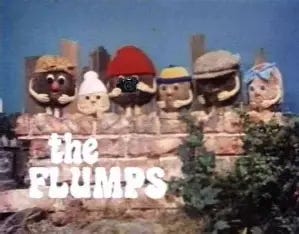
The Flumps were first seen on British television screens in February 1977 on BBC1. Although the series ran for just thirteen episodes, it has left a surprisingly lasting impression on a generation of viewers. The Flumps were created and written by Julie Holder and produced by David Yates. The programme followed the adventures of a family of fluffy, burrow-dwelling creatures living in a strange but wonderfully comforting world.
The show came out of what many now consider the golden age of British children’s television, a period when imagination, storytelling, and character were valued above the spectacle associated with some animations.
With soft colours, gentle pacing, and a very distinctive visual style, The Flumps offered something very different from the fast-paced children’s programming that later started to dominate children’s television screens.
Unlike some animated shows, The Flumps never relied on action or chaos to keep viewers engaged; rather, it thrived on warmth and curiosity, with the interactions between its memorable characters.
Every episode felt inviting, creating a world that was both dreamlike and reassuring. Part of that charm came from the family’s own unique language. Pootle frequently mangled words into expressions such as ‘extra-plorer’ and ‘hodgeheg’, which is what small children do, and parents can relate to. Father Flump’s favourite phrase was that things were ‘all of a tiswas’. These little quirks helped give the series a personality all of its own and remain fondly remembered by fans decades later.
Then there is the theme tune. Even now, many people of a certain age need only hear the opening few notes to be instantly transported back to their childhood, which is quite a feat for such a short-running show.
Despite producing only thirteen episodes, the series was repeated on BBC television several times between 1977 and 1988, helping it become a genuine cult classic of British children’s TV.
Grandfather Flump is the wise one of the family. Whether he was tending the garden, playing his Flumpet, or snoozing beneath a newspaper in his favourite chair, he brought warmth, humour, and reassurance to every episode. I think his calm presence makes him the emotional centre of the Flump household.
The clever, practical, and endlessly inventive Father Flump is often found building, fixing, or experimenting with new ideas. He could be working in his workshop or tending the allotment; he always approached every task with patience and good humour.
Mother Flump is the real heart of the household, spending time baking, tidying, and caring for the family, which comes across as incredibly nurturing and wholesome on screen. She has this big book of stories that she reads from often to inspire the children’s imaginations and adventures.
Perkin is the eldest of the Flump children. Both curious and energetic, and frequently the driving force behind each episode’s adventure. Sometimes a little moody and occasionally prone to grumbling, he nevertheless views the world with a sense of wonder that helps draw viewers into the family’s world.
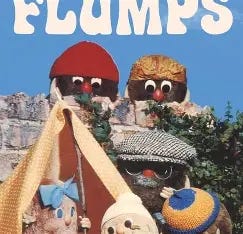
Posie is the family’s sensible yet imaginative daughter. She is kind-hearted and practical; she often helps solve problems with calm thinking and creativity, bringing balance (and a brilliant voice) to the children’s adventures. Her blue ribbon makes her one of the most instantly recognisable members of the family.
The youngest of the Flump children, Pootle, is, I think, my favourite child. innocent, inquisitive, and endlessly lovable. His habit of misunderstanding expressions and taking things literally often leads to funny situations, although his childlike curiosity makes him one of the show’s most endearing characters.
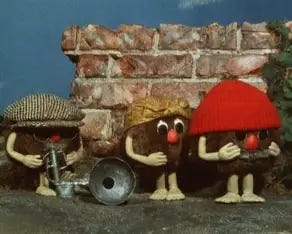
Visually, The Flumps remains unmistakable. The characters were all physical puppets constructed from papier-mâché and then coated with fur. It was then that carefully crafted features and articulated limbs brought them to life. It is their simple, toy-like appearance that gives the series a rustic, handmade quality that still feels grounded today.
The production used stop-motion animation. Physical models were moved and photographed frame by frame. Modern animation often relies on computers, but the tactile nature of stop-motion gives The Flumps a unique personality that I think remains difficult to replicate.
And then there’s the music. The theme tune was composed by Paul Reade and performed by renowned jazz musician George Chisholm. Instantly recognisable and just a delight to the ear.
If you would like to listen, here it is - Flumps theme tune
Revisiting The Flumps reminded me that not every story needs world-ending stakes or constant excitement to be memorable. This series succeeds because of its simplicity. Problems are small, kindness wins out, and the characters genuinely enjoy spending time together. In an age where so much entertainment competes for our attention by being louder and faster, there’s something surprisingly refreshing about a programme that actually makes you slow down.
Perhaps that’s why The Flumps still feel relevant today. Sometimes a little gentleness goes a long way in an overly distracted and fragmented world.
No posts
Comments
Nothing yet. Say the first thing.
Sign in to join the conversation.