
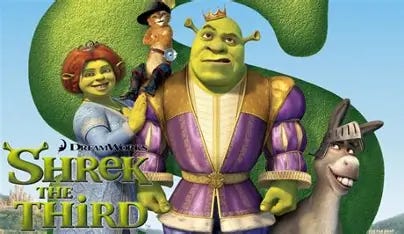
The next chapter in DreamWorks’ fairy-tale phenomenon
Hello and welcome to Animated, where I explore animation history, classic cartoons and television as well as the artists who shaped the animated worlds we grew up in. Animated is public, so please feel free to share and subscribe.
After the incredible success of Shrek 2, DreamWorks found itself in an enviable position as the first sequel had become one of the biggest animated films ever released. The sequel even introduced fan favourites such as Puss in Boots, expanding the world of Far Far Away in the process.
The great thing is DreamWorks didn’t rush out another animated film, but they took their time, and three years later, Shrek the Third arrived in cinemas. While it never quite achieved the same acclaim as its predecessor, it did continue the Shrek story of Shrek and Fiona and build the film around responsibility.
Following the events of the second Shrek film, King Harold passes away, leaving the kingdom of Far Far Away without a clear heir. This makes Shrek and Fiona in line for the kingdom.
What is clever is the way the character arcs have developed, and Shrek becomes aware that he is probably the worst possible candidate to rule a kingdom. As the films all love to have a mission, Shrek sets out with Donkey and Puss in Boots to find another successor.
Their search leads them to Artie, Fiona’s awkward teenage cousin who is currently attending a medieval-style school. However, while Shrek searches for a replacement king, Prince Charming returns with a grudge. He gathers together a collection of disgruntled fairy-tale villains in an attempt to seize control of Far Far Away. This plays brilliantly against the fairy-tale arc we all know.
Alongside all of this, Fiona reveals some life-changing news. Shrek is going to become a father.
The result is a story that mixes royal succession, fairy-tale comedy and the anxieties of growing up and accepting responsibility really well, with emotional depth and animation brilliance.
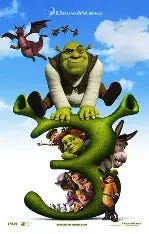
Animated is public, so please feel free to share it
Unlike the first two films, which focused heavily on fairy-tale parody, Shrek the Third puts much more emphasis on the characters themselves.
The biggest theme throughout the film for me is insecurity. Shrek genuinely struggles with the idea of becoming a parent, Artie lacks confidence in himself, and even Charming is desperate for the approval he believes he deserves.
I also think that one of the more interesting aspects of the film is seeing Shrek deal with fears that many adults can relate to, especially as life becomes more complicated. The film still contains plenty of fairy-tale jokes and pop-culture references, but it often feels more like a character story than the outright parody that made the original such a brave hit.
Once again, the returning cast brings plenty of personality to the film.
Shrek - Mike Myers returns, but this time we see a more vulnerable side to the character as he worries about becoming a father and potentially ruling a kingdom he has no interest in governing.
Princess Fiona - Cameron Diaz continues to play Fiona with warmth and confidence. While Shrek is away on his quest, Fiona is given a larger role as she works alongside a group of fairy-tale princesses in fighting off Prince Charming.
Donkey - Eddie Murphy remains one of the film’s highlights. His energy and constant chatter continue to provide many of the film’s funniest moments.
Puss in Boots - Antonio Banderas returns with all the charm, confidence and dramatic flair that made him an instant fan favourite in Shrek 2.
Artie - Voiced by Justin Timberlake, Artie is introduced as the future heir to the throne. Initially insecure and uncertain, his journey forms a major part of the story.
Although only a side character, Eric Idle as the wizard is one of my favourite characters in the whole franchise and again shows the brilliance of matching the right character with the right voice.
Like the previous films, music remains an important part of the franchise. The soundtrack features a mixture of pop and rock tracks that were very much in keeping with the franchise’s identity. Although it doesn’t contain Holding Out for a Hero, of course I do think that “Immigrant Song” by Led Zeppelin is an absolutely classic scene.
By 2007, Shrek had become one of DreamWorks’ flagship brands.
The usual cascade of merchandise, including toys, books, video games, clothing and fast-food promotions, all clamoured for attention on the release of Shrek the Third. The franchise’s popularity was now so great that we started to see the characters becoming instantly recognisable around the world. Shrek, Donkey and Puss in Boots were no longer animated characters; they had now become major mascots for DreamWorks itself.
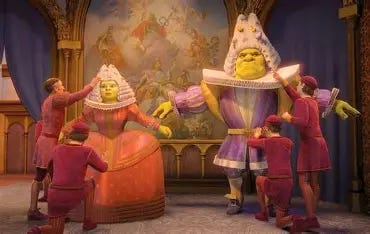
Although opinions on Shrek the Third have always been a little more divided, it was still an amazing commercial success, taking a reported $808m worldwide.
The film also helped bridge the gap between Shrek 2 and the eventual release of Shrek Forever After in 2010. This kept audiences invested in the characters, and of course the cynical may say their merchandise.
It also showed that DreamWorks was willing to shift the focus of the series. Rather than simply repeating the formula of the previous films, the studio explored new stages in Shrek’s life, particularly his fears about parenthood and responsibility, which was brave for a success like Shrek.
Justin Timberlake was cast as Artie after previously expressing interest in voice acting roles.
Shrek the Third became one of the highest-grossing films of 2007 despite receiving more mixed reviews than its predecessors.
I hope that you have enjoyed reading about Shrek the Third. As ever, if you would like to receive weekly posts directly, please subscribe by hitting the button below.
If you liked reading this, you might like Toy Story
Have a great week.
No posts
Comments
Nothing yet. Say the first thing.
Sign in to join the conversation.