
Welcome to Animated, a weekly publication exploring animation, craft, and the ideas behind how things are brought to life. If that sounds like your kind of thing, feel free to subscribe or follow.
A Brief History
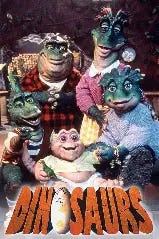
The Dinosaurs series debuted in April 1991 and ran for three years until July 1994. In this time, it produced 65 episodes across four seasons. It was unlike traditional animated sitcoms of the era as the show relied heavily on elaborate puppets from Jim Henson Productions to bring a prehistoric suburban family to life.
Initially airing on ABC in primetime, the show targeted a family audience by blending broad humour with critical social commentary, which I think set it apart from many of its contemporaries. Developed by Michael Jacobs and Bob Young, Dinosaurs was heavily influenced by the success of sitcoms like The Simpsons, though it carved out its own identity through physical performance.
The show enjoyed solid ratings during its initial run, but it didn’t have the legs to continue past this. However, it has since gained a cult following, particularly for its darker themes.
What’s it all about?
Set in the year 60,000,003 BC, Dinosaurs follows the Sinclair family, who are a working-class group of anthropomorphic dinosaurs navigating everyday life in a world that mirrors late 20th-century American society.
At the centre, the show is a traditional family sitcom, complete with workplace frustrations, domestic squabbles, and generational clashes. However, it frequently uses its prehistoric setting to show modern issues such as consumerism, environmental destruction, corporate greed, and social norms.
It will often juxtapose light-hearted humour with biting satire. For example, the family patriarch, Earl Sinclair, works for a tree-pushing corporation responsible for environmental damage, which feels very modern now. In this comedic tone, the show is perhaps best remembered for its willingness to confront serious topics, culminating in a famously bleak ending that reinforced its environmental message.
The Sinclair Family
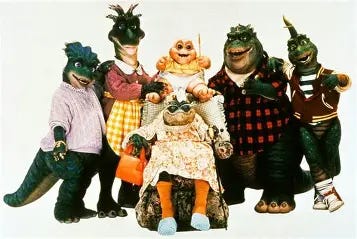
Earl Sinclair, a brash, often short-sighted father and tree-pusher for the WESAYSO Corporation. Earl represents the traditional sitcom dad but is frequently portrayed as out of touch or misguided. His catchphrase-driven humour and tendency to learn lessons the hard way make him appealing for a sitcom market- flawed and yet human.
Fran Sinclair, Earl’s practical wife, often serves as the emotional centre of the family. She has to balance traditional homemaker roles with a quiet inner strength, occasionally pushing back against societal norms in subtle ways that have impact and meaning.
Robbie Sinclair, the teenage son, is idealistic and socially conscious, often questioning authority and challenging outdated beliefs. He acts as a moral counterpoint to his father and reflects the voice of a more progressive younger generation. For me, you can really see how this follows the sitcom genre so well.
Charlene Sinclair is the teenage daughter who deals with issues of identity, popularity, and self-worth. Charlene’s storylines often explore social pressures and the desire for independence, which still hold up incredibly well.
Baby Sinclair is the youngest in the family and best known for his catchphrase, ‘Not the mama!’ His mischievousness made him one of the most memorable characters of the show.
Grandma Ethyl Phillips is Fran’s outspoken mother with a sharp tongue. She often serves as an observer of family dynamics and isn’t afraid to speak her mind.
The World Around Them
The wider world of Dinosaurs is populated with similarly anthropomorphic creatures and institutions that reflect modern society. Corporations dominate the economy, the media influences public opinion, and social structures often mirror real-world inequalities and traditions…Oh, how the world has changed!
Earl’s employer, WESAYSO (‘We Say So’), shows us unchecked corporate power leading to environmental destruction. The corporation has no concern for the consequences with executives or social leaders, being depicted as self-serving or oblivious, reinforcing the show’s satirical sharp edge.
Puppetry and Production
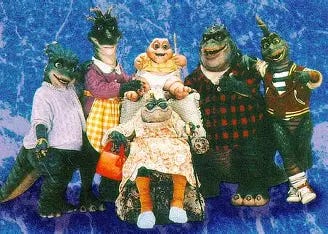
One of the fantastic features of Dinosaurs is its use of puppetry and animatronics. Jim Henson’s team crafted incredibly detailed dinosaur suits and facial mechanisms. What these did was allow performances that blurred the line between puppetry and live-action acting, while enhancing the storytelling by enabling characters to convey subtle emotions through movement and facial expressions, particularly in its more dramatic moments.
This production style also distinguished Dinosaurs from animated sitcoms, giving it a tactile, physical presence that remains impressive even years after its release when you re-watch it now.
Legacy and Beyond
Although its original run was relatively short, Dinosaurs has endured through reruns and streaming. This has helped introduce it to new audiences with its distinctive mix of humour and social commentary that still looks at home in 2026.
Merchandise such as toys and videos helped extend the show’s presence beyond television. Baby Sinclair, in particular, became a cultural icon of the early 1990s.
The finale remains one of the most talked-about in television history, leaving a lasting impression that continues to spark discussion among viewers. In the finale, Earl’s company accidentally destroys the ecosystem through a series of misguided ‘quick fixes,’ triggering a new ice age that dooms all dinosaur life. The series ends with the Sinclair family huddled together in their home, facing extinction as they realise there’s no way to stop what they’ve caused. I will leave you with that thought…
No posts
Comments
Nothing yet. Say the first thing.
Sign in to join the conversation.